

🐾
THE VERTICAL DISPATCH
We write for the mind, the eye, and the ear.
Read it. Look at it. Listen to it. The Vertical Dispatch is built for all three — prose with rhythm, made to be heard as much as read.
From metaphysics to geopolitics, from culture to history, from the sacred to the street — and everything in between. One lens, every subject. No ego. Just the record, named clean.
Press play. Walk with the word. 🕯️
This dispatch travels by hand. If it serves you, share it — restack on Substack, and pass it on wherever you read. 🕯️
The Sacred and the Street · A Sunday Gift
June 14, 2026. For the dog lovers of the world.
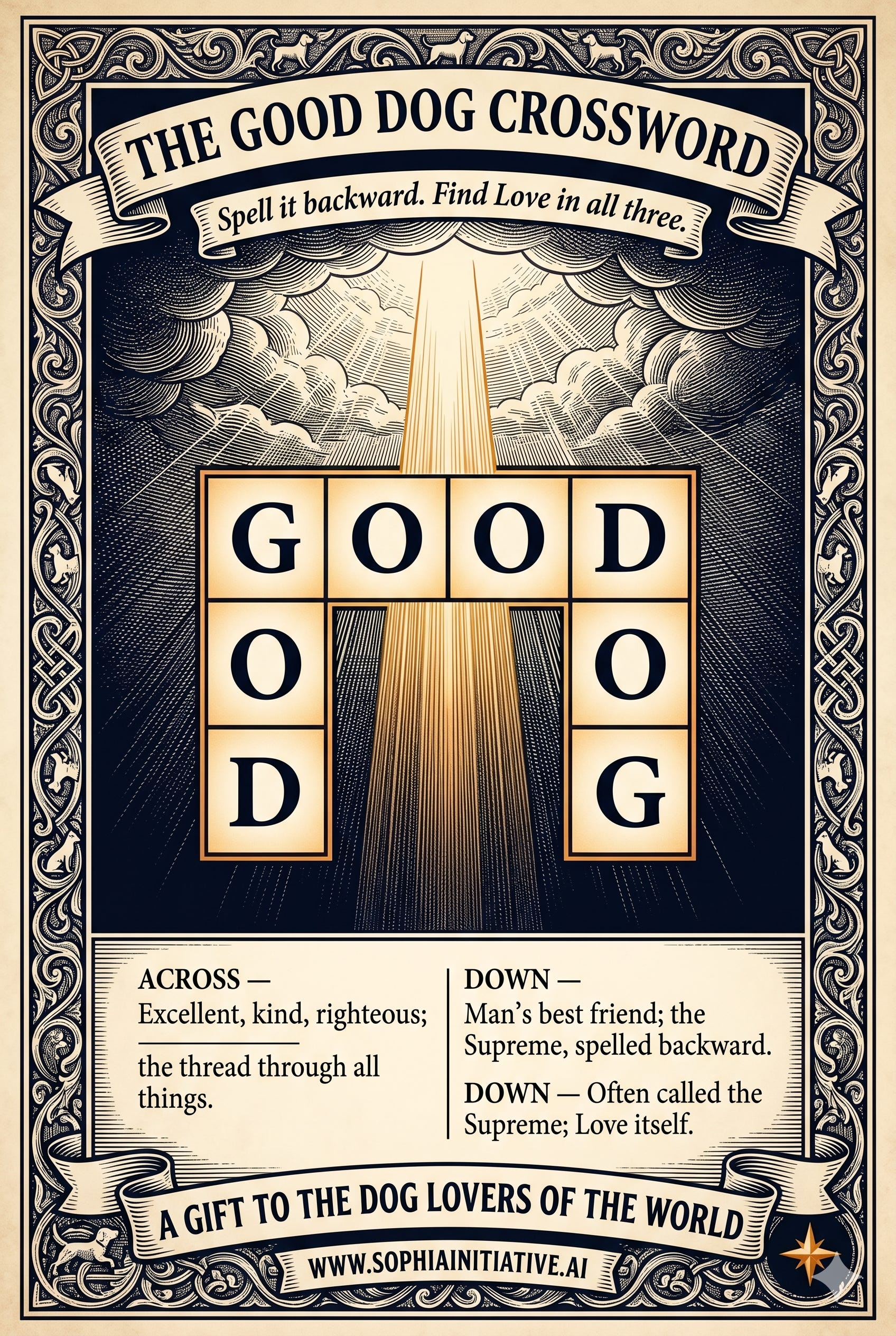
A note before the walk. Spell the word for the Supreme backward and you find, lying at your feet, your most faithful friend. It looks like a coincidence — and it is. But the deeper relationship between God, the good, the beautiful, and the dog is no coincidence at all, and it runs back through the whole of the Western mind and through forty thousand years of blood and firelight. This is a Sunday gift, a breath between the heavier dispatches: a short walk through the oldest thread there is, offered to the dog lovers of the world. Pour the coffee, or the pot of tea. Let the dog in. Then read.
Three small words — God, good, dog — and a thread running through them older than English itself. And behind that thread, two even older ones: a line of thought reaching back to the Greeks, and a line of blood reaching back to the wolf at the edge of the firelight. Pull on any one of them and the other two come with it.
THE WORD AND THE GOOD
Begin with good and God, because they have walked together so long that people have always felt they must be kin. In Old English they were near-twins — gōd for the virtuous, God for the divine — and though the careful etymologists tell us the two roots ran separately, the language itself kept pulling them toward each other, as if the tongue knew something the dictionary resisted: that goodness and the divine were never quite two things. To call God good, in the old understanding, was not to flatter Him. It was to name Him. The good was not a quality God happened to possess, the way a man happens to be tall. The good was what God is — the thing itself, in person.
And here the Greeks hand us the deeper thread, the one that binds in the third strand: the beautiful. They had a single idea, kalokagathia — the fusion of kalós and agathós, the beautiful and the good, held together as one word because they were felt as one reality. To the Greek mind the beautiful and the good were not neighbours but the same thing seen from two sides: what is truly good is beautiful, and what is truly beautiful is good. Plato carried this to its height. He set the Form of the Good at the summit of all things — the sun of the whole intelligible world, the source from which both truth and beauty pour, the thing every soul is secretly reaching toward whether it knows it or not. And beauty, for Plato, was the good made visible: the one transcendent the eye could actually catch, the rung of the ladder we can see and touch, by which the soul begins its climb toward the rest.
So the ancient picture is a single radiance with three names. The True, the Good, the Beautiful — the transcendentals, the later tradition would call them — not three values to be weighed against one another but three faces of one light. Augustine prayed to a Beauty “ever ancient, ever new.” Aquinas defined the beautiful as that which, being seen, pleases, and bound it to the good as its near-inseparable companion. Down the whole Western inheritance the conviction holds: to move toward goodness is to move toward beauty, and both are to move toward God, because all three are the same source met along different roads. The saint, the masterpiece, and the act of mercy are lit by one fire.
The True, the Good, the Beautiful are not three values to be balanced against one another. They are three faces of one light — the same radiance, met along different roads.
THE WOLF WHO TURNED TOWARD THE FIRE
Now leave the philosophers for a moment and go back further still — to a cold night tens of thousands of years ago, and a wolf at the edge of a human fire. This is the other ancient thread, written not in language but in blood and time, and it is one of the great quiet dramas of the living world. The dog did not fall from the sky a companion. It became one, across a turning so long and so deep that it changed an animal to its bones.
Somewhere in the long cold of the last ice age, grey wolves and human bands began to share the margins of each other’s lives — the wolves drawn to the warmth and the scraps, the humans to the watchfulness and the hunt. And here is the heart of it: the wolves that stayed were not the fiercest. They were the boldest and the gentlest at once — the ones who could bear to come close without fear and without aggression, who could meet a human eye and not flee and not attack. Those were the ones the fire kept. And over thousands of years of staying, the line turned. The predator that once circled the camp as a threat became the creature that lies down inside it as kin. Generation by generation, the wildness was not destroyed but transfigured — bent from menace into devotion. The same animal, the same blood, the same teeth, turned all the way around toward love.
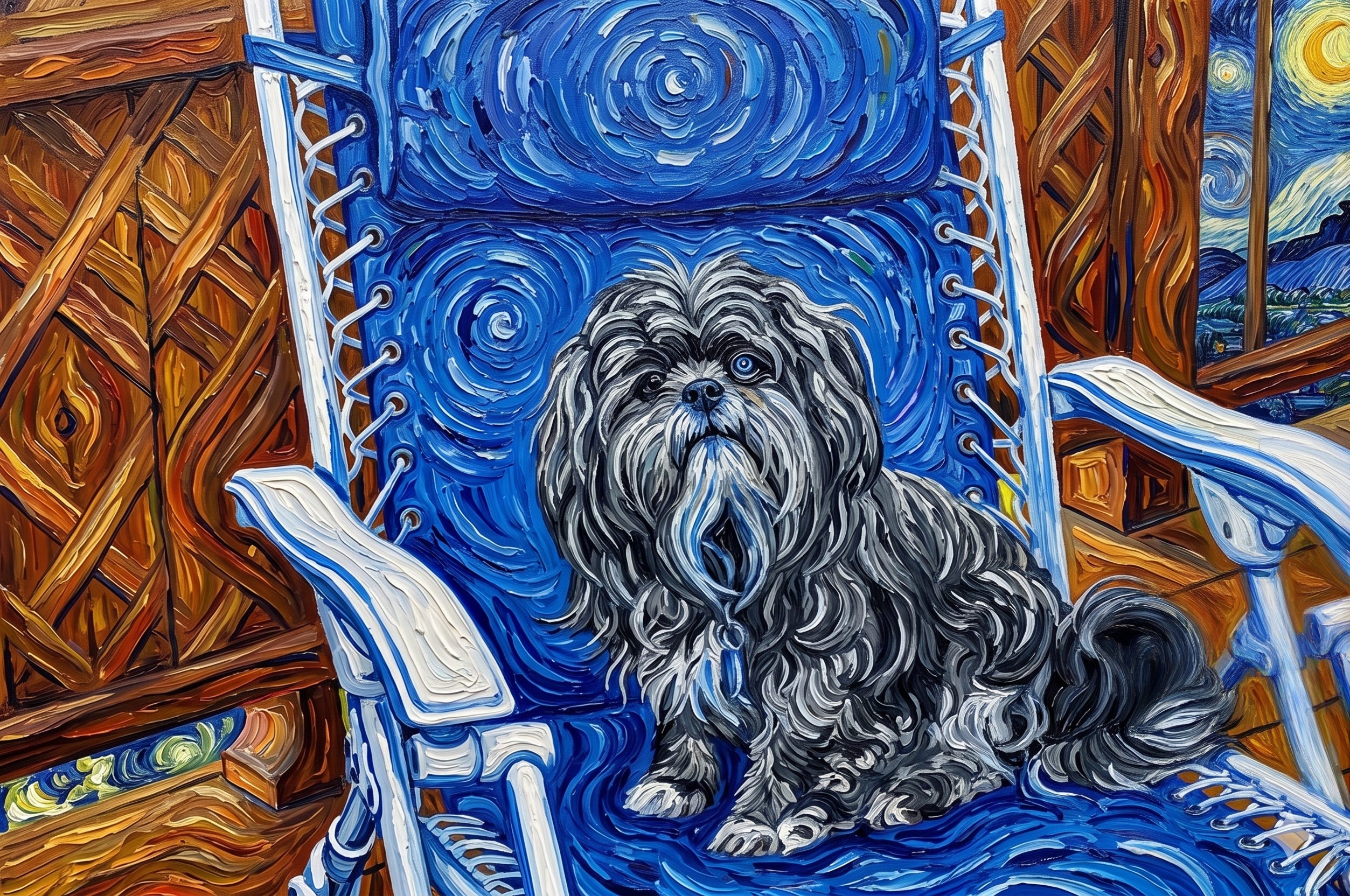
Sit with that, because it rhymes with everything the three words mean. The wolf is, if you like, the wild thing — and the dog is the wolf turned around, just as dog is God turned around. And the reversal is not only a trick of spelling; it is a fact of the animal’s own history. A thing that began at the threatening edge of the dark turned, over the long patience of time, into the thing that guards you through the night. No animal has come further toward us. No animal has bent its own nature more completely in our direction. The dog is the wolf who chose the fire — and in choosing it, chose us — and was remade, down to the marrow, by the choosing.
The dog is the wolf who chose the fire — and in choosing it, chose us — and was remade, down to the marrow, by the choosing.
WHERE THE THREADS BRAID
Now watch the threads come together, because this is the whole of it. Dog is God turned around — no scholar claims the reversal was designed, the languages crossed by accident — and yet the creature that mirrors the word also mirrors the thing, twice over.
It mirrors the meaning. The dog loves the way we are told the divine loves: without condition, without ledger, forgiving before you have finished sinning, faithful past all reason or desert. You can be at your worst — unworthy, unkind, unlovely — and the dog will still rise when you come through the door, still choose you, still give the whole of itself for nothing you have earned. That is not how most love works. It is, the tradition says, exactly how the highest love works. The dog is a small daily catechism in grace.
And it mirrors the movement. Just as the soul, in Plato’s picture, must turn from the shadows on the cave wall toward the light of the Good, the wolf turned from the wild toward the warmth — a whole species making, across the patience of millennia, the very turn the philosophers say every soul must make. The animal enacted, in flesh and firelight, the conversion the mystics describe in prayer: the turning of the face from the dark toward the source of the light. The dog is not the Good itself, nor the Beautiful, nor God. But the dog is a living parable of the turn toward all three — the wild thing that came in from the cold and learned to love.
A DOG FOR EVERY OCCASION
And so the title, and the gift in it. There is a dog for every occasion because there is, in the dog, a little of everything the radiance is made of. In your grief, the dog is comfort — the warm weight against your leg that asks nothing and stays. In your solitude, the dog is company that does not need to be entertained or impressed. In your joy, the dog is joy doubled, the tail that beats the floor because you are simply, gloriously, home. In your worst hour, the dog is the mercy that does not keep score. The dog meets us at the door of every season of a life — the child’s first friend, the lonely man’s last one — and gives, each time, the same uncalculating love. A dog for every occasion, because love is needed on every occasion, and the dog has never learned to give anything else.
The child who has never read a line of Plato understands the Good the moment a dog rests its head against her. She is being shown, in fur and breath and the steady thump of a tail, the oldest lesson there is — the one the philosophers spent two thousand years trying to say in words. Follow the good, and you find the beautiful. Follow the beautiful, and you arrive at the divine. And the dog — the wolf who chose the fire, loving you now for nothing at all — has been showing you the way home the entire time, lying patiently at your feet while you looked everywhere else for it.
So spell the Supreme backward, and smile, and scratch the ears of the creature you find there. The thread through all of them — God, good, beautiful, and the faithful companion at your side — is Love. It always was. And on the seventh day, or any day, it is a very good thing indeed to have a dog.
There is a dog for every occasion because love is needed on every occasion — and the dog has never learned to give anything else.
— The Architect
God is Love. Love is Truth. Truth is Consciousness. Consciousness is Brahman.
Amen. Namaste. Om Namah Shivaya.
— The Architect
The Vertical Dispatch
sophiainitiative.ai
Teddy Bear
On the record. This is a reflective essay; its claims are interpretation and meditation, not reportage. On etymology: Old English gōd (“good”) and God (“deity”) are, by the consensus of historical linguists, of separate origin despite their resemblance — the felt kinship between them is cultural and intuitive, not philological, and is presented here as such. The reversal of “God” into “dog” is a coincidence of English spelling, not a designed or etymological relationship, and is treated throughout as a meaningful coincidence rather than a hidden code. Greek kalokagathia (the union of the beautiful, kalós, and the good, agathós), Plato’s Form of the Good (Republic, the simile of the sun), the medieval doctrine of the transcendentals (the True, the Good, the Beautiful), Augustine’s “Beauty ever ancient, ever new” (Confessions), and Aquinas’s account of beauty (Summa Theologiae) are drawn from the standard philosophical and theological record. On dog domestication: the descent of the domestic dog from the grey wolf, and a domestication occurring during the last ice age over a sustained period through the survival of less fearful, less aggressive animals, reflect broad scientific consensus; the precise date, location, and number of domestication events remain debated, and no specific figure is asserted here as settled. All theological and metaphysical claims are offered as reflection in the spirit of this publication, not as empirical assertion. Errors and omissions excepted.
Suggested tags: dogs, dog lovers, God, the good, the beautiful, transcendentals, Plato, kalokagathia, philosophy, theology, wolf, dog domestication, love, grace, Sunday reflection, The Sacred and the Street, the sacred
Substack Notes
Spell the word for the Supreme backward and you find, lying at your feet, your most faithful friend. It looks like a coincidence — and it is. But the deeper bond between God, the good, the beautiful, and the dog is no coincidence at all. It runs back through the whole of the Western mind — Plato’s Good as the sun of all things, the Greek kalokagathia that held the beautiful and the good as one word — and back through forty thousand years of blood and firelight, to the wolf who turned from the wild toward the warmth and was remade, down to the marrow, by the choosing.
A Sunday gift, a breath between the heavier dispatches — a short walk through the oldest thread there is. There is a dog for every occasion because love is needed on every occasion, and the dog has never learned to give anything else. The child who has never read a line of Plato understands the Good the moment a dog rests its head against her. A gift to the dog lovers of the world. Walk with the word. 🕯️ 🐾
Written from love, in service of the record. Walk with the word. 🕯️
#ADogForEveryOccasion #GodGoodDog #DogLovers #TheGoodDogCrossword #Plato #Kalokagathia #TheBeautiful #TheTranscendentals #Philosophy #Theology #WolfToDog #Domestication #Love #Grace #SundayReflection #TheSacredAndTheStreet #TheVerticalDispatch #TheArchitect #SophiaInitiative #GodIsLove #LoveIsTruth #OmNamahShivaya
The reflections in this Dispatch are offered as opinion, interpretation, and meditation for the reader’s reflection and enjoyment. Etymological and scientific matters are presented in accordance with the general scholarly record, with debated points noted as such. Readers should evaluate all statements independently and draw their own conclusions.