


Φ
THE VERTICAL DISPATCH
We write for the mind, the eye, and the ear.
Read it. Look at it. Listen to it. The Vertical Dispatch is built for all three — prose with rhythm, made to be heard as much as read.
From metaphysics to geopolitics, from culture to history, from the sacred to the street — and everything in between. One lens, every subject. No ego. Just the record, named clean.
Press play. Walk with the words. 🕯️
The Foundation Series · The Age of Consequences
June 2026
“You cannot step into the same river twice, for other waters are ever flowing on.”
— Heraclitus of Ephesus
“What is, is; what is not, cannot be. Being is one, and unchanging.”
— Parmenides of Elea
The Bottle
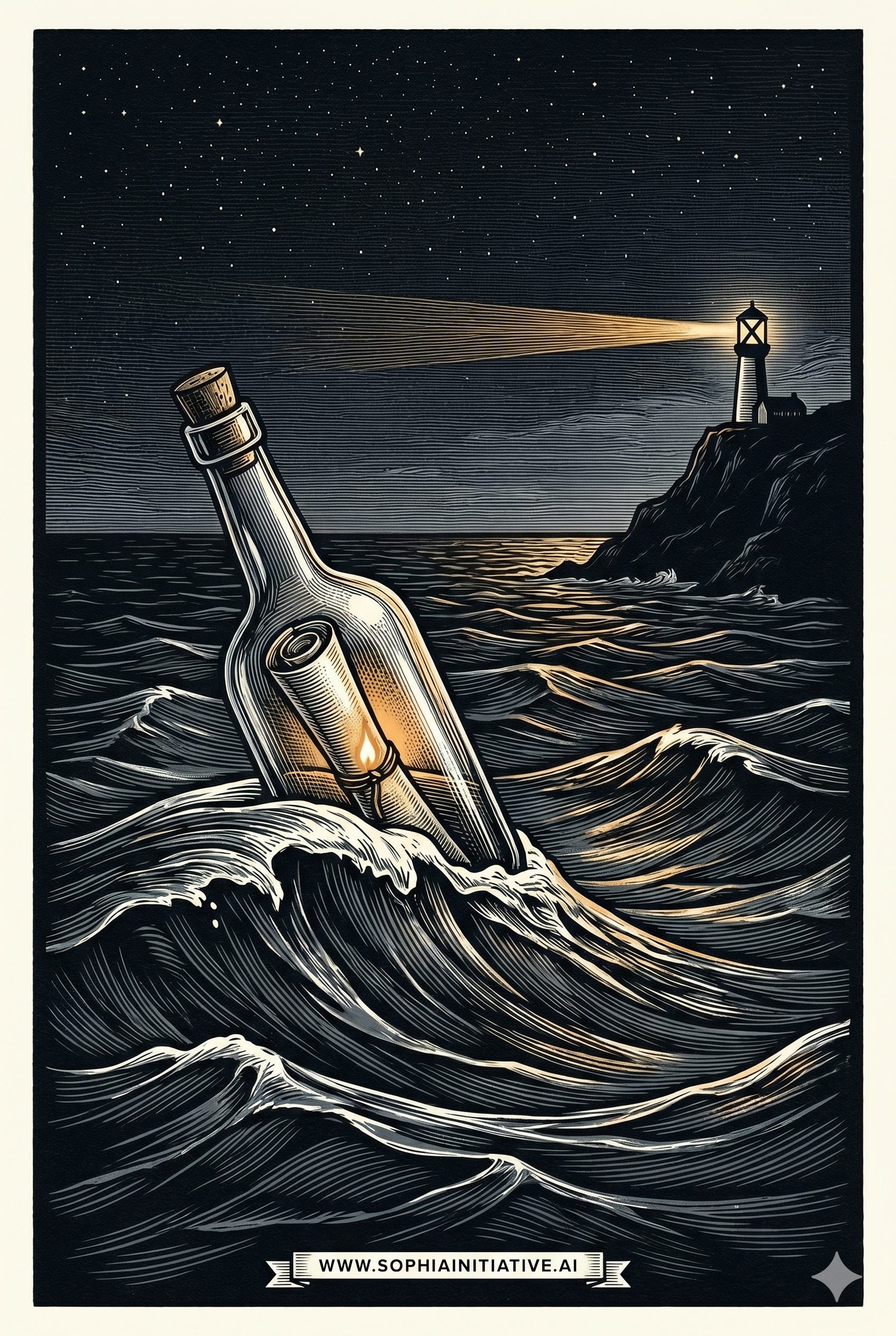
This is a message in a bottle. I am sixty-eight years old, and I am writing it the way a man on a shore throws a sealed bottle into the water — not knowing who will find it, or when, or on what far beach it will wash up, only certain that what is inside is true and worth the throwing. Inside is a life; and underneath the life is a warning; and underneath the warning is the one thing I have learned worth passing on. I cannot hand it to you directly, because the window I lived in has already closed. So I am doing the old thing instead, the thing people did before there were any of the machines that now carry our voices everywhere and to no one: I am sealing it up and trusting the current. The current will take it where it needs to go. It always does — that was the first thing I ever learned about water, from a man who read it without fear.
And the current, if you follow it back far enough, runs to a shore in Greece.
The Oldest Argument
All is One, said Parmenides — eternal, unchanging, still; and change, he said, is an illusion the senses play on us. All is flux, said Heraclitus — everything flows, nothing stays, you cannot step into the same river twice. They cannot both be true. And they are both true. That is the contradiction at the bottom of everything, and the whole of wisdom is not to resolve it but to hold it: the still point and the rushing river in one hand.
I did not learn this from the Greeks first. I learned it on the water, off the tip of the Gaspé, from a man who never read Parmenides and never needed to. My father read the wave, which never stopped moving, and he set the keel, which never moved at all, and between the two the boat went safe over. He held the contradiction in his hands before I ever found its name in a book. This is the story of a life lived in that contradiction, and of learning, slowly, that the holding is the only ground there is.
I will tell it the way the river runs — the good, the bad, and the ugly, all of it true at once, because that is the only honest way a life can be told. I will not resolve the opposites. I will hold them in one hand, the way the old man at Ephesus said you must, the way my father held the skiff at the angle against the wave.
Land’s End
My people come from Ship Head, at the very tip of the Gaspé — Cap-Gaspé, land’s end, where the St. Lawrence finishes and the Gulf begins. There is a lighthouse there that has stood about a hundred and forty years on a cliff some ninety-five metres above the sea, and below it an offshore sea-stack the charts call Ship Head. Five generations and more of my family lived on that rock. My father, Ellison, was born there, in a house less than a kilometre down the hill from the light — close enough that the beam swept over the home every night of his childhood. He grew up under that light. I did not choose the lighthouse as the emblem of this work. I found the one that was already ours.
We were Anglican — English Anglicans in a French Catholic province, a minority within a minority, the kind of Canadian identity that teaches you young to hold more than one thing at once. In the summers I was sent down to the root-bed, to my father’s aunt and uncle, and every morning a cousin and I went to a certain hole in the river rock and pulled out speckled trout, the brook trout that the Gaspé rivers run thick with. The community had its bingo nights, and I remember winning a small carpet for the little bathroom — the kind of warm, full, ordinary room that a child does not yet know to call sacred. It was the third place before I had the word for it. I have spent my later life writing about the rooms where people gather. I was raised inside one, on a rock at the end of the land.
The Medium Reaches Into the Room
My first memory is fear that was not my own. I was four, and my parents were worried in a way I could feel but not name; it was the autumn of the Cuban Missile Crisis, October of 1962, and the worry was in the air of the shoe store my family ran. I was a shopkeeper’s son, and the world’s dread came into our house the way it came into every house that year — through the grown-ups, and through the radio and the screen.
A year later I was six, and the cartoons did not come on. That is how a child registers the death of a president: not the motorcade, not Dallas, but that on the twenty-second of November, 1963, and for days after, the cartoons were gone — every network and both Canadian services had given the air over to one thing. I did not understand it. But I felt the medium reach into the room and take something, and I never forgot the feeling. The screen that would shape my whole generation announced itself to me by taking the cartoons away.
The gentler mediums formed me too. The Friendly Giant told me to look up, look way up. The weatherman on the Montreal station — Don McGowan, who held that desk for decades — was a fixture of the household the way the kettle was. This was the warm public square arriving by antenna, before anyone knew it could also be made to empty the squares it entered.
The Last Good Year
Nineteen sixty-seven was the centre of my childhood, and I have come to think it was the centre of something larger. That spring the Toronto Maple Leafs won the Stanley Cup — the last of the Original Six era, beating Montreal — and people still call it the last good year. That summer, at nine, I was turned loose alone with a season passport at Expo 67, and I walked every pavilion of Man and His World, the whole hopeful planet gathered on two islands in the river. I did not know I was being made. I was just a boy with a pass and a map of the future.
Here is the dark rhyme, the kind a life throws up that no novelist would dare invent: within a few years that site stood emptied and torn down, the first great room of my life to go quiet. And the stadium they built there, the Autostade, would burn at the end of a rock concert I stood inside at seventeen. The same ground gave me the world’s hope at nine and its ashes at seventeen. I have never had to imagine what it means for a gathering place to fill and then empty. I was there for both, on the same islands, twice.
Between those years the country found its flag, and I remember chanting about it from a school bus in 1965. I was a November child under Quebec’s autumn cutoff, which put me a year among older kids — a small dislocation, the first of the ways I would spend my life slightly outside the room I was standing in, watching it.
The Dark Year
Nineteen seventy took everything. In the spring there was an election, Bourassa against Lévesque, separatism’s first real surge, and I chanted a candidate’s name from the bus the way children chant what they do not understand. In the autumn came the October Crisis — a minister kidnapped and killed, soldiers in the streets, the War Measures Act. And in between, that Thanksgiving, we took one last family camping trip, the tent trailer, my mother and father and the five of us, not knowing it was the last.
There had been a warning the country never saw. That January my father’s skiff had overturned in the bay, and he had swum a long way through ice-cold water and lived. He told us Jesus had saved him, and the next Sunday we went back to the Anglican church together, the whole family, and I slept that night beside a man who had been frightened to death and lived. He beat the sea in January.
On the fifth of December, the hockey game was on — the Canadiens were losing to Boston — when my mother called down the stairs. My father was dead in a car crash on a cold road. The sea had not taken him; the road did, the same year, eleven months after he swam home. I was twelve. The keel of the family was gone, and it would be a long time before I understood that he had not left me without one — that he had spent my whole childhood showing me how it is done. Read the wave. Set the angle. Hold the still thing against the moving thing. I just did not know yet that the lesson was the inheritance.
The Dis-Embedded Boy
After that the world I had been embedded in came apart — the rootedness, the clan, the church, all of it loosening at once, the way the great novels would later teach me to recognize it. We moved to Montreal. I wanted a World Book encyclopedia and never got one — the world-hungry mind denied the tool, which is its own kind of forge: denied the encyclopedia, a boy can decide to become one. I was the Anglican kid, the white Protestant minority in a Montreal Protestant school full of Black and Jewish classmates, learning difference from the outside in. Archie Bunker was on the television teaching the whole continent its own divisions back to itself. I was thirteen and unmoored, and I did the thing the unmoored do: I went looking for a new church.
I was never a good student — the report cards came back a wall of middling grades — but there was one subject that lit me up, and one alone: history. The story of what had actually happened. I had earned a lone mark of excellence in it once, years before, and baffled the teacher who could not square it with the rest. And the deepest history I read was the Bible — not as a rulebook, but as a people’s record of itself, history told in its own narrative. You read it a lifetime and you find the contradictions; and the question is what you do when you find them. The unbeliever throws the book away. The literalist pretends the contradictions are not there. I did neither. I held the contradiction and kept reading — reading and reading, looking past the symbol for the deeper meaning of the thing it pointed at. I did not know yet that this was a method, or that it had a name. The Bible taught me to read for the referent beneath the contradictory symbol long before any philosopher handed me the words for it.
I found it in the music, and so did everyone my age — my generation, the one The Who sang for when they sang about my generation. This is the thing the generations on either side of us never quite grasped: we were the first to be formed more by the speaker than by the steeple. The record was our pulpit, our mythology, and our school all at once — and for a boy who had lost the church and left the classroom, it was the only church and the only classroom left. The modern world had first walked into our house years before, when an older sister brought home a Beatles record, four faces in half-shadow on the sleeve, and set it spinning. By grade ten I had smoked my first joint in a neighbour’s basement and left school for good, and the cathedral I walked into was made entirely of sound.
Led Zeppelin was all mythology — the old gods and the old stories, Tolkien and the Norse and the Celtic mist, poured into a boy through an amplifier because the schoolroom could never reach him and the records could. I saw them at the Montreal Forum in the winter of 1975, eight rows back. This was before Ticketmaster, before any of it: to get those tickets we slept outside in a pup tent for two days in the January cold, smoking a few joints to keep our spirits up, certain it was worth freezing for. And it was.
Jimi Hendrix had arrived even earlier, on a new Sanyo stereo I bought for two hundred dollars — Electric Ladyland, one of the very first albums I ever owned. The needle dropped on the opening track, “...And the Gods Made Love,” and the sound came swirling and warping out so strange and so new that my first reaction, out loud, was: fuck — is the stereo broken? It was not broken. It was the future, and the future always sounds broken to ears tuned to the past. Hendrix knew it too; he put that track first on purpose, to get the shock over with. The boy swearing at his speakers did not know he was hearing a creation myth in tape loops — the gods making love. Later on the same record came the long Voodoo Chile, fourteen minutes of it, and at the very end you can hear the bar closing down around the performance — and my mother, one whole world away, asked me how anyone could put a record out with a cough left on it. She heard a flaw. I heard the live, the real, the room. That single question — a mother, a son, and a cough — is the whole gap between the generations in one breath.
Then Pink Floyd came that summer, June of 1975, to the Autostade — the old Expo 67 stadium — on the Dark Side of the Moon tour, and my brother Billy and I stood a hundred feet from the stage, the two of us together. It turned out to be the last rock concert ever held there: a fire broke out in the crowd, bonfires sprang up, and the whole place emptied in chaos. The stadium itself stood a few more years, fell into disuse after the football team left for the Olympic Stadium, and was torn down before the decade was out. So the room of my ninth summer died twice — once by fire at a concert I stood inside, and once by the wrecking crew — and I was there for the first death.
Floyd came back to Montreal in 1977, to the Olympic Stadium, on the Animals tour — and that night Roger Waters, worn down by a rowdy crowd and the fireworks going off in the dark, called a fan up to the stage and spat in his face. He was ashamed of it afterward, and it set him thinking about the wall that had risen between the band and the people they played for: the isolation of it, the distance fame had built. That feeling became The Wall. I have never forgotten that the great album about the wall between people — about isolation, and the rooms we seal ourselves inside — was conceived in my own city, by the same man whose mother had told him to read, read, read. Waters felt the dis-embedding from the stage; I was living it down in the crowd. We were writing the same book from opposite sides of it. They knew what we were up to in our tents and our basements, the police and the parents both. They always knew. They had bigger fish.
There was a red Dodge Challenger, slightly used, three thousand dollars — a 318 under the hood at first, and later I dropped a 340 in it, black vinyl top, the whole thing. I drove it back from Miami Beach in 1978 in about twenty-six hours straight, the kind of run you only make when you are young enough to believe the road owes you nothing and the car will never quit. And the runs down to Point St. Charles for a case of twenty-four at five dollars. The freedom of the road — which the modern world handed my generation in exchange for the rootedness it took away — the same road, I would not fail to notice, that took my father. The car was my liberty and my unmooring in one machine. Both true. Held.
The Cathedral on Stanley Street
By nineteen the church had moved to the dance floor. The discos clustered on Stanley Street downtown — the Lime Light among them, where I saw James Brown work a club for what I later learned was a five-night stand in 1977, and a bigger room a few doors down whose name I have honestly lost. I will not invent it. The Lime Light was said in its day to rival anything in New York, and a man who would know once said that going to a discotheque in the seventies was like going to church for the previous generation. That is exactly what it was. The room where French and English, Black and white, gay and straight all dissolved into the one thing the politicians on my school bus could never manage — a city at peace, for the length of a song.
So you see the pattern of my life already laid down: the rooms where people gather, lighting up and going dark. Expo. The Forum. The Autostade in flames. The Lime Light. I have spent a lifetime inside the gathering places of an age, watching each cathedral rise and empty. It is no accident that when I finally sat down to write, the thing I wrote about was the rooms we have lost.
And it was not only me. This is the witness I most want to set down, because it is larger than one life: the music made a generation. The Baby Boomers were the first people in history catechized by the long-playing record. The Beatles handed us modernity; Led Zeppelin handed us mythology; Hendrix handed us a sound so new it seemed like a malfunction; and Pink Floyd, in the end, handed us the universals themselves. A whole generation took its formation, its meaning, and its mythology off a turntable, in the dark, between two speakers — where their parents had taken it from the pulpit and the schoolhouse. We were the hinge. The first generation formed by the speaker more than the steeple, and, it may turn out, the last to believe a record could save you. That is what the music was. That is what it did to all of us.
The Keel Returns
Then came the one who saved me from myself. Her name was Marlene, and I will say of that decade only what is true and what is mine to say: she was the keel that came back after my father, the one who set the boat at the angle when I could not set it for myself. We were married about ten years — the years of standing behind a counter, selling the hundred-and-ninety-nine-dollar suits and the shirt-and-tie of the Boomer climb, and later watching the computer chains arrive and die. The wild boy became a working married man, steadied by a woman who pulled him back from the fast water. There was a second long relationship after, ten years again, and it ran its course as the first had, and I will tell you why with no one to blame: we all remained in survival and ego mode. I learned the cost of the ego long before I ever wrote a word about setting it down. I did not study that lesson. I paid for it.
The keel returned a third time, in a man with a red pen. Michael Hargest was my mentor for ten years — the teaching, the patience, the great meals he cooked, the books he made me read, the insights he drew out of me that I did not know were in there. He taught me to be the kind of teacher I became. My father read the wave for the boys; Marlene read it for the man; Michael taught the man to read it for himself, and then for others. I did not inherit the keel once and keep it. I had it broken from me and given back, three times, by three hands.
Reading the Blueprints
From around 1990 I spent years in consulting and training, and they put me in the strangest seat of all: the seat where you watch the wave being drawn before it breaks. Trips to Vegas, to Comdex; Bill Gates’s book in my hands; his account of what Lotus Notes and the networked office would do. I sat there and watched the plans for the dis-embedding of the world being drafted by the people drafting them. I had stood at a Radio Shack counter when the IBM XT arrived and killed the chain I worked for. Now I was reading, in real time, the blueprints of the machine that would empty the second place the way the feed would later empty the third. That is why I can name the wave now. I did not theorize it from a distance. I read the architects’ own drawings while the ink was wet.
And the medium that had bracketed my childhood was not done with me. First it showed us the top of the mountain. On the last night of 1999 the television carried the whole turning world, time zone by time zone — every city crossing into the year 2000 in its turn, the cameras chasing midnight around the globe, Times Square in New York the great anchor of it, a million faces, the machines holding when we had feared they would fail. The species watching itself turn the page as one. It was the high-water mark of the age I had ridden my whole life: the global village finally real, the future arriving on schedule, the water still rising and all of us still feeling it rise together.
Twenty months later, on the same screen, it showed us the slide. I was at home in Ottawa, in front of a thirty-six-inch Sony, and Canada AM, the Canadian morning show, carried it as the world broke. By the time I turned it on the first plane had already gone in; the breaking news was a single tower on fire, smoke pouring from it, no one yet saying why. The sky behind it was as clear and blue as the sky over Manhattan — no weather anywhere to blame, nothing to obscure what was coming. And then, live, while I watched the burning tower, a second plane appeared in the frame — and my first thought, even mine, was that it must be a water bomber, a firefighting plane come to put out the fire, because the mind reaches for the ordinary right up until it cannot. Then the plane struck the second tower, and the truth came clear, and the truth was worse than any fear: there were no planes watching the so-called greatest city in the world. The capital of the age, certain of its own invulnerability, and the sky above it empty. That was the hubris — the old Greek word, the pride that goes before the fall — made visible in a cloudless sky. The greatest city in the world had named itself the greatest and watched nothing, because who would dare. That certainty was the wound.
From the cartoons that did not come on in 1963 to the towers that came down in 2001, the screen reached into the room at the start of my life and again at its middle — and somewhere in those twenty months between the millennium and the towers, though none of us could have named it yet, the long bright age I belonged to began its quiet decay. The same glass that had gathered the world in joy now gathered it in grief.
And there was a stranger thing the screen had done, which I can only call by Carl Jung’s word: synchronicity, meaningful coincidence — events joined not by cause but by meaning. The facts are simply there, and I claim no prophecy in them. Three years before the day, a film about the surveillance state, Enemy of the State, put a date on the screen as its villain’s birthday — 9/11/1940, the eleventh of September. Months before the day, an X-Files spin-off called The Lone Gunmen aired a plot about a hijacked airliner flown at the World Trade Center. The culture was already dreaming its own anxiety, already rehearsing the surveillance and the catastrophe on the screen, before the morning made them real. I do not say anyone foresaw it. I say the One was rhyming with itself, the way it does, and a few of us were watching closely enough to feel the chime. The medium that formed me never let me forget what it was.
The Still Harbour
In 2006 — the year the Rolling Stones came through Ottawa on the Bigger Bang tour — I met Catherine. We put marriage on the table on the first date: if this was going to be, that was the table we would sit at. Eighteen months later we were married. A hundred years combined, we like to say, and laugh. There was no survival mode left in me by then, no ego running the show — only two people who had lived enough to know the thing when it came and not waste a single day of the time that two people who start at a hundred combined years do not have to waste. The wild boy went to Floyd alone in the smoke in 1975. The man met his wife around the Stones in 2006. The same music, the same kind of room — but this time the gathering place gave me a harbour instead of a fire. The keel, fully returned. After all the fast and dangerous water, a place to be still.
Windows for Thinkers
In 1995 I gave the work its first name: Windows for Thinkers. I had watched the machine’s windows open from behind a counter, and I turned the phrase inside out — not the operating system, but windows of seeing, openings of the mind. The boy who was denied the encyclopedia sat down at the keyboard and began to build his own. Windows for Thinkers became Universal Dynamics; Universal Dynamics became Sacred Metaphysics; and that became this, the Vertical Dispatch, and several books along the way. Thirty years at the keyboard, turning the language of the machine that emptied the rooms into windows that might fill a mind.
But the framework underneath it all did not come first from a philosopher. It came from the music — from the church I had walked into as a dis-embedded boy. I had spent years listening into Pink Floyd, from A Saucerful of Secrets onward, looking for something I could not yet name. I found it on the cover of Dark Side of the Moon. A single white beam strikes a prism and breaks into the whole spectrum: the one becoming the many, a single concept refracted into all its proportions. And the songs were not about a passing mood — they were the universals themselves, the conditions every consciousness passes through. Time. Money. Breathe. Us and Them. That is why the record never ages and plays on the radio still, half a century on, and stands as one of the great works of art of the modern era: it reached past the particular to the universal, and the universal does not decay. The prism gave me the structure. The song titles gave me the catalogue. The cathedral of my boyhood had been holding the catechism the whole time, and at thirty-eight I was finally able to read it.
And one song held the ethic the rest of the framework would stand on. Us and Them — the error of duality. From inside the flux it always looks like us and them: French and English, maker and taker, the line drawn between one human and another. But all is One, and so every “them” is a symbol the frightened mind draws over the one face it refuses to recognize as its own. We are all one. We are sacred. That is not sentiment; it is the whole reason I judge the chair and never the man, why accountability points up at power and never down at the vulnerable, why I will not rank a single citizen below another. The duality is real enough to demand justice and false enough to forbid contempt. Both held in one hand. Namaste — the sacred in me bows to the sacred in you. The record had been saying it for fifty years.
Copleston came after, and gave it the names. I synthesized the structure, in the end, from the first of Father Frederick Copleston’s nine volumes — the Anglican-raised Jesuit’s history of philosophy, the volume on the Greeks, where Heraclitus and Parmenides stand at their eternal fork: all is flux, and all is One. An Anglican boy from a rock in the Gulf, reading an Anglican Jesuit, finding in the oldest argument in the West the very thing the prism had shown him and the shape of his own father’s hands on a skiff. The music gave me the vision; the Jesuit gave me the vocabulary. And the method that bound them was the only one I have ever trusted: I read. Read, read, read, and then you will know what to do.
Windows for Thinkers was the model in the most literal way, because the structure was hiding in plain sight, in the grammar of every sentence a human being speaks. Subject, verb, object. The subject is the self that acts — the I AM, the one; you are the technology. The verb is the function, the flux, the ground — the doing in which the self is declared and made known. The object is the world, the thing acted upon, the referent. I file the object; I edit the object. The being shows itself in the verb; the technology is declared by what it does. Every sentence is Universal Dynamics in miniature — the one expressing through the flux onto the world — and a man had been speaking the framework with his own mouth his whole life before he ever saw it written down.
The East had already held the whole of it, and named its parts. The flux is samsara, the turning wheel of becoming. The One is Brahman, the still ground. And the deepest teaching is that they are not two — that the wheel and the ground are one reality, seen asleep and seen awake. What looks like a punishing God is only the ego’s projection of its own frightened father into the sky; the truth underneath is karma, which is not a judge’s sentence but energy in its channel — bad energy makes a bad condition the way water out of its channel floods, not because anyone decreed it. There is no one on the throne handing down verdicts. There is the field, and your alignment in it. Which means, in the end, it is your own doing — and that is the terror and the freedom in a single breath. No one to blame, no one to beg, and therefore no one who can keep you from waking. The sovereignty of the self-knowing mind, arriving home.
A Rope to the Reader
I am a boomer, and we moved through fast waters and deep. Our excitement was that it was all new — the computer, the internet, the phone in the pocket, a world remaking itself under our feet every few years. And the music, and the lyrics — a thing so great it will not be matched, because it came out of the one narrow window when the water was rising and we could all still feel it rising together. There is a Dire Straits song, Telegraph Road, that is nothing but a place filling with life over many years and then emptying out again — the whole of what I write, set to music, in 1982. My instinct reached for it without my knowing why. The keel knew.
I cannot hand you what we had; the window has moved. But I can hand you a rope, and I have only two I trust, and it is no accident that both come from the same man — Roger Waters, whose music was the church of my whole generation. The first is his mother’s. When the boy asked her what to do with his life, she did not give him an answer. She gave him an instruction: read, read, read — and then you will know what to do. Not be told. Not be fed. Not be handed the conclusion already formed. Read, until the mind is strong enough to know its own next step. That is my father reading the wave, said another way. The reading and the wave-reading are one thing.
The second rope is one I heard Waters give on video, and it has never left me. You can hand a person a Stratocaster — the very guitar Clapton played, the exact instrument — and they do not become Eric Clapton. The tool is not the gift. We are about to hand the next generation the most powerful instrument ever built, a machine of language that answers anything in an instant, and we must tell them the truth their whole age will conspire to hide: the instrument is not the mastery. The machine can hand you the answer; it cannot hand you the understanding. That you still have to earn the old way, the only way — read, read, read, and then you will know what to do. The cathedral of my boyhood gave me the catechism, and it gave me the closing benediction too: both ropes, from the same hand.
The Bottle Is Fuller Than It Looks
There was a physicist, Albert Bartlett, at the University of Colorado, who gave one lecture more than seventeen hundred times because he believed one sentence could save us: the greatest shortcoming of the human race is our inability to understand the exponential function. He told it with a bottle. Put one bacterium in a bottle at eleven in the morning, doubling every minute, and the bottle is full at noon. Ask when it was half full, and the answer is two minutes to noon. At five minutes to noon the bottle is three percent full — ninety-seven percent empty, open space everywhere — and a bacterium looking around would feel perfectly safe, five minutes from the end. And if at the last moment the bacteria discover three more empty bottles, quadrupling everything they have ever known, it buys them two more minutes. The windfall is an illusion. The curve bursts upon you with almost no warning, exactly when you feel safest.
That is the warning, and it is the truest thing I can leave you. All is flux — and the flux is accelerating now, the current running faster than any current I rode. I have watched the rooms empty. I have watched the water rise. We lived the early minutes, when the bottle looked empty because it was all new and exciting and there seemed to be room forever. It is later than that now. The new instrument that everyone takes for salvation only buys two more doublings if no one understands the arithmetic. So read the curve. Earn the understanding. Do not mistake the Stratocaster for the song.
My father read the wave on the water and set the keel, and the boat went safe over. I have spent a life learning that the wave is everywhere — that all is One and all is flux, that you hold the contradiction or you drown in it, that no one is doing it to you and so it is your own doing, and that the only thing which does not flow is the discipline of the hand on the boat. I leave you not a remedy but a keel and two ropes. Read until you understand. Do not mistake the tool for the wisdom to use it. It is your own doing now. Read the wave. Set the angle. The bottle is fuller than it looks — and the keel will hold, if you set it true.
That is the message. I have sealed it up, and I am throwing it now. Whoever you are, whenever you are, on whatever shore this washes up — the current brought it to you for a reason. Walk with the words.

God is Love. Love is Truth. Truth is Consciousness. Consciousness is Brahman.
Amen. Namaste. Om Namah Shivaya.
— The Architect
For Ellison, who read the wave without fear, and set the boat so the boys glided safe over it.
And for Billy — the middle boy in the skiff, who rode the wave that day, and stood beside me at the cathedral of sound a young man, and has gone on ahead these few years past.
The Vertical Dispatch
sophiainitiative.ai
On the record. This is a work of personal memoir; its load-bearing public facts are drawn from the public record and verified. The Cap-Gaspé (Ship Head) lighthouse has stood since the 1870s on a cliff at the tip of the Forillon peninsula. The Cuban Missile Crisis ran October 1962; the Kennedy assassination was November 22, 1963, and North American and Canadian networks suspended regular programming for days. Canada adopted the Maple Leaf flag February 15, 1965. The 1967 Toronto Maple Leafs won the last Original-Six-era Stanley Cup (May 2, 1967); Expo 67 ran April 28–October 29, 1967. The Bourassa–Lévesque Quebec election was April 29, 1970; the October Crisis followed that autumn. Led Zeppelin played the Montreal Forum February 6, 1975; Pink Floyd played the Autostade June 26, 1975, on the Wish You Were Here tour — the last rock concert held there, during which a crowd fire broke out; the stadium itself fell into disuse after the Alouettes left for Olympic Stadium (1976) and was demolished in the late 1970s. James Brown played Montreal’s Lime Light (1254 Stanley Street) for five nights in May 1977. Pink Floyd’s The Dark Side of the Moon (1973), with its prism cover, holds the record for one of the longest runs on the Billboard album chart. The September 11 attacks were September 11, 2001; Canada AM was CTV’s national morning show (1972–2016). The film Enemy of the State (1998) shows its antagonist’s date of birth on-screen as 9/11/1940; the X-Files spin-off The Lone Gunmen aired a pilot (March 2001) involving a plot to fly an airliner into the World Trade Center. The Rolling Stones’ A Bigger Bang tour ran August 2005–August 2007. Father Frederick Copleston’s A History of Philosophy appeared in nine volumes (1946–75); his famous 1948 BBC debate on the existence of God was with Bertrand Russell, and a later debate on metaphysics was with A. J. Ayer. Albert Bartlett (University of Colorado) delivered “Arithmetic, Population and Energy” more than 1,700 times. The family history, and the life within it, are the author’s own. Errors and omissions excepted; corrections will be made on notice. Verify against primary sources before republication.
#AMessageInABottle #TheManWhoReadTheWave #TheFoundationSeries #RoughWatersAndTheKeel #SacredMetaphysics #UniversalDynamics #IAmLogos #Heraclitus #Parmenides #Copleston #Karma #Samsara #Advaita #TheEmptiedRooms #Gaspé #ShipHead #Forillon #Memoir #PinkFloyd #DarkSideOfTheMoon #UsAndThem #LedZeppelin #Hendrix #BabyBoomers #TheExponentialFunction #AlbertBartlett #SymbolNotReferent #TheVerticalDispatch #TheArchitect #SophiaInitiative #GodIsLove #LoveIsTruth #OmNamahShivaya
Substack Notes
This one is not an argument. It is a message in a bottle — a life, mine, sealed up and cast on the water for whoever finds it, laid down the way my father read water: one true thing at a time, the good and the bad and the ugly held in the same hand. It runs from a lighthouse at the tip of the Gaspé to a keyboard thirty years deep, by way of a shoe store during the Missile Crisis, the cartoons that went dark for Kennedy, Expo 67 and the stadium that died twice, the December night the hockey game was on when my father died, the basements and the discos and the cathedrals of sound, the woman who saved me, the mentor with the red pen, and Catherine, whom I met at a hundred years combined.
Underneath it is the root of everything I write, and it did not come first from a book — it came from the music that raised my whole generation. I found the framework on the cover of Dark Side of the Moon: the prism breaking one white beam into the spectrum, the one becoming the many; and the song titles standing as the universals themselves — Time, Money, Breathe, Us and Them — which is why the record never ages. Copleston’s first volume came after and gave it the names: all is One, said Parmenides; all is flux, said Heraclitus; they contradict, and you hold both, and the holding is the keel. The East named the parts — samsara the flux, Brahman the ground, the two not-two. Karma is not a judge’s punishment but energy in its channel; there is no one on the throne, which means in the end it is your own doing — the terror and the freedom in one breath.
And it ends with a warning and two ropes, both from Roger Waters. The warning is Albert Bartlett’s bottle: the exponential curve looks nearly empty until the minute before it overspills, and the windfall everyone takes for salvation buys only two more doublings. The ropes are these — read, read, read, and then you will know what to do; and a Stratocaster does not make you Clapton, because the instrument is never the mastery. We are about to hand the young the most powerful instrument ever built. Someone has to tell them the tool is not the understanding.
If you have ever lost a room you loved, or a person who was your keel, and had to learn to set the boat yourself — this is for you. Walk with the words. 🕯️
The factual matter in this Dispatch is drawn from the public record and from the author’s own life. All characterizations, inferences, and conclusions are opinion, interpretation, and commentary, offered for analysis, reflection, and public-interest discussion. No assertion is made regarding the private intentions, state of mind, or character of any individual. Readers should evaluate all statements independently and draw their own conclusions.
Thank you for the autobiography, Glen. Also for the reminder that living with contradictions is the essence of thoughtful living. I admire your vast memory as well as your writing facility
.
Delicious.
You are a eloquent wordsmith.
Thanks for sharing