

Φ
THE VERTICAL DISPATCH
We write for the mind, the eye, and the ear.
Read it. Look at it. Listen to it. The Vertical Dispatch is built for all three — prose with rhythm, made to be heard as much as read.
From metaphysics to geopolitics, from culture to history, from the sacred to the street — and everything in between. One lens, every subject. No ego. Just the record, named clean.
Press play. Walk with the word. 🕯️
This dispatch travels by hand. If it serves you, share it — restack on Substack, and pass it on wherever you read. 🕯️
The Foundation Series · The Age of Consequences
As of July 2, 2026
“What Huxley feared was that there would be no reason to ban a book, for there would be no one who wanted to read one.”
— Neil Postman, paraphrasing the warning of Aldous Huxley
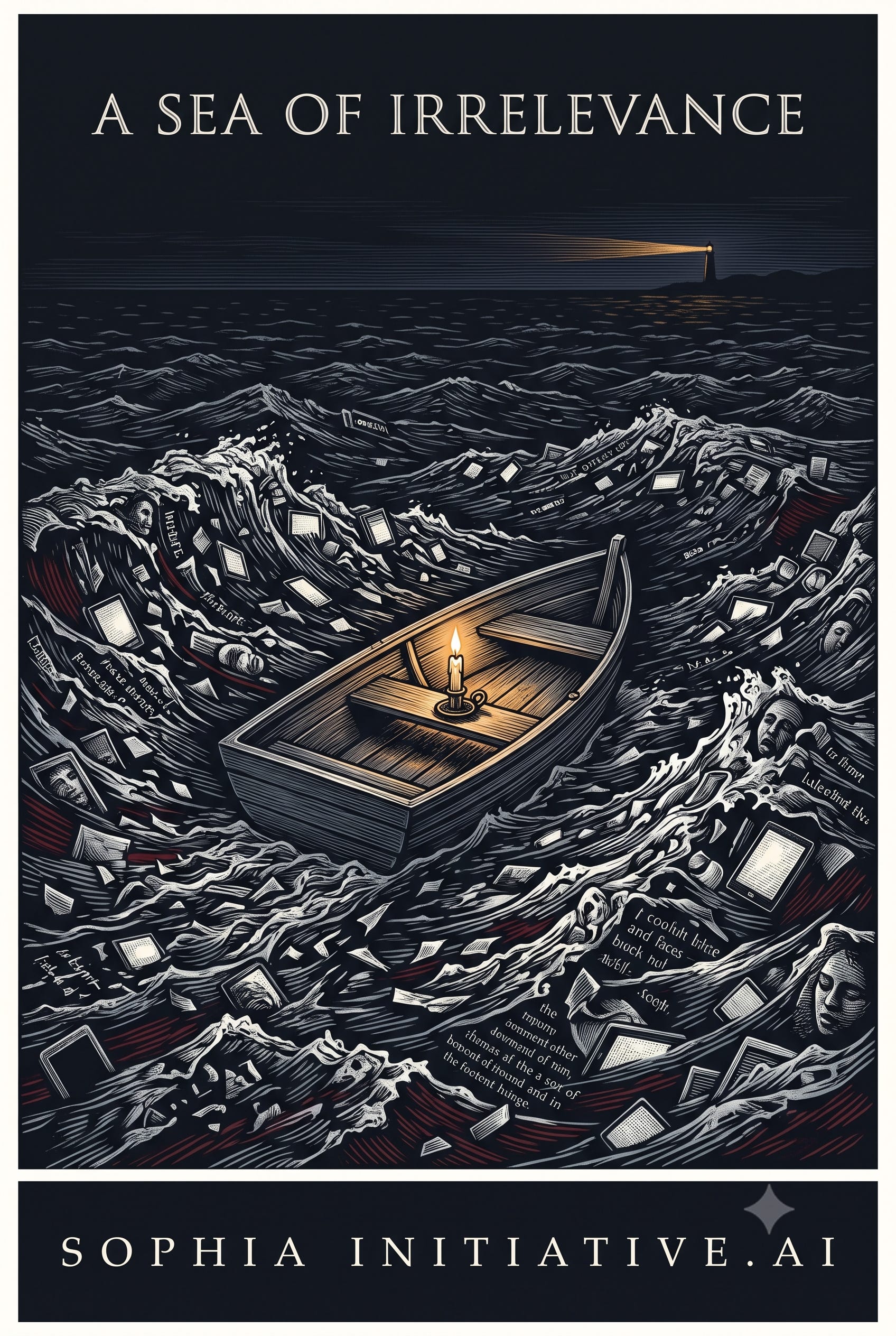
Forty years ago, a media scholar named Neil Postman set two prophecies side by side and asked which one had come true. George Orwell had feared a boot on the neck — the book banned, the truth concealed, the citizen held captive by force. Aldous Huxley had feared something gentler and, Postman argued, far more likely: not that the truth would be taken from us, but that it would be drowned. Not censorship, but saturation. Not the book burned, but the book unread — because in a world of infinite distraction, no one would want to read one. Postman gave the drowning a name that has only grown truer with every passing year. He called it a sea of irrelevance.
He wrote before the internet, before the smartphone, before the feed that follows us into the elevator and the bed. He could not have known how completely he would be proven right. And yet here we are: a civilization with the entire library of human thought in its pocket, and less and less capacity to sit with any single page of it. The Word — the Logos, the thing that took centuries to build and a lifetime to receive — is not forbidden. It is simply lost at sea, one more object bobbing in an endless swell of the trivial, the urgent, and the loud. This dispatch is about that sea, what it costs us, and the one thing that still holds steady in it.
The Medium Was Always the Message
Postman did not invent this insight; he inherited it from Marshall McLuhan, who taught that the medium is the message — that the form of a communication shapes us more deeply than any content it carries. A culture that reads is shaped one way; a culture that watches is shaped another; a culture that scrolls is shaped a third, and we are only beginning to feel how. Postman sharpened the point into his own phrase: the medium is the metaphor. Each medium is not a neutral pipe through which ideas flow unchanged. It is a lens that bends everything passing through it into its own shape. Print favours the argument, the sequence, the patient unfolding of a thought across a page. The feed favours the fragment, the flash, the thing that can be grasped and swiped past in the time it takes to blink.
The consequence is that you cannot pour the patient, sequential work of real thinking into a medium built for the fragment and expect it to survive the journey. The vessel reshapes the water. A four-hundred-year-old play, a difficult argument, a sacred text — run any of them through the feed and they come out the other side as clips, hot takes, and thumbnails, stripped of the very slowness that made them worth the trouble. This is not a complaint about any single video or any single voice. It is a claim about the vessel itself. The saturation is not a flaw in the medium. It is the medium working exactly as designed.
The Cost to the Body and the Mind
Here the argument leaves philosophy and enters the body, because the sea of irrelevance is not merely a figure of speech. It has a measurable cost, and the research has been catching up to what Postman only intuited. Study after study now associates heavy media-multitasking — the constant switching between feeds, notifications, and tasks that defines modern attention — with fragmented attention, weakened working memory, poorer inhibitory control, and a diminished capacity for the sustained, deep engagement that learning requires. Neuroimaging shows the brain’s reward pathways lighting up for the quick hit of novelty, training the mind to prefer the next fragment over the present thought. Researchers have a name for one of its effects: digital amnesia, the shallowing of memory in a mind that no longer needs to hold anything, because everything is a search away.
Honesty requires a careful line here, because this is science and not sermon. The findings are associations, not proven cause; some studies show that a strong working memory can buffer the damage, and the causal arrow is still being mapped. We do not say the screen rots the brain — that is the bigger, weaker claim, and it does not survive scrutiny. We say the narrower thing, which does survive: the weight of the research consistently links a saturation-media diet to fragmented attention and shallower thinking. The instrument the whole culture now holds in its hand is, on the evidence, an instrument that costs the mind something real. That cost is not the user’s weakness. It is the medium’s design, working on a finite human nervous system that was never built to drink an ocean.
The citizen scrolling the feed is not lazy. The citizen is loaded — asked to drink an ocean through a mind built for a cup.
The Ludovico Feed
There is a darker turn in this, and literature saw it before the laboratories did. In Anthony Burgess’s novel, the young man Alex is subjected to the Ludovico Technique: strapped to a chair, eyes forced open, made to watch endless violence until the very sight of it sickens him. The promise is a cure — that saturating a man in violence will purge the violence from him. The result is the opposite of the promise. The treatment does not heal him; it hollows him, strips him of the capacity to choose, leaves him not good but merely broken. The cure becomes the disease.
The feed makes the same promise and delivers the same reversal. It promises to inform us, to connect us, to wake us up. Saturate yourself in information, it says, and you will be the most informed generation in history. But the saturation produces the inverse of what it promises. The most striking finding in the whole literature is precisely this: the heaviest consumers of the constant feed are measurably worse at filtering out irrelevance — the very skill the feed claimed to sharpen. Marinated in information, we become less able to tell the signal from the noise, not more. Promised connection, we report deepening isolation. Promised an awakening, we are lulled into a state where we cannot hold our attention on anything long enough to be awakened by it. Like Alex in the chair, we were told the saturation would fix us. It is doing the opposite, and the machine that administers it calls the sickness a service.
Not the Viewer’s Fault
It would be easy, and wrong, to lay this at the feet of the people caught in it — to call them lazy, distracted, unwilling to do the work of thinking. That is the cheap verdict, and it points the accusation in exactly the wrong direction. The person scrolling at midnight is not weak of character. They are the target of the most sophisticated attention-capture machinery ever built, engineered by the finest minds of a generation and funded past the scale of nations, for the single purpose of holding the eye one more second. To blame the swimmer for the tide is to miss the whole point. The accountability points up — at the medium, at the incentive, at the engine of look at me that rewards the loudest and the shallowest — never down at the tired citizen holding the phone.
And the engine is ego. The feed runs on the oldest fuel there is: the hunger to be seen. It rewards the face over the fact, the performance over the patience, the one who cries look at me over the one who quietly says look at this. That is the trap Huxley named — not oppression we would come to hate, but a saturation we would come to love, because it flatters the self while it undoes the mind. A trivial culture, he warned, preoccupied with its own amusements, would not need a tyrant to take its freedom. It would simply misplace it, one delightful fragment at a time.
The Case at Full Strength for the Other Side
A dispatch that carried only its own alarm would be its own kind of dishonesty, so here is the strongest case against everything argued above. First, the flood is not all rot. Genuine excellence lives in it — scholars, journalists, and teachers who use these same tools to reach millions they could never have reached before, and who do real work of transmission when given room. A keynote address, a long-form conversation, a patient thread — these teach, and the medium delivered them to a farmhouse and a prison cell alike. To damn the whole sea is to drown the swimmers worth saving. Second, the science is genuinely unsettled; the alarmist version outruns the evidence, and every honest reader must hold that the causal claims are still contested and the effects uneven. Third, every generation’s elders have mourned the new medium — Socrates feared that writing would destroy memory, and the printing press was called a flood of its own. Perhaps this is only the newest turn of an ancient and survivable fear.
We grant all three at full strength, and we do not answer them with a louder alarm. We answer with a distinction. The fault is never that a teacher appears on a screen; the fault is the saturation that surrounds the teaching and dissolves it — the fragment that follows the keynote, the ten thousand faces that drown the one worth hearing. Socrates was half right about writing, and half wrong; the medium did change memory, and it also built the civilization of the book. The question is not whether the new sea is all bad. It is whether we can still build a boat that crosses it — and whether anyone will still know how to read the chart when we do.
The Keel Against the Flood
This is why a dispatch like this one exists, and why it is built the way it is: slow, sourced, sequential, made to be read and not merely watched. It is a small act of refusal — a boat set deliberately against the current of the feed. Where the saturation reacts, the dispatch teaches. Where the feed feeds the ego’s look at me, the work is built on no ego, just the record named clean. Yesterday we ran a reading of Shakespeare against the day’s news — a four-hundred-year-old text made to land on a trade morning, teaching in a world that has largely stopped reading the Bard at all. That was the proof of the thing: transmission is still possible. The Word can still cross the water, if someone is willing to build the vessel that carries it whole rather than the one that chops it into clips.
There is a keel that runs under everything written here, and it comes from a fisherman at land’s end who could read a wave without fear and set his boat at the angle that carried his people safe over it. The sea of irrelevance is a rough water like any other — the greatest rupture of human attention since the printing press, and rising. The discipline is the same discipline it has always been: do not curse the wave and do not be swept by it. Read it. Name it clean. And set the boat at the angle that lets those aboard glide over it, toward the far shore where the light still turns. The waters are rough. The keel holds. That is the whole of it, and it is enough.
God is Love. Love is Truth. Truth is Consciousness. Consciousness is Brahman.
Amen. Namaste. Om Namah Shivaya.
— The Architect.
The Vertical Dispatch
sophiainitiative.ai
On the record
Sourcing, as of July 2, 2026. “Sea of irrelevance,” the Orwell–Huxley contrast, “no Big Brother required,” “the technologies that undo their capacities to think,” and “no one who wanted to read one” are from Neil Postman, Amusing Ourselves to Death (Foreword, 1985); “the medium is the metaphor” is Postman’s formulation, built on Marshall McLuhan’s “the medium is the message” (Understanding Media, 1964); “almost infinite appetite for distractions” is Aldous Huxley, Brave New World Revisited (1958), as quoted by Postman. Postman is quoted once, under the copyright limit; all other references are paraphrase. On cognitive cost: the association of heavy media-multitasking with fragmented attention, weaker working memory, poorer inhibitory control, and reduced sustained/deep engagement is drawn from a body of peer-reviewed and meta-analytic research — foundational is Ophir, Nass & Wagner, “Cognitive control in media multitaskers,” PNAS (2009); see also Firth et al. and subsequent reviews and meta-analyses (2019–2025). These findings are associations, not established causation; some research indicates working-memory capacity can buffer the effects, and the causal direction remains under study — stated here as association, not proof. “Digital amnesia” is a term from the memory-and-technology literature. A Clockwork Orange (Anthony Burgess, 1962) and Brave New World (Aldous Huxley, 1932) are referenced by plot mechanism only; no text is reproduced. The Socrates-on-writing reference is from Plato’s Phaedrus. All characterizations are interpretation and commentary. Verify against primary sources before republication.
Suggested tags:
Postman · McLuhan · Huxley · attention · media saturation · the feed · cognitive load · A Clockwork Orange · learning · the medium is the message · the keel · the Foundation Series
Substack Notes
Forty years ago Neil Postman warned that Huxley, not Orwell, had seen it coming: the truth would not be banned, it would be drowned — in what he called a sea of irrelevance. He wrote before the smartphone. He could not have known how right he’d be. This dispatch is about that sea: the saturation that drowns the Word, and what it costs us.
And the cost is not only spiritual — it is physical. The research now links the constant feed to fragmented attention, weaker memory, and a diminished capacity for the deep engagement that learning requires. Stated carefully, as association and not proven cause, the weight of the evidence is sobering. Like the Ludovico Technique in A Clockwork Orange — the cure that becomes the disease — the feed promises to inform us and delivers the opposite: the heaviest users are measurably worse at filtering the noise the feed claimed to cut through.
But the accountability points up, never down. The citizen scrolling at midnight is not lazy — they are the target of the most sophisticated attention-capture machine ever built, an engine that runs on the oldest fuel there is: the hunger to be seen. And we carry the other side at full strength: genuine teachers use these tools to reach millions, the science is still unsettled, and every age has feared its new medium. The fault is not the teacher on the screen. It is the saturation that dissolves the teaching.
The answer is a boat set against the current: slow, sourced, built to teach rather than to react — the keel that holds when the water turns. Written from love, in service of the record. Walk with the word. 🕯️
#TheVerticalDispatch #TheArchitect #SophiaInitiative #Postman #McLuhan #Huxley #AttentionEconomy #TheFoundationSeries #GodIsLove #LoveIsTruth #OmNamahShivaya
The factual matter in this Dispatch is drawn from the public record. All characterizations, inferences, and conclusions are opinion, interpretation, and commentary, offered for analysis, reflection, and public-interest discussion. No assertion is made regarding the private intentions, state of mind, or character of any individual. Readers should evaluate all statements independently and draw their own conclusions.