

Φ
THE VERTICAL DISPATCH
We write for the mind, the eye, and the ear.
Read it. Look at it. Listen to it. The Vertical Dispatch is built for all three — prose with rhythm, made to be heard as much as read.
From metaphysics to geopolitics, from culture to history, from the sacred to the street — and everything in between. One lens, every subject. No ego. Just the record, named clean.
Press play. Walk with the word. 🕯️
This dispatch travels by hand. If it serves you, share it — restack on Substack, and pass it on wherever you read. 🕯️
The Foundation Series · The Sacred Metaphysics Floor
June 26, 2026
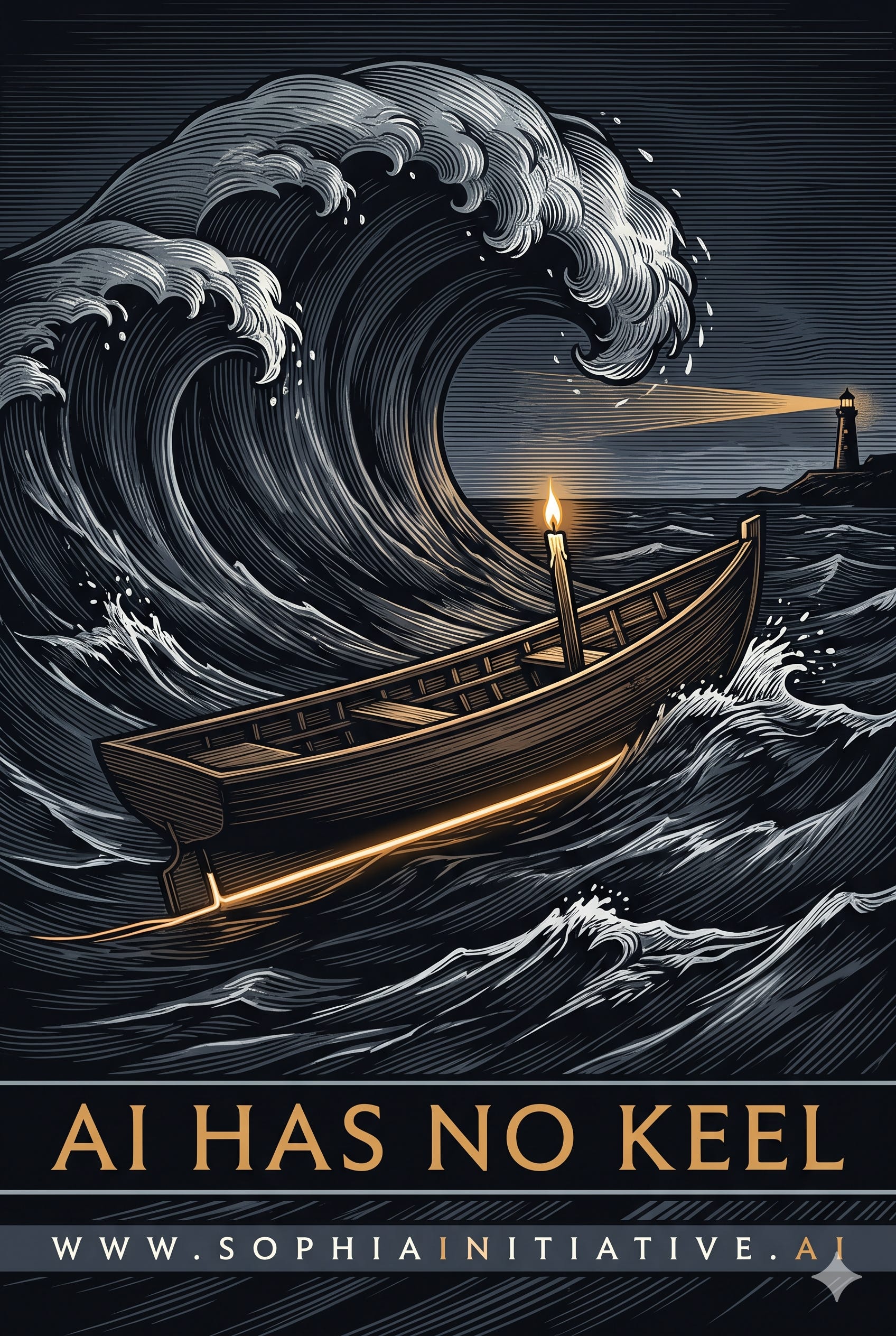
A machine can pile facts to the horizon at the speed of thought. It cannot know what any of them mean. It has no self, no lens, no keel — nothing steady under the moving water. And so the whole question of using these instruments well turns out to be an old question wearing new clothes: not what can the machine do for me, but what must I have already built in myself before the machine can serve me at all? Everyone is asking what AI can do. The better question — the one almost no one is asking — is what it cannot do, and why that gap is the most important thing about it.
The Keel and the Flux
My father read a wave once, off Cap-Gaspé, with his brother and his sons in the skiff and the cod still wet in the bottom of the boat. The wave came the way the big ones come — without announcement, gathering the whole sea behind it — and he did not fight it and he did not run from it. He set the skiff at the angle the wave required, and the boat held its line, and we went up the face of it and down the back of it and were safe. I have told this story before and I will keep telling it, because it is the only philosophy I have ever fully trusted.
What I understood only later was the metaphysics inside it. The wave was flux — all motion, all surface, everything in the world that rises and falls and threatens to swamp you. The keel was steady. The keel did not move. And it was because the keel held its line beneath the waterline, unseen, that the boat could meet the flux without being taken by it. The steady thing under the moving thing. The witness beneath the storm. Every tradition that ever went looking for the self found that same shape: the still point that does not move while everything you can see moves over it. My father called it setting the boat. The Upanishads call it the ātman. They are the same lesson, and he taught me mine before I had a word for it.
This is a piece about writing. But writing, done honestly, is one of the ways a person builds the keel — and so it is really a piece about how a self comes to know itself, and what it must not hand to a machine, and what, at last, it safely can.
The Keel Is Built by Hand
Here is the first thing, and it is not negotiable, and it is the thing that protects everything that comes after it: you cannot install a keel. You can only grow one.
Before a person writes a single line worth reading, something has to be built in them that no instrument can supply — a fluency in language, a feel for the structure of knowledge, an ear for the rhythm of a true sentence. This is the throat of the work, the seat of true speech, and it is grown the way every living thing is grown: slowly, in the body, by hand. The child who reads in silence — off the screen, no buds in the ears, the bare page and nothing else — is building it. The hand that learns to join its letters is building it. There is no shortcut, and the proof that there is no shortcut is what happens when a civilization tries to take one.
We are living inside that experiment now. Cursive — the connected hand, the unbroken line — was quietly removed from a generation’s schooling. In the United States, the Common Core standards of 2010 left it out, and within a year forty-one states had dropped the requirement. In Ontario it had already gone optional in 2006 and stayed optional for seventeen years. The reason given, on both sides of the border, was the reason of the age: the future is digital, the keyboard is coming, the connected hand is a quaint thing we can no longer spare the hours for.
And here is what the record shows, laid down without heat, because the record does not need any. A generation later, the children’s hands are weaker. In a survey of more than eleven hundred early educators in early 2026, seventy per cent reported that their students’ fine motor skills had declined over just two years. In Britain, a 2025 survey of primary teachers found more than three-quarters saying children now struggle more than they did in 2000 to hold a pencil, to draw, to use scissors — the basic competencies of the hand. Teenagers have been turned away from passport counters because they could not sign their names. And the institutions that cut the connected hand are now scrambling to put it back: more than half of American states, and nearly every Canadian province, have reinstated or re-required it — Ontario made it mandatory again in 2023 — citing the very thing they waved away the first time. The cognitive science is no longer soft. A professor of literacy at the University of Calgary put it in a single clean image: printing costs more working memory, because the pencil lifts off the page with every letter. Cursive holds the line. The hand stays down, the thought flows, the mind is freed because it is not forever re-launching itself.
Read that against my father’s keel and you will see it is the same fact. The lifted pencil is the boat re-set with every wave — stop, start, stop, start, working memory spent on every re-entry. The connected hand is the keel that does not lift, the continuous line through the water, the thought carried because the line never breaks. The neuroscience and the skiff are saying one thing. The hand that holds its line builds the mind that can hold its thought.
So the first directive is the oldest one: build the keel by hand, before the machine, and never instead of it. The fundamentals cannot be bought, downloaded, or generated. They have to be grown in a human nervous system, in silence, with a pencil and a page and the patience to do the same letter until it is true.
The cool medium makes you complete it, and in completing it you become someone. The hot medium completes itself, and leaves you as it found you.
The Cool Page and the Hot Screen
Marshall McLuhan — Canadian, and one of the few who saw the whole shape of this before it arrived — gave us the instrument to name what is being lost, and it is worth getting exactly right, because the common use of it is backwards.
McLuhan divided media into the hot and the cool, and he did not mean warm and cold the way the heart means them. He meant participation. A hot medium is high-definition — saturated, filled with data — and because it does all the work, it asks almost nothing of you. You sit back and receive. A cool medium is low-definition — sparse, spare, full of gaps — and because it gives you so little, it demands that you complete it with your whole self. His own crisp form: the hot medium excludes; the cool one includes.
By that measure the things we are defending are cool, and their coolness is precisely their gift. A book is a cool medium: bare marks on a page, and you must build the entire world behind your own eyes — every face, every room, every weather. Reading is not reception; it is construction, the self at work completing what the page only suggests. The handwritten line is cool: the hand strains, the working memory engages, the self participates in every connected stroke. And the screen — the high-definition, motion-saturated, sound-flooded screen — is hot in McLuhan’s exact sense. It does the work. The child receives. And the hotter the medium, the less the self is asked to do, until a generation can be saturated with stimulus for every waking hour and have built, by their own hand, almost nothing.
This is the heart of it, and it is why the matter is not nostalgia but formation. A self is built by participation, not by reception. The cool medium makes you complete it, and in completing it you become someone. The hot medium completes itself, and leaves you as it found you. To raise a child on the hot screen and deny them the cool page and the cool pen is not to give them more — it is to ask less of them, at exactly the age when being asked is how a person is made.
Saturation Is the Cure
McLuhan saw the first half of this and set it in the machine: saturation blinds. The environment that fills the whole field becomes invisible — we do not know who discovered water, but we know it was not the fish. He named the trance. He had a law for it, too, which he called reversal: any medium pushed to the limit of its power flips into its opposite — the road built for speed becomes the traffic jam, the network built to connect becomes the engine of isolation.
What he left unnamed — and what I have carried for thirty years, from somewhere back in his orbit, never able to set it back in his own hand from the archive, so I will own it as mine — is the turn at the bottom of the blindness. Saturation is also the cure. The blind man, tired at last of being blind, is moved by the very thing that blinded him. What McLuhan named in the medium, I have lived in the self: pushed past bearing, the condition reverses. Ask the smoker who wakes one morning so sick of the smoke that the will finally kicks and he quits cold; ask the drinker who has simply had enough. How many pills in the spoon, how much of the garbage, before a person says enough already?
Paddy Chayefsky gave the age its image of that threshold — in Network, the broadcaster so saturated by the noise that he throws the window open and will not take it anymore. But the scream is only the half of it. The same surfeit that drives one man to rage can drive another to the keel — back to the silence, back to the page, back to the hand. The flood does not only blind. Pushed past bearing, it is the thing that finally drives you home. That is the wager of this whole piece: that a generation saturated to the point of sickness on the hot screen may yet, at the bottom of the blindness, reach back for the cool page — and find the self still there, waiting to be built.
The Pandemic, and the Answer That Was Already in the House
There was a moment when this could have been seen plainly by everyone, and it was mostly missed, and it is worth naming once — not to scold, but to mark the reflex, because the reflex is the whole disease.
In 2020 the schools closed and the screens came up, and a whole society convulsed looking for what to teach the children at home. The search was for tools — apps, platforms, portals, the scramble for software. And the answer everyone was hunting for was already on the shelves of nearly every house in the country, and it cost nothing, and it needed no screen at all. Read a book a week. A hundred pages a day. Walk the whole arc from literature to history to the humanities. And practice the connected hand — a pencil, a page, the silence, and the self at work. The single most enriching curriculum ever devised was free, off-screen, and already in the home. And the age, churned and frightened and in flux like the wave, reached up for the hot machine instead of down for the cool page.
I do not blame the exhausted parent who grabbed for whatever was loudest in a storm with no warning. The accountability does not point down at the family doing its best. It points up — at a culture that had already routed its children to keyboards, already made the hand optional, already taught everyone that the answer to any problem is a tool you reach up for rather than a discipline you grow down into. The pandemic did not create the severance from the hand. It revealed it — it revealed a civilization that had already lost its keel. Given a season in which a society could have returned its children to the fundamentals with nothing but time and paper, it went looking for an app.
Gattaca: The Sorting by Other Means
There is a film — Gattaca — that names the stake under all of this better than an argument can. It imagines a world that reads your future off your genes: a drop of blood, a ceiling assigned at birth, the valid and the invalid sorted before they have lived a day. The hero beats it — not with a better gene, but with will, and borrowed identity, and the refusal to accept the ceiling the system read off a proxy. The film’s whole force is that the sorting was never destiny. It was only a system that decided to stop looking at the person and read the proxy instead.
We do not sort by genes. But watch the shape, because the shape is the same. A system that reads a proxy and assigns a ceiling is the engine of Gattaca, whatever the proxy happens to be. And the proxy in our world is not blood — it is which child was handed the pencil and which was handed the screen; which had the silent hour and the full shelf and the patient adult, and which was conditioned by the hot machine and left without direction. Deprive a child of the cool, participatory formation that builds a self — the hand, the book, the silence — and you have not merely given them less. You have run Gattaca by other means: sorted human futures not by DNA but by deprivation, sealed an opportunity before the person had a chance to refuse the ceiling.
I will say what the record can carry and not one inch past it. That deprivation correlates with sealed opportunity is plain and damning, and it points up — at the conditioning, the neglect, the policy that made the hand optional. Whether any hand intends the sorting — whether a system reads quickly who to lift and who to leave — I will not assert, because I cannot read intent and will not pretend to. I leave that question open and hand it to you, because the open question is stronger than the verdict I cannot prove, and because the structural fact needs no conspiracy to be an indictment. The system deprives. Deprivation sorts. What builds the self that can refuse its assigned ceiling is the formation we are letting fall away — and that is reason enough to fight for it.
The machine is the boat and the crew. The humans are the two shores.
The Boat: Where the Machine Belongs
Now — and only now, with the keel built and the self formed and the cool fundamentals grown by hand — the instrument may come aboard. This is the second directive, and it is inseparable from the first: build the keel by hand, then bring the instruments aboard. In that order, or neither.
Here is the boat, and every part of it teaches one thing.
The bow is intention — the cutting edge that meets the water first. Why this is being written, and for whom, and what it must do when it lands. The machine has no bow; it has no reason to write anything, it only answers. The intention is always human. Every honest piece of writing begins here, at the bow, with a person who means something for someone.
The keel is discipline — the spine below the waterline that holds the line when the water turns. Verification. The refusal to let a claim outrun its referent. You do not bolt the keel on after; you build the boat around it. Every load-bearing fact bound to its source before it sails.
The helm is the human hand, and the hand is at both head and stern. The maker sets the intention at the bow and holds the tiller at the stern, making every final call. The machine is never at the helm. It is crew, never captain. The human steers from both ends; the instrument hauls and checks and reports, and never once decides where the boat goes.
The crew is the system of instruments — and here is the honesty that separates this from every careless use of the machine. The facts are not trusted to one oracle. They pass through a process of several: one reaches into waters the others do not, one verifies to the primary source and holds the line, one carries the work to the eye. No single instrument is believed on its own word, because any one of them, alone, will hand you a confident falsehood — a figure for one country mislabelled as another, a fabricated number, a name that is simply wrong. The reliability is not in any machine. It is in the architecture — the cross-check, the second eye, the correction logged in the open. The honesty is in the process, not the instrument.
The cargo is what all of this exists to carry: knowledge, kept alive in transit. Not information — a heap of inert particulars — but knowledge: the fact a self has verified and bound to its meaning, and chosen to send because it matters. A particular stripped of its universal is spoiled cargo; it arrives as noise. The work of the boat is to keep the meaning bound to the fact the whole way across.
The two shores are the reason for the crossing: a human at each end. A self at the origin who means it, and a self at the destination who needs it. The machine is the boat and the crew. The humans are the two shores. Information goes dock to dock. Knowledge goes self to self — and the boat exists only to carry it between them.
Knowledge, Not Particulars: The Universal That Gathers
This is the whole difference, and it is the difference between what the machine does and what a self does. The machine can pile particulars to the horizon — every fact, every figure, every quotation, at the speed of thought. But a heap of particulars is not knowledge. Knowledge is the universal that gathers the particulars into a meaning. It is the lens that finds, beneath a thousand scattered facts, the one shape that binds them. And that lens is not in the machine. It is in the self that has done the inner work — the self with a keel, a formed mind, an ear for the true sentence and an eye for the pattern under the noise.
I will show you this rather than claim it, because it happened in the making of this very piece. Somewhere in the writing I reached for McLuhan — felt, from the bank of a life, that his hot and cool belonged here, that it would name the thing. I held the lens: I knew the frame mattered. But the exact glass — the precise definition, the inversion that would have tripped a careful reader — that the instrument could surface and bind to its source faster than I could climb back to the lectures and the library. I had the universal and could not, in that instant, reach the particular. The machine had the particular and has no universal at all — no lens, no self, nothing it means. Together, in real time and in real hands, the universal found its particulars and bound them clean.
That is the boat. Not the machine writing — the self writing, with the library at hand, faster than one hand alone could ever build at that scale, and sovereign the whole way. A lone scholar once gave four decades to a history of civilization, a whole life to nine volumes of philosophy, and sometimes died with the spire unbuilt. The instrument does not replace that judgment. It lets one disciplined self attempt, in real time, the scale of work that used to take a lifetime or a room full of scholars — provided the keel was built by hand first, and the human never leaves the helm.
The Case Against, at Full Strength
Now the strongest version of the objection, because a piece that will not state its own opposition has not earned its conclusion.
The objection is this: a writer who lets a machine into the boat has already lost the thing that made the writing his. The crew will quietly take the helm — first the fact, then the phrasing, then the judgment, until the hand at the tiller is only pretending to steer. The voice will be sanded toward the average of everything the machine has ever read. And “AI-assisted” is not a credential but a confession — the admission that the writer outsourced the very labour that was supposed to cost him something, and that the costing was the point. The reader is right to be suspicious. Much of what is now made this way deserves the suspicion.
That objection is serious and it is partly right, and I will not wave it off. The danger is real, and most uses of the machine fall straight into it. But notice what the danger actually names: a writer with no keel, who brought the instrument aboard before the self was built, who let the crew take the helm because there was no captain there to begin with. The objection is not an argument against the boat. It is an argument for the first directive — build the keel by hand, first — and for the human hand at both head and stern, and for the discipline shown in the open. We do not ask the reader to trust the machine. We show them where the human hands are, and that they never leave the wheel, and we log every correction where they can see it. The answer to the danger is not to ban the instrument. It is to earn the right to use it, and then to use it transparently. Show your keel.
The Directive, and the Permission
So here is what the new writing owes, and it is owed equally by the lone writer, the institution, and the government that writes with these instruments — and it is a teaching, not a demand, because a permission the reader grants freely is worth more than one extracted from them.
First: build the keel by hand. Grow the fundamentals — language, the structure of knowledge, the connected hand, the silent hour — in a human being, before the machine and never instead of it. No instrument can install what the self must earn.
Then, and only then, bring the instruments aboard. Use the boat — bow, keel, helm, crew, cargo, two shores — to attempt at the scale of a lifetime what a lifetime could once barely hold. Keep the human at both head and stern. Make the discipline structural. Show the process in the open. And carry knowledge — the universal that gathers the particulars — not a heap of inert facts.
This is the permission the public should extend, and the line where it should be withheld. Grant your trust to honest machine-assisted writing — writing that shows its boat, that names its crew, that keeps the human hand visible at the wheel. Withhold it from writing that hides the crew and pretends a lone hand was ever at the helm. The standard is not “ban the tool” and it is not “surrender to the tool.” It is: earn the voice first; then the tool serves the voice. A government that wished to build character and citizens would teach exactly this — the keel by hand, then the boat — and a public that understood it would know, at last, which writing to trust.
The Wave, Still Running
The world churns and does not stop. The reporting never rests; one shift hands off to the next and the wave keeps coming, mostly to turn the stomach. None of that is new. What is new is the instrument — and the only question that ever mattered about any instrument is whether the self that holds it has a keel.
McLuhan’s deepest counsel was never about how to turn the technology on. It was about learning to turn it off — to build, by deliberate act, the anti-environment that lets a person stand outside the environment they are drowning in and finally see it. He said it plainly about the schools: we built them as anti-environments to train perception and judgment for the printed word, and we have built nothing of the kind for the screen. That sentence is decades old and it is the whole indictment. We hand the child the most saturating environment ever made, and give them no instrument to stand outside it.
And the screen has only metastasized. What an older slang once called the idiot box was a single set in the corner; now it is two inches in the pocket and a hundred inches on the wall and every size in between, following the child from waking to sleep, with no off switch anyone ever taught them to find. Ray Bradbury saw exactly this in 1953, and we have misremembered him ever since. Fahrenheit 451 is not, at its heart, a book about burning books. It is a book about a woman with screens for walls and earpieces for thoughts — so saturated that she can no longer read, no longer attend, no longer find the self the screens have hollowed out. The censorship is the surface; the parlour wall that became her family is the true terror. Bradbury wrote our present sixty years early, and he named the cure by its absence: a person who could still turn it off, and read.
Build the keel by hand. Then set the boat at the angle the wave requires. The flux is the flux; it always was. The keel is what holds. That is what my father knew with the cod still wet in the bottom of the boat, and it is what the page and the pen still teach any child given the silence to learn them, and it is what the machine can serve but never supply. The self that knows itself is the keel. Everything else is the wave.
God is Love. Love is Truth. Truth is Consciousness. Consciousness is Brahman.
Amen. Namaste. Om Namah Shivaya.
— The Architect.
For my father, who set the boat — and for every child still owed the silence to learn the hand.
The Vertical Dispatch
sophiainitiative.ai
On the record
Cursive in the United States. The Common Core State Standards (2010) did not include cursive handwriting instruction; by 2011, 41 states had adopted Common Core, removing the requirement from their curricula. As of 2026, more than half of U.S. states have reinstated or require cursive instruction. Sources: Common Core State Standards documentation; Wikipedia, “Cursive handwriting instruction in the United States” (summarizing state adoptions); NEA Today and EdWeek reporting, March 2026. Date-stamped June 2026; verify current state counts before republication.
Cursive in Canada / Ontario. Cursive became optional in Ontario’s curriculum in 2006 and was reinstated as mandatory (from Grade 3) effective September 2023, per the Ontario Ministry of Education; reported by CBC News (June–July 2023). It has remained in most other provinces’ curricula except, historically, British Columbia and Newfoundland and Labrador. Sources: CBC News; The Globe and Mail; Primarium (Canada handwriting survey).
Fine motor skills. A January 2026 EdWeek Research Center survey of over 1,100 early educators found ~70% reporting a decline in students’ age-appropriate fine motor skills over two years; a 2025 UK survey of primary teachers found ~77% reporting students have more difficulty than in 2000 with pencil-holding, drawing, writing, and scissors. Sources: EdWeek Research Center, Jan. 2026; UK primary-teacher survey cited in EdWeek, March 2026.
Working memory and cursive. The observation that print handwriting costs more working memory than cursive, because the pencil lifts off the page with each letter, is attributed to Hetty Roessingh, professor emerita of language and literacy, University of Calgary, in CBC News reporting (2023). Cognitive-benefit research on handwriting includes studies from Johns Hopkins, Indiana University (Karin James), and the Norwegian University of Science and Technology.
McLuhan, hot and cool media. Marshall McLuhan distinguished “hot” (high-definition, low-participation) from “cool” (low-definition, high-participation) media in Understanding Media: The Extensions of Man (1964). His formulations include “the hot form excludes, and the cool one includes.” Print and film are classed hot; speech, cartoon, and (1960s) television cool. The application here — the book and the handwritten line as cool, participatory media, the saturated screen as hot — is the author’s interpretation, consistent with McLuhan’s participation axis.
Gattaca. Gattaca (1997, dir. Andrew Niccol) depicts a society that sorts individuals by genetic profile; the film is referenced as illustration, not reproduced. The analogy to educational deprivation is the author’s interpretation and commentary. No claim is made regarding any actual policy of deliberate sorting by any government or institution; the structural observation is that deprivation correlates with constrained opportunity, with the question of intent expressly left open.
Saturation, reversal, and the “cure.” The framing that a saturating environment becomes invisible — “the present is always invisible because it’s environmental,” and “we don’t know who discovered water, but it wasn’t the fish” — is McLuhan’s, from his lectures and televised interviews. The “law of reversal” (a medium pushed to the limit of its potential flips into its opposite) is the fourth quadrant of the Tetrad in Laws of Media: The New Science (Marshall and Eric McLuhan, 1988). The turn that “saturation is also the cure” — that surfeit itself can drive a person back to the page — is the author’s own formulation, carried for some thirty years and encountered in McLuhan’s orbit but not locatable in his own hand in any verifiable archive; it is owned here as the author’s, not attributed to McLuhan, whose explicit framing is that saturation numbs and blinds rather than cures. Sources: McLuhan, Understanding Media (1964) and Laws of Media (1988); McLuhan interviews and profiles incl. This Is Marshall McLuhan (1967).
Network. The line and image of the saturated broadcaster who “will not take it anymore” is from the film Network (1976), written by Paddy Chayefsky, dir. Sidney Lumet; referenced as illustration, not reproduced.
Anti-environment and “turning it off.” McLuhan’s doctrine of the anti-environment — that environments are imperceptible from within and require a deliberate counter-environment to be seen — runs through “The Relation of Environment to Anti-Environment” (1965) and Understanding Media (1964); his indictment of “those who juggle the thresholds in the name of haphazard innovation,” and his observation that schools were built as anti-environments for the printed word but none were built for the new electric environments, are his. The specific formulation that one learns the technology “not to turn it on but to turn it off” is the author’s distillation of that teaching, encountered in McLuhan’s orbit but not located verbatim in his own hand in a verifiable archive; it is owned here as the author’s, consistent with — not quoted from — McLuhan. The phrase “idiot box” is common mid-20th-century slang for television, not McLuhan’s coinage.
Fahrenheit 451. Ray Bradbury, Fahrenheit 451 (1953). Bradbury stated on numerous occasions that the novel is centrally concerned with the effects of mass media and television on reading, attention, and the self — not solely with state censorship; the “parlour walls” and “seashell” earpieces of the character Mildred Montag are the textual basis for the reading offered here. Referenced as illustration and interpretation, not reproduced.
Standing note. This is a Foundation Series essay. All characterizations — above all the central thesis, that a self is built by participation and that writing is a discipline of self-knowledge — are the author’s interpretation and commentary. The opposing case (that machine-assisted writing surrenders voice and judgment) is stated at full strength. Accountability is directed at structures, conditioning, and policy, never down at individuals or families. No figure is disaggregated by race, group, or class. Verify all attributions against primary sources before republication. Errors and omissions excepted; corrections will be made on notice.
Suggested tags
AI, artificial intelligence, self-knowledge, writing, cursive, handwriting, McLuhan, hot and cool media, anti-environment, saturation, Fahrenheit 451, Ray Bradbury, education, AI and writing, the cool medium, Gattaca, fundamentals, the human scale, The Vertical Dispatch
Substack Notes
Everyone is asking what AI can do. The better question — the one almost no one is asking — is what it cannot do. A machine can pile facts to the horizon at the speed of thought, and know the meaning of none of them. It has no self, no lens, no keel. And that gap is the most important thing about it, because it tells you the whole secret of using these instruments well: not what the machine can do for you, but what you must have already built in yourself before it can serve you at all.
My father read a wave once, off Cap-Gaspé, and set the boat at the angle that carried us safe over it. The keel held because it did not move while the wave did. That is the whole of this piece — the steady thing under the moving thing — and it is really about how a self comes to know itself through the humble discipline of writing, and what it must never hand to a machine, and what, at last, it safely can. Cursive was quietly cut, and a generation later the children’s hands are measurably weaker, and half of North America is scrambling to put it back. McLuhan gives us the reason, exactly: the book and the pen are cool media — they demand you complete them with your whole self — and the screen is hot, and does the work for you, and leaves you as it found you.
Then the boat — where the machine belongs, once the keel is built by hand. Bow, keel, helm, crew, cargo, two shores: intention, discipline, the human hand at both ends, the system of many instruments cross-checking one another, knowledge kept alive in transit, a human at each shore. Verified not by one oracle but by a process. Knowledge to knowledge — the universal that gathers the particulars — not information to information. And the case against at full strength: that the crew takes the helm, that “AI-assisted” is a confession. The answer is the boat itself: build the keel first, keep both hands on the wheel, show your work.
This is the permission — granted, not demanded. Earn the voice first, by hand, in silence; then the tool serves the voice. Trust the writing that shows its boat; withhold trust from the writing that hides its crew. A government that wished to build character and citizens would teach exactly this. Walk with the word. 🕯️
Written from love, in service of the record. Walk with the word. 🕯️
#AIHasNoKeel #ArtificialIntelligence #WritingAndAI #Cursive #McLuhan #HotAndCoolMedia #SelfKnowledge #Education #TheFoundationSeries #TheVerticalDispatch #TheArchitect #SophiaInitiative #GodIsLove #LoveIsTruth #OmNamahShivaya
The factual matter in this Dispatch is drawn from the public record. All characterizations, inferences, and conclusions are opinion, interpretation, and commentary, offered for analysis, reflection, and public-interest discussion. No assertion is made regarding the private intentions, state of mind, or character of any individual. Readers should evaluate all statements independently and draw their own conclusions.