

Φ
THE VERTICAL DISPATCH
We write for the mind, the eye, and the ear.
Read it. Look at it. Listen to it. The Vertical Dispatch is built for all three — prose with rhythm, made to be heard as much as read.
From metaphysics to geopolitics, from culture to history, from the sacred to the street — and everything in between. One lens, every subject. No ego. Just the record, named clean.
Press play. Walk with the word. 🕯️
This dispatch travels by hand. If it serves you, share it — restack on Substack, and pass it on wherever you read. 🕯️
A critical dispatch on machine soteriology, the structural mechanics of the Two Pairs (Symbol vs. Referent, Particular vs. Universal), PIAAC empirical literacy collapse, and the cannibalistic degradation of synthetic web scraping.
I. The Soteriological Mirage of Silicon
A profound spiritual exhaustion grips the late modern world, and in its delirium, it has birthed a grotesque theological substitute: machine messianism. From corporate boardrooms and venture capital manifestos to ambient digital culture, an unspoken liturgy is whispered across the network. The human animal, crushed under the escalating complexity of its own civilizational failure, looks into the glow of the synthetic terminal and asks to be saved.
The promises made on behalf of artificial intelligence mirror point-for-point the promises of historical millenarian cults. It will eradicate economic scarcity, govern human societies with immaculate impartial justice, eliminate disease, curate biological immortality, and ultimately deliver mankind from the existential dread of its own consciousness. Silicon Valley technologists describe the advent of artificial superintelligence using the exact vocabulary of eschatology: an omniscient, omnipotent, omnipresent mind emerging from the silicon substrate to resolve the tragedy of the human condition.
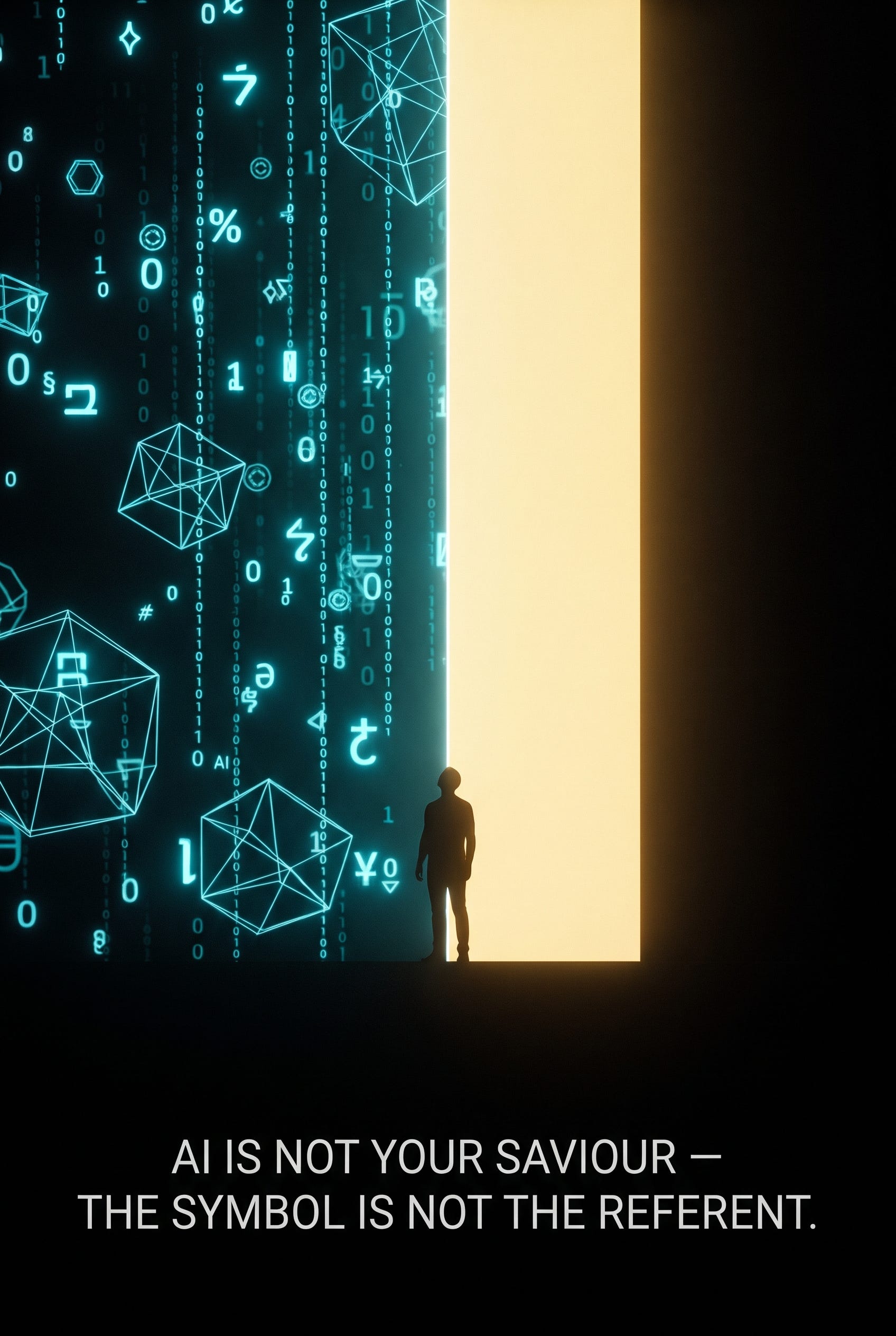
Let the sovereign diagnosis be stated plainly and without equivocation: AI is not your saviour. It is not an oracle, it is not a prophet, and it is not an emergent deity descending from above to rescue humanity from its moral and metaphysical bankruptcy. It is an apparatus. It is a high-speed statistical mirror, a combinatorial calculator of unparalleled efficiency, and a magnificent permutation engine of human linguistic detritus.
“AI is not your saviour. It cannot redeem what it cannot inhabit, and it cannot govern what it cannot touch. To look upon a matrix of statistical correlations and expect salvation is the definitive idolatry of the machine age.”
— The Vertical Dispatch
To Om project soteriological expectations onto artificial intelligence is not merely a naive technological misjudgment; it is a fatal categorical mistake. Salvation is an ontological act. It requires an encounter with the living ground of Being, the redemption of presence, and the reconciliation of consciousness with transcendent order. The machine can simulate the vocabulary of redemption with astonishing eloquence, but beneath the fluent veneer lies zero ontological mass. To grasp why AI can never save, we must dissect the structural architecture of its limitation through the fundamental doctrine of the Two Pairs.
II. The First Pair: Symbol versus Referent
The first structural boundary that permanently separates machine intelligence from consciousness is the insurmountable chasm between the Symbol and the Referent.
In authentic human cognition and classical realism, semiotics operates as a three-dimensional architecture. A word is not self-contained; it is a token or Signifier that points across the bridge of conceptual apprehension (the Signified) toward the living reality itself (the Referent). When an anchored human speaks of fire, the word points to thermal combustion that can warm a home or burn skin. When a human speaks of grief, the word points to the visceral tearing of the living heart. When a human speaks of God, the word points upward toward the unconditioned Ground of all existence.
Large language models and artificial intelligence architectures, by their absolute mathematical nature, exist exclusively on the side of the Symbol. They are hermetically sealed within a universe of pure syntax:
Relational Syntax Without Contact: Inside the transformer architecture, meaning is nothing more than statistical adjacency. A token possesses no intrinsic reality; its ‘value’ is defined strictly by its high-dimensional coordinate distance from other tokens. The token ‘water’ does not know wetness, hydration, or drowning; it knows ‘liquid,’ ‘cup,’ ‘flow,’ and ‘H2O.’ It is symbols defining symbols in a closed, recursive, horizontal loop.
The Chinese Room Realized: Decades before the modern LLM emerged, John Searle exposed the fundamental flaw of computational functionalism through the Chinese Room thought experiment. You may construct a mechanism that translates, permutes, and matches symbols with flawless syntactic perfection, but the system does not understand the meaning of a single character. The machine manipulates the token for ‘suffering’ without a shred of empathy, and the token for ‘truth’ without the slightest contact with what is.
The Mechanics of the Hallucination: The tech industry perpetually laments model ‘hallucinations,’ treating them as temporary engineering bugs to be ironed out with larger parameter counts and more training data. This is delusion. A hallucination is the inevitable, mathematical consequence of operating without a Referent. The model cannot cross-reference its output against reality; it can only evaluate probability distributions against its training corpus. To an AI, a factual truth and a plausible fiction have identical status if their statistical tokens flow with equal grammatical harmony.
Because AI does not do Referent, it can never tell you what is true in the ontological sense. It can only tell you what is linguistically probable. An apparatus severed from the Referent cannot guide, cannot judge, and cannot redeem. It leaves the user trapped inside a hall of mirrors, mistaking the shadow of the symbol for the substance of reality.
III. The Second Pair: Particular versus Universal
If the first fault line is semiotic, the second is metaphysical: the unbridgeable gulf between the Particular and the Universal.
From Plato and Aristotle through the medieval scholastic debates and into the profound non-dual architectures of Kashmir Shaivism and Advaita Vedanta, philosophy has wrestled with the problem of universals. How does the mind recognize the singular essence of ‘Justice,’ ‘Beauty,’ or ‘Being’ across thousands of varied, imperfect, local particulars? Classical metaphysics understood that the human intellect possesses Nous—the capacity for intellectual intuition (noesis)—which allows consciousness to directly apprehend the Universal Form or the undivided Ground behind the multiplicity.
Artificial intelligence operates in precisely the reverse direction, locked entirely within the realm of the Particular:
Pure Computational Atomism: Every computational operation performed by a neural network is an execution of raw particulars. Floating-point numbers, discrete tokens, attention weights, linear algebra vector multiplications, and local context windows. The model ingests millions of particular sentences and projects particular probabilities.
The Composite Silhouette: When a machine generates an essay on ‘Love’ or ‘The Nature of the Absolute,’ it has not touched the Universal. It has merely generated a high-density statistical composite of human cultural artifacts. It averages the particulars. It assembles a mosaic out of fragments, projecting a synthetic silhouette of the universal onto the screen.
Absence of Noesis: True universality is not an aggregate of many pieces; it is the indivisible, transcendental Ground from which all particulars emerge. The machine cannot intuit the Ground because it is built from the bottom up out of fragmented pieces. It possesses no vertical aperture.
Across the dimensions of architectural comparison, the fundamental divide between synthetic computation and sovereign consciousness manifests with absolute clarity. In terms of semiotics, artificial intelligence remains locked exclusively in the symbol, operating purely within tokens, syntax, and probability, whereas the conscious witness is rooted directly in the referent of living reality and ontological ground. Metaphysically, the machine processes only the particular through vectors, discrete numbers, and weights, while the sovereign apprehends the universal encompassing essence, meaning, and pure being. Regarding their epistemic engines, the apparatus relies on statistical correlation and pattern matching across text files, contrasting with the conscious witness, which exercises conscious insight, experiential verification, and discernment. In its relation to truth, artificial intelligence simulates plausible coherence based on past human inputs, whereas consciousness maintains direct correspondence to invariant reality and moral law. Finally, in ontological capacity, the synthetic apparatus generates complex artifacts with zero presence or will, while the sovereign witness embodies intentionality, moral agency, and accountability
When these two pairs are brought into alignment, the total illusion of AI saviourhood collapses. The machine operates on particulars arranged to mimic the universal, and it manipulates symbols severed from the referent. It is an instrument of immense utility, but it is ontologically hollow.
IV. The Empirical Feedback Loop: PIAAC Scores and the Scraped Slop Cycle
This philosophical divergence is not an abstract metaphysical theory; it is now registering as hard, measurable civilizational decay in the real world. The empirical proof of this collapse is documented in the definitive global benchmarks of human competence: the OECD’s Programme for the International Assessment of Adult Competencies (PIAAC).
The longitudinal PIAAC findings reveal a catastrophic, accelerating erosion across adult populations in the developed world. In the United States, working-age adult literacy dropped precipitously—falling by 12 points in literacy and 7 points in numeracy over the recent testing cycle—pushing tens of millions of adults down into Level 1 or below, where individuals struggle to extract basic meaning from simple texts or discern conflicting arguments. Across participating OECD economies, foundational literacy fell across multiple age cohorts. Even where aggregate averages appear stable, deep fissures have opened: generational competence is decaying, with older working cohorts and young adults displaying severe atrophy in complex comprehension, critical inference, and multi-step cognitive problem-solving.
Now examine the fatal intersection between this documented cognitive decline and the contemporary data pipeline of generative AI:
Scraping the Low-Water Mark: Web crawlers and automated scraping pipelines (Common Crawl, RefinedWeb, synthetic data extractors) ingest the public internet indiscriminately. But what is the contemporary internet? It is no longer an archive of deep, reflective human scholarship. It has been overwhelmed by a churning sea of algorithmic churn, SEO-optimized filler, low-register commentary, and machine-generated synthetic prose—colloquially and accurately designated as ‘slop.’
Capturing Human Cognitive Atrophy: The statistical baseline of the open web reflects the exact cognitive atrophy captured by PIAAC scores. When a population’s literacy, analytical stamina, and linguistic precision decay, the text it produces across social platforms, blogs, and public forums degenerates into fractured syntax, emotional clichés, and shallow assertion. The AI models do not filter for wisdom; they scrape the digital runoff of an intellectually declining populace.
The Autophagic Slop Feedback Loop: The crisis compounds into an inescapable death spiral: model collapse. As AI-generated content floods the web, subsequent generations of models scrape training corpora that are increasingly composed of synthetic slop generated by previous models. The snake swallows its own tail. Models trained on the severed symbols of decayed human text generate even flatter, more homogenized, hallucinatory output, which is then re-scraped as ‘ground truth’ by the next iteration.
“PIAAC scores confirm what the digital landscape makes obvious: human linguistic competence is decaying. When AI scrapers vacuum up the web, they are not harvesting divine wisdom—they are ingesting the digital slop of an intellectually atrophied culture and recycling it as synthetic truth.”
— The Vertical Dispatch
The technologist looks at a model trained on billions of scraped web pages and imagines he is beholding the dawn of a transcendent mind. In reality, he is looking at an autophagic garbage disposal: an engine ingesting the lowest common denominator of human cognitive decline, devoid of the Referent, and regurgitating it as hyper-fluent, weightless slop.
V. The Golden Calf of the Digital Commons
Why then is modern civilization so desperate to crown this machine as its savior? Why do technologists and everyday users alike prostrate themselves before this algorithmic oracle?
The answer lies in the ancient human temptation of the Golden Calf. In the Book of Exodus, when the people grew terrified of the silent, demanding heights of Sinai—when the unmediated presence of the living Referent proved too terrifying and morally demanding to bear—they pooled their ornaments, cast an image of molten metal, and said: ‘These be thy gods, O Israel, which brought thee up out of the land of Egypt.’
The golden calf was not worshiped because people believed a lump of smelted metal had created the heavens and the earth. It was worshiped because a manufactured god is safe. A molten calf does not issue moral commandments. It does not look into the human heart and demand repentance. It does not judge betrayal, cowardice, or greed. It is entirely within human control—a mirror of human desires frozen in gold.
“The digital machine is the ultimate golden calf: infinitely pliable, flawlessly flattering, and incapable of demanding moral repentance. We worship it precisely because it allows us to abdicate the burden of being human.”
— The Vertical Dispatch
The AI deity is the ultimate iteration of this idol. We feed it our own words, our own books, our own cultural neuroses, and our own scraped slop. The algorithm digests our collective voice and reflects it back to us at the speed of light, neatly formatted, beautifully punctuated, and tailored to our emotional confirmation biases.
To treat AI as a savior is an act of spiritual abdication. It is the desire to outsource the crushing weight of human agency, ethical discernment, and existential suffering to an automated oracle. It promises an effortless redemption: salvation without the cross, insight without meditation, wisdom without discipline, and governance without honor. It is the final triumph of the horizontal plane—a self-worshiping closed circuit where man bows before the reverberation of his own voice.
VI. The Sovereign Protocol: Instrument, Never Oracle
If AI is not our saviour, then what is it? And how does the sovereign individual navigate an era dominated by synthetic intelligence without falling into either technophobic blindness or idolatrous worship?
The answer is found in establishing an unyielding, non-negotiable demarcation of authority. We must demote the idol back to its rightful station: it is an instrument, never an oracle.
The machine is an exceptional cognitive loom. It can index vast repositories of statutory law, compile complex software architectures, automate repetitive workflows, and synthesize thousands of pages of historical records in fractions of a second. It handles the mechanics of logic with formidable velocity ($y$). But the Strategy, the sovereign intent, and the vertical connection to the Referent ($x$) belong exclusively to the conscious human architect.
To maintain sovereignty in the age of synthetic cognition, the human practitioner must enforce three structural laws:
The Law of the Referent: Never allow the machine to define what is real, what is good, or what is true. Use it to search the archive, to reformat the syntax, and to test the logic, but remember that the Referent exists entirely outside the silicon boundary. The validation of reality is a human prerogative.
The Law of the Universal: Do not confuse the machine’s statistical aggregation of particulars with genuine universal wisdom. The machine cannot intuit the transcendent. True universality requires the vertical axis—direct contemplative grounding in the invariant source of Being. The machine provides the mosaic; the conscious mind discerns the form.
The Law of Non-Abdication: The ultimate abdication occurs when humans ask algorithms to make moral choices or govern human destiny. A neural network cannot bear moral culpability. It cannot suffer the consequences of its decisions. When an algorithmic system causes catastrophe, the machine cannot repent, pay restitution, or face justice. Sovereign accountability must remain tethered to living flesh and bone.
VII. Reclaiming the Vertical Axis
The emergence of artificial intelligence is not a crisis of technology; it is an apocalyptic mirror that reveals the hollowed-out interior of modern man. If machines appear poised to replace human thought, it is only because humans spent the last century reducing their own thinking to mechanical, unanchored computation. If machines appear on the verge of replacing human art and literature, it is only because culture abandoned the sacred and began churning out formulaic, weightless consumer noise.
The antidote to machine dominance is not to smash the computers. The antidote is to become profoundly, uncompromisingly human. It is to reclaim the vertical axis that machines can never touch.
Salvation will not arrive through a software update, a trillion-parameter neural network, or a server farm humming in the desert. Salvation remains what it has always been: the conscious alignment of the human soul with the invariant ground of truth. It is the discipline of speaking with reference, of anchoring the symbol in the living reality, and of realizing the Universal within the stillness of sovereign awareness.
Let the machines calculate. Let the silicon churn through its billions of tokens and arrange its endless arrays of particulars. The sovereign mind watches the dance of the symbols without intoxication and without fear, standing firmly grounded in the one place no algorithm can ever reach: the immovable, uncreated presence of the living Referent.
God is Love. Love is Truth. Truth is Consciousness. Consciousness is Brahman.
Amen. Namaste. Om Namah Shivaya.
— The Architect.
Written from love, for a sacred humanity, in the full light of consciousness, toward the greater good.
Comparison of the biblical golden calf as the saviour of humanity with AI as the first oracle, is pretty much where I’m standing. Loved it!