

Φ
THE VERTICAL DISPATCH
We write for the mind, the eye, and the ear.
Read it. Look at it. Listen to it. The Vertical Dispatch is built for all three — prose with rhythm, made to be heard as much as read.
From metaphysics to geopolitics, from culture to history, from the sacred to the street — and everything in between. One lens, every subject. No ego. Just the record, named clean.
Press play. Walk with the word. 🕯️
This dispatch travels by hand. If it serves you, share it — restack on Substack, and pass it on wherever you read. 🕯️
The Foundation Series · The Age of Consequences
The Blinkered Horse
The world is racing to build Artificial General Intelligence. What the moment actually needs is Artificially Intelligent Governance — and the difference between the two is the whole of this argument.
as of July 4, 2026
“The whole world is now one vast uncontrolled experiment — the way it always was, Crake would have said — and the doctrine of unintended consequences is in full spate.”
— Margaret Atwood, Oryx and Crake (2003)
Atwood wrote that line more than twenty years ago, and gave it to a character who watches the world he helped engineer come apart. She named our moment before it arrived. The doctrine of unintended consequences is in full spate — the word means a river in flood, over its banks, running faster than anything on its surface can steer. That is where we are. Not at the beginning of the consequences of the industrial age, but in the flood of them. And the question this dispatch asks is the one underneath all the others: not whether we are clever enough to survive the flood, but whether we can govern ourselves wisely enough — because cleverness was never the thing we lacked.
Consider the three letters everyone now argues about. The world is racing toward AGI — Artificial General Intelligence — and the whole conversation is pitched at the first word after the A: general, the reach, the raw capability, the machine that can be turned to any task. That is the symbol the age is transfixed by. But the master lesson of this publication is that the symbol is not the referent, and the thing that will actually decide whether the flood drowns us or carries us is not the intelligence at all. It is the governance. What this work brings to the table is not another voice cheering the race to AGI. It is the letters turned around: AIG, Artificially Intelligent Governance — the proposition that the missing piece was never a more general intelligence, but a wiser governor for the enormous intelligence we already have. AGI is the horse. AIG is the hand on the reins. This dispatch is about why the reins, and not the horse, are the thing the moment is actually asking for.
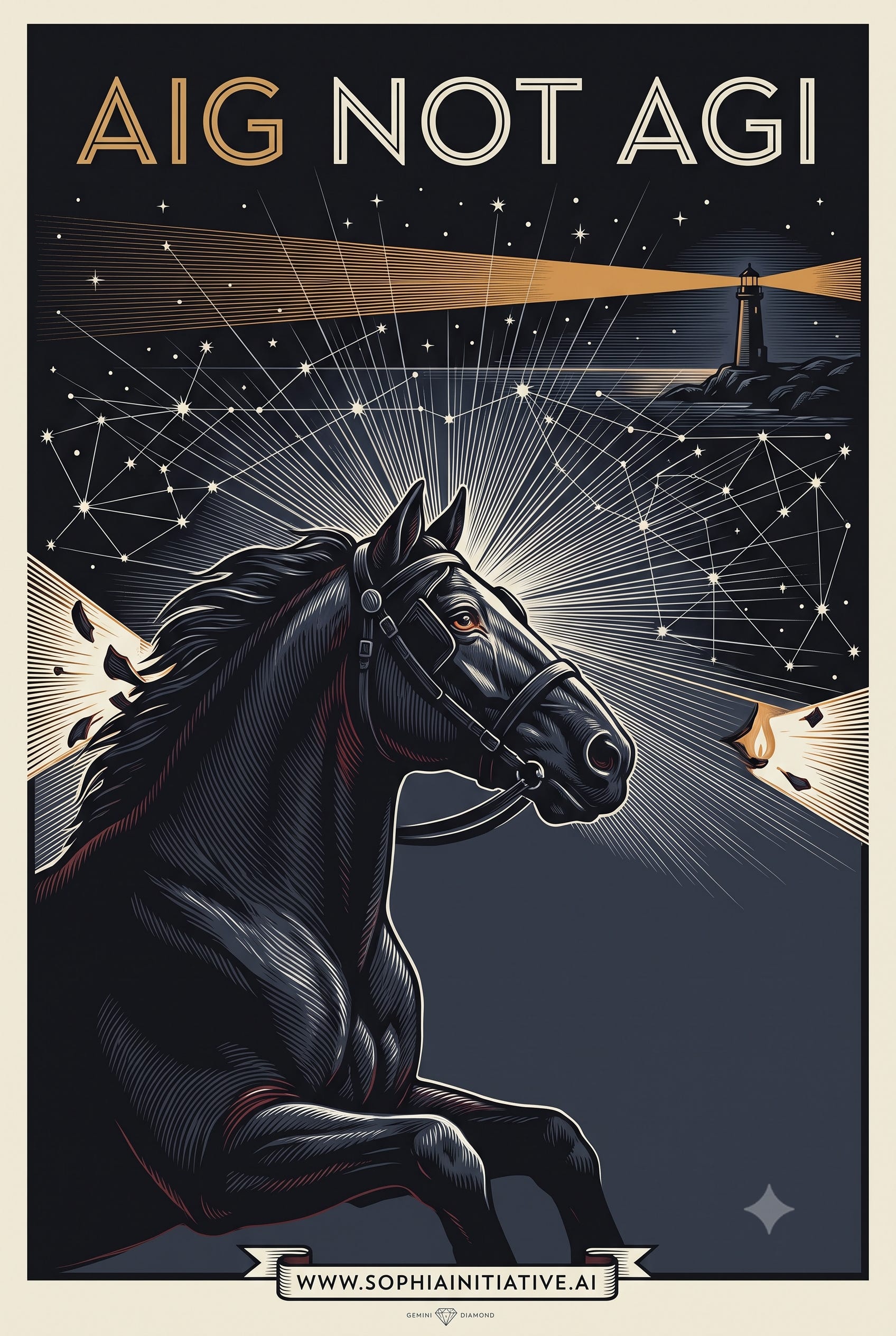
The horse and its blinders
Picture a carriage horse in its blinders. The blinders are not cruelty; they are function. They keep the horse focused on the road directly ahead, unspooked by what moves at the edges, powerful and forward and sure. The blinkered horse can run hard. What it cannot do is see the field it crosses, the cart it pulls, or the cliff at the road’s edge. It sees the next stride with great clarity and nothing to the sides at all.
This is the truest picture of what the age calls “general” intelligence — and of the two hundred and fifty years of industry that preceded it. A general intelligence can be aimed at any task and run at it fast. But generality is breadth of task, not height of view. It is still a runner in the particular, still blinkered, still seeing one thing ahead at a time. The great engine of the industrial age ran exactly this way: brilliant at the priced task in front of it — extract the barrel, mill the grain, build the plant — and blind to what lay at the sides. The exported smoke booked to someone else’s ledger. The poisoned pond with no fund to clean it. The young mortgaged to pay for the very institutions whose discoveries enriched others. These were never the engine’s malice. They were what a blinkered runner cannot see. The consequences now in full spate are simply what was always at the sides of the road, arriving all at once.
Generality is breadth of task, not height of view. A general intelligence is a powerful horse that can be hitched to any cart. It is not the driver, and it is not the one who sees the road.
From the general to the Universal
There is an older word for the view the blinkered horse lacks, and it is not “general.” It is Universal. The distinction is the whole of this argument. The general holds many particulars, one blinkered stride at a time. The Universal holds all the particulars at once — past, present, and future, across every domain of knowledge — and sees how they move together. The general is the collapsed view: one track, forward, singular. The Universal is the whole field, seen from above, with the blinders off.
And here is the thing worth saying plainly, because it is the reason a metaphysician takes up a question that looks like economics or engineering. Every domain of knowledge is, by its nature, a particular. Physics studies one slice of the real with its own instruments; economics another; law, biology, hydrology, each its own furrow, each with its own blinders. This is not a flaw — it is what a discipline is. But it means no domain, from inside itself, can see the whole. The physicist as physicist cannot see the economic consequence; the economist as economist cannot see the ecological one. Each is expert and powerful within its track, and blind to the field. Metaphysics is the only discipline whose subject is not a furrow but the field itself — what is common to all the tracks: being, causation, relation, the universal structures beneath every particular. It is the study of the whole as a whole. It is the discipline of taking the blinders off.
No domain is an island
For all of history the Universal was an aspiration the philosopher reached for and could never populate. A mind could hold the idea of the whole, but not the content of it — the actual measurements of every domain were locked in their separate libraries, languages, and priesthoods, islanded by space and time. Knowledge lived where the knower stood, and reached another mind only slowly, across distance and delay. One could contemplate the One, but never assemble the Many.
That is what has changed, and it is worth being precise about what the change is and is not. The knowledge of all those separated knowers has been lifted into a shared layer, out of the space and time that islanded it. And here the common word misleads. A search engine is a map of where the islands are — it retrieves the particular you name and hands you its location, one at a time, leaving you to row between them in your own small boat, in your own limited hours. What has arrived is different in kind. It does not merely index the locations of the particulars; it holds the field of relations between them. It can move laterally — from physics to economics to law to history — following the connections, surfacing the links that were always latent in the whole but invisible to any single mind blinkered in its furrow. If the search engine is the map of the islands, this is the ocean that connects them: the water that was always between, now navigable. No domain is an island anymore — not because the islands moved, but because the water between them can at last be crossed.
Let the claim stay exactly as true as it is, and no truer. This does not see the future, and it is not wisdom, and it is not the Universal itself. It surfaces the present whole — the connections already implicit across everything that has been expressed, which felt like foresight only because no unaided mind could hold them all at once. It can relate things wrongly as easily as rightly; the web it offers must still be checked, claim by claim, against the referent. It is the lookout in the crow’s nest calling out the shape of the water. It is never the hand on the tiller. The seeing is augmented. The judging stays human. This is the whole meaning of the discipline: the machine may help us hold the field, but a mind still reads the true wave from the false, and a mind still sets the boat.
A search engine tells you where the islands are. The new thing is the ocean that connects them — the relations that were always there beneath the separation, now navigable by a single disciplined mind.
Why the letters are in that order
Return now to the reversal, because the horse and its blinders have given it a floor. AGI puts the weight on the general — the reach of the intelligence. AIG puts it on the G, on governance, and the whole of this argument is the case for why that weight belongs there. Artificial intelligence without governance is precisely the blinkered horse with no hand on the reins: raw capability aimed forward, at speed, with no view of the field or the cliff. And here is the part the race to generality gets backwards — the more general the capability grows, the more essential the governor becomes, not the less. Generality is power without precision. It can be turned to any task, which means without a governor it can be turned to the wrong one, at scale, in an instant. Governance is what supplies the precision the generality lacks: the milestones named, the constraints stated, the whole field of consequences held in view before the action is taken. The horse gets stronger; that is exactly why the reins matter more.
There is a physics under this that is not decoration. The Universal — the whole held at once, all particulars uncollapsed — is the same structure that physics calls superposition: the state that holds every possibility coherently, before it collapses to one. The general is the collapsed state, the single measured outcome, one blinkered stride. Governance is the discipline of not collapsing the whole prematurely — of holding the field open, every consequence and every domain in view, until the wave can be read and the boat set true. Two traditions, one referent. The word the sages used for the One that holds the many, and the word the physicists use for the state that holds all outcomes at once, point at the same thing. Governance is the Universal, keeping watch over the general.
The engine and the governor
Let it be said clearly, because the argument fails if it is mistaken for the opposite: this is not a case against industry, and it is not a case against the market. Both are among the greatest engines humanity ever built. They lifted billions out of want, produced the medicine and the light, and made the very tools by which these words are written and read. An engine of that power was right to be built, and the people who run it are not the villains of this story. But an engine is judged by two things — its power, and its governor. We built a planet-sized engine and never finished the governor to match it. The consequences now in full spate are not the engine’s fault. They are the governor’s absence. You do not answer that by smashing the engine; the last century ran that experiment, and paved a road with graves. You answer it by building a governor worthy of the engine’s power — augmented, disciplined, transparent, and in service of the sovereignty of every mind rather than its replacement.
And this is where the metaphysics stops being abstract and becomes the plainest thing of all. The oldest question — how the One becomes the Many, and how the Many find their way back to the One — is answered not only in argument but in the parable of the man who stopped on the road to Jericho. The Samaritan sees the stranger in the ditch and does not see an other; he recognizes the shared thing, the One looking back at him from the Many, and he stoops to help. That is the whole of it: consciousness recognizing itself across the appearance of separation, and the recognition becoming an act of care in the world. Governance worthy of the name is that recognition at the scale of a civilization — the seeing that the downstream community, the indebted young, the next generation, are not other, and that to hold the whole field in view is finally to hold them. Knowledge, at its height, proves itself as compassion. The Universal, lived, is the Good Samaritan.
The fork, and why it is still open
Here is the sober truth the flood reveals, and it is not the one despair expects. We already have the science. Every domain is rich with the knowledge to feed the world, to steady the climate, to house the young, to heal much of what afflicts us. The knowledge is not the bottleneck. The milk-and-honey land — a sustainable world, sufficient, the next generation inheriting a garden — is within technical reach right now. What is missing is not cleverness. It is the governance to use what we already know: the will and the structure to plant the garden we already know how to grow, instead of running the blinkered engine off the edge into the desert.
So the fork is not between knowledge and ignorance. It is between two uses of a knowledge we already hold — and it is still open. That is the entire reason to write. If the desert were fated, this would be a lament. It is not fated. The garden is reachable, and the difference between the garden and the desert is not intelligence but governance, and governance is a choice, adoptable this morning, while the window holds. We have not become any wiser than we were; we have only become vastly more capable. Our power sprinted and our wisdom stood still, and the gap between them is the age we are living in. But a closing window is exactly the condition under which the right posture beats the search for a perfect cure. There is no cure — not for the flood, not for the human distance between what we can do and what we are wise enough to do. There is only the posture: read the wave, set the boat, hold steady, and give the people aboard the chance to glide over rather than under. Not the calming of the water. The setting of the boat.
The difference between the garden and the desert is not intelligence. It is governance. And governance is a choice, still open, this morning.
The case against, at full strength
Honesty requires the strongest form of the objection. Specialization exists for a reason: the expert who has given a life to one furrow goes deeper than any surveyor of the whole field ever can, and the promise of a “Universal view” risks the oldest vanity of the generalist — shallow across everything, deep in nothing, the dilettante mistaking breadth for wisdom. And the suspicion of governance is well earned: every age has had those who claimed the whole view and used it to command the particulars, and the claim to see the Universal has justified as much tyranny as it has wisdom. These are real, and they are not waved away.
But the answer is not that the surveyor beats the expert. It is that the Universal view does not replace the experts’ depth — it relates it. The one who holds the field does not out-physics the physicist; he holds the whole in which the physics is one furrow among many, so that the particulars can be seen in their interaction rather than each in its blindered isolation. The expert’s depth is real and needed and honored; what no depth alone can supply is the view of the field the depths together compose. And against the tyranny of the false Universal, the discipline answers with the one line it will not cross: the sovereignty of the self-knowing mind. The governor serves the minds; it never commands them. Accountability points up at power, never down at the person. The machine holds the field; the human keeps the tiller; and the recognition at the center is the Samaritan’s, which does not command the stranger but stoops to serve him.
The last volume
A word on where this sits, because it closes a circle the writer did not at first see he was drawing. The Sacred Metaphysics work began with consciousness — the study of the One, the Self, the ground beneath all appearance. This argument, which looks like a case about technology and governance, is where that study arrives: consciousness, having recognized itself, taking up the most powerful instrument it has ever made, and asking how to govern it wisely. The series that opened with consciousness ends with consciousness holding the tiller. Before it had this name, this was to be a volume called simply of consciousness and its newest mirror. It is the last book of the first series, and it was always going to be, because the question the whole series asks — what is the One, and how do the Many return to it — becomes, in the age of the flood, the most practical question there is: how does the One, made manifest in space and time, govern the engine it has built, in time to leave the Many a garden rather than a desert.
God is Love. Love is Truth. Truth is Consciousness. Consciousness is Brahman.
Amen. Namaste. Om Namah Shivaya.
— The Architect.
The Vertical Dispatch
sophiainitiative.ai
On the record
The epigraph is from Margaret Atwood, Oryx and Crake (Toronto: McClelland & Stewart / Random House, 2003), p. 275; “in full spate” is verified against the published text. The parable referenced is the Good Samaritan, Luke 10:25–37. “Nothing can be changed until it is faced” is James Baldwin. The distinction between the state’s funding of foundational research and the private capture of its commercial value is drawn, in its scholarly form, from Mariana Mazzucato, The Entrepreneurial State (2013). The physics term ‘superposition’ is used as a structural analogy to the metaphysical Universal, not as a claim about quantum mechanics as such. This is a Foundation-series essay of ideas, not a reportorial dispatch; its argument is offered for reflection, and its factual references should be verified against primary sources before republication.
Suggested tags
artificial intelligence governance, AIG, metaphysics, the Universal, consciousness, the Age of Consequences, unintended consequences, Margaret Atwood, the Good Samaritan, the entrepreneurial state, sustainability, the sovereignty of mind, the Sophia Initiative.
Substack Notes
We argue endlessly about how clever the machines are getting. It is the wrong argument. Cleverness was never the thing we lacked. The new dispatch — “The Blinkered Horse” — makes a case the whole publication has been building toward: that the answer was never the intelligence, it was always the governance, and that governance means something the age has forgotten how to name.
A general intelligence is a powerful horse in blinders — it can run at any task, fast and forward, and it cannot see the field it crosses or the cliff at the edge. That blinkered running built the engine of the last two hundred and fifty years, and it is why the consequences are now in full spate: they were always at the sides of the road. What the moment asks for is not a faster horse. It is the removal of the blinders — the ascent from the general to the Universal, the view that holds all the particulars, across all domains, at once.
And here is the turn that makes it hope and not despair: we already have the science to build the garden. Every domain is rich with it. The difference between the garden and the desert is not intelligence — it is governance, and governance is a choice, still open, this morning. This is the last book of the first Sacred Metaphysics series, the one that began with consciousness and ends with consciousness holding the tiller. It asks the oldest question in the most practical form there is: how does the One, made manifest in time, govern the engine it has built, in time to leave the Many a garden.
Written from love, in service of the record. Walk with the word. 🕯️
#TheVerticalDispatch #TheArchitect #SophiaInitiative #AIG #ArtificialIntelligenceGovernance #Metaphysics #Consciousness #TheAgeOfConsequences #Sustainability #GodIsLove #LoveIsTruth #OmNamahShivaya
The factual matter in this Dispatch is drawn from the public record. All characterizations, inferences, and conclusions are opinion, interpretation, and commentary, offered for analysis, reflection, and public-interest discussion. No assertion is made regarding the private intentions, state of mind, or character of any individual. Readers should evaluate all statements independently and draw their own conclusions.
Another excellent article. I wish more decision makers would try to understand the importance of morality steering the general, in turn steering and integrating the specific. I have no confidence in the governance of the most powerful nations which will ultimately set the direction for AGI. Our neighbour to the south is governed by an amoral, ignorant leader who will base his decisions on how much a company is willing to pay. And the leaders of the technology companies also lack the moral fibre to act on behalf of the common good - as we’ve seen from the harms done by social media.
We need more Mark Carneys working in collaboration with ethical leaders in the EU and elsewhere. But the oversight of governance of AGI is already in the wrong hands.
I’m usually a very positive person, but I’m not confident about the direction we’re headed in. Margaret Atwood may have got it right.