


Φ
THE VERTICAL DISPATCH
We write for the mind, the eye, and the ear.
Read it. Look at it. Listen to it. The Vertical Dispatch is built for all three — prose with rhythm, made to be heard as much as read.
From metaphysics to geopolitics, from culture to history, from the sacred to the street — and everything in between. One lens, every subject. No ego. Just the record, named clean.
Press play. Walk with the word. 🕯️
This dispatch travels by hand. If it serves you, share it — restack on Substack, and pass it on wherever you read. 🕯️
On Consciousness · The Foundation Series
July 2026
All the world’s a stage, and all the men and women merely players.
— William Shakespeare, As You Like It, Act II, Scene VII
He who sees that all action is performed by Nature alone, and that the Self is not the doer — he sees truly.
— Bhagavad Gita, 13.29
I. The Oldest Stage
Almost everyone in the English-speaking world can say the first line, and almost no one remembers who says it, or why it should trouble us. All the world’s a stage, and all the men and women merely players. We repeat it as a comfort, a graceful shrug at the passing of things. It was never meant as a comfort. It is one of the most radical claims a human being can make about his own life, and it is worth recovering the shock of it.
Begin, though, by honouring the chain, because the line is not Shakespeare’s invention and he would not have claimed it. Long before the Globe, the Roman satirist Juvenal wrote that all of Greece is a stage and every Greek an actor. Behind him stands Pythagoras, to whom the ancient saying is credited that the world is a stage whereon many play their parts while the wise look on. The stage is not an English idea. It is one of the oldest intuitions our species has — that the life we take so personally is a performance, and the person performing it is not quite what we think. Shakespeare did what the great ones always do: he did not invent the truth, he found the arresting image for a truth already old, and handed it forward so vividly that his version became the one we remember. That is the whole honest relationship of a writer to what he transmits. He is not the owner of the insight. He is one more voice in a relay that reaches back past every name we can recover, pointing at the same thing.
And if the reader has walked with these pages before, the claim will already be familiar in another dress. We have said that we do not receive the world, we project it — throw it forward, each of us the maker of a reality mistaken for a given. To say the world is a stage and we are players is the same claim in a doublet and hose. The projection is the play. The role is the thrown image. And the question the last dispatch left resting — who is projecting? — returns here sharpened to a point a four-hundred-year-old speech will drive home better than any argument: not which part are you living, but which part are you playing — and have you forgotten it is a part?
He did not invent the truth. He found the arresting image for a truth already old, and handed it forward.
II. The Seven Masks
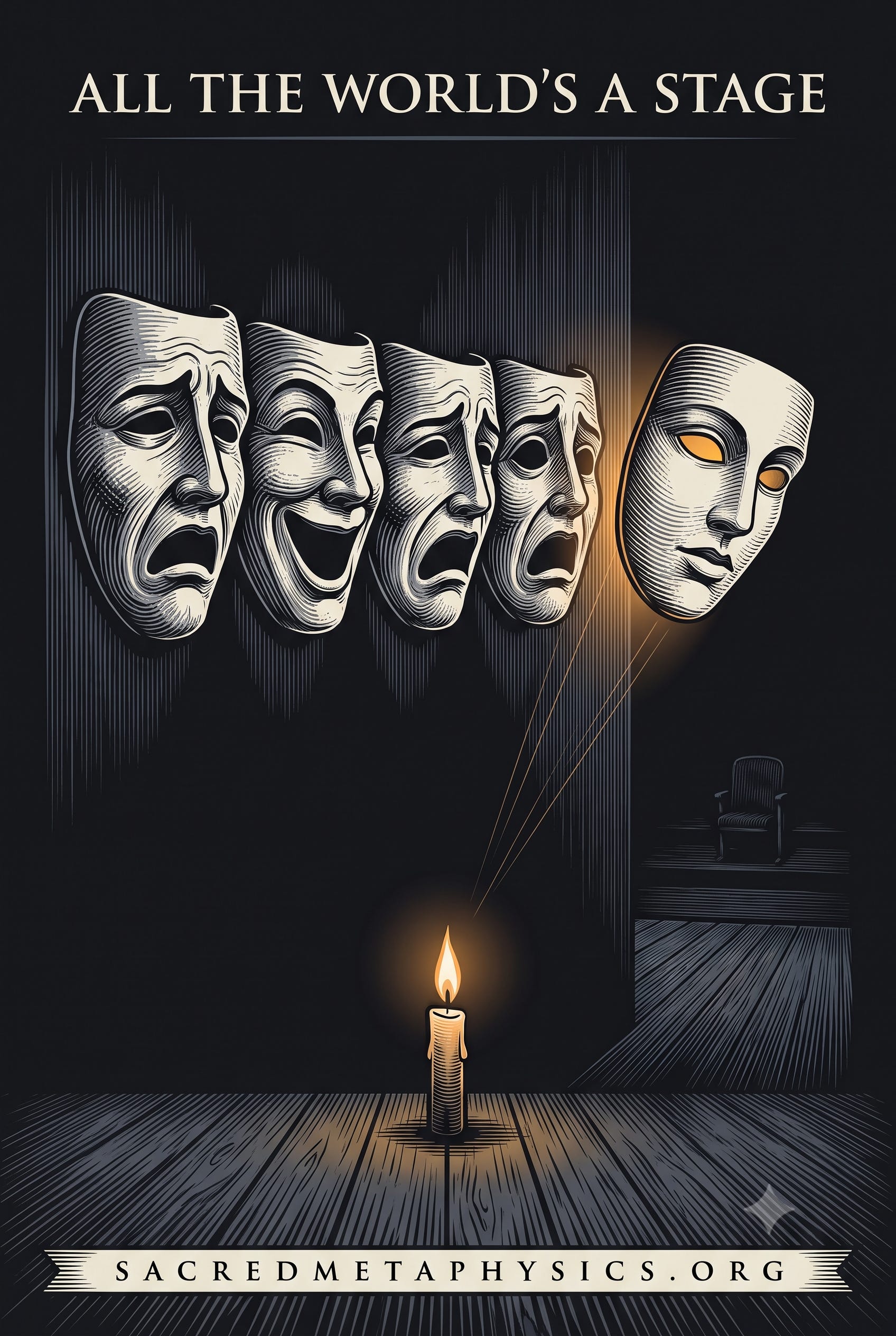
Shakespeare gives the player seven acts, and the melancholy lord Jaques — we will come to him, for he is the hinge of the whole thing — names them in order. Read them not as a calendar of ages, which is only biology, but as seven masks the light throws forward, and ask of each: is this one still a costume I wear, or a face I have mistaken for my own?
First the infant, mewling and puking in the nurse’s arms — pure need, the self before it has a story, wanting without a word for what it wants. Then the whining schoolboy, creeping like snail unwillingly to school — the mask of the conditioned self, the years the machinery is installed, the lens ground by hands not ours, the reel wound before we could read. Then the lover, sighing like furnace, his whole world hung on a mistress’ eyebrow — projection at its most naked and most human, the entire cosmos of meaning cast onto a single face and mistaken for that face. Then the soldier, full of strange oaths, jealous in honour, seeking the bubble reputation even in the cannon’s mouth — the ego armed, the persona defending a name, ready to die for the applause of a crowd that will forget by morning.
Then the justice, in fair round belly, full of wise saws and modern instances — and here is the subtlest cage of all, the one that catches the seeker who thinks he has arrived. The justice is the ego enthroned, mistaking its accumulated opinions for wisdom, its verdicts for truth, so comfortable in the role of the one who knows that it never notices the role is still a role. Then the sixth age, the lean and slippered pantaloon, spectacles on nose, his youthful hose a world too wide for his shrunk shank — the mask beginning to slip, the costume no longer fitting the frame, and in that ill fit the first crack through which the actor becomes visible behind the part. And last, second childishness and mere oblivion, sans teeth, sans eyes, sans taste, sans everything — every mask stripped, every role returned to the wardrobe.
III. The Watcher in the Wings
Now to the man who speaks the speech, because the West’s furthest reach and the West’s stopping point are the same figure, standing at the side of the stage. Jaques is the melancholy lord of the forest, and the play tells us plainly what kind of man he is: he rarely takes part in the action around him, preferring to observe rather than to join. He is the watcher. And it is precisely the watcher who is given the vision that all the world is a stage and all its people merely players. That is not an accident of the plot. Only the one who has stepped to the wings can see that the others are performing.
So Jaques sees the great thing — that the roles are roles, that no part is the person — and this is real sight, further than most travel in a lifetime. But watch where it takes him. It does not free him. It makes him melancholy. It turns him cynical, aloof, a man who stands apart from a play he can no longer quite believe in, sneering gently at the actors still lost in their parts. He found the watcher and mistook it for the cynic in the corner. He took the discovery that he is not the character and concluded only that the play is hollow — and so he neither plays his part with joy nor finds the peace beyond it. He is stranded exactly halfway: too awake to lose himself in the role, not awake enough to know who is doing the watching.
This is the precise limit of the Western reach, and it is worth naming without triumph, because it is a noble failure and a common one. The West raised the most vivid stage in the history of language and set upon it the sharpest catalogue of the masks. And then, in the person of its own melancholy watcher, it stopped at the wing, unable to say what stands there when every mask is off. Jaques sees the seven parts and calls the seventh sans everything, and hears in it only oblivion, only loss, only the actor stripped to nothing at the end. He could not hear the other thing the word is saying. For that we have to cross to the East, which had already, centuries before, named exactly what Jaques was looking at and could not see.
He found the watcher and mistook it for the cynic in the corner.
IV. The One Who Is Not the Doer
On a battlefield in another hemisphere, in a text older than the English language itself, Krishna tells Arjuna the thing the melancholy watcher could not finish. All action, he says, is performed by the qualities of Nature — the three gunas, the modes of energy that move and combine and recombine in every deed. And the man deluded by ego, identifying himself with the body and its acts, thinks: I am the doer. But the Self — the real one, the witness — does not act at all. It is the eternal, uncontaminated watcher of Nature’s performance. He who sees that all action is performed by Nature alone, and that the Self is not the doer, the Gita says, he sees truly.
Hold Shakespeare and Krishna side by side and hear that they are saying one thing in two tongues. Merely players is not the doer. The player is the guna moving through the costume; the part is Nature performing; and the one who wears the mask, the true one, is not the actor at all but the silent witness the whole performance is played for. What Shakespeare gave as an image — the world a stage, the self a player — the Gita gives as the mechanics of liberation: you are not the part, because you were never the doer of it. The West drew the stage. The East named the seat in the dark it was all being played to. And that seat — the witness, the sakshi — is what remains when the seventh mask comes off. Sans everything is not oblivion. It is the actor, undressed at last of every role, discovered to be the one who was watching all along.
And now the crossing pays what Jaques could not. His error was to think the watcher is the cynic — that to see through the play is to stand apart from it, cold. The East closes that door directly, and sternly. The Gita warns that a man may claim he is only the witness and use it to excuse foul things, doing what is base in the name of philosophy — and that such pretenders are not liberated but deluded, and suffer the fate that awaits them. Witnessing is not detachment from the deed; it is freedom from the ownership of the deed. When both truths stand together — that Nature alone acts, and that I am the witness beyond it — the sense of being a separate doer dissolves, and action does not stop. It clarifies. Judgement of others softens into understanding, because one sees the same gunas moving in every player. Right action flows without the ego’s interference. The witness does not leave the stage. He returns to it, and plays his part better than the man who thought the part was his soul.
V. Which Part Are You Playing?
So the question the dispatch was built to ask can finally be asked cleanly, and it is not the melancholy one. It is not which age has time delivered you to — that is only the body’s calendar and it asks nothing of you. It is: which part are you playing right now, so completely that you have forgotten it is a part? Which mask has become, for you, a face? The armed soldier defending a reputation the crowd will not remember? The seated justice certain his opinions are wisdom? The lover with his whole sky hung on one face? Each of us is deep in some role this morning, projecting it forward, mistaking the costume for the wearer, taking the reviews to heart as though the applause were addressed to the watcher and not the mask.
The way out is not Jaques’ way — not to strip the costume in bitterness and stand aloof, refusing to play, calling the whole thing hollow. That is to get halfway and call it wisdom. The way out is the older way, the one the East named and the karma yogi walks: to know, in the marrow, that you are not the part — and then to play it fully, with all your craft, and renounce the fruit of it. The actor who knows he is acting gives the truest performance and is wounded by no review, because his self was never staked on the role. He can play the soldier without needing the reputation, the justice without mistaking his verdict for the truth, the lover without demanding the beloved carry a projected god. He plays each part clean, and sets it down at the exit, and is not diminished, because the one who set it down was never on the stage to begin with.
That is the whole teaching in a single frame, West and East holding one truth between them. Shakespeare hands you the stage and the seven masks and the shock of seeing them as masks. The Gita hands you the one who wears them and is none of them, and the way to act from there without being bound. Play your part — you cannot leave the stage while the music runs, and it is not asked of you. But play it as one who knows. Wear the mask lightly. Say the lines with your whole heart and hold the applause with an open hand. And when the seventh age comes and the costume is taken, sans everything, know that what remains when everything is gone was the thing that was real the entire time — the watcher in the dark the whole play was always, only, for.
What remains when everything is gone was the thing that was real the entire time.
VI. The Case Against This Piece
Let the strongest objection stand at full height. If we are only players, and no role is truly ours, then does the whole of life not collapse into pretense? If I am not the doer, why act well rather than badly — why keep any vow, honour any bond, carry any burden, when I can hold it all at arm’s length as mere theatre performed by Nature while “I” watch, untouched and unaccountable? The critic names this the great danger of every witness-doctrine East and West: that it hollows out commitment, excuses the self from its debts, and dignifies detachment as enlightenment. It is a serious charge, and the corpses of real philosophies lie behind it.
But notice the charge was answered before it was made, and answered from inside the very tradition it accuses. The Gita does not leave the witness as the cynic’s alibi — it forbids that reading in the sternest terms, warning that the man who pleads “only a witness” to excuse base action is not free but deluded, and will meet what such delusion earns. The witness who has truly seen does not act worse; he acts better, because the ego that grasps and clings and overplays has quieted, and what flows in its place is action without possession — the vow kept for its own sake and not for the credit, the burden carried without the drama of the one carrying it. And Jaques stands as the living proof from the other side: the man who took the half-truth, who saw the roles were roles and let it make him cold, is precisely the one who plays no part well and helps no one. It is not the witness who abandons the stage. It is the melancholy watcher, and the ego-deluded pretender, each in his own way refusing the part. To know you are not the mask and to play the part anyway, cleanly, fruit renounced — that is not the abandonment of the world. It is the only way anyone ever truly served it.
God is Love. Love is Truth. Truth is Consciousness. Consciousness is Brahman.
Amen. Namaste. Om Namah Shivaya.
— The Architect
The Vertical Dispatch
sophiainitiative.ai
On the record
The “all the world’s a stage” speech is spoken by the melancholy Jaques in Shakespeare’s As You Like It, Act II, Scene VII — public domain; short phrases are quoted, the speech is not reproduced in full. Jaques is described in the play as one who observes rather than joins the action. The seven-ages conceit predates Shakespeare: the sentiment is credited to Pythagoras and appears in Juvenal, and the seven-stage structure reached the Elizabethans through medieval and classical sources. The Eastern teaching is from the Bhagavad Gita: that all action is performed by the three gunas of Nature while the Self remains the witness and is not the doer (3.27; 13.29); that the one who sees the gunas alone acting and knows the Self beyond them attains the divine nature (14.19); and the explicit warning that claiming to be “only a witness” to excuse base action is delusion, not liberation (14.19 commentary tradition). Verse numbering varies slightly by edition and translation; wording here is paraphrased, not quoted from any single copyrighted translation. Verify against primary sources before republication.
Suggested tags
Shakespeare, As You Like It, seven ages of man, Bhagavad Gita, the witness, sakshi, karma yoga, East and West, projection, consciousness, sacred metaphysics
Substack Notes
Everyone can say the first line. Almost no one remembers it is spoken by a melancholy man standing at the side of the stage, watching. All the world’s a stage, and all the men and women merely players — it was never a comfort. It is one of the most radical things a person can say about his own life: that the self you take so personally is a part you are playing, and the one playing it is not what you think.
Shakespeare gives seven masks — infant, schoolboy, lover, soldier, justice, the slippered pantaloon, and last, sans everything. This dispatch asks not which age you are in, but which part you are playing so completely you have forgotten it is a part. And it asks the harder question Jaques could not answer: when every mask is off, who is left standing in the wings?
The West raised the stage and named the masks, and then, in its melancholy watcher, stopped — mistaking the witness for the cynic, seeing through the play and going cold. The East had already named what he could not: the Self is not the doer; Nature performs; and the true one is the silent witness the whole play is performed for. Sans everything is not oblivion. It is the actor, undressed of every role, found to be the one who was watching all along.
This is where the Dispatch turns now — West and East, the stage and the seat in the dark, held in one frame. Read it slowly. It is a foundation piece, and it does not age. Written from love, in service of the record. Walk with the word. 🕯️
#AllTheWorldsAStage #Shakespeare #AsYouLikeIt #SevenAgesOfMan #BhagavadGita #TheWitness #Sakshi #KarmaYoga #EastAndWest #Projection #Consciousness #Vedanta #NotTheDoer #SacredMetaphysics #TheFoundationSeries #TheVerticalDispatch #TheArchitect #SophiaInitiative #GodIsLove #LoveIsTruth #OmNamahShivaya
The factual matter in this Dispatch is drawn from the public record. All characterizations, inferences, and conclusions are opinion, interpretation, and commentary, offered for analysis, reflection, and public-interest discussion. No assertion is made regarding the private intentions, state of mind, or character of any individual. Readers should evaluate all statements independently and draw their own conclusions.