


The Vertical Dispatch · The Requisite Cabinet · Entry One
THE REQUISITE CABINET — A NOTE ON THE SERIES
Elliott Jaques spent fifty years arriving at one finding that should govern how a country reads its own government and almost never does. The capacity of an organisation to govern a function well is determined by whether the cognitive complexity of the person in the chair matches the cognitive complexity of the chair itself. Put someone below the stratum a role demands and you do not get a slightly weaker version of good performance. You get a different and usually destructive kind of failure — the appearance of governance without its substance.
A national cabinet is the highest-stratum organisation in the country. Mark Carney is, on the documented record, a Stratum VII mind — a central banker whose entire career was the construction of institutional frameworks across decade horizons. Jaques would predict one of two outcomes for such a leader. He either builds a requisite bench — ministers whose stratum matches the chairs he places them in — or he is slowly strangled by a sub-requisite one, forced to do at the centre the work his ministers cannot do in their portfolios.
This series audits the bench. One minister, one dispatch, one chair at a time. The question is always the same Socratic question. Mr. Carney, define the competence of the person you chose. Show your work.
The standing editorial standard applies without exception. Every figure is assessed against the Jaques Requisite Organization framework and the PIAAC literacy scale, from the documented public record only, without malice and without flattery. The opposition profiles — Ford, Poilievre, Smith — form the contrast set. This series is the other half of the ledger. It begins with Anita Anand because she is the strongest case the bench has to offer, and a series that audits a government should begin by establishing that the bar can, in fact, be cleared.
I. THE INVESTOR’S ADVOCATE
Before she was ever a name on a ballot, Anita Anand spent more than two decades as one of the country’s foremost legal scholars of a single question. It sounds technical. It is not. The question is: who gets protected when markets fail, and who writes the rules in the first place?
She held the J.R. Kimber Chair in Investor Protection and Corporate Governance at the University of Toronto — the first research chair for investor rights in all of North America. The chair is named for the author of the 1965 report that built Canada’s modern securities regulatory regime. To hold it was not to be merely a professor of the field. It was to be the person the country trusted to define it.
Her published work tracks one preoccupation across every title. Shareholder-Driven Corporate Governance, an Oxford University Press volume on the mechanisms by which shareholders hold boards accountable. Systemic Risk, Institutional Design, and the Regulation of Financial Markets, which she edited — a study of how regulatory architecture either contains a crisis or amplifies it. A 2011 examination, written after the Air India Flight 182 bombing, of whether Canada’s anti-terrorist-financing law actually works. A forthcoming comparative study of how Canada and the United Kingdom pursue — or fail to pursue — financial criminals. The recurring noun in all of it is the same. Protection. The recurring verb is enforcement. The recurring subject is the ordinary person on the wrong side of a system that was supposed to hold.
She did not only publish. Governments repeatedly called her in to design the actual architecture: the Task Force to Modernize Securities Legislation, the Wise Person’s Committee, the Commission of Inquiry into the Air India bombing. She was the inaugural Chair of the Ontario Securities Commission’s Investor Advisory Panel. In 2019 the Royal Society of Canada awarded her the Yvan Allaire Medal for outstanding contributions to governance — a lifetime-achievement recognition for a scholar who had, by then, fundamentally shaped how Canada thinks about corporate accountability.
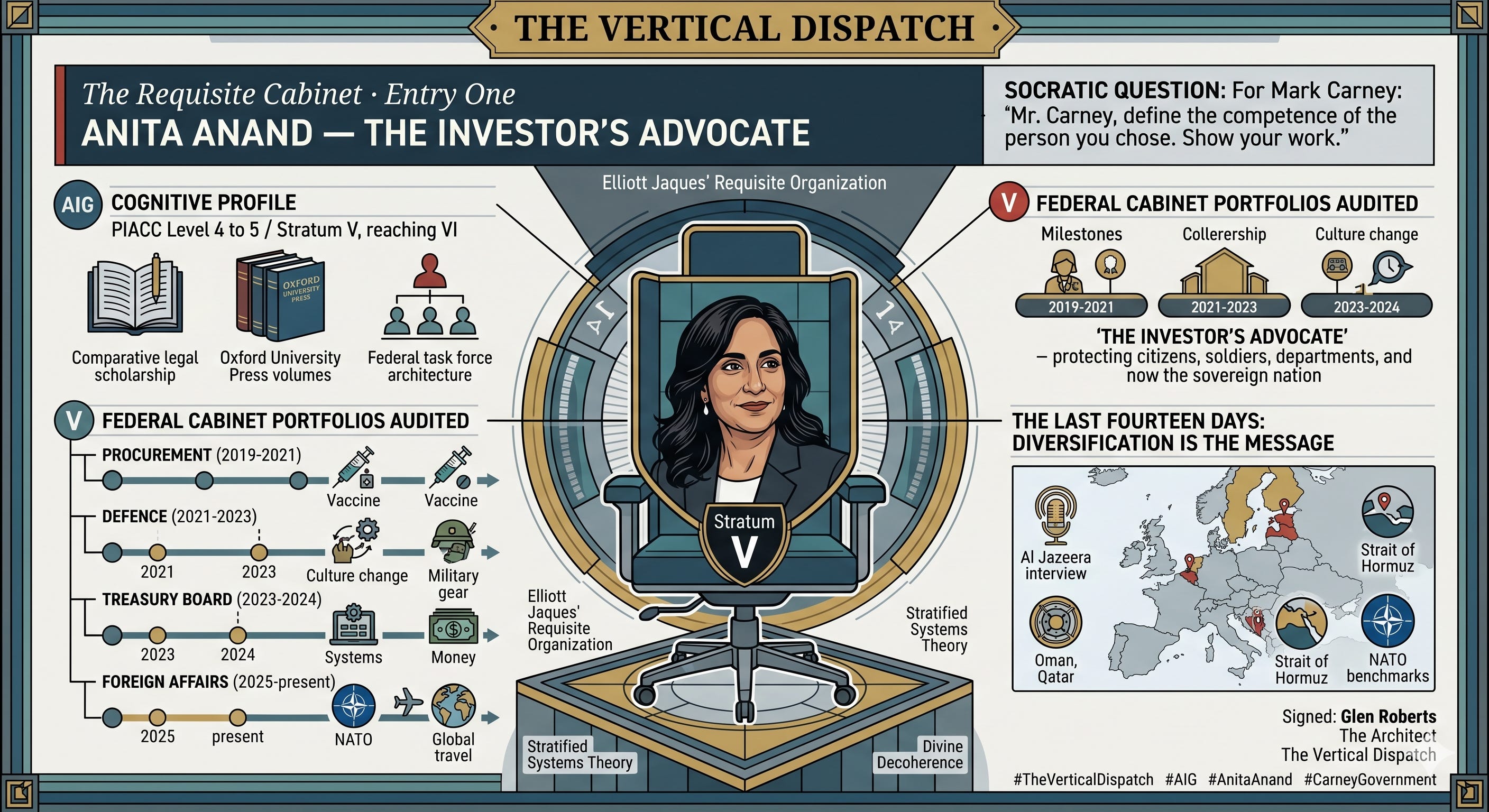
This is where the cognitive profile is earned rather than asserted. Two decades of peer-reviewed comparative legal scholarship, Oxford University Press volumes on systemic risk, federal task-force architecture written and adopted. That is sustained Level 4 and 5 work in the documented record — not a ceiling inferred from its absence, the way it had to be inferred for the man at the bar.
Hold that thread. It does not end in the library. It runs through every cabinet chair she has occupied since, and the only thing that changes is the identity of the investor who needs protecting.
II. THE DEPARTURE THAT WASN’T
The most revealing biographical fact about Anand is not a portfolio. It is a reversal, and the chronology is exact.
On January 11, 2025 — five days after Justin Trudeau announced his intention to resign — Anand posted that she would not enter the Liberal leadership race, would not seek re-election in Oakville, and intended to return to teaching, research, and public policy after the next election. She was, in plain terms, walking out the door. Trudeau’s exit was the exit cue for much of his inner circle, and several senior ministers made the same choice in the same window.
Then the ground moved. Through February and March, the Trump administration began openly threatening tariffs on Canadian goods and musing about annexation. Anand, then Minister of Transport and Internal Trade, was heavily engaged on the Canada-US file. On March 1, 2025, she reversed. Canada, she wrote, was facing an existential crisis; the times were too critical for her to step away; she would run again.
A career decision had become, in her telling, a national obligation. That is itself a stratum signal. The lower-stratum response to a personal exit plan is to execute the exit plan. The higher-stratum response is to re-read the board, recognise that the board has changed, and subordinate the personal timeline to the structural moment.
On March 9, Mark Carney won the leadership. He had not needed Anand as a rival — she had removed herself from that contest. What he did immediately was move to keep her. He named her Minister of Innovation, Science and Industry. Then, in the cabinet reshuffle of May 13, 2025, he elevated her to Minister of Foreign Affairs, succeeding Mélanie Joly.
A word of discipline here, because this series will not pre-judge a chair it has not yet audited. The reshuffle is a documented fact. It is not, on its own, evidence of anything about Joly’s competence. Foreign Affairs portfolios move for many reasons — strategic fit, the optics of a reset, the simple arithmetic of a thirteen-seat table. Mélanie Joly’s record will receive its own full audit in Entry Two of this series, assessed on its own terms. It is not written here. The only claim Entry One makes is about Anand: that a Prime Minister who is himself a creature of institutions looked at a minister who had been leaving, and decided he could not afford to let her go.
III. THE RECORD, AUDITED
Five portfolios. Run each through the AIG lens and the same structural pattern appears: she does not merely occupy high-stratum chairs. She builds capability inside them.
Procurement, 2019–2021. Her first cabinet post landed months into her first term as an MP and could not have landed at a worse moment. As Minister of Public Services and Procurement she was handed the pandemic file — a portfolio that had never before been the centre of national attention. She negotiated the contracts that delivered hundreds of millions of vaccine doses under conditions of supply-chain collapse and open international competition. By August 2021 Canada had among the highest vaccination rates in the world. The investor being protected was every Canadian waiting in a queue.
Defence, 2021–2023. She inherited a military in institutional freefall after a sexual-misconduct crisis her predecessor had been criticised for failing to address. She was the second woman, and first woman of colour, to hold the post. She committed to transferring misconduct cases to civilian authority, delivered a formal government apology to survivors, and launched a culture-change process still underway. It was a repair job on an institution that had lost the trust of the people it was sworn to protect. The investor being protected was the soldier reporting an assault.
Ukraine, 2022–2023. When Russia invaded in February 2022, Anand was the minister overseeing the military response — aid, training missions, defence posture, coordinated in real time. The structural point is the continuity: the procurement discipline of the vaccine file reappears as the logistics discipline of an arms-supply file.
Treasury Board, 2023–2024. She was moved to a role less visible than Defence and arguably more powerful in its reach — roughly $450 billion in annual federal expenditure and a workforce near 300,000. This is the unglamorous machinery of making the state function. It is also, in Jaques’ terms, a genuine systems chair: not the management of one institution but the oversight of the financial nervous system of all of them.
Foreign Affairs, 2025–present. And now the chair that defines Canada’s posture at the most precarious moment in Canada-US relations in generations. The investor being protected is no longer a citizen, a soldier, or a department. It is the sovereign nation itself — a country that can no longer assume its southern neighbour will speak for it, and must therefore learn to speak for itself.
IV. THE LAST FOURTEEN DAYS
A dispatch that audits a sitting minister should look at the minister sitting. Take the fortnight to May 17, 2026, exactly as the public record reports it. It is not a quiet one.
On May 11, in Brussels, Anand met NATO Secretary General Mark Rutte and confirmed that Canada had reached the Alliance’s two-percent-of-GDP defence-spending benchmark and was on a path toward the five-percent Hague pledge. The same day she co-chaired the High-Level Meeting of the International Coalition for the Return of Ukrainian Children, and announced sanctions on a further twenty-three individuals and five entities involved in the unlawful deportation, indoctrination, and militarisation of Ukrainian children.
From May 12 to 15 she travelled to Oman and Qatar. The Muscat stop was the first official visit by a Canadian foreign minister to Oman in over a decade. The stated agenda was trade, defence cooperation, and — pointedly — the safe passage of commercial shipping through the Strait of Hormuz amid its continued closure. On May 17 she gave a twenty-eight-minute interview to Al Jazeera. And on that same May 17 her office announced the next leg: Latvia, Estonia, and Sweden, May 19 to 22 — Camp Labrie and Operation REASSURANCE in Riga, the Canada-Baltics “3+1” meeting in Tallinn, the inauguration of a new Canadian embassy in Estonia, and the NATO Foreign Ministers’ Meeting in Sweden.
Read the fortnight as a single object. Ukraine, the Gulf, the Arctic, the Baltic, NATO burden-sharing, an embassy opening, a global broadcast interview — and the connective tissue running through all of it is one word. Diversification. Every stop is a hedge against the assumption that the United States can be relied upon to underwrite Canadian security and Canadian trade.
The Al Jazeera interview is the part of the fortnight worth pausing on, because the choice of venue is itself the message. The interview was built around a single question — is the United States still a reliable ally? — and it ranged across Trump, NATO, the Arctic, Gaza, Iran, China, India, and the trade diversification file. That a Canadian foreign minister sat down for it with Al Jazeera, rather than confining herself to the traditional Western channels, is a deliberate act. It says Canada intends to explain itself directly to a global audience, on platforms its southern neighbour does not control, at a moment when it can no longer assume that neighbour will explain Canada favourably, or at all.
This is the checkers, chess, and Go typology in operation. The checkers player explains the country to the room directly in front of him. The chess player anticipates that the room in front of him may soon be hostile and secures a second room. The Go player understands that influence is territory — that an interview on Al Jazeera, an embassy in Tallinn, a first visit to Muscat in a decade, and a NATO benchmark met are not separate events but stones placed on a single board, each one widening the space in which Canada can still act when the largest piece on the board has turned unpredictable. The fortnight is a Go player’s fortnight.
V. THE COGNITIVE PROFILE
The standing editorial standard now applies, in the same format used for every major figure this publication examines — from the documented public record only, without malice and without flattery.
Anita Anand. B.A. Political Studies, Queen’s. B.A. Jurisprudence, Oxford. LL.B., Dalhousie. LL.M., Toronto. Over two decades as Professor of Law at the University of Toronto, holder of the J.R. Kimber Chair, the first investor-protection research chair in North America. Yvan Allaire Medal, Royal Society of Canada, 2019. Five federal cabinet portfolios across two ministries. PIAAC Level 4 to 5 — and here, unusually, the assessment carries no hedge. The published scholarship is the proof of the ceiling and the proof that the ceiling is habitually occupied. This is a mind that has demonstrably sustained the elenctic chain across decades, in writing, under peer review. Stratum V, reaching toward VI. The Treasury Board and Defence files are unambiguous Stratum V systems work — the oversight of institutions, not merely management within them. The Foreign Affairs portfolio is the first chair she has held that structurally demands Stratum VI to VII work: the multi-decade reconstruction of a country’s entire strategic position. It is too new to score. The honest finding is a minister operating at the top of V, with the reach toward VI visible in the record, placed in a chair that will require VI or VII to be filled completely. The next two years will reveal whether the reach becomes the grasp.
Two things follow from that finding, and both matter more than a flattering number would have.
The first is that this is not hagiography, and a Level 4 reader will notice that it is not. Stratum VII is held for Carney. It is not handed to his strongest minister as a courtesy. The distinction between operating a complex system superbly — which Anand demonstrably does — and architecting a civilisational framework across decades is a real distinction, and a series that collapsed it would forfeit the standard it opened with. Anand is the strongest case on the bench. The strongest case on the bench is a minister at the top of Stratum V with a genuine reach toward VI. That is a high finding. It is also an honest one.
The second is the elenchus, because an AIG audit that produces only praise has not been an audit. The Socratic question for Anand is not about her competence. It is about the definition underneath her central project. She speaks, correctly and constantly, of diversification — of trade beyond the United States, of partnerships beyond the traditional Western channels. AIG asks the prior question. Define the destination. Diversification toward what, precisely, on what timeline, at what measurable cost, and by what date will Canadians be able to audit whether it worked? A first visit to Oman in a decade is a stone on the board. It is not yet a market. An embassy in Estonia is a building. It is not yet a supply chain. The diplomatic fortnight is real motion. Whether it is motion toward a defined and costed strategic end — or motion that is its own justification — is the question the record cannot yet answer, and the question this publication will keep asking.
One further item belongs under the legal standard this publication holds. The India file is described, in the government’s own framing, as a reset — the repair of ties nearly ruptured under the Trudeau government. That rupture has a documented cause: Canadian allegations of Indian state involvement in the killing of a Canadian citizen on Canadian soil. Those are allegations advanced within a legal and investigative process; they are not, in this dispatch, treated as settled findings, and the framing sometimes offered — law and order at home set against Khalistani fringe groups — is a political characterisation, not an established fact. A reset built on an unresolved allegation of that gravity is a diplomatic instrument balanced on a legal question that has not closed. Anand has been handed both halves of that contradiction to carry at once. The audit notes it. It does not pretend the contradiction has been dissolved.
THE VERDICT OF ENTRY ONE
Carney kept the minister who was walking out the door. The series began here because that decision is one of the more revealing facts about the present Canadian government, and because Anand is the proof the bench needs to offer at the outset: that the bar Jaques described can be cleared, that a Prime Minister operating at Stratum VII can in fact find people whose minds were built, over decades, in the rooms where the rules get written.
She is the investor’s advocate. The only thing that has changed across twenty-five years is the size of the investor. It began as a shareholder. It became a citizen in a vaccine queue, a soldier filing a report, a department inside a $450 billion ledger. It is now a sovereign country, standing at the most exposed moment in its modern history, with a neighbour that has stopped speaking for it.
Entry One finds that the chair is well filled, that the reach toward the stratum the chair ultimately demands is visible and credible, and that the open question is not the minister’s capacity but the definition of the destination she is steering toward. That is a strong opening to the audit. It is not the end of it. The bench has twelve more chairs.
Entry Two follows: Mélanie Joly — the minister who held the Foreign Affairs chair before Anand, audited on her own record and her own terms.
God is Love. Love is Truth. Truth is Consciousness. Consciousness is Brahman.
Amen. Namaste.
DISPATCH HASHTAGS
#TheVerticalDispatch · #TheArchitect · #TheRequisiteCabinet · #AnitaAnand · #AIG · #ArtificiallyIntelligentGovernance · #CarneyGovernment · #CanadianForeignPolicy · #ElliottJaques · #RequisiteOrganization · #StratifiedSystemsTheory · #PIAAC · #StructuralLiteracy · #CanadianSovereignty · #TradeDiversification · #NATO · #CanadaUkraine · #StraitOfHormuz · #CanadaIndia · #ArcticSecurity · #TheElenchus · #CheckersChessGo · #Substack · #CanadianPolitics · #CivicLiteracy · #LongformWriting · #PolicyAnalysis
I am amazed at the depths of the research you must do to rewrite these articles. Thank you for the work!
I wondered why I admired her work so much
Thank you for filling her out for those of us who mostly observe.