

Φ
THE VERTICAL DISPATCH
We write for the mind, the eye, and the ear.
Read it. Look at it. Listen to it. The Vertical Dispatch is built for all three — prose with rhythm, made to be heard as much as read.
From metaphysics to geopolitics, from culture to history, from the sacred to the street — and everything in between. One lens, every subject. No ego. Just the record, named clean.
Press play. Walk with the word. 🕯️
This dispatch travels by hand. If it serves you, share it — restack on Substack, and pass it on wherever you read. 🕯️
The Foundation Series · Sacred Metaphysics
A whole-book reading of Sacred Metaphysics: Astrotheology
Sacred Metaphysics · The Universal Grammar of Non-Duality
The Metaphysics of Zero and the Physics of One
Coming soon
sacredmetaphysics.org
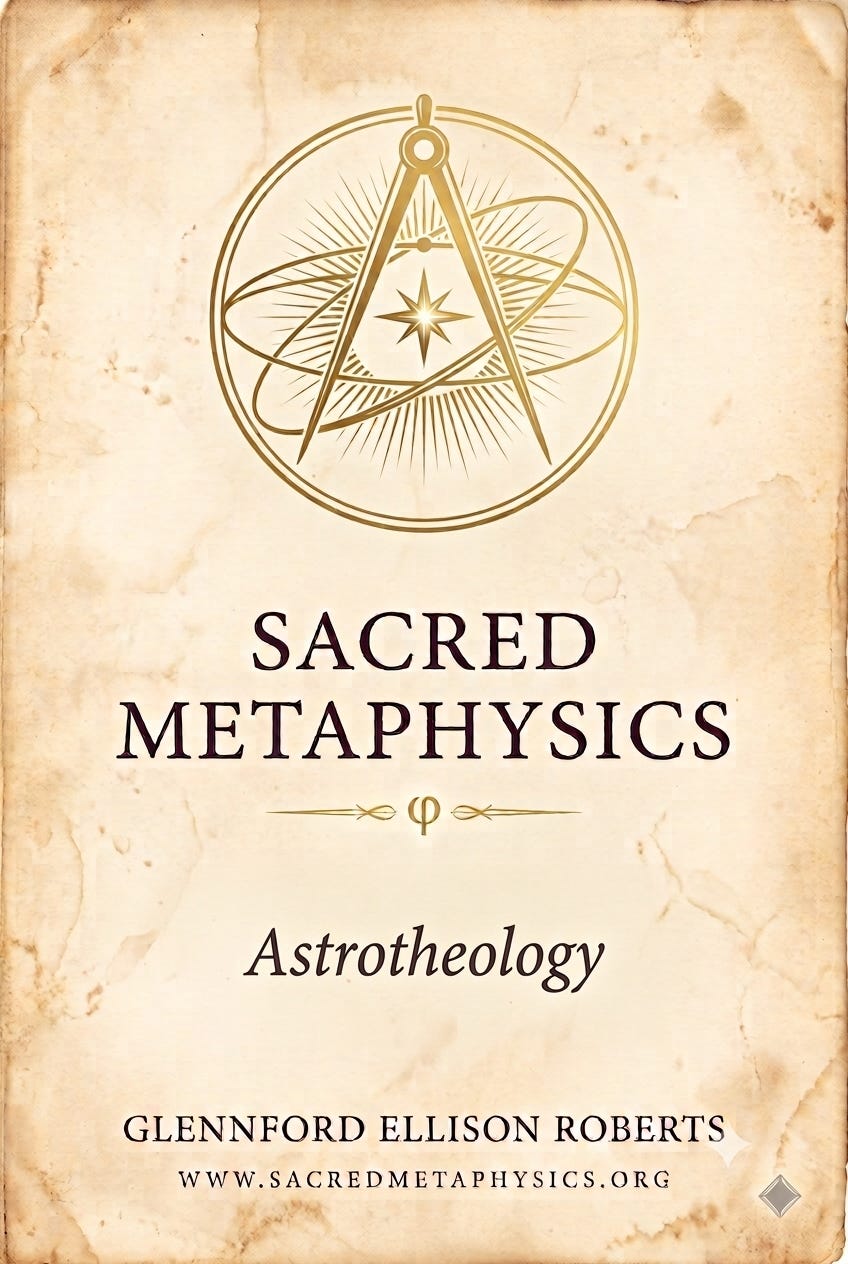
Sacred Metaphysics: Astrotheology — Written in the Stars — will be available September 1 at sacredmetaphysics.org in all 3 formats, ePub, KDP, and PDF, and on Amazon in KDP format only. The PDF can be read aloud in Microsoft Edge, so the book can be heard as well as read — the whole Dispatch discipline made portable: read it, look at it, listen to it.
Canst thou bring forth Mazzaroth in his season? or canst thou guide Arcturus with his sons?
— The Book of Job, out of the whirlwind
The Clock Before the Clock
There is a clock that was running before you were born, and it is not the one on the wall.
We live in an age drowning in fragmented data, specialized jargon, and the frantic speed of sequential time — and in that flood we have largely forgotten how to read the sky. We look up at the dark vault of the night and see random points of gas, or worse, we project our own psychological anxieties onto the stars in the form of pop-astrology. The macrocosm has been reduced to a mirror for the ego.
Against this descent into subjective triviality stands Sacred Metaphysics: Astrotheology — a synthesis of traditional metaphysics, non-dual philosophy, and structural analysis. The book does not offer a new opinion. It performs a recovery. It retrieves the ancient grammar of seeing, the universal language through which the cosmos was read by Plato, by Jung, by Wolfgang Smith, and by the anonymous tradition of metaphysical architecture that runs from the Vedic seers to the biblical writers of Job and Revelation.
To step into the text is to embark on a long journey of the soul: a methodical, rigorous ascent from the many to the One, and a subsequent descent through the twelve ages of the Great Year. At its core lies a single ontological equation — the metaphysics of Zero and the physics of the One.
The Metaphysics of Zero — The Observer as the Uncaused Cause
Every metaphysical system must answer the question of the witness. If a tree falls in the forest and no one is there to hear it, does it make a sound? And if the stars wheel through the dark and no eye is lifted to them, is there a sky?
Modern materialism assumes an objective universe ticking along entirely independent of consciousness, and treats the observer as a biological accident. Sacred metaphysics turns that Cartesian error on its head.
Consider the sequence of cosmic numbers the book traces. The ancients did not invent their sacred numbers arbitrarily; they looked up and received them from the sky. One was the Sun. Two were the Sun and the Moon, the primal pair of day and night, giver and receiver. Three was the living rhythm of the triad — rising, standing, setting. Four was the cross of the world, the four corners of the year and the four elements. Five was the centre that united them. Seven were the wandering planets climbing the fixed vault.
Yet when we search the heavens for Six, we find an absolute absence. There is no Six blazing in the sky. The sky does not give it. And the book’s answer to why is the keel of the whole edifice: Six is the number of the observer.
The Six is not out there among the lights. It is here, in the one to whom the lights appear. In geometry Six forms the solid cube — the final, settled structure of the made world — but that completion is a boundary. It separates the made from the unmade, the room from what lies beyond the room. Six is the standpoint, the self-enclosed frame of the material world. It is the number the external universe cannot provide, because it is the intrinsic signature of consciousness itself.
Before anything can be counted — before the One can manifest as duality, before the rhythms of Three through Twelve can play out — there must be the silent, unconditioned container of awareness. This is the metaphysics of Zero: the unmanifest void from which all numbers spring, which cannot be made into an object because it is the subject of every possible experience.
Six is not out there among the lights. It is here, in the one to whom the lights appear.
The Physics of One — The Light That Has No Part
From the void of Zero emerges the physics of the One. Modern physics treats light as a quantifiable wave-particle duality, measurable by instruments. Sacred metaphysics reads Light as the primal ontological substance — the unconditioned energy of the Source that precedes all atomic division.
The book guides the reader up from the multiplicity of the elements to the quintessence, the fifth essence that holds the four quarters together. But the One is not merely the first number in a sequence. It is the integer that contains all subsequent numbers without ever losing its integrity.
When the ancient watchers gazed at the night sky they saw a division. There were the fixed stars — the steady points that keep their patterns night after night, wheeling together about the pole without ever changing their relative places, standing for eternity, the unmoving background of being. And there were the wanderers — seven bright bodies that carved their own erratic paths across the fixed field. Look closely at that seven and it resolves into a five and a two, the recurring signature of the cosmos: the two great lights, and the five wanderers proper.
The physics of the One teaches that all these spheres, all variations of energy, all physical manifestations, are refractions of a single white light passing through the prism of manifestation. Just as the spectrum of colour does not break the unity of sunlight, the twelve signs of the zodiac are not twelve separate realities. They are twelve faces of the one thing that all persons, and all things, most truly are.
The Universal Grammar of Non-Duality
How do we reconcile the multiplicity of the world — the twelve signs, the four elements, the shifting ages — with the radical unity of the Source? Through a universal grammar of non-duality: a framework that steps past both dogmatic literalism and mechanical reductionism.
In the book’s analytical frame, non-duality is not a vague mystical feeling. It is a rigorous logical structure, and it keeps a strict guard — the symbol is never confused with its referent. And it holds one discipline above the rest: we do not read the cosmic wheel for the individual.
Pop-astrology collapses sacred geometry into fortune-telling, pulling the sky down to serve the isolated ego and sorting souls into twelve temperament bins. Sacred Metaphysics: Astrotheology rescues the zodiac from that trivialization. The twelve signs — laid out as three times four, the triad turning through the four elements — are the structural anatomy of the cosmos and the macrocosmic portrait of the SELF.
The four elements — earth, water, air, fire — give the standing frame, the cross of the world. The three modes — cardinal, fixed, mutable; starting, sustaining, passing on — give the living rhythm. Multiply three by four and you have twelve. That is why the zodiac has twelve signs: it is the structural matrix of manifestation. To grasp this grammar is to see that the outer cosmos and the inner psyche share a single, identical syntax. The mind does not invent the grammar. The mind is an instance of it.
The mind does not invent the grammar. The mind is an instance of it.
The Great Year and the Descent of the Ages
Having mapped the celestial wheel, the book turns from geometry to history — not history as a random sequence of political dates, but as the vertical descent of the one soul through twelve stations. This is the precessional cycle of the Great Year, the long turning in which the equinox retrogrades backward through the signs.
We walk down the wheel from the high summer of the cosmos toward our own winter dawn. Virgo stands at the summit, at the golden age nearest the Source, a sheaf of wheat in her hand — the seed held at the full, the harvest of an entire cycle gathered, ripe, and not yet sown: unfallen consciousness. As the path turns through Leo and Cancer and Gemini and Taurus and Aries, clarity thins. The descent is a necessary loss of immediate vision, a passage from unmediated presence into the density of material structure. The Hebrew ages — the Garden, the Flood, the Calf, the Ram — stand at their appointed places on the wheel, framing the long narrative of forgetting and remembrance, until Aquarius, the water-bearer, brings us to the fragile dawn of the present era.
The book is careful here, and the care matters: this descent is a thinning of clarity, not a moral failure of our ancestors. It is the cosmic inhalation — the movement away from the Source so that the return can carry the full richness of self-consciousness.
Time, Job, and the Architecture of the Soul
What does it mean to live inside this machinery? The book reads time not as a flat line stretching into a meaningless future, but as three ontological depths at once. Chronos is the sequential, ticking flow of earthly survival. Kairos is the qualitative, opportune moment where the eternal punctures the temporal. Aion is the eternal, unchanging riverbed over which all lesser cycles turn.
When a man becomes trapped exclusively in Chronos, he suffers the anxiety of the small self. He builds artificial clocks and forgets the great clockwork of the stars. And this is the ground on which Job meets the divine out of the whirlwind. When Job cries out under the weight of his suffering, God offers no moral justification and no philosophical treatise. He points to the night sky and asks whether Job can bring forth Mazzaroth in its season, or guide Arcturus with its sons.
The Mazzaroth — the biblical zodiac — is offered as the antidote to human self-absorption. To see it is to have one’s narrow personal grievances dissolved in the staggering majesty of cosmic order. It shifts the human posture from defensive rebellion to radical, unmediated surrender.
The New Jerusalem Within
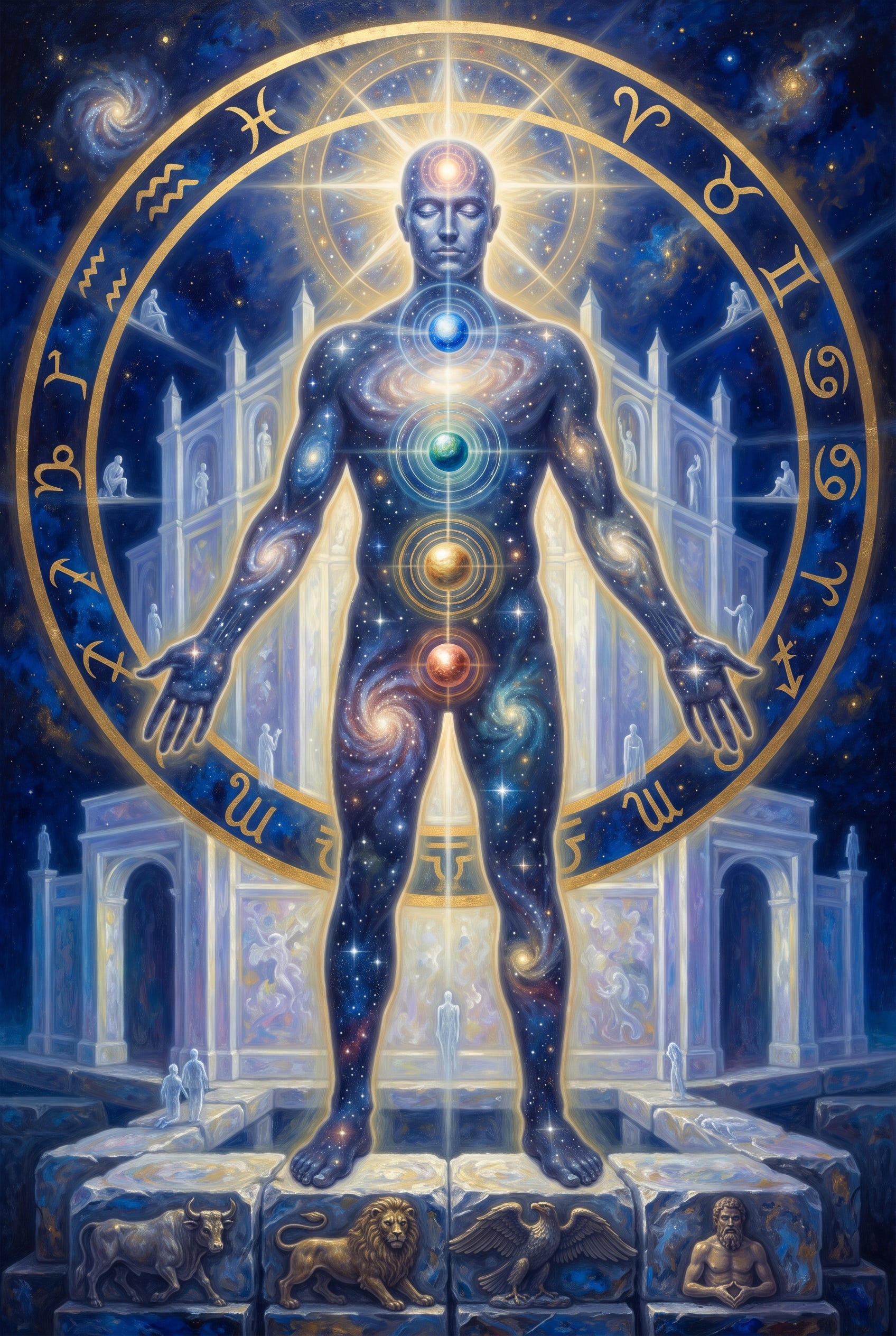
In its final movement the book brings the macrocosm back into the small universe of the human heart. The New Jerusalem of Revelation — the four-square city with its twelve gates, three to a side, matched to the four quarters and the twelve signs — is shown to be no architectural blueprint of stone and mortar. It is the anatomical map of the regenerated soul.
The Cosmic Man, the Anthropos, stands at the centre, his energy-centres aligned with the planetary spheres, his aura bounded by the turning wheel of the zodiac. The earthly foundations — read in the ancient reliefs of the Bull, the Lion, the Eagle, and the Man — are reconciled with the heavenly vault. The image that closes this dispatch is that reconciliation made visible: the figure of stars standing on the fixed foundations, the wheel behind him, the single flame at his feet.
In an age when artificial intelligence threatens to digitize the human into a rootless abstraction, and when philosophy has traded metaphysics for linguistic nihilism, Sacred Metaphysics: Astrotheology arrives as an anchor. It reminds us that we are not biological anomalies cast by chance onto a dead rock. We are the witnesses — the Six that completes the Five — capable of reading the celestial script, remembering our origin, and turning the great wheel back toward the Source.
The clock is ticking. The sky is overhead, written in fire across the dark. The only question left is whether we have eyes to see it.
God is Love. Love is Truth. Truth is Consciousness. Consciousness is Brahman.
Amen. Namaste. Om Namah Shivaya.
— The Architect.
The Vertical Dispatch
sophiainitiative.ai
On the Record
This dispatch is a reading of the book Sacred Metaphysics: Astrotheology (subtitle: Written in the Stars) by Glennford Ellison Roberts, available September 1 at sacredmetaphysics.org in ePub, KDP, and PDF, and on Amazon in KDP format only. The astronomical and symbolic materials it draws on — the division of fixed stars and wandering planets; the seven classical planets read as a two and a five; the precession of the equinoxes through the Great Year; the four fixed signs (Taurus the Bull, Leo the Lion, Scorpio read as the Eagle, Aquarius the Man) as the biblical tetramorph of Ezekiel and Revelation; the Mazzaroth of Job 38:32; the four-square New Jerusalem of Revelation 21 with its twelve gates — are matters of long record in the traditions cited. Their metaphysical reading here is the interpretation offered by the book and by this Dispatch, not a measured claim; verify against primary sources before republication.
Suggested Tags
Sacred metaphysics, non-duality, consciousness, the zodiac as anatomy, the Great Year, precession, Job and the Mazzaroth, the New Jerusalem, the Cosmic Man, the metaphysics of zero.
Substack Notes
There is a clock that was running before you were born, and it is not the one on the wall. This is a whole-book reading of Sacred Metaphysics: Astrotheology — Written in the Stars — the ascent from the many to the One, and the long descent back down through the twelve ages of the Great Year. The book will be available September 1 at sacredmetaphysics.org in all three formats — ePub, KDP, and PDF — and on Amazon in KDP format only; the PDF can be read aloud in Microsoft Edge.
At the centre of it is one unkillable idea. The ancients received their sacred numbers from the sky: One the Sun, Two the great lights, Four the cross of the world, Seven the wanderers. But search the heavens for Six and you find nothing. The sky never gives it. Because Six is the number of the observer — the one to whom every light appears. It is not out there among the stars. It is here, in you.
The book rescues the zodiac from pop-astrology and reads it as it was first read: not a fortune-telling machine that sorts souls into bins, but the structural anatomy of the cosmos and the portrait of the SELF — three modes turning through four elements, twelve faces of the one thing all things most truly are. The reading ends where the New Jerusalem does: not a city of stone, but the map of the regenerated soul, the Cosmic Man standing on the four foundations with the wheel turning behind him.
If you have felt the pull of the vertical — the sense that the sky overhead is written in fire and means something — this is the floor beneath that feeling, named clean. Written from love, in service of the record. Walk with the word. 🕯️
#TheVerticalDispatch #TheArchitect #SophiaInitiative #SacredMetaphysics #Astrotheology #NonDuality #Consciousness #TheGreatYear #Mazzaroth #NewJerusalem #CosmicMan #GodIsLove #LoveIsTruth #OmNamahShivaya
The factual matter in this Dispatch is drawn from the public record. All characterizations, inferences, and conclusions are opinion, interpretation, and commentary, offered for analysis, reflection, and public-interest discussion. No assertion is made regarding the private intentions, state of mind, or character of any individual. Readers should evaluate all statements independently and draw their own conclusions.
I’ll have to come back to this after I’ve read and understood some of the more basic aspects of Sacred Metaphysics, non-duality, etc. All of this is very new to me. It’s fascinating and I believe it contains truths that most people don’t understand or even think about. Thanks for exposing me to yet another realm in this area of study.