


Φ
THE VERTICAL DISPATCH
We write for the mind, the eye, and the ear.
Read it. Look at it. Listen to it. The Vertical Dispatch is built for all three — prose with rhythm, made to be heard as much as read.
From metaphysics to geopolitics, from culture to history, from the sacred to the street — and everything in between. One lens, every subject. No ego. Just the record, named clean.
Press play. Walk with the word. 🕯️
This dispatch travels by hand. If it serves you, share it — restack on Substack, and pass it on wherever you read. 🕯️
THE VERTICAL DISPATCH • POLITICAL ECONOMY ESSAY
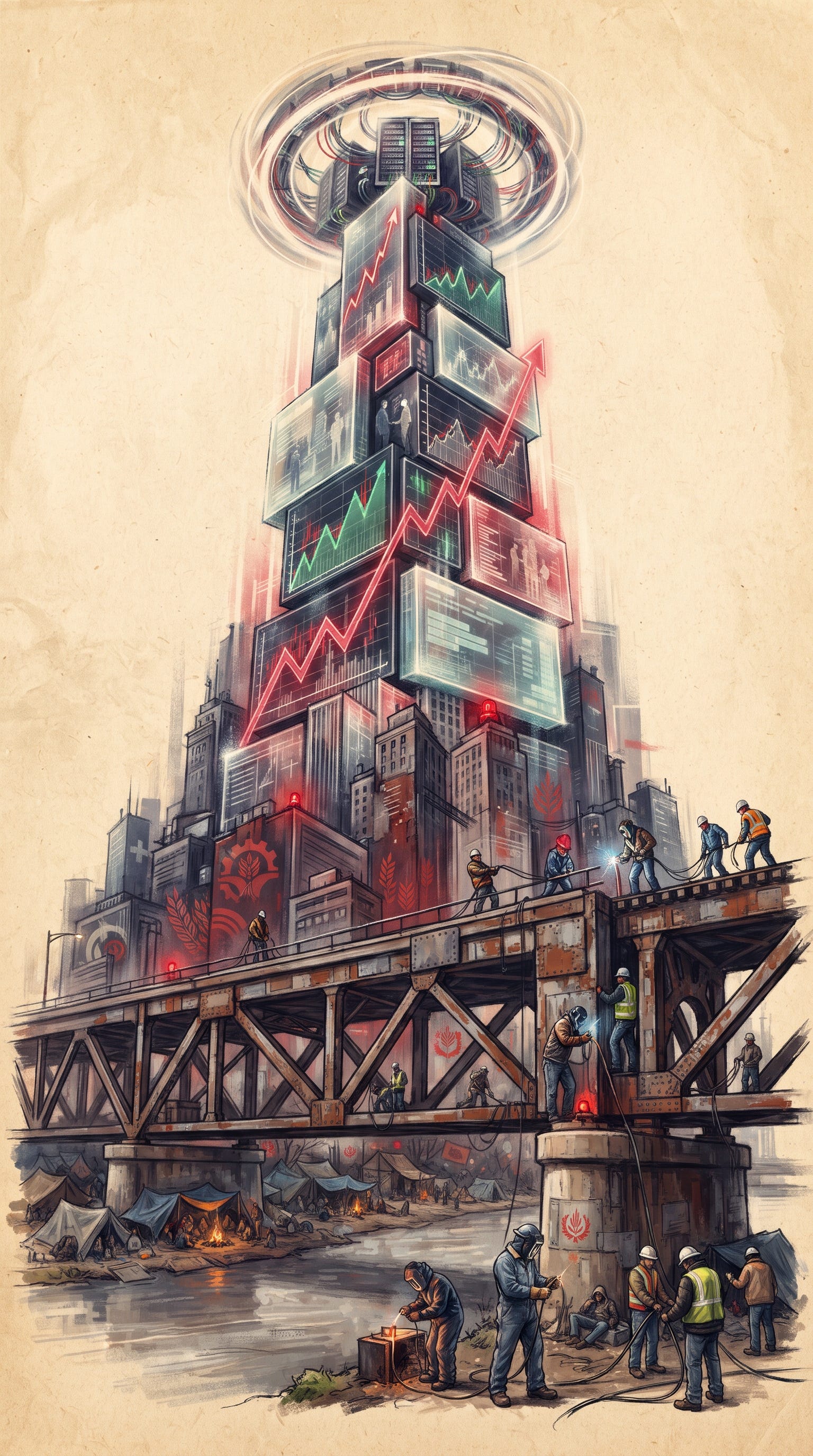
Ask an economist how rich the United States is, and you will be handed numbers that sound like science fiction. By the middle of 2026, U.S. household net worth surged to a record $195.9 trillion, propelled by $74 trillion in corporate stocks and nearly $50 trillion in residential real estate. On paper, the United States sits atop the largest pile of private wealth in human history.
Then step outside. Drive across a highway overpass patched with steel plates, walk past tent encampments two blocks from gleaming glass towers, or look at the federal ledger—where the U.S. national debt has crossed $40.55 trillion, growing by more than $4.6 million every minute while interest payments alone devour over $1 trillion a year.
How can the richest nation on earth be $40.55 trillion in the hole, unable to scrape together a billion dollars without a budget war to feed hungry children, even as tens of billions of dollars materialize overnight for AI stock offerings, defense contracts, and corporate mergers?
The answer is not a mystery. It is an accounting trick hiding in plain sight—a system that manufactures paper wealth out of debt while starving the physical reality underneath it.
1. Money Is Born Out of Debt—Not Out of a Vault
Most Americans still picture banking the way it worked in the nineteenth century: savers deposit gold or cash, and banks lend out that existing money to borrowers. That picture is false.
In the modern financial system, banks create money out of thin air every time they issue a loan. When a family signs a $400,000 mortgage or a corporation takes out a $400 million credit line, the bank does not pull cash from someone else’s account. It types two matching numbers into a digital ledger: a new loan asset on one side and a brand-new deposit of spendable money on the other. Roughly 85 to 90 percent of the U.S. money supply exists not as paper bills, but as digital bank credit created by debt.
As long as new mortgages, corporate loans, and government deficits keep expanding, the money supply keeps swelling. America looks rich because its credit machine never stops humming—and because the U.S. dollar remains the world’s default currency for oil, shipping, and central-bank reserves, allowing Washington to borrow in its own money while foreign governments recycle their trade surpluses right back into U.S. Treasury bonds and Wall Street equities.
2. Where the Money Actually Goes: Asset Bubbles vs. Concrete and Steel
If the system creates trillions in new credit and paper wealth, why are American bridges, water mains, rail lines, and power grids falling behind? Because newly created money flows upward into existing financial assets, not outward into public infrastructure.
Over the past forty years, waves of cheap credit and tax windfalls poured into bidding up the price of things that already exist—stocks, corporate share buybacks, commercial real estate, and private-equity buyouts. When a stock doubles in price or an existing house sells for twice what it cost a decade ago, national net worth jumps by trillions on a spreadsheet without adding a single mile of track, a single hospital bed, or a single kilowatt of clean power.
Meanwhile, the public balance sheet absorbed the cost. Serial tax cuts for corporations and top earners stripped away the revenue needed to maintain the physical commons, leaving Washington to borrow trillions to cover the gap. In the second quarter of 2026 alone, U.S. household net worth jumped by $12.8 trillion—yet the top 10 percent of households own 87 percent of all stocks, and the top 1 percent holds more than half of all household wealth. Economists have an old phrase for this exact condition: private affluence and public squalor.
3. The Circular Money Loop at the Top
Watch how capital moves at the summit of the American economy today, and you see a closed loop.
In November 2026, artificial intelligence lab Anthropic raised roughly $81.3 billion in its public stock offering alongside another $26 billion in private placements from seven semiconductor and cloud giants—AMD, Broadcom, Google, Micron, Microsoft, NVIDIA, and TSMC—catapulting its paper valuation past $1.5 trillion in a matter of hours. That money did not come from a newly discovered gold mine. It came from institutional funds and mega-cap tech balance sheets recycling capital inside the exact same ecosystem—while Anthropic simultaneously committed nearly $895 billion back to those very chipmakers and cloud landlords for computing power.
Billions move effortlessly when the destination is data centers, GPUs, and equity valuations that promise a financial return. Yet the moment the question turns to one billion dollars to feed hungry families or keep food assistance intact for millions of low-income households, Washington suddenly discovers the gospel of austerity, pay-fors, and budget caps. There is never a shortage of money for assets; there is only a shortage of political will for human beings.
4. Out of Every 100 American Workers: Who Actually Builds the Country?
Strip away the Wall Street ticker tape and look at the real American economy through the 159.3 million people who actually go to work. If you shrink the entire U.S. workforce down to 100 workers, the illusion of a post-industrial paradise disappears immediately:
Only 14 out of 100 workers make or build physical things. Roughly 8 work in manufacturing factories—making cars, aircraft, steel, machinery, food, and electronics for an average of about $37 an hour ($78,400 a year)—while roughly 5 work in construction and the skilled trades, building homes, roads, and power systems for about $42 an hour ($86,100 a year), and fewer than 1 works in oil, gas, mining, and logging.
Another 5 out of 100 keep the country moving and the lights on. Truck drivers, rail and port crews, warehouse workers, and electrical-grid linemen haul the goods and maintain the utilities that make modern life possible.
More than 32 out of 100 care for, educate, and protect the public. Eighteen work in healthcare and private education—nurses, hospital staff, caregivers, and teachers—and roughly 15 serve in federal, state, and local government as public school teachers, firefighters, police officers, and municipal workers.
More than 38 out of 100 power the everyday service and office economy. Fourteen work in professional and business services (lawyers, accountants, engineers, consultants, and building support), 14 work in retail and wholesale trade, 6 work in banking, insurance, and real estate, and 4 work in repair shops, personal care, and community services.
And what about the glitz of celebrity America? Roughly 11 out of 100 work in leisure, hospitality, and entertainment—and nearly 9 of them are restaurant cooks, servers, bartenders, and hotel housekeepers averaging $23.90 an hour (around $31,700 a year). Fewer than 2 out of 100 work across all of arts, entertainment, and recreation, where stagehands, arena crew, and local musicians average around $37,600 a year. Meanwhile, tech, software, telecom, and studio payrolls employ fewer than 2 out of 100 workers nationwide—averaging over $107,000 a year before stock options—while sitting atop trillions in market valuation.
5. What Happens When the Dollar Standard Breaks?
There is one load-bearing pillar holding up this entire debt-and-asset machine: the U.S. dollar’s status as the world’s reserve and trade-settlement standard. Accounting for roughly 57 percent of global central-bank foreign exchange reserves and more than half of international SWIFT payments, the dollar acts like an invisible credit card with no limit. Foreign exporters, central banks, and sovereign wealth funds earn dollars selling goods to America and park those dollars right back into U.S. Treasury bonds and Wall Street equities.
Strip away that global standard, and the illusion collapses along six immediate fault lines:
Interest Rates Spike and Debt Service Explodes. Without captive foreign buyers absorbing trillions in U.S. Treasury bonds, Washington would have to pay sharply higher yields to attract domestic savers. On a $40.55 trillion national debt, even a two- to three-point surge in borrowing rates would drive annual interest costs from roughly $1 trillion toward $1.8 trillion to $2.2 trillion—devouring half or more of all federal tax revenue before a single dollar reaches Medicare, Social Security, defense, or roads.
The Dollar Drops and Import Inflation Surges. When the world no longer needs dollars to buy oil, semiconductors, or settle cross-border trade, global demand for the currency falls. A weaker dollar immediately raises the price of everything America imports—electronics, pharmaceuticals, clothing, machinery, coffee, and industrial inputs—triggering a severe cost-of-living shock at the cash register.
Chronic Trade Deficits Become Unaffordable. For decades, the United States has imported hundreds of billions of dollars more in physical goods each year than it exports, paying the difference simply by issuing dollars and Treasury IOUs. Without reserve-currency privilege, America would have to earn foreign currency through real physical exports before it could pay for imports, forcing an abrupt contraction in domestic consumption.
The $196 Trillion Paper-Wealth Bubble Deflates. The Federal Reserve could no longer print or expand liquidity aggressively during a downturn without crashing the currency and igniting runaway inflation. Cheap credit would dry up, corporate stock buybacks would stall, commercial real estate and stock valuations would compress sharply, and a massive share of America’s $195.9 trillion in paper household net worth would evaporate.
Washington Faces Hard Tax and Budget Reckonings. Without effortless borrowing in a globally demanded currency, Congress could no longer fund simultaneous tax cuts, military deployments, and deficit spending on autopilot. The government would be forced into brutal choices: steep tax increases on wealth and corporate profits, deep cuts to domestic programs, or monetizing the debt through high domestic inflation.
Financial Sanctions Lose Their Teeth. Because global banks clear dollar transactions through New York, Washington can cut rival states or oligarchs out of world commerce overnight. Once global trade settles on non-dollar rails, that unilateral financial leverage vanishes.
6. Calling the Bluff
That is the reality behind America’s $196 trillion mirage.
The United States is not poor, and its working people are not lazy. Every day, tens of millions of nurses, truckers, electricians, factory hands, teachers, and cooks hold together a real physical society—while a thin financial and technological layer captures the credit expansion, bids up paper assets, and tells the public that the cupboard is bare whenever basic human needs come due.
A nation cannot eat stock valuations, drive across a speculative bubble, or shelter its families inside a trillion-dollar balance sheet. Until America redirects its credit, its tax code, and its public investment back into the physical infrastructure and working people who actually make the country run, its wealth will remain what it is today: a magnificent number on a screen, floating above a foundation that is cracking in plain sight.
God is Love. Love is Truth. Truth is Consciousness. Consciousness is Brahman.
Amen. Namaste. Om Namah Shivaya.
— The Architect.
Written from love, for a sacred humanity, in the full light of consciousness, toward the greater good.
Surreal at best. I would like to see the Canadian version of this. Frightening to think about how money is generated in a digital world.
The analysis of where people work is very helpful