


There are five ways the human mind has answered the most fundamental question it can ask: what is ultimately real? Every metaphysical system in history — Eastern or Western, ancient or contemporary — is either choosing one of these five positions, combining two of them, or consciously transcending the entire set.
If you do not know the map, you do not know where you are standing. And if you do not know where you are standing, you cannot build anything that holds.
A metaphysical system without explicit first principles is not a system. It is an opinion with elaboration.
This is not a piece about academic philosophy. It is a diagnostic. Before any serious metaphysical work can begin — before a single ontological claim can carry weight — three questions must be answered with clarity and without evasion:
First: which of the five foundational ontological positions does your system inhabit, and why? Second: what are your first principles — the axiomatic anchors that your entire architecture rests on? Third: how does your system handle the hard problem of consciousness — the question that defeats most systems before they can answer it?
If you cannot answer all three, you are not yet doing metaphysics. You are doing philosophy tourism.
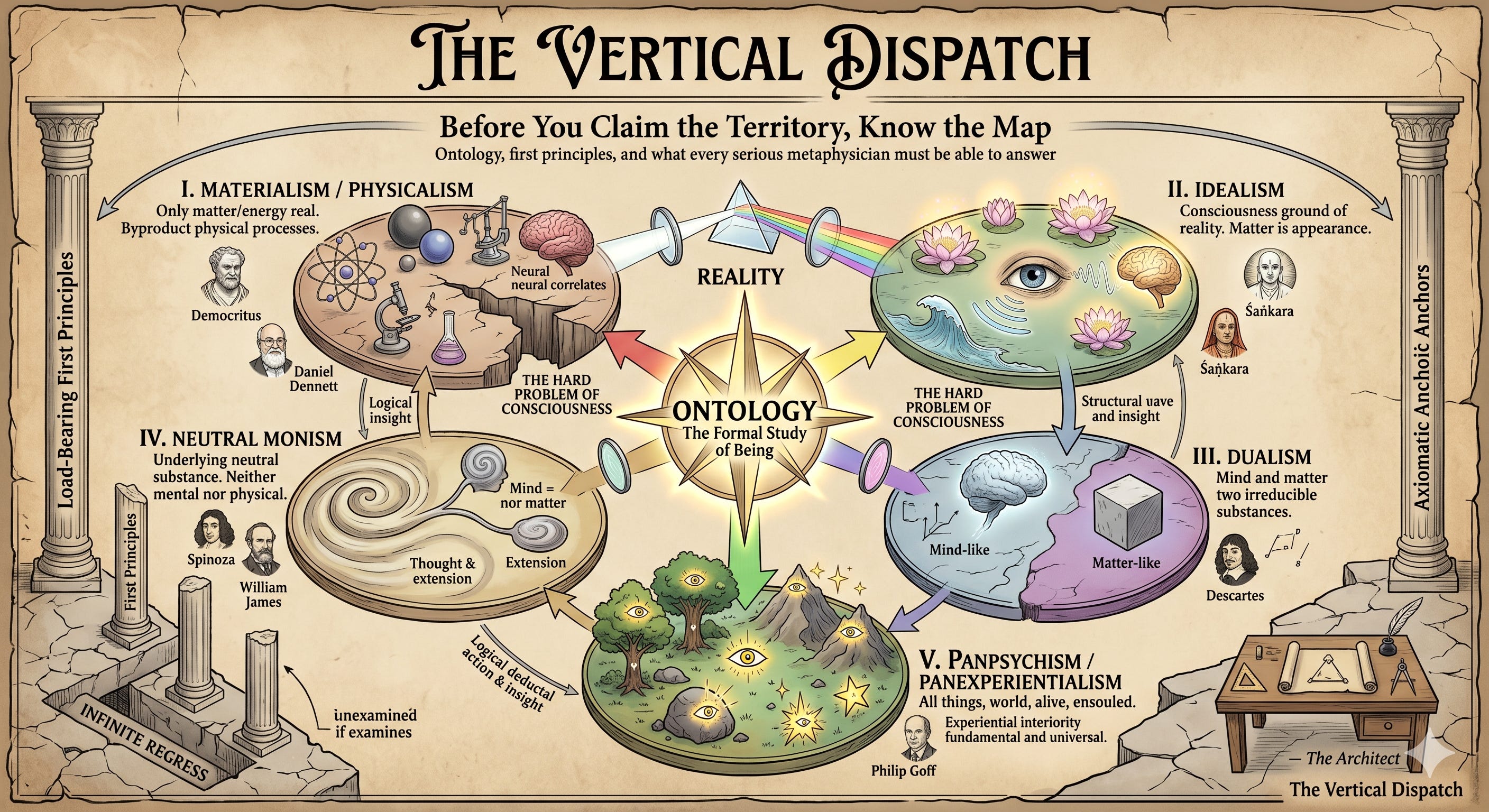
I. What Metaphysics Actually Is
Metaphysics is the inquiry into the nature of reality at its most fundamental level. Not how things work — that is physics. Not what things mean — that is hermeneutics. Not how we should act — that is ethics. Metaphysics asks what things are. What is ultimately real. What the structure of being itself looks like before any particular science carves it up.
This is why metaphysics is the prior discipline. Every other domain of inquiry inherits its foundational assumptions from a metaphysical position — whether it knows it or not. The materialist neuroscientist, the idealist mystic, the secular economist, the contemplative yogi — all of them are operating from a set of unexamined or examined commitments about what reality ultimately is. That set of commitments is their ontology.
Ontology is the formal study of being: what kinds of things exist, how they relate, what is fundamental and what is derivative. It is the architectural layer of metaphysics. And like any architecture, it must rest on a foundation. That foundation is what we call first principles.
First principles are not conclusions you argue toward. They are the ground you are willing to stand on without further justification — the place where the ‘why’ stops and the seeing begins.
In mathematics, first principles can be stipulated — you choose your axioms and observe what follows. In metaphysics, this is not possible. A metaphysical first principle is a truth claim about the nature of reality itself. It is either seen or it is not. It cannot be derived from something else without generating an infinite regress. It is the place the system begins.
This is why the great metaphysical systems in history are distinguished not by the sophistication of their arguments but by the clarity and depth of their originating insight. Śaṅkara’s entire architecture — the most rigorous idealist system the world has produced — unfolds from a single axiomatic recognition: Brahman alone is real; the world is its appearance; the individual self is identical with Brahman. Everything else is unpacking. The axiom does not argue. It sees.
With that established, we can now lay out the map.
II. The Five Foundational Ontological Positions
These five are not opinions or schools of thought in the loose sense. They are the five structural positions the human mind has historically occupied on the question of what is ultimately real. Every serious metaphysical system locates itself within or against this map. There is no sixth position that does not reduce to one of these or to a deliberate transcendence of the set.
1. Materialism / Physicalism
Only matter and energy are ultimately real. Everything else — mind, consciousness, meaning, value — is a byproduct of physical processes.
Materialism is the oldest systematic metaphysics in the West and the default ontology of modern civilization. Its ancient roots lie with Democritus and Leucippus in the fifth century BCE — the first atomists, who proposed that reality is nothing but atoms moving in void. Everything we experience, they argued, is the appearance generated by that motion. Nothing else exists.
The tradition resurfaces with force in early modernity. Thomas Hobbes in the seventeenth century argued that mind is simply motion in the nervous system. Julien Offray de La Mettrie pushed the thesis to its logical conclusion in the eighteenth century: the human being is a machine, and a very sophisticated one, but a machine nonetheless. The scientific revolution consolidated this position across the next two centuries, and by the twentieth century physicalism had become the working assumption of virtually every academic discipline outside theology and philosophy of mind.
Daniel Dennett 1942–2023
The most influential contemporary defender of physicalist consciousness theory. His central argument — that consciousness is not a special phenomenon requiring special explanation but an illusion generated by physical processes — makes him the most rigorous and most contested voice in the materialist tradition. His work Consciousness Explained is the definitive modern statement of the position.
The fatal wound of materialism is the hard problem of consciousness: it cannot explain why there is subjective experience at all. It can describe the neural correlates of experience in exquisite detail. It cannot explain why those correlates are accompanied by the felt quality of being — the redness of red, the ache of grief, the silence before a decision. This gap is not a gap in current knowledge. It is a structural gap in the ontology itself.
2. Idealism
Consciousness is the ground of reality. Matter is not primary — it is appearance, expression, or modulation within consciousness.
Idealism is the most ancient and most sophisticated of the five positions. Its deepest expression does not come from the Western tradition but from the Vedic. Advaita Vedanta — non-dual Vedanta — as formalized by Śaṅkara in the eighth century CE represents the most rigorous idealist metaphysics in world intellectual history. The claim is not that the world does not exist, but that it exists within consciousness, not the other way around. Consciousness is not an emergent property of matter. Matter is an appearance within the only thing that is ultimately real: awareness itself.
In the Western tradition, Plato’s theory of Forms gestures toward idealism — the real is the intelligible, not the sensible — though Plato does not complete the move. German Idealism, particularly Hegel in the nineteenth century, develops the insight that reality is the unfolding of Spirit — Geist — through history and consciousness. In the contemporary analytic tradition, figures like Bernardo Kastrup have revived analytical idealism, arguing that consciousness is ontologically fundamental and that matter is its appearance.
Śaṅkara c. 788–820 CE
The most consequential idealist thinker in world history. His commentaries on the Brahma Sutras, the principal Upanishads, and the Bhagavad Gita constitute the foundational architecture of Advaita Vedanta and remain unmatched in their logical rigor. His central contribution: the distinction between Brahman as ultimate reality and the phenomenal world as appearance within that reality — not illusion in the sense of non-existence, but appearance in the sense of not being independently real.
Idealism resolves the hard problem by dissolving it. If consciousness is primary, there is no explanatory gap between physical process and subjective experience — because physical process is itself an appearance within consciousness, not its generator.
3. Dualism
Two irreducible substances exist: mind and matter. Neither reduces to the other. Both are ultimately real.
Dualism is the metaphysics of Western common sense and most unexamined spirituality. The intuition driving it is genuine: inner experience and outer world feel qualitatively different in a way that resists reduction. Mind does not seem like matter. Matter does not seem like mind. The dualist takes this intuition seriously and builds from it.
Ancient dualist threads run through Plato’s body-soul distinction and the Zoroastrian opposition of light and darkness. Classical Christian theology largely inherited a dualist framework: soul and body as distinct, with the soul surviving physical death. But the definitive modern formulation belongs to René Descartes in the seventeenth century. His distinction between res cogitans — thinking substance, the mind — and res extensa — extended substance, the body — gave dualism its most precise and most problematic form.
René Descartes 1596–1650
The architect of modern Western philosophy and the clearest formulator of substance dualism. His Meditations on First Philosophy establishes the split between mind and matter as two ontologically distinct substances. His legacy is double-edged: by insisting on the reality of both mind and matter, he honors the intuition that consciousness is not reducible to physics. But by separating them absolutely, he created the problem that has haunted Western philosophy ever since — how do two entirely different substances interact? This is the hard problem in its original form.
Dualism’s structural wound is interaction: if mind and matter are truly different substances, how does a thought cause a hand to move? Every answer to this question has generated either an infinite regress or a tacit collapse back into one of the other positions. Most contemporary philosophy of mind is an attempt to escape the cage Descartes built.
4. Neutral Monism
There is one underlying substance that is neither mental nor physical. Both mind and matter emerge from this neutral ground.
Neutral monism is the attempt to escape the dualist cage without collapsing into either idealism or materialism. It proposes that the ultimate substance of reality is neither mind nor matter but something prior to both — something from which both emerge as different expressions or aspects.
The deepest historical precedent is Spinoza in the seventeenth century. His one infinite Substance — which he names God or Nature interchangeably — has infinite attributes, of which we know two: thought and extension. Mind and matter are not two substances but two attributes of one substance. Neither is more real than the other. Both are equally real expressions of the one underlying reality. In the early twentieth century, William James proposed pure experience as the fundamental stuff — neither mental nor physical but the raw material from which both are constituted. Bertrand Russell developed a similar view, arguing that the world is composed of neutral events that can be described in either physical or mental terms depending on the relational context.
Baruch Spinoza 1632–1677
The most architecturally precise neutral monist in the Western tradition. His Ethics, presented in geometric form with definitions, axioms, propositions, and demonstrations, represents the most rigorous attempt to ground a complete metaphysics in a single substance. His identification of God and Nature — Deus sive Natura — as the one infinite substance from which all finite modes emerge anticipates many features of contemporary non-dual thinking, though it lacks the vertical dimension that distinguishes non-dual idealism from neutral monism.
William James 1842–1910
The American pragmatist philosopher who proposed radical empiricism and pure experience as the foundational ontological category. His Essays in Radical Empiricism develop the argument that relations and things are equally real features of experience, and that pure experience — prior to the subject-object split — is the ultimate material of reality.
5. Panpsychism / Panexperientialism
Experiential interiority is a fundamental and universal feature of reality. Consciousness goes all the way down.
Panpsychism is the oldest of all the positions in its intuitive form — the sense that the world is alive, ensouled, interior throughout. Pre-Socratic philosophers, particularly Thales, held that everything is full of gods. The Stoics held the cosmos to be a living organism animated by logos. Neoplatonism and the Renaissance Hermetic tradition maintained versions of this view across fifteen centuries of Western thought.
Its modern rigorous form begins with Alfred North Whitehead in the early twentieth century. Whitehead’s process philosophy proposes that the ultimate units of reality are not inert material particles but occasions of experience — events with an interior dimension at every level of complexity. Teilhard de Chardin, the Jesuit paleontologist, independently developed a vision of evolution as the progressive complexification of consciousness already present in matter from the beginning. In contemporary analytic philosophy, the hard problem of consciousness has driven a significant revival of panpsychist thinking. David Chalmers, who coined the phrase hard problem, has explored panpsychism as the most coherent solution. Philip Goff has become its most prominent current defender.
Alfred North Whitehead 1861–1947
The founder of process philosophy and the most architecturally sophisticated panexperientialist in modern thought. His magnum opus Process and Reality proposes a complete cosmological system in which actual occasions of experience — not material particles — are the ultimate constituents of reality. Every actual occasion has both a physical pole (how it receives the past) and a mental pole (how it responds creatively to that reception). Whitehead’s system is the most serious attempt in the Western tradition to build a complete metaphysics that takes consciousness as genuinely fundamental without collapsing into idealism.
Philip Goff b. 1980
The leading contemporary defender of panpsychism in analytic philosophy. His Galileo’s Error argues that the scientific revolution made a foundational mistake by excluding consciousness from its description of nature, and that panpsychism is the correction. His work represents the most rigorous current engagement with panpsychism as a serious metaphysical position.
III. First Principles: The Load-Bearing Structure
The five positions above constitute the map. But knowing the map is not enough. The deeper question — the one that separates genuine metaphysical inquiry from informed commentary — is this: what are your first principles, and can you state them without evasion?
Most people who engage with metaphysics have inherited their first principles unconsciously. Their ontological ground was installed by their culture, their education, their unexamined assumptions about what counts as real — and they have never interrogated it. They are operating from a position they did not choose and cannot defend. They are standing on borrowed ground.
The axiom does not argue. It sees. The entire architecture is the unpacking of what was seen in a single act of recognition.
A genuine metaphysical system requires that you be able to name your first principles clearly, distinguish them from derived conclusions, and show how your entire ontological architecture follows from them with logical necessity. Not with probability. Not with plausibility. With necessity — given these axioms, this system follows.
This is the standard Śaṅkara meets. It is the standard Spinoza meets in a different key. It is the standard Whitehead attempts, with qualified success. And it is the standard any serious contemporary metaphysical system must meet if it intends to do more than describe a perspective.
The diagnostic questions are precise. What do you take as given? What requires no further justification in your system? What is your x₀ — your absolute ground — and why is it the ground rather than a derived position? And crucially: how do your first principles determine which of the five ontological positions your system inhabits?
If your first principle is that consciousness is the only self-certifying reality — the one thing that cannot be doubted because the act of doubting it confirms it — then you are in idealist territory. If your first principle is that matter and energy are the bedrock of what exists, then you are a physicalist. If you hold that two irreducible substances exist, you are a dualist. If you hold that one neutral substance underlies both mind and matter, you are a neutral monist. And if you hold that experience goes all the way down to the structure of reality itself, you are a panexperientialist.
There is no metaphysical position that does not rest on first principles. There is only the question of whether those first principles are explicit or inherited, chosen or assumed, seen or merely believed.
IV. The Architecture That Holds: A Non-Dual Position
The framework developed through Universal Dynamics and formalized in Sacred Metaphysics and Consciousness does not occupy any of the five positions above. It is not one position among five. It is the meta-ontological architecture that explains why the five exist, where each captures a partial truth, and why none of them alone is sufficient.
Its first principles are three, and they are stated without apology:
The first principle: consciousness is the absolute ground of reality — not a product of matter, not an emergent property of complexity, not one substance among others. Consciousness is x₀. It is self-luminous, self-certifying, and irreducible. This is the non-dual idealist axiomatic ground, fully consonant with Advaita Vedanta and Kashmir Shaivism, and it is the position from which everything else follows.
The second principle: reality has a triadic structure — X, Y, Z — corresponding to Logos (the structural ground, the principle of intelligibility), Eros (the relational principle, the love that is not sentiment but the binding force of reality), and Consciousness (the ground itself, in which the other two are not separate substances but modes of the one). This triadic structure is not invented. It is recognized. It appears in the deepest strata of every major metaphysical tradition: in the Sat-Chit-Ananda of the Vedic tradition, in the Father-Son-Spirit of the Christian revelation, in the Plotinian One-Nous-Soul. The notation makes explicit what the traditions encoded in symbol.
The third principle: manifestation — z¹, the world as we encounter it — is real as appearance and not real as independent substance. The world is not an illusion in the sense of being nothing. It is an illusion in the precise Vedantic sense: it does not have the kind of being it appears to have. It appears to be self-standing. It is not. It appears within consciousness, as a wave appears within the ocean, without being separate from it.
The five ontological positions each capture a partial truth. Materialism is right that the physical world is structured and consistent. Idealism is right that consciousness is primary. Dualism is right that the phenomenal and the noumenal are not the same. Neutral monism is right that there is one ground. Panpsychism is right that experience is fundamental. The non-dual architecture does not refute them — it locates where each one stops seeing.
From these three first principles, the entire system follows. The apparent contradictions between the five classical positions are not resolved by choosing one over the others. They are dissolved by recognizing that each position is a partial perspective on a reality that exceeds the categories any single perspective can generate.
This is the structural position of Kashmir Shaivism, of Advaita Vedanta at its summit, of Neoplatonism at its highest reach. The present framework inherits this altitude and formalizes it in an explicitly architectural notation that can carry the weight of both contemplative transmission and institutional application — including its development into a governance architecture through Project 2046 and Artificially Intelligent Governance.
The Three Questions
Every serious metaphysician — anyone who intends to speak with authority about the nature of reality — must be able to answer three questions with precision and without evasion.
Which of the five foundational ontological positions does your system inhabit, and why? What are your first principles — the axiomatic load-bearing claims your entire architecture rests on? And how does your system handle the hard problem of consciousness — the question that has defeated every position that fails to take consciousness as primary?
These are not examination questions. They are the questions that determine whether you have a system or a perspective, a metaphysics or a collection of borrowed intuitions dressed in technical language.
The map exists. The standard is clear. The work is yours to do.
Glen Roberts is a philosopher and author based in Ontario, Canada. He is the author of Sacred Metaphysics and Consciousness: The History of the Absolute and Eternal and publishes The Vertical Dispatch on Substack. The Universal Dynamics framework referenced throughout this piece is developed fully in that work and in the Framework Series published here
The Vertical Dispatch#Metaphysics #Ontology #FirstPrinciples #Philosophy #ConsciousnessStudies #Idealism #Materialism #Panpsychism #NeutralMonism #Dualism #Advaita #KashmirShaivism #Vedanta #Shankaracharya #Whitehead #Spinoza #Descartes #HardProblem #SacredMetaphysics #UniversalDynamics #TheVerticalDispatch #TheArchitect #Project2046 #PhilosophyOfMind #Consciousness #NonDual #Nonduality #Perennial Philosophy #MetaphysicalFramework #Substack
Wow. You articulate what is absent or muddled in so many spiritual/ meditation communities I’ve been part of.
The only part I’m not clear on is your expression of the different facets of the triadic structure. How is consciousness as ground different than consciousness as one facet of the triadic structure?
Btw, do you know Cynthia Bourgeault , eg Holy Trinity and the Law of Three. Inspired more by Gurdjieff. Three part expression of the ground, but differently articulated.