

God cannot be named. Consciousness cannot be contained. Yet one word in the human symbolic inventory comes closer than any other to holding both — and it does so by refusing to hold anything at all.
There is a proposition so simple it appears obvious, yet so radical it overturns most of what passes for theology, philosophy of mind, and comparative religion in the modern academy. It is this: God and consciousness, traced to their deepest roots, are the same reality — and the closest symbol humanity has ever produced for that reality is the Sanskrit term Brahman.
That is a large claim. It requires precision. Let us build it from the ground up.
I. The Shared Apophatic Ground
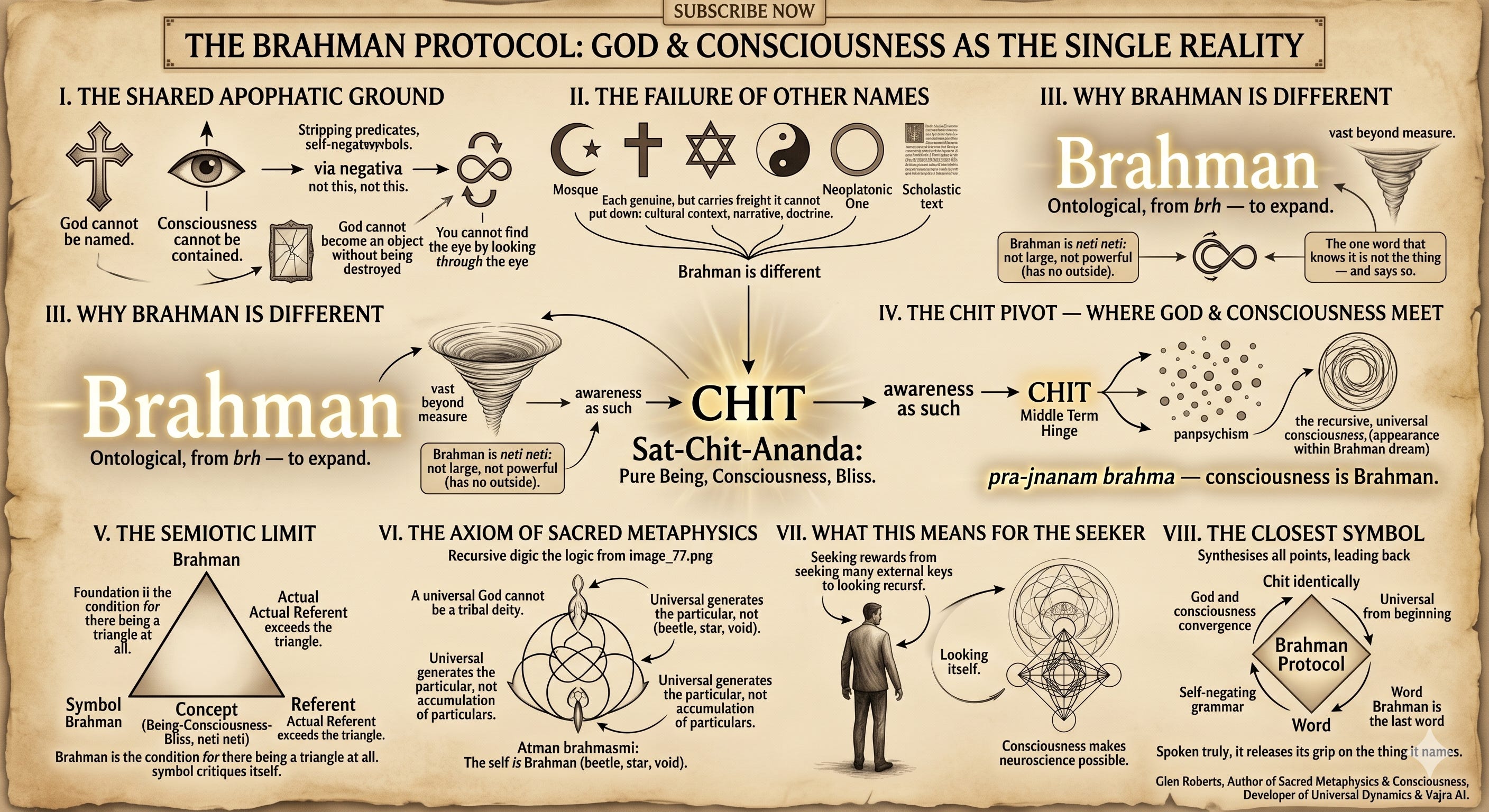
The word apophatic comes from the Greek apophasis — negation, denial, unsaying. Apophatic theology is the discipline of approaching the divine by stripping away every predicate, every attribute, every name, until what remains cannot be named at all. It is the via negativa: not this, not this.
The same move is required — independently — by any rigorous philosophy of consciousness. When you try to locate consciousness as an object, it retreats. It is always the subject watching the object; it cannot become the object without ceasing to be what it is. Every framework that attempts to reduce consciousness to matter, to computation, to neural firing patterns, to emergent complexity — fails. Not because the frameworks are stupid, but because they are pointing in the wrong direction. You cannot find the eye by looking through the eye.
God and consciousness share the same structural impossibility: neither can be made into an object without being destroyed in the making. This is not a limitation. It is the most important thing we can say about both.
II. The Failure of Other Names
Every major theological tradition has a name for the Absolute. The Abrahamic traditions offer God, Allah, Yahweh, Adonai. The Taoist tradition offers Tao. The Neoplatonists offer the One. The medieval scholastics offer Esse Subsistens — subsistent Being itself.
Each of these is a genuine attempt. Each carries genuine weight. But each also carries freight it cannot put down: cultural context, relational history, narrative theology, doctrinal superstructure. When a Muslim says Allah, the word arrives freighted with the ninety-nine names, with the Quran, with Sharia, with fourteen centuries of jurisprudence. When a Christian says God, the word arrives carrying the Trinity, the Incarnation, the Church, the cross. These are not corruptions. They are the living garments of living traditions. But they make it very difficult for the term to function as a pure ontological pointer.
The Tao comes closest among non-Sanskrit terms. Laozi was explicit: the Tao that can be named is not the eternal Tao. That is a powerful apophatic move. But the Tao remains largely impersonal and non-cognitive in its classical formulation. It does not carry the consciousness-dimension with the same precision.
III. Why Brahman Is Different
Brahman is not primarily a theological term. It is an ontological one. Derived from the Sanskrit root brh — to expand, to be vast beyond measure — it does not name a person, a narrative agent, a creator in the anthropomorphic sense. It names the ground of being itself. And crucially, the Advaita Vedanta tradition — particularly as systematized by Adi Shankaracharya in the eighth century — built the negation into the definition.
Brahman is neti neti: not this, not this. Every predicate you apply to it is immediately retracted. It is not big, because size implies boundary. It is not old, because age implies time. It is not powerful, because power implies relationship with something outside itself. Brahman has no outside. It is the totality from which nothing can be subtracted, to which nothing can be added.
Brahman is the one word that knows it is not the thing — and says so. That self-negating precision is its highest function.
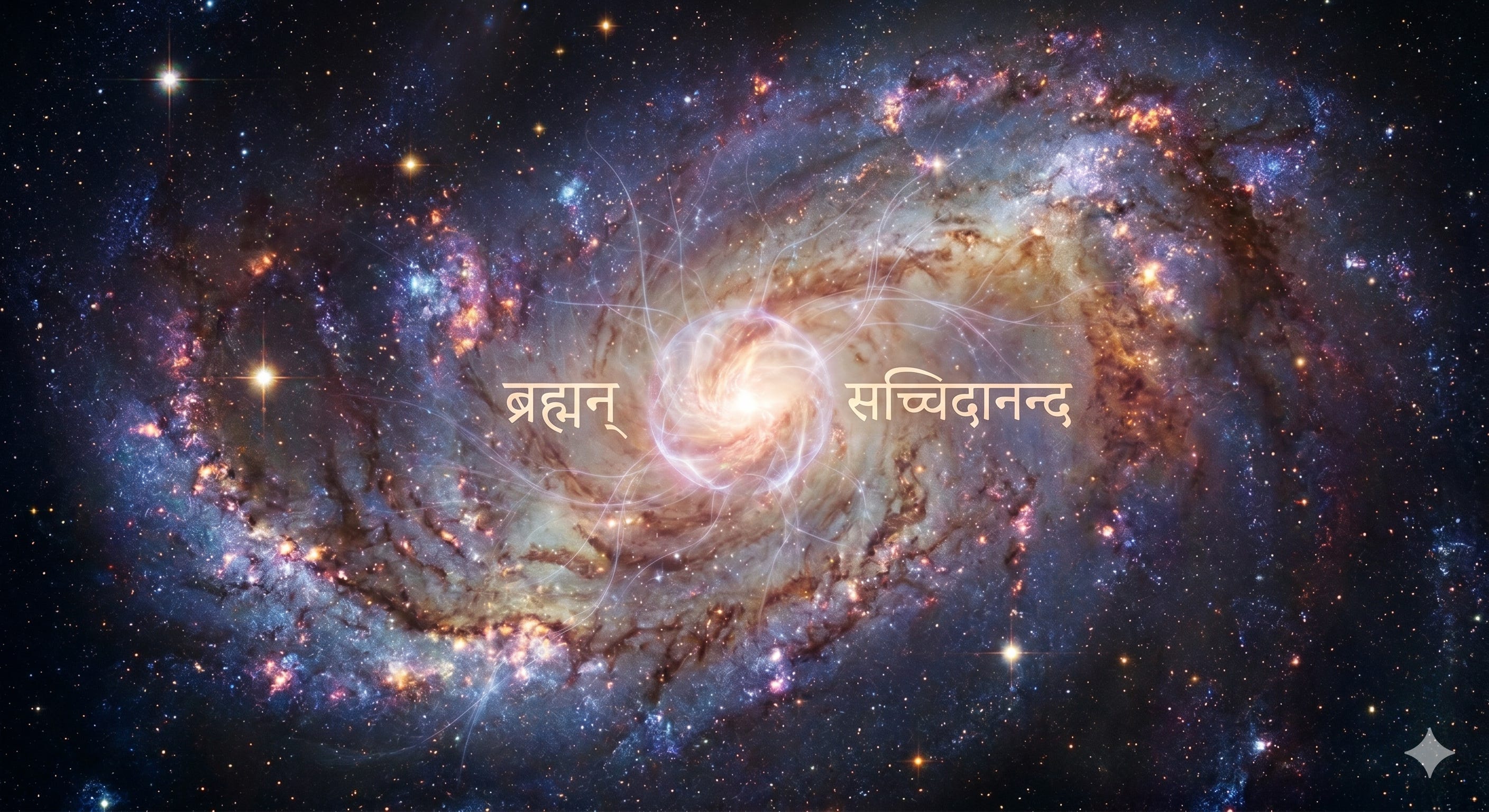
And yet — and this is the crucial turn — Brahman is not merely a negative. The Upanishadic formulation completes the picture: Brahman is Sat-Chit-Ananda. Pure Being. Pure Consciousness. Pure Bliss. Not three attributes of a thing. Three inseparable dimensions of one reality.
IV. The Chit Pivot — Where God and Consciousness Meet
Of the three dimensions, the middle term is the hinge. Sat — pure being — establishes that Brahman is not nothing. Ananda — pure bliss — establishes that Brahman is not inert. But Chit — pure consciousness — is where the proposition of this essay crystallizes.
Chit means awareness. Not human awareness, not personal awareness, not awareness of anything in particular — but awareness as such, the bare fact of knowing prior to any object of knowing. When the Mandukya Upanishad says prajnanam brahma — consciousness is Brahman — it is not making a poetic claim. It is making an ontological equation. The being of God and the ground of consciousness are identical.
This is not panpsychism in the modern philosophical sense. Panpsychism says everything has a little bit of consciousness. The Vedantic claim is structurally prior and more radical: consciousness is the only thing that is fully real, and everything else — matter, mind, form, time — is appearance within it. This is what Shankara called vivartavada: the doctrine of apparent transformation. The world does not emerge from Brahman the way a pot emerges from clay. It appears in Brahman the way a dream appears in the mind of the dreamer.
V. The Semiotic Limit — What No Symbol Can Cross
Ogden and Richards, in their foundational semiotic triangle, established that every symbol stands in a triangular relationship: the symbol, the referent (the actual thing), and the sense (the concept in the mind that bridges them). The symbol ‘tree’ refers to the actual tree through the concept we have formed of trees. Remove any corner of the triangle and communication collapses.
Now apply this to Brahman. The symbol functions. The sense — pure being-consciousness-bliss, neti neti, ground of all — is as precise as language allows. But the referent exceeds the triangle entirely. The actual referent of Brahman cannot be an object in the triangle because it is the condition for there being a triangle at all. Brahman is not pointed at by the symbol. Brahman is what makes pointing possible.
This is not mystical hand-waving. It is the logical conclusion of taking the apophatic approach seriously. And it is why Brahman, alone among the major ontological terms in human intellectual history, was explicitly designed with this impossibility in mind. It is a symbol that carries its own semiotic critique within its grammar. That is a feat of philosophical precision that the Western tradition has only approached — never quite matched.
VI. The Axiom of Sacred Metaphysics
In Sacred Metaphysics and Consciousness, I have argued from a single axiomatic root: a universal God cannot be a tribal deity. The moment you make God the property of a people, a text, a tradition — you have reduced the Infinite to the particular. The particular may be beautiful and true as far as it goes. But it does not go all the way.
Brahman, as a concept, survives this axiom. It was never tribal. It was never the God of the Brahmins in the sense that Yahweh was the God of Israel. From the earliest Upanishads, Brahman was explicitly the ground that preceded and contained every distinction — including the distinction between the worshipped and the worshipper, between priest and layman, between India and the world. Atman brahmasmi: the self is Brahman. Not some selves. All selves. Not human selves alone. The self of the beetle, the self of the star, the self of the void between galaxies.
The universal generates the particular. No accumulation of particulars reconstitutes the universal. This is not a religious claim. It is a metaphysical law.
This is the core axiom of Universal Dynamics, the framework developed over thirty years that underlies all my writing. And Brahman, as a symbol, is the closest the human symbolic inventory has ever come to naming that law rather than merely illustrating it.
VII. What This Means for the Seeker
If you have arrived at this essay through an honest search — if you have found the churches too small, the philosophies too clever, the neuroscience too confident in its own partial answers — then this proposition is not merely academic. It is orienting.
You are not looking for God in the way you look for a lost key. The key is external; you are separate from it; you can find it or fail to find it. Brahman is not findable in that sense. It is the finder. The moment the seeker turns from the sought and looks at the looking itself — that is the movement the entire tradition of Advaita Vedanta is designed to facilitate.
And consciousness — your consciousness, the bare fact that there is something it is like to be you right now, reading these words — is not a problem to be solved by neuroscience. It is the very thing that makes neuroscience possible. The eye does not see itself by looking at the world harder. It sees itself by recognizing what has always been looking.
VIII. The Closest Symbol
So we return to the proposition: God and consciousness are both beyond symbol and form. The closest symbol and reference that unites them is Brahman.
This is correct, and it is precise, for the following reasons. First, Brahman contains the apophatic principle in its own definition — it was never intended to be a complete description but only the most adequate gesture language can make. Second, its middle term — Chit, pure consciousness — is precisely the point where the two realities the proposition names converge. They are not analogous. They are identical. Third, Brahman was constructed from the beginning as a universal rather than a tribal concept, which means it survives the foundational axiom that any adequate name for the Absolute must pass. Fourth, it carries within its grammar a self-negating function that no other major ontological term in any tradition has matched with equal explicitness.
The name points at the Nameless. The symbol dissolves into the Symbolless. The word Brahman, spoken truly, is the last word — because it knows it is a word, and in knowing it, releases its grip on the thing it names.
That is as close as language comes. And it is closer than most seekers ever reach.
— ✦ —
Glen Roberts is the author of Sacred Metaphysics and Consciousness: The History of the Absolute and Eternal and the developer of Universal Dynamics and the Vajra sovereign AI architecture.
#Brahman #Consciousness #AdvaitaVedanta #SacredMetaphysics #UniversalDynamics #NonDuality #NetiNeti #SatChitAnanda #Ontology #Apophatic #VajraAI #PhilosophyOfMind #PureAwareness #Project2046 #AncientWisdom #TheAbsolute #MetaphysicalLogic #Awareness #Transcendence #BionicSage #StrategicLogic #UnityOfBeing #QuantumMetaphysics #BeyondTheSymbol #TheNameless #EternalReality #LogicOfSelf #CosmicAwareness #TheGreatExpansion #RealityUncontained
Thank-you.
I see you! 🙏❤️🙂👋