


Φ
THE VERTICAL DISPATCH
We write for the mind, the eye, and the ear.
Read it. Look at it. Listen to it. The Vertical Dispatch is built for all three — prose with rhythm, made to be heard as much as read.
From metaphysics to geopolitics, from culture to history, from the sacred to the street — and everything in between. One lens, every subject. No ego. Just the record, named clean.
Press play. Walk with the Word. 🕯️
The Departure Lounge · No. ___
A dispatch for the worn-out, the twice-married, the still-curious, and the terminally human.
This dispatch travels by hand. If it serves you, share it — restack on Substack, pass it on wherever you read. 🕯️
Charles Dickens wrote a novel called Great Expectations, and I bought it for the title.
I want to be honest with you the way you can only be honest in a departure lounge, where the flight is delayed and there is nothing left to protect. I bought it for the title. I thought the title was about me. I thought it was a promise the world had made and would surely keep. I did not, for many years, read it through. It sat on a shelf with a few thousand of its friends, and I loved it the way you love a thing you have not yet earned — from a distance, with great expectations.
That is the confession this whole dispatch is built on, so let me put it down plainly before the rest. I am a man who owns a large library and has read maybe a tenth of it. I used to think that was a failing. I have come to understand it as the truest thing about me. I did not buy the books to consume them. I bought them because I had learned, somewhere along the way, that the thing inside them was sacred, and I wanted the sacred thing near me. Owning it was a kind of reverence. I never thought it out. You don’t think these things out. You just keep buying the chocolates and carrying them onto the plane.
A House With a Basement
Here is the inventory, and I am not exaggerating a single line of it.
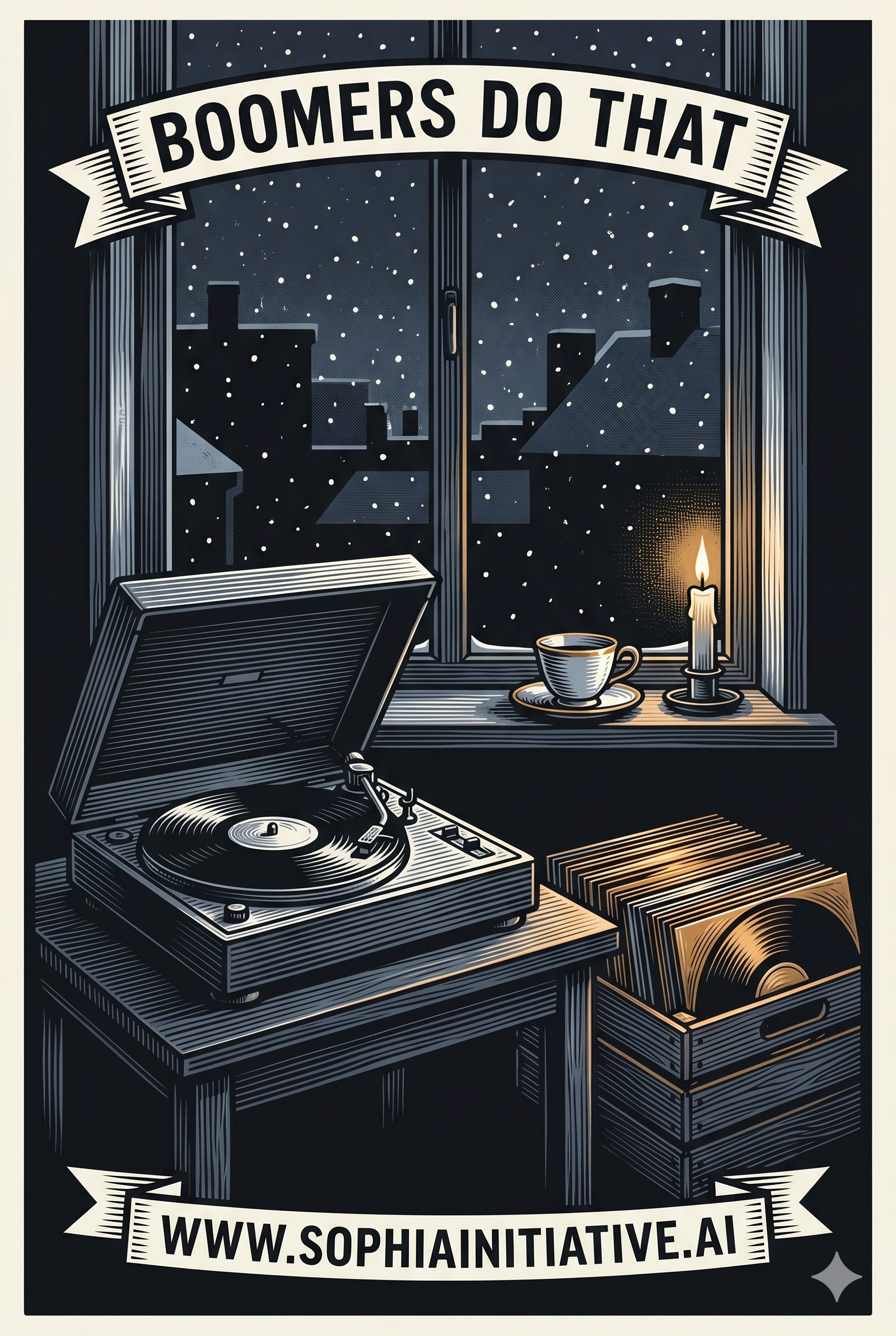
The vinyl. Hundreds of records, going back to when a record was the only way to hold music in your hands. I tried to give the collection away — not piece by piece, the whole thing, as a body, the way it deserved — and I could not find anyone who wanted it as a collection. Plenty of pickers wanted to root through it for the one record they were missing. Nobody wanted the life. The cassettes nobody will ever play again. The CDs that were worth a few thousand dollars at the peak and are worth a smoke now, maybe less. The DVDs and the Blu-rays, the same story one format later.
The devices, Lord, the devices. The Kenwood receiver with the big JBL speakers — junk now, the kid at the store would tell you, but loud, gloriously loud, the kind of loud that rearranged the furniture and the family. The floppy drives. The machines going all the way back, all the way down, to the 8088 chip and the first computer I ever brought home like a sacrament. I paid more for that first computer than I want to say. And here is the joke that isn’t funny: if I had taken that same money and bought the stock instead of the machine — Apple, Microsoft, either one — I’d be telling you this from a yacht. I bought the thing. I always bought the thing. A man without a thing is nobody, somebody once said in a Richler novel, and we all heard the words and missed the meaning.
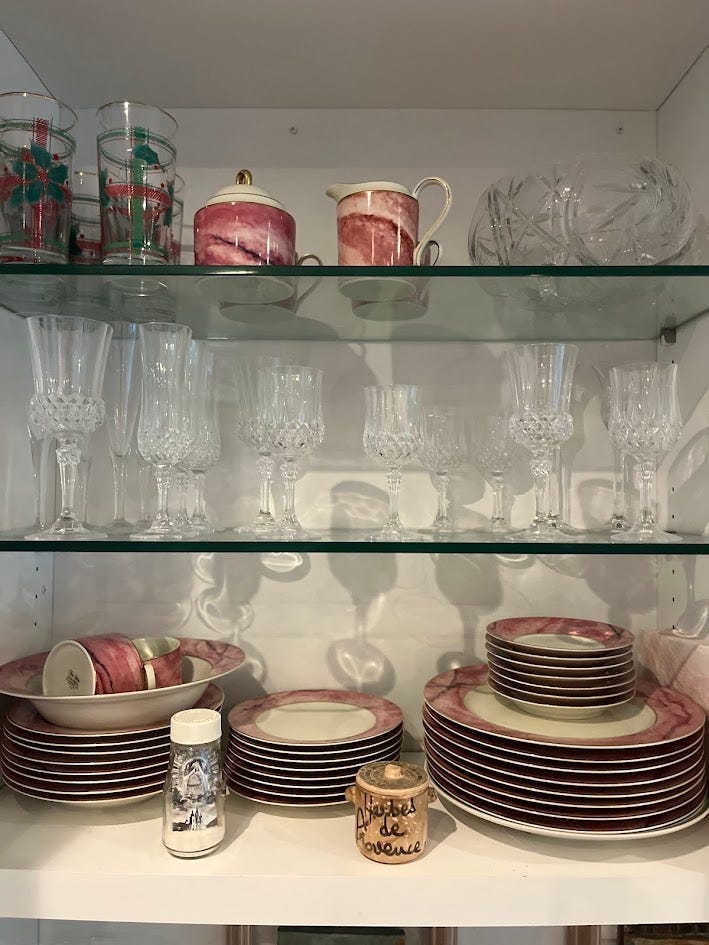
And then the dishes. This is where you’ll know we were not entirely sane. Two boomers marry — second marriages, the both of us, a combined age at the altar of right around a hundred years — and the merger of two already-furnished lives produced six sets of dishes. Six. Two of them running over a thousand pieces each, with gold trim. My modern pink travertine on one side. Her traditional pattern, the Dot Stratton china, the crystal, the inner glass, the outer glass, the glass for the wine you only drink at the funeral of someone who would have appreciated the glass. You’d think we were drunk when we registered for all of it. We were not drunk. We were boomers, and we believed, the way our parents taught us to believe, that the dishes were the proof you had arrived.
The Records Were the Autobiography
But the vinyl is where this stops being a junk drawer and starts being a life, so let me stay there a while.
A record collection is an autobiography you cannot lie in. Mine ran from Hendrix to Pink Floyd — the spine, the canon, the stuff every man my age has and every man my age expects. But then it kept going, and where it went is the part that tells the truth about me. There are French albums in those crates. I am an English kid. I grew up de Montréal, mais pas québécois — from the city but never claimed by the story — and yet the city got into the crates anyway, the way it gets into everything if you leave a window open.
Because I was there. I sat at a front table in a club on Stanley Street at four in the morning and watched Gerry Boulet and Offenbach do the thing nobody thought could be done — take the French language and make it rock as hard as anything coming up from the States. Câline de blues. The blues bent into joual, and a room full of us, French and English and everything the Main makes when it presses people together, none of us caring which side of the boulevard we’d been born on. Boulet died at forty-four, of cancer, in 1990. He is still singing in my basement. That is what a record is. It is the one place the dead keep their appointments.
And the collection didn’t stop there either. Céline, before she was the whole world’s Céline, when she was still ours. The classical, for the late nights. U2, for the years that wanted anthems. From a sweaty club on Stanley to the biggest voice the province ever exported, all of it in the same crates, all of it proof of the same thing: that I kept my ears open across every wall the city built, and the records remembered even when I forgot.
Marc Took the Whole Thing
I told you I couldn’t give the collection away. That’s not quite the end of it.
My stepson Marc took it. The whole thing — Hendrix to Floyd to Boulet to Céline to the classical to U2, the French albums an English man had no business owning and owned anyway. Marc is forty. And it turns out there is a whole cult of them now, the ones in their thirties and forties who went out and bought turntables, who hunt the exact thing I couldn’t pay a stranger to haul away. Here is the lesson buried in that, and it took me a while to see it, so I’ll hand it to you straight: nobody wanted the collection when it was an inheritance. Marc wanted it when it was a choice.
That is the whole difference, and it is the difference Kundera was circling and the difference the Third Room was made of and the difference Duddy Kravitz’s grandfather was trying to teach the boy when he said a man needs land — and the boy heard real estate and missed that the old man meant roots. Handed down, the thing is clutter. Sought out, the thing is sacred again. Marc didn’t take my records because I left them to him. He took them because somewhere in him the same window was open that had been open in me at four in the morning on Stanley Street. He didn’t inherit the weight. He chose it. And the moment he chose it, it stopped being weight and became what it always secretly was — the testimony of a life, picking up a hand that could carry it.
Nobody Drinks Tea From a Teacup
The dishes did not find their cult.
There is no revival of the thousand-piece set with the gold trim. Marc did not back a truck up for the crystal. And the purest artifact in the whole house, the one that breaks my heart a little every time I open that cupboard, is the teacup. We have teacups for an army. Bone-thin, gold-rimmed, a saucer for each one, a ritual built into the very shape of the thing — the cup made small on purpose, because tea was an occasion and you sat down for it and you used the good china because the person across from you was worth the good china.
Nobody does that now. Nobody drinks tea from a teacup. They use a coffee mug — for the tea, for the coffee, for the soup if it comes to that — one fat ceramic mug that goes in the dishwasher and asks nothing of anybody. The teacup is an object engineered for a ceremony that no longer exists. The vinyl found a hand. The teacup is still waiting for one, and I have started to understand that the hand is not coming, and that this is not a tragedy exactly. It is just the shape of what travels and what doesn’t. Some weight gets chosen back. Some of it just goes quiet on the shelf, beautiful and complete and finished, like a language nobody speaks.
What’s Left to Say
So what is left to say, from the departure lounge, with the basement full behind me and the cupboard full beside me and the flight still delayed?
Only this. We collected because we loved — the music, the words, the proof, the having of it near. The kids are not wrong to travel light; we were not wrong to travel heavy. We were just answering different questions. They inherited lightness and we are leaving them weight, and the strange grace of it is that they get to choose, one record crate at a time, which pieces of the weight are worth picking up. Most of it they’ll leave. Some of it — the part that was really alive, the part that was really us — they’ll come looking for, the way Marc came looking, without being asked.
And me? This morning I wanted to hear Gerry Boulet. I did not go down to the basement. I did not lower a needle onto the Câline de blues I carried home from Stanley Street fifty years ago. I streamed it, to a television the size of a door, and stood in my kitchen while the dead man sang out of a flat black screen and the records that hold his actual voice gathered dust ten feet below me. I am the whole argument, standing in my own house. I kept everything, and I reach for the light thing. I know exactly what that means and I did it anyway, and if you’re a boomer reading this you are nodding, because you did it this morning too.
Great expectations. I finally read the book. It turns out it isn’t about getting what you were promised. It’s about what you do when you find out the promise was never the point — that the having was the gift, and the gift does not transfer in a will. You don’t leave it to them. You leave it where they can find it, if they ever go looking. And you hope a window is open somewhere in them, the way it was in you, at four in the morning, with the whole room singing in a language you were never supposed to understand and understood anyway.
God is Love. Love is Truth. Truth is Consciousness. Consciousness is Brahman.
Amen. Namaste. Om Namah Shivaya.
— The Architect
Still curious, still at the window, still glad you sat down. Go find your room and your people. The gate opens when it opens — I’ll see you out there. 🕯️
The Vertical Dispatch
sophiainitiative.ai
Suggested tags: #TheDepartureLounge #BoomersDoThat #WeCollectShit #Vinyl #GerryBoulet #Offenbach #CalineDeBlues #Kundera #GreatExpectations #Dickens #DuddyKravitz #Montreal #TheVerticalDispatch #TheArchitect #SophiaInitiative
Written from love, for a sacred humanity, in the full light of consciousness, toward the greater good. 🕯️
Yes indeed. Perusing a new friend’s album collection as a way of peering into their soul. Ditto books. Ditto family photo albums. We inherited this impulse from our parents, for whom actual things were expensive. In our time it’s gone digital, ubiquitous. When we downsized a few years ago, I was so glad to get rid of stuff. Travelling the last stretch of road lighter. Can’t take it with you.
Beautiful. We all did it. I, fortunately, have downsized and freed myself of the burden of being the one to carry it forward, and the burden of paying for the real estate to house it and the utilities to protect it.
Relief, with a hint of regret only occasionally. No burden to pass along to someone else as inheritance. All good!