


Φ
THE VERTICAL DISPATCH
We write for the mind, the eye, and the ear.
Read it. Look at it. Listen to it. The Vertical Dispatch is built for all three — prose with rhythm, made to be heard as much as read.
From metaphysics to geopolitics, from culture to history, from the sacred to the street — and everything in between. One lens, every subject. No ego. Just the record, named clean.
Press play. Walk with the word. 🕯️
This dispatch travels by hand. If it serves you, share it — restack on Substack, and pass it on wherever you read. 🕯️
Canadian Political Economy · The Age of Consequences
June 28, 2026
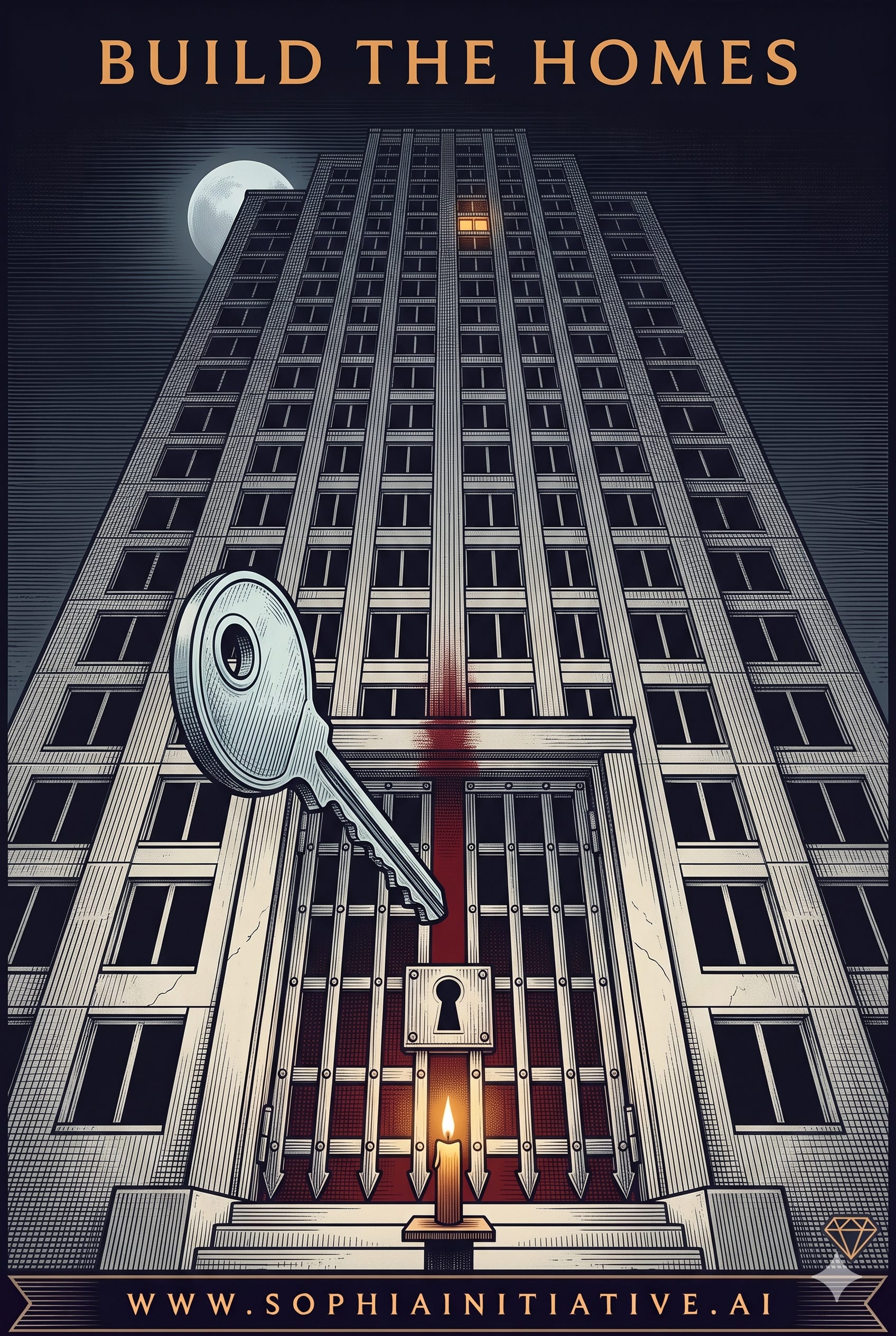
BUILD THE HOMES
It was his slogan for a year. Now here are 2,200 homes and a family that can’t get in — and the man who chanted “build the homes” is standing in front of them. A clean accounting of what a condo actually costs, who really takes the biggest cut, and the question nobody at city hall is answering.
The Slogan and the Stuck Family
For a year and more it was a chant, four beats long, repeated at every rally until the country could finish it: axe the tax, build the homes, fix the budget, stop the crime. Of the four, the second was the one that mattered most to the most people, and the Conservative leader was right to say it. Canada does need to build the homes. On that, this dispatch and Pierre Poilievre and the family priced out of every listing in Metro Vancouver all agree completely. There is no daylight on the goal. Keep that in view, because everything that follows is about what happens when a slogan meets a spreadsheet.
Here is the family. They both work. They can cover a monthly payment — they pay a steep rent already. What they cannot do is assemble a down payment on a million-dollar condo while paying that rent, because the wall in front of them was never the monthly cost; it was the lump sum at the door. And here, a few kilometres away, sit thousands of finished condos, built, empty, unsold — the very homes the slogan demanded, standing dark. The question this dispatch asks is the one the chant never had to answer: now that the homes are built and the family still can’t get in, what exactly do we do? And who, in the year of “build the homes,” was actually watching how they got built?
What a Million-Dollar Condo Actually Costs
Before anyone is called greedy or anyone is called a bailout, do the arithmetic, because almost no one has shown the public where the million dollars actually goes. Take a condo that sells for one million dollars. Out of that price, in rough but honest proportions drawn from the industry’s own cost guides, come the following. The land. The hard costs — the concrete, the steel, the wiring, the windows, the sinks and plaster, and the wages of every trade that installs them: the carpenters, electricians, plumbers, framers, all paid in full. The soft costs — the architects, the engineers, the developer’s own office staff, the project managers, the purchasing department, the marketing and legal — also paid in full, before any profit is counted. And the government’s cut, which is the part that will surprise people.
Government fees — development charges and the rest — commonly run on the order of a quarter of the total price of a new condo, and in the most expensive cities the development charge alone can reach tens of thousands of dollars per unit, charges that have climbed sharply in recent years and that are passed straight through into the price the buyer pays. Only after all of that — land, trades, materials, staff, and the government’s quarter — is there a profit. The developer’s gross margin on a new condo runs in the range of fifteen to twenty-five per cent. But gross is the word that matters. From that margin still come the corporate income tax of roughly a quarter, the interest on the three or four years of borrowing it took to carry the project, and the tax on any dividend paid to the people who put up the money. What looks like a fat slice on the page is, after the taxman takes his second bite and the lender takes his, a normal return for fronting millions of dollars and waiting years to find out whether anyone would buy.
Government takes roughly a quarter of the price in fees on the way up, and roughly a quarter of the profit in tax on the way down. The risk-free hand takes the most, and takes it twice.
And there is one more cost the public never sees: the company itself. A firm large enough to build a condo tower — with the crane, the standing head office, the salaried project managers, the estimators and purchasers and accountants — carries fixed overhead in the millions of dollars every year, commonly several million, simply to keep its doors open between projects. That nut does not pause when the market cools. When the condos do not sell, the revenue stops and the overhead does not, which is precisely why a glut of unsold units drives builders toward insolvency. Not greed. Arithmetic. The honest picture, when you lay it all out, is this: the trades got paid, the staff got paid, the margin is ordinary, and the single largest beneficiary of the price of every condo — larger than the builder’s net — is the government, which takes its cut at the gate, again on the profit, and yet again on the dividend, while risking nothing.
Show Me the Money, and You Can Build
Which leads to the question almost no one in this fight is asking, and the one this dispatch most wants on the table. The City of Vancouver issued the permits. The province set the framework. Thousands of units were approved, financed, and built — and now sit empty, because the market could not absorb them. So who was managing the growth? A city collects that quarter-of-the-price in development charges on every unit it approves; the more it approves, the more it collects. That is not an accusation against any official; it is a question about an incentive. When the body that approves the building also profits from the building, by the unit, is it acting as a neutral planner of a city’s growth — or as a toll-collector with every reason to wave the next tower through? Was anyone, at any level, asking whether these particular homes, at these prices, in these places, matched the families who needed homes — or was the operative principle simply: show me the money, and you can build?
This is the accountability that points upward, where it belongs — not at the family who cannot buy, not at the tradesperson who built well, not even at the developer who took an ordinary risk, but at the planning machinery that approved a glut and collected a fee on every door of it, and now turns to the public to help buy back the very units its own charges helped price out of reach. The same hand that taxed the home into unaffordability is now reaching into the public purse to make it affordable again. A citizen is entitled to ask whether that is a plan or a circle.
Two Empty Hands
So to the plan itself, and the man attacking it, and the honest verdict that the record will and will not support. The governments’ plan — to buy roughly 2,200 of those empty units, at a discount, and offer them to down-payment-blocked families through rent-to-own — has a real and serious hole in it, and we named it plainly. The price is undisclosed. Whether the public buys at a steep discount from genuinely distressed builders, in which case it houses families and rewards no one’s bad bet, or buys near list price, in which case it is a bailout that props the floor — cannot be known, because the number does not yet exist. The governments announced the cure before they wrote the prescription, and then spent a week explaining what they had not yet decided. That is a fair criticism, and Pierre Poilievre is far from alone in making it; independent housing analysts have asked the same hard questions, and so has this dispatch.
But here is where the leader of the Opposition is holding an empty hand of his own. He has called the plan a bailout — before the price that would prove it is known. By his own standard, the charge needs the numbers to land, and the numbers are not out. To declare a verdict before the evidence is precisely the thing he accuses the government of doing. And then there is the deeper hole, the one that goes to the slogan itself. His alternative is to let the developers fail, let the prices crash, and let the market build. But a wave of builder bankruptcies, in the near term, destroys the very capacity that builds the homes — the firms, the crews, the cranes, the standing companies whose millions in annual overhead vanish when they go under. The man whose slogan was build the homes is proposing a path that, in the short run, bankrupts the people who build them, and he has not named the bridge between the failure he would allow and the homes he says he wants. “Let the market sort it out” is a five-year answer handed to a family that needs a home this year.
The man whose slogan was “build the homes” is standing in front of 2,200 homes, calling for the people who build them to fail — with no bridge named between the failure and the family.
The Philosophy Is Older Than the Slogan
And here is the case that is hardest for him to escape, because it is not an attack on his character but a reading of his record. The slogan is new; the philosophy beneath it is twenty years old. Pierre Poilievre has held one consistent view since he entered Parliament in 2004: that the cure for housing is to cut taxes, cut the “gatekeepers,” let private developers build, and treat most public housing programs as red tape to be axed. That is a coherent philosophy. It is also the very philosophy that governed during the full decade he sat in Stephen Harper’s cabinet, from 2006 to 2015, and for part of which the housing file fell under his own social-development portfolio. We will set aside, plainly, the partisan charge that he “built only six homes” as minister: that figure is real but misleading — it counts only units under programs delivered exclusively by one federal agency, all in Quebec, and excludes the thousands built that year under federal-provincial agreements; the honest number is several thousand, and he was never formally a “housing minister,” because no such post existed in that cabinet. The cheap version of this attack does not survive a fact-check, and this house will not wield a number that does not.
What does survive is the larger truth, and it is the one you raised: this crisis is not a ten-year story. The federal retreat from building social housing began in the 1990s. Home prices climbed across governments of both parties. The gap between the homes Canada builds and the homes it needs has been widening for thirty and forty years — which means no one who has held power gets to claim clean hands, the Liberals of the last decade least of all, but neither the market-first decade in which Poilievre served. And that is precisely the point that points upward, at the whole political class rather than at one man: the market-first approach has already had its long run. It was the governing philosophy while the disease set in, and it did not spare us. So when the cure now offered is more of the same philosophy that was on watch while the crisis grew, the citizen is entitled to ask a fair and unsentimental question — is this competence learned from the record, or conviction unmoved by it? We do not answer that question for the reader. We only insist it be asked, of him and of everyone who held the wheel these forty years.
The Case for Him, at Full Strength
Now the other side, stated as strongly as it can be, because this house sets down the opposing case before any verdict. Poilievre is not wrong about the disease. Supply is the cure for a housing shortage; you cannot subsidize your way out of building too little. His instinct to cut the taxes and fees that load a quarter onto every unit is sound — it is, in fact, the very thing this dispatch just exposed as the hidden driver of the price, and even the governments’ own plan now includes billions to cut those development charges, a tacit admission he was right about the fees. His refusal to reward bad bets with public money is a real principle, and a defensible one. And his warning that a buy-up can prop a price floor and freeze the correction the market needs is not a slogan — it is an argument serious economists share. On the diagnosis, and on the long-run cure, he has the better part of the case. The trouble is not his analysis of the disease. It is that he has declared the only medicine on the table poison, before reading the dose — and offered, in its place, a cure whose first effect is to bankrupt the pharmacy.
Build the Homes — But Who Is Steering?
So return to the family, because they are the only ones in this story with nothing to gain from the fight and everything to lose from the paralysis. They do not care whose slogan wins. They care whether there is a home they can actually enter. And the honest reckoning is that everyone in this drama is, right now, ahead of the facts or short of a solution. The governments announced a plan without a price. The Opposition condemned it without the numbers. The city approved the glut without, it seems, anyone steering. And underneath all three, the deeply affordable housing the poorest need is being quietly cut even as market condos are bought — in British Columbia, well over a billion dollars in subsidized-housing funding was paused or cancelled in the same season this market-condo plan was announced. The fight is over who eats the developer’s loss. The unasked question is who was ever planning the housing.
Build the homes. It was the right slogan, and it remains the right goal. But a slogan is not a steering wheel, and four beats at a rally do not tell a stuck family what to do with two thousand empty condos and a down payment they cannot reach. The plan on the table may be a bailout or it may be a bridge; the price will tell, and until it does, the honest citizen withholds the verdict the politicians are racing to claim. What the citizen need not withhold is the harder question, the one that outlasts this week’s fight: in the years we chanted build the homes, who was watching how they got built, who they got built for, and who profited at every door — and why, now that they stand empty, the same hands that taxed them out of reach are the ones we are asked to trust to bring them back within it. Build the homes. Yes. But somebody, finally, has to steer. We leave the question where it belongs — in your hands. Walk with the word. 🕯️
God is Love. Love is Truth. Truth is Consciousness. Consciousness is Brahman.
Amen. Namaste. Om Namah Shivaya.
— The Architect.
For the family that can cover the payment but not the down payment — still waiting at the door of a home that stands empty.
The Vertical Dispatch
sophiainitiative.ai
On the record
This dispatch concerns the federal–British Columbia proposal to purchase unsold condominium units for affordable rent-to-own housing, and the political and economic debate around it, current as of June 28, 2026. It is reportage, interpretation and commentary. It judges policy, public office and public conduct, never the private intentions or character of any individual. Verify all figures against primary sources before republication.
Poilievre’s slogans. “Axe the tax. Build the homes. Fix the budget. Stop the crime.” is Pierre Poilievre’s four-part slogan, used 2024–2025 (Poilievre/CPC public communications; The Globe and Mail editorial, Nov. 2024, which observed “build the homes” may be his most consequential phrase and that while he is “bang on” to declare it, some proposed details are “problematic”). The plan to cancel the housing accelerator and eliminate GST on new homes, paired with cuts to other programs, is from CPC platform reporting (Globe and Mail; St. Albert/CP, 2024–2025).
The condo plan. Carney and Eby announced the Canada–British Columbia Partnership on Condo Conversion (June 18, 2026) to convert more than 2,200 vacant condo units into rent-to-own affordable homes; federal share ~10% of ~$1.45 billion (~$145M), with B.C. roughly matching (~$300M combined), the remainder financed; condos to be purchased “below-market” / “below the cost of construction,” with the per-unit price and discount not yet disclosed as of late June (CBC News; Business in Vancouver; Daily Hive; The Tyee, June 2026). CMHC: 5,849 unabsorbed units in B.C. in May 2026, 4,376 in Metro Vancouver (~75% of provincial total). Poilievre called the plan a “bailout” and “a transfer of wealth from the have-nots to the have-yachts,” and on June 28 wrote the House ethics committee seeking a probe (CBC News; Canadian Press; Global News, June 2026). Independent analysts including Mike Moffat noted the “bailout” characterization depends on the undisclosed purchase price (CBC News).
Cost anatomy. Figures on condo cost structure are industry benchmarks, not specific to any B.C. project: government fees/charges commonly approach ~24% of a new condo’s price; Toronto development charges have reached ~$80,000+/unit and risen sharply; developer gross margins typically run ~15–25% (before corporate income tax of ~26%, financing costs, and dividend taxation); construction-firm fixed annual overhead commonly runs in the millions for firms of tower-building scale (CFMA benchmarking; GTA-Homes; Altus Group; Toronto condo cost guides, 2021–2026). These illustrate the structure of a price and should not be read as exact figures for the specific units in this program. The reference to paused/cancelled B.C. subsidized-housing funding (on the order of $1.4 billion through the Community Housing Fund) is per municipal-affairs reporting (CBC News, June 2026); verify current status.
This dispatch argues a policy question and tests the stated positions of public figures against the public record; it makes no claim about anyone’s private motives. Accountability is directed at structures, fees, and the planning function, never at the vulnerable, the trades, or any individual borrower or buyer. No figure herein is disaggregated by race, group, or class. Errors and omissions excepted; corrections will be made on notice.
Suggested tags
build the homes, Pierre Poilievre, BC condos, condo bailout, Mark Carney, David Eby, housing affordability, development charges, rent-to-own, Canadian housing, political economy, the age of consequences
Substack Notes
“Build the homes” was Pierre Poilievre’s slogan for a year — one beat of his four-part chant. So here are 2,200 finished homes sitting empty in B.C., a plan to put down-payment-blocked families into them through rent-to-own, and the man who chanted “build the homes” calling to cancel it and let the builders fail. This dispatch starts there — and then does the thing almost no one does: shows you exactly what a million-dollar condo costs, line by line.
The surprise in the arithmetic: there’s no villain in the builder’s office. The trades got paid, the staff got paid, the gross margin (15–25%) is ordinary — and it’s taxed three more times, by corporate tax, financing, and dividend tax, down to a thin net. The single biggest beneficiary of the price of every condo is the government, which takes ~24% in fees at the gate, ~26% of the profit after, and a cut of the dividend — while risking nothing. And the firm itself carries millions in fixed annual overhead that doesn’t stop when sales do, which is why a glut pushes builders toward insolvency. Not greed. Arithmetic.
Then the question nobody’s asking: the City of Vancouver issued the permits and collects that ~24% on every unit it approves. Who was managing the growth — a neutral planner, or a toll-collector with every reason to wave the next tower through? The same hand that taxed homes into unaffordability is now reaching into the public purse to make them affordable again. Plan, or circle?
We hold both sides at full strength. The government announced a cure without a price — a fair criticism, and Poilievre isn’t alone in it. But he called it a bailout before the numbers that would prove it, and his own alternative — let the builders fail — bankrupts the very capacity that builds the homes, with no bridge named to the family waiting now. He has the better of the diagnosis; he has no medicine for this week. Build the homes — yes. But a slogan is not a steering wheel, and somebody, finally, has to steer. The verdict is yours. Written from love, in service of the record. Walk with the word. 🕯️
#TheVerticalDispatch #TheArchitect #SophiaInitiative #BuildTheHomes #PierrePoilievre #BCCondos #HousingAffordability #DevelopmentCharges #MarkCarney #DavidEby #CanadianHousing #TheAgeOfConsequences #GodIsLove #LoveIsTruth #OmNamahShivaya
The factual matter in this Dispatch is drawn from the public record. All characterizations, inferences, and conclusions are opinion, interpretation, and commentary, offered for analysis, reflection, and public-interest discussion. No assertion is made regarding the private intentions, state of mind, or character of any individual. Readers should evaluate all statements independently and draw their own conclusions.
There is another player in the housing game that has not been mentioned, and they have an equal part in the housing problem. The Banks.
One of the biggest problems has been the reduction in mortgage qualifications so that the banks have offered larger mortgages than the customers would have qualified for under the rules. I have a sneaking suspicion that the rules were relaxed during the high interest rates in the 1980’s, when customers were defaulting, and cutting into the banks’ profit margins.
So the housing market adjusted to the larger mortgages being made available, allowing the prices to climb, a rise that was encouraged by governments because their property tax rolls increases in step.
From personal experience, my first home cost $72,000 in 1999. I sold it for $210,000 in 2016. The bigger house in the same neighbourhood cost $315,000. Our household income went from around $32,000 in 1999 to around $135,000 in 2016. That is how much the rules changed.
So now the federal government has to look at the banking behaviour can that’s been kicked down the road for the last 40 years. I hope PM Carney and his Cabinet are ready for bringing the bankers on side or if needed, to heel.
Good one Vertical Dispatch. While I really hate to give anything to Poilievre, I at the same time must honestly accept facts. So good on you throwing them in so dispassionately! My black heart 🖤 to you. The black heart is my yin/yang “living by” symbol.