


Pierre Poilievre is a relentless and calculating political fighter. But when fighting means working against Canada’s plan at the most consequential moment in a generation, that is not opposition — it is a liability. The record makes the case.
He lost his seat — and how he got a new one matters
Let us start with a fact that tends to get buried. In the April 2025 federal election, Pierre Poilievre lost his own seat. He was defeated in Carleton — a riding he had held for over twenty years — by Liberal candidate Bruce Fanjoy, by more than 4,500 votes. He became the first Conservative leader to lose his own seat since Kim Campbell in 1993.
What happened next is worth examining carefully. Mark Carney, at his very first post-election press conference, was explicit: he would call a byelection for Poilievre as soon as legally possible. No delays, no games. His exact words: “I will ensure that it happens as soon as possible. No games. Nothing. Straight.”
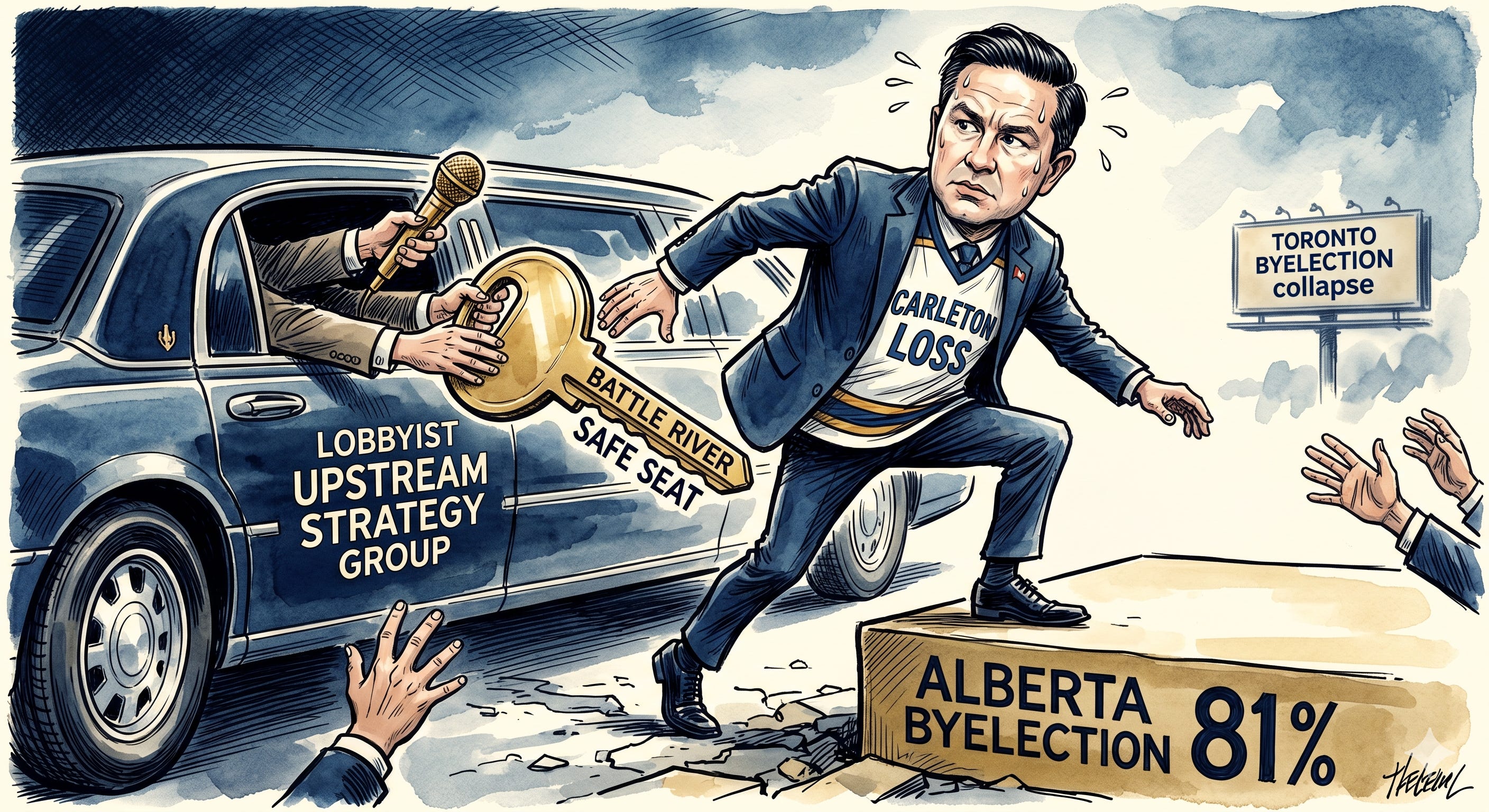
That byelection was held in Battle River–Crowfoot, Alberta — a riding that had just been won by Conservative MP Damien Kurek with over 82% of the vote. It is widely regarded as one of the safest Conservative seats in the entire country. Kurek voluntarily stepped aside so Poilievre could run there. Following his resignation from Parliament, Kurek joined Upstream Strategy Group, a Toronto-based government relations and lobbying firm, as a principal.
Poilievre won the August 2025 byelection with nearly 81% of the vote. He then returned to Parliament and immediately resumed attacking Carney for — of all things — backroom deals.
Carney played it completely straight, gave Poilievre the earliest available date, and Poilievre was handed the safest Conservative seat in Canada. He should choose his words carefully when the subject is backroom deals.
April 13, 2026: not a loss — a collapse
On April 13, 2026, the Liberals won all three byelections — University–Rosedale, Scarborough Southwest, and Terrebonne — securing a majority government. The Conservative performance was not simply a loss. It was a collapse.
In University–Rosedale, the Toronto riding previously held by Chrystia Freeland, Liberal candidate Danielle Martin took approximately 65% of the vote. The Conservative candidate finished with roughly 12%, down from around 18% in the 2025 general election. In Scarborough Southwest, Liberal Doly Begum won by a margin of nearly 2,300 votes, with the Conservative candidate pulling about 15%, down from 22% a year earlier.
The most dramatic numbers came from Terrebonne, Quebec. Conservative candidate Adrienne Charles received approximately 3% of the vote — down from 18% in the 2025 general election, a drop of fifteen percentage points in a single year. Pollster Nik Nanos did not mince words: “Conservative support is at 3.3 per cent, a far cry from 18 per cent. If you’re a Conservative strategist looking at this number, you’re going to be asking yourself questions — this is just another signal.”
These are not the numbers of a party consolidating in opposition. They are the numbers of a party that is losing the argument everywhere outside its rural western base.
Four Conservative MPs have walked out the door
Poilievre talks a great deal about betrayal. But consider what it takes for a sitting MP — someone elected under your banner, someone who knocked on doors for your platform — to resign from your caucus and join the other side. It is not a casual act. It is a public, career-defining statement that carries real electoral risk. Since November 2025, four Conservative MPs have made exactly that statement.
Chris d’Entremont of Nova Scotia was the first, in November 2025. He cited Poilievre’s leadership style directly as a reason for leaving. Michael Ma of Markham–Unionville, Ontario, crossed the floor in December — a newly elected MP who had been at the Conservative Christmas party the night before. Matt Jeneroux of Edmonton Riverbend, Alberta, followed in February 2026. He said it was Carney’s speech at the World Economic Forum in Davos that convinced him he could no longer sit on the sidelines. Marilyn Gladu of Sarnia–Lambton, Ontario, was the fourth, in April 2026 — a Conservative MP since 2015, and a woman who had personally endorsed Poilievre in his 2022 leadership race.
These are not fringe figures or disgruntled backbenchers. Gladu had been one of the most recognizable faces in the Conservative caucus for a decade. Dimitri Soudas, a former top aide to Stephen Harper, said plainly that her departure — more than the previous ones — weakened Poilievre’s leadership, because she was, in his words, “a true-blue conservative.”
Meanwhile, two Conservative sources told CBC News that the caucus was demoralized. Poilievre’s own director of communications resigned the same week Gladu crossed the floor. His office had been sending letters to critic MPs asking them to justify their roles — letters that caucus members described as insulting and off-putting.
When four of your own MPs — qualified, professional, longstanding representatives — walk out publicly, the question is not what happened to them. The question is what is happening inside the leadership that makes leaving look like the better option.
The floor-crossing history nobody is telling you — because it destroys the argument
Pierre Poilievre has used the word betrayal so many times in the last five months that it has almost lost meaning. He calls the floor crossings dirty backroom deals. He says Carney is seizing a majority that voters denied him. He demands byelections. He talks about democratic principle as though it were a hill he has always stood on.
He has not. And the record is long enough, and specific enough, that it deserves to be laid out in full. Because no one else seems to be doing it.
The numbers first
Since Confederation in 1867, more than 300 Canadian MPs have changed party affiliation while in office. Library of Parliament data shows approximately 80 have done so in just the last 25 years alone. Floor crossing is not an aberration in Canadian parliamentary history. It is woven into the fabric of it. Of all the parties, the Conservative family has the longest list of departures — 99 MPs have left Conservative or Progressive Conservative caucuses over the history of Parliament, more than from any other party. As of April 2026, the Conservative Party’s net floor-crossing balance stands at minus 7, its worst position in history. That is the numerical context. Now for the cases that matter.
1917 — The conscription crisis: Conservatives engineer their own mass crossing
The first major floor-crossing crisis involving the Conservative family was not caused by the other side. It was orchestrated from within. Prime Minister Robert Borden, a Conservative, formed a Union Government during the First World War by actively recruiting Liberal MPs to cross the floor and support mandatory military service. Dozens crossed to sit as Unionists. In response, a number of Quebec Conservative MPs walked the other way and joined the Liberals over their opposition to conscription. The entire episode was a government-engineered, mass floor crossing — organized by a Conservative prime minister when it served the national agenda he was pursuing. The principle of democratic mandate did not appear to trouble him.
1977 — Jack Horner: a Conservative Alberta MP walks straight into Trudeau’s cabinet
Jack Horner had been a Progressive Conservative MP representing an Alberta riding since 1958 — nearly two decades of service. He ran for the PC leadership in 1976 and lost to Joe Clark. The following year, 1977, he crossed the floor to sit with Pierre Trudeau’s Liberal government and was immediately given a cabinet position as Minister of State for Economic Development. He lost his seat in the 1979 election. The Conservatives were outraged. But no one argued it was a structural attack on democracy.
2001 — The Alliance implosion: thirteen Conservative MPs walk out at once
This episode is almost entirely absent from the current debate — which is remarkable given how directly relevant it is. Over a period of just a few months in 2001, thirteen of the Canadian Alliance’s 66 MPs left or were suspended from the caucus in a rebellion against leader Stockwell Day. Some eventually rejoined. Others formed what became known as the Democratic Representative Caucus, a separate parliamentary group that operated independently for months.
The schism was so severe it ultimately led to Day’s resignation as leader and directly triggered the merger negotiations between the Alliance and the Progressive Conservative Party that created the modern Conservative Party of Canada in 2003. The party that Pierre Poilievre leads today was born out of the largest single floor-crossing rebellion in modern Canadian parliamentary history. That is not a footnote. That is the origin story of his own party.
2003 — Scott Brison: PC to Liberal, the day after the merger vote
Within days of the vote that created the modern Conservative Party, Progressive Conservative MP Scott Brison crossed the floor to the Liberals. He said the party he had grown up with no longer existed and that he wanted to work with, in his words, a party fuelled by bold ideas rather than rigid ideologies. He went on to serve as a cabinet minister under both Paul Martin and Justin Trudeau, and was re-elected repeatedly in his Nova Scotia riding by wide margins. Voters accepted his reasoning. The Conservatives fumed.
2005 — Belinda Stronach: Conservative leadership candidate to Liberal cabinet minister
Belinda Stronach had run for the Conservative leadership in 2004 — one year before crossing the floor to Paul Martin’s Liberals in May 2005. She was immediately appointed Minister of Human Resources. Her vote, two days later, was decisive in keeping Martin’s minority government alive in a confidence vote that ended in a tie broken by the Speaker. Without her crossing, the government would have fallen.
Stephen Harper called it, at the time, an opportunistic, self-serving betrayal. The language was nearly identical to what Poilievre uses today. The critical difference is that Harper was in opposition when he said it — and one year later, as Prime Minister, he would do the exact opposite.
2006 — David Emerson: elected as a Liberal on Monday, sworn into Harper’s cabinet two weeks later
This is the case that should end the Conservative argument entirely — and it is the one that receives the least attention in current coverage.
On January 23, 2006, David Emerson was elected as a Liberal MP in the riding of Vancouver-Kingsway with 43.5% of the vote. The Conservative candidate received less than 20%. On February 6, 2006 — fourteen days later — Emerson arrived at Rideau Hall and was sworn in as Stephen Harper’s Minister of International Trade. He had not returned to his riding. He had not consulted his constituents. He had not resigned to trigger a byelection. His Liberal colleagues, the press, and most Conservatives did not know it was coming until he walked through the door.
The public reaction was fierce. An online Globe and Mail poll found 77% of respondents wanted Emerson to step down and run in a byelection. Ipsos Reid found that even in staunchly Conservative areas of British Columbia, 75% of people wanted a byelection called. An ethics inquiry was formally launched into whether Harper had offered an improper inducement — specifically, the cabinet position itself. The Ethics Commissioner ultimately cleared both men, but noted that the public’s sense that their vote had been devalued could not be dismissed as merely partisan. He called on Parliament to debate the practice.
Stephen Harper’s response to the outrage? He said Emerson would be accountable to his constituents for his decisions at the next election. He did not call it a betrayal. He did not demand a byelection. He gave Emerson a cabinet post, defended the decision, and moved on.
Harper accepted a Liberal MP two weeks after an election, gave him a cabinet job, and called it accountability to voters. Poilievre calls the same practice dirty backroom deals when the traffic runs the other way. This is not principle. It is arithmetic.
2007 — Wajid Khan: Liberal to Conservative, welcomed personally by Harper
In 2007, Liberal MP Wajid Khan, who had already been serving as a special adviser to Prime Minister Harper on Middle Eastern affairs while technically still sitting as a Liberal, formally crossed the floor and joined the Conservative caucus. Harper welcomed him personally. There were no demands from the Conservative benches for a byelection. There was no language about betrayal or backroom deals. There was a handshake and a press conference.
2018 — Leona Alleslev: Liberal to Conservative, greeted with a standing ovation
In September 2018, Liberal MP Leona Alleslev crossed the floor to join Andrew Scheer’s Conservatives, citing concerns about the economy, foreign affairs, trade, and military spending. Conservative MPs rose to their feet in the House and applauded. Scheer held a press conference welcoming her. There were no demands for a byelection. There was no talk of betrayal or manipulation. There was a standing ovation. Alleslev was re-elected in 2019 under the Conservative banner. She lost her seat in 2021. Voters had their say, as the system intends.
The polling reversal that says everything
An Angus Reid Institute poll conducted after the recent floor crossings found that 78% of recent Conservative voters now say floor crossing should be banned outright. In 2018 — the year Alleslev walked toward them — a majority of Conservative voters supported the practice.
The principle did not change. The direction of traffic did.
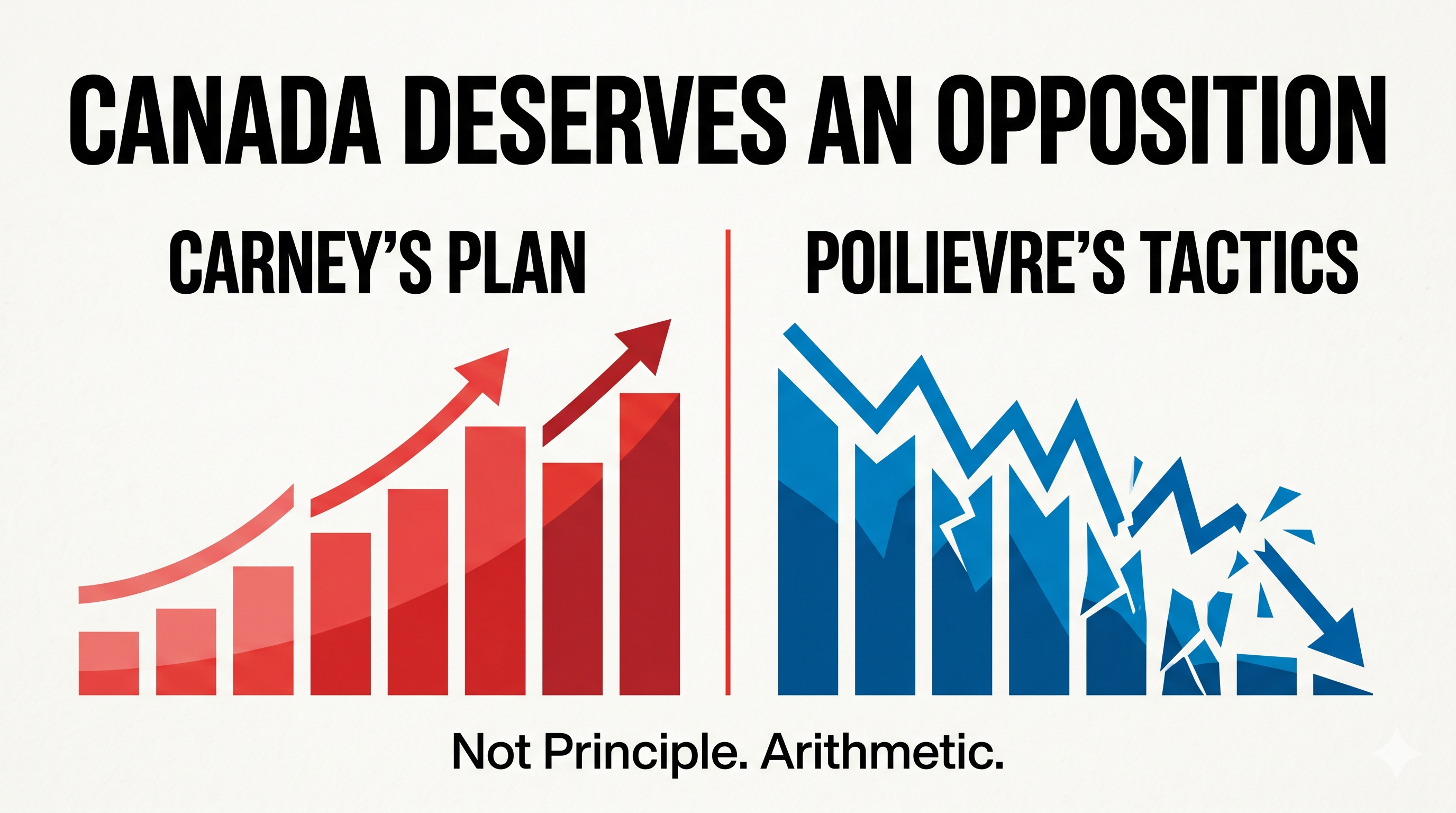
The Conservative Party has benefited from floor crossing at every stage of its modern existence — from the Alliance rebellion that created it, to Emerson, to Khan, to Alleslev. The outrage is not principled. It is a position of convenience, adopted the moment the numbers stopped working in their favour. That history belongs in the public record. Someone has to put it there.
The framework that explains what is actually happening — Elliott Jaques and the stratified organization
To understand why Poilievre’s approach is not simply ineffective but actively harmful to Canada at this particular moment, it helps to look outside political commentary altogether — to a body of work in organizational theory that is rarely applied to elected politics, but which maps this situation with unusual precision.
Elliott Jaques was born in Toronto, Ontario. He was educated at the University of Toronto and studied medicine at Johns Hopkins University before receiving his Ph.D. in social relations from Harvard University. He then trained as a psychoanalyst at the British Psychoanalytical Society. He was a founding fellow of the Royal College of Psychiatrists in Britain, a visiting professor at George Washington University in Washington, D.C., and an honorary professor at the University of Buenos Aires. He spent more than thirty years as an organizational consultant, most famously conducting a decades-long study of the Glacier Metal Company in Britain that produced some of the most rigorously observed research ever conducted on how human organizations actually function.
His central body of work — known as Requisite Organization theory and Stratified Systems Theory — developed one foundational insight: different levels of organizational work require fundamentally different cognitive capacities, and the most critical of these is the ability to manage time horizon and complexity simultaneously. Jaques argued that individuals are not simply smarter or less smart. They operate at genuinely different cognitive strata, and placing someone in a role that exceeds their stratum does not produce a stretched version of good performance. It produces a qualitatively different and usually destructive kind of failure.
He identified distinct strata of work. At the lower strata, the work is about execution, tactics, pressure points, and short time horizons — days, weeks, months. The feedback is fast and the results are visible. At the upper strata, the work involves building institutional frameworks, managing systems across decades, holding together many large abstractions simultaneously while making decisions whose consequences may not be visible for years. There is no fast feedback. There is no applause. The output of upper-stratum work is largely invisible — it is the crisis that did not happen, the framework quietly built, the relationship cultivated over years that pays off in a moment of national need.
Carney’s entire career is a study in upper-stratum work. Central banking is perhaps the most demanding expression of it in the civilian world. You are managing a national economy across a multi-year horizon, making decisions under deep uncertainty, accountable to institutional frameworks rather than to daily public reaction. When Carney stood before the World Economic Forum and laid out a vision for Canada’s repositioning in a fragmenting global order — building new trade relationships, anchoring institutional credibility, defining a long-term economic framework — he was operating at exactly the stratum Jaques described.
Poilievre, by contrast, is a genuine talent at the lower strata of political work. He reads a room, identifies the pressure point, delivers the line, controls the message cycle. These are real skills and they are not to be dismissed. They are the skills of a gifted opposition tactician. But Jaques was precise about something that the current political commentary is almost entirely missing: the problem is not simply that Poilievre is operating at a lower stratum than the moment requires. The problem is that he is directing his considerable tactical energy against the national plan itself.
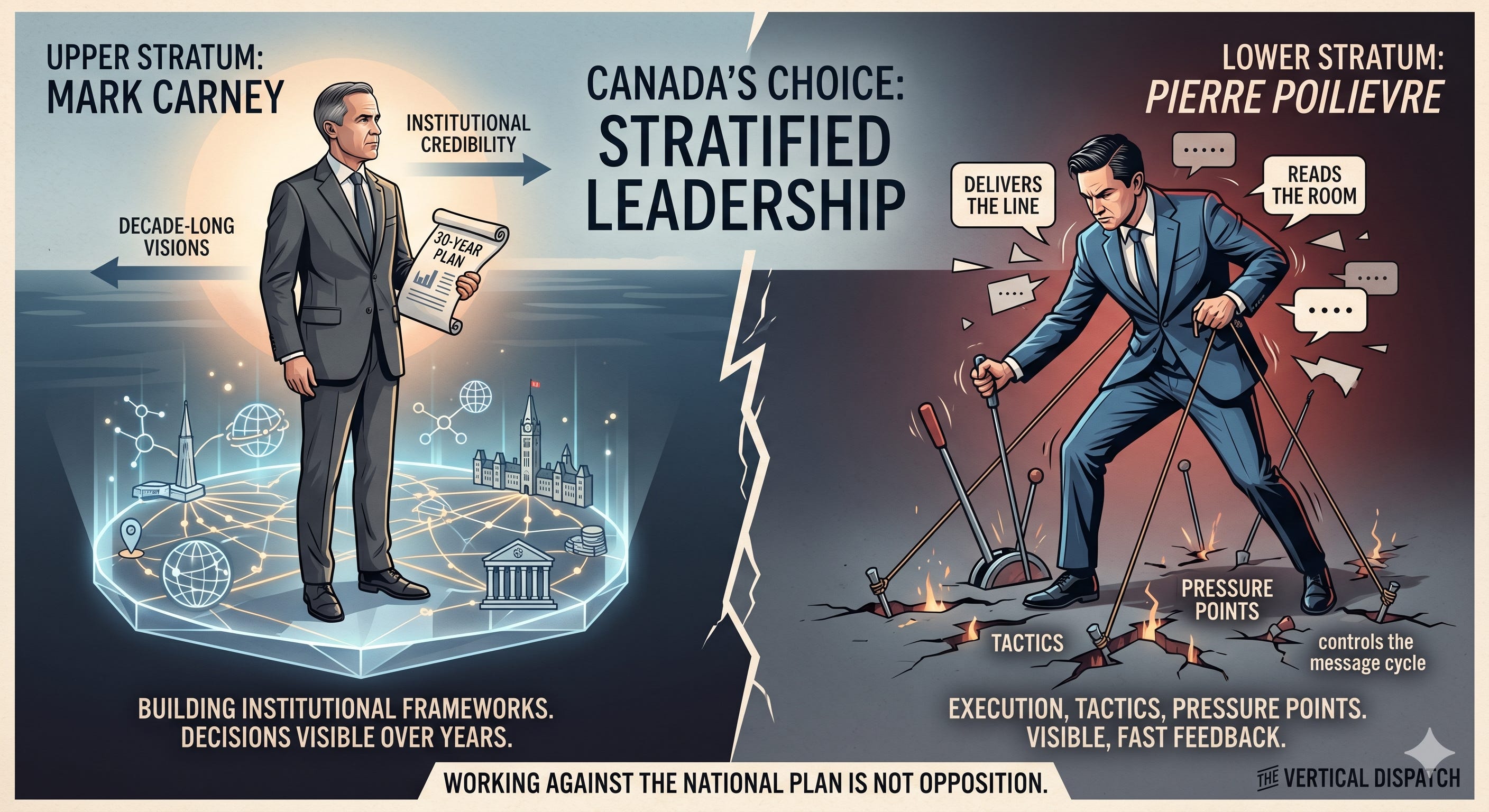
Jaques was unambiguous on this point. In a requisite organization, there is a fundamental distinction between challenging the methods of an organizational mission and working against the mission itself. The former is legitimate, necessary, and healthy — it is how organizations course-correct. The latter is not a performance issue or a stratum mismatch. It is a values issue. And in any well-functioning organization, it is a firing offence, regardless of the individual’s talent at their own level.
Canada right now is an organization facing an existential strategic challenge. The post-war rules-based international order that has structured global trade, security, and institutional cooperation for eighty years is fracturing in real time. The United States — Canada’s largest trading partner, closest ally, and immediate neighbour — is being led by an administration that is actively dismantling the architecture that made the relationship work. Canada is also still absorbing the economic aftershocks of COVID in housing, labour markets, and public finances. These are not normal times that call for normal opposition tactics.
Carney has done what upper-stratum leadership requires. He has articulated a vision, established values and a framework, and begun building the institutional relationships and trade diversifications that the vision requires. You may disagree with elements of it. You can challenge his deficit projections. You can question his housing targets. You can argue his energy corridor strategy is too slow. All of that is legitimate and Canada needs it.
What Poilievre is doing is different. He is attacking the institutional credibility of the Bank of Canada. He is opposing trade diversification at the moment Canada most needs new economic partnerships. He has undermined Canada’s unified posture toward American economic coercion at moments when that unity was a genuine national asset. These are not critiques of how the plan is being executed. They are attacks on the plan itself and on the institutional framework the plan depends on.
In Jaques’ terms, that is not opposition. That is working against the organization. And the organization, in this case, is Canada.
Elliott Jaques spent a career showing that the most dangerous person in any organization is not the incompetent one — it is the talented one whose energy is directed against the mission. Talent directed against the national interest at a civilizational inflection point is not an asset. It is a cost Canada pays every day.
What Canada actually needs from its opposition
This is not an argument that the Conservatives should become the Liberals, or that disagreement is unwelcome, or that the government should be beyond criticism. Canada needs a vigorous, credible, rigorous opposition. It needs a party that can hold the government to account on housing delivery, on deficit management, on trade execution, on the pace of economic transition, on the quality of public services. All of that is vital and legitimate and the country is poorly served without it.
But the criticism must be met with intellectual force. It must work within Canada’s national interests, not against them. It requires a leader who understands the difference between challenging the government’s methods and undermining the national plan. A leader who, when Canada is in a room negotiating with the American administration or building new partnerships with European allies, is not a liability to the national position.
A leader who, in Jaques’ language, is operating at the stratum the moment actually requires.
Poilievre received 87.4% support in his January 2026 leadership review. His base has not moved and it is a substantial base — 8.3 million Canadians voted Conservative in the 2025 election. That mandate is real and it deserves serious representation. But three byelections lost, four MPs who walked out publicly, a vote share in Terrebonne that collapsed from 18% to 3%, a demoralized caucus, and a director of communications who resigned in the same week — these are not the marks of a leader who is growing into the moment Canada is facing. They are the marks of a leader whose approach is driving qualified people away from his own party while failing to persuade anyone else.
The Conservative Party has the talent, the institutional strength, and the obligation to ask a hard and honest question: is this the leader Canada’s official opposition deserves right now? Not because he lost three byelections. Not because four MPs crossed the floor. But because Canada is navigating the most turbulent period in the global order since the Second World War, and the country needs an opposition that is fighting for its future — not against the framework being built to secure it.
Legitimate opposition challenges how the plan is executed. It does not work to destroy the plan itself. Canada needs the former. What it has, at the moment, is the latter.
Sources and references
Elections Canada, April 13, 2026 byelection results. CBC News. CTV News. CP24. The Globe and Mail. Policy Magazine. Angus Reid Institute, floor-crossing polling 2018 and 2026. Abacus Data Canadian Political Tracker, April 2026. Wikipedia: 2025 Canadian federal election; By-elections to the 45th Canadian Parliament; Damien Kurek; List of Canadian politicians who have crossed the floor; David Emerson; Battle River–Crowfoot federal by-election 2025. Library of Parliament floor-crossing historical data. Office of the Conflict of Interest and Ethics Commissioner, Harper–Emerson Inquiry, 2006. Elliott Jaques, Requisite Organization: A Total System for Effective Managerial Organization and Managerial Leadership for the 21st Century (1989, revised 1996). Elliott Jaques, Stratified Systems Theory.
The Vertical Dispatch
Published by Glen Roberts, writing as The Architect
The framework of Universal Dynamics underlies the structural reading of geopolitical force in this and all Dispatch analyses.
© 2026 The Vertical Dispatch. All rights reserved
#cdnpoli #canadianpolitics #Poilievre #PierrePoilievre #MarkCarney #CPC #LPC #Canada2026 #Conservatives #Liberals #CanadaPolitics #HouseOfCommons #Parliament #OppositionLeadership #PoliticalLeadership #LeadershipMatters #CanadaDeservesMore #TrueOpposition #AccountabilityMatters #ElliottJaques #RequisiteOrganization #StratifiedSystemsTheory #ManagementTheory #OrganizationalLeadership #LeadershipTheory #CognitivePower #CanadaStrong #CanadaEconomy #TradeWar #Tariffs #CanadaUS #EconomicSovereignty #RulesBasedOrder #GlobalTransition #FloorCrossing #CanadianHistory #ParliamentaryDemocracy #DemocraticAccountability #cdnhistory #Substack #LongformWriting #PoliticalAnalysis #CanadianCommentary #PublicPolicy #ThinkingOutLoud
Poilièvre is being eclipsed by Prime Minister Carney and he will do anything to sabotage him and the vision he has for Canada. He doesn’t have the chops to compete on the Carney level so he will do it on his level. Let’s hope Canadians see this….
Brilliant assessment of Poilievre and his work against Canada's interest. He refers to himself as a fighter, but I prefer the term tone deaf, because he isn't capable of hearing the 60%+ of Canadians who support the direction we are headed. Poilievre has proven repeatedly why he is unfit to lead Canada and the biggest reason is he has no plan other than to do exactly what he is told to do by the US!