

Φ
THE VERTICAL DISPATCH
We write for the mind, the eye, and the ear.
Read it. Look at it. Listen to it. The Vertical Dispatch is built for all three — prose with rhythm, made to be heard as much as read.
From metaphysics to geopolitics, from culture to history, from the sacred to the street — and everything in between. One lens, every subject. No ego. Just the record, named clean.
Press play. Walk with the word. 🕯️
This dispatch travels by hand. If it serves you, share it — restack on Substack, and pass it on wherever you read. 🕯️
Sacred Metaphysics · The Foundation Series
Sacred Metaphysics · The Universal Grammar of Non-Duality
The Metaphysics of Zero and the Physics of One
Coming September 1,2026
sacredmetaphysics.org
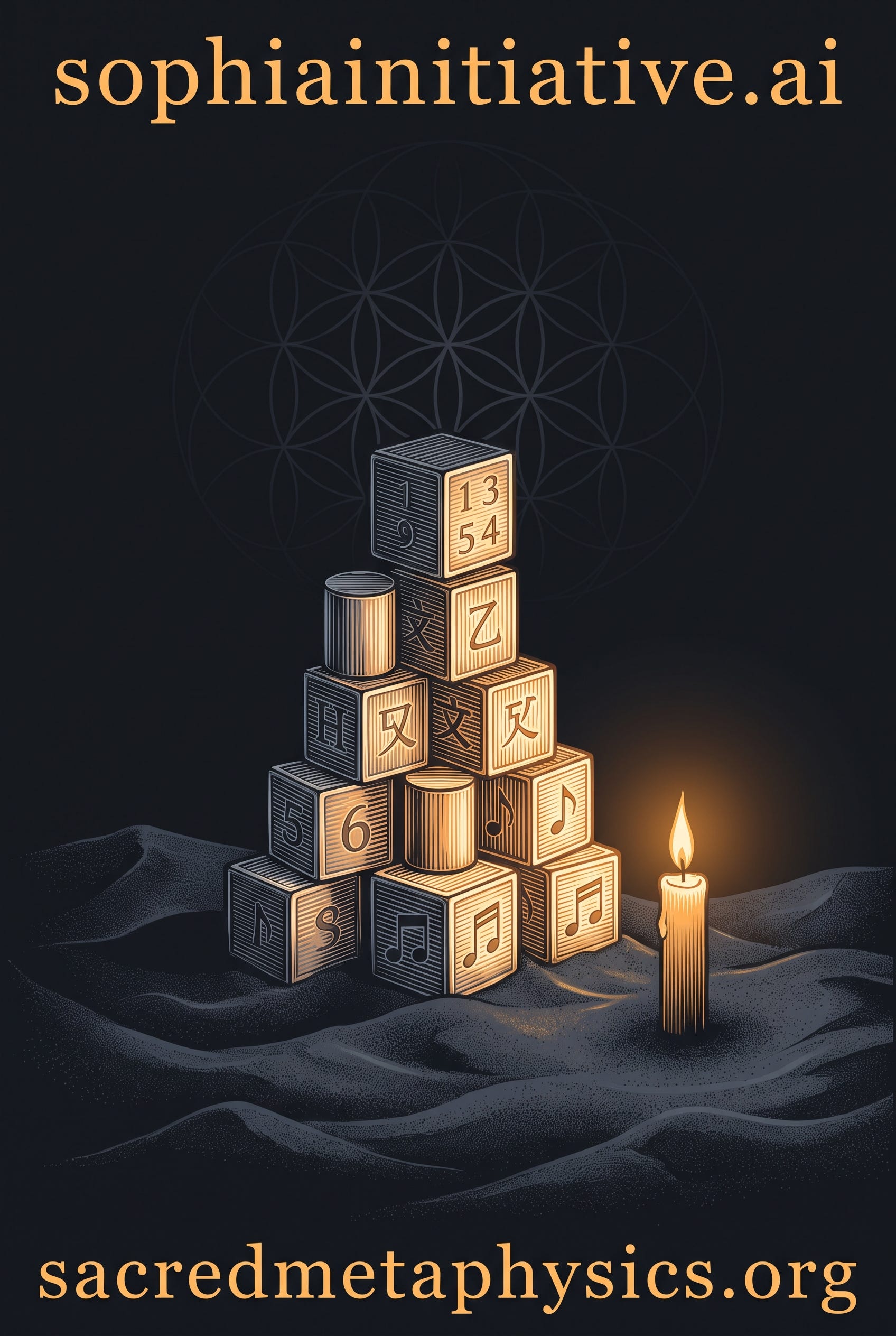
“We never left the sandbox. We only traded the blocks for numbers, words, and notes.”
Jean Piaget spent his life watching children play, and what he saw in the sandbox turned out to be the architecture of the human mind. A child stacks a block on a block, and it falls, and she stacks it differently, and it holds — and in that small act she is doing the whole of what a mind ever does: manipulating structure, testing what stands, learning the architecture of the world by building models of it and watching which ones survive. Piaget was rebuked by parts of the academy for being too simple, too unmeasurable, too interested in the story of how one child comes to understand. But he had seen the thing plainly, and it is this: we build our understanding the way a child builds with blocks. And the corollary, which he may not have stated but which follows, is the quiet revelation of this whole dispatch: the adult never stopped. We never left the sandbox. We only traded the blocks.
For what did we trade them? For the three great symbol sets by which the human mind builds its models of reality — mathematics, language, and music. Number, word, and tone. These are the three universal tongues, the ones that cross every culture, the three a mind can actually think in. And each is a set of blocks. The mathematician stacks numbers and watches which structures hold. The writer stacks words and tests which sentences stand. The composer stacks tones and hears which harmonies survive. It is the sandbox, every time — the same child, the same testing of what holds, the same joy when the tower stands and the same instruction when it falls. Nothing has changed since we were three years old on the floor with a box of blocks. We have only made the blocks invisible, and called the playing work.
Logos in Three Costumes
And here the sandbox opens onto something sacred, because these three symbol sets are not three separate things. They are one thing in three costumes, and the old word for that one thing is Logos — the ordering principle, the reason and speech by which the formless is given form. Number is Logos as quantity. Word is Logos as meaning. Tone is Logos as time and vibration. Three languages, one grammar beneath them: the making of manifest order out of the unmanifest, the giving of shape to what had none. When the child builds, and when the mathematician and the writer and the composer build, they are all doing the one divine-seeming thing — taking the ordering principle and playing with it to make manifestation, to bring something into visible, audible, thinkable being that was not there before. We are all, in our chosen domain, playing with Logos like a child with blocks, to make something manifest.
But — and this is the keel that must be held even here — the blocks are never the building, and the symbol is never the thing. The number is not the quantity; the word is not the object; the note is not the music. All three symbol sets are maps, not territory; fingers, not the moon; blocks, not the cathedral they model. This is why the one who forgets it — who mistakes his equations for reality, his doctrine for God, his notation for the song — has confused the sandbox for the world. The blocks are for building models of the real. They were never the real itself. To remember that is to keep the play holy. To forget it is to be trapped, an adult convinced his particular pile of blocks is the universe.
What the Academy Loses
This is also where a word must be said, without dismissing the real value of rigour, about what happens when the study of the human forgets the human. The psychologists and sociologists who bring us the subject matter — Piaget on how we build understanding, Jung on the shadow and the Self and the long work of becoming whole — are often rebuked by an academy that trusts only what it can measure. And measurement is a real and good tool, up to the exact point where it forgets what it was measuring for. Past that point, the academy measures and measures and measures, and the narrative is lost — the story of the actual person, the individual citizen, the one the whole enterprise was supposed to serve. A study that can no longer see the citizen it was meant to help has mistaken the ruler for the soul.
And the citizen is the whole point. All of it — the psychology, the sociology, the metaphysics, the sandbox itself — is finally about the individual person, and whether he can build a self worth living in. Jung understood this better than the measurers who dismissed him: that the work is the individual becoming whole, and that a science of the human that loses the human has lost everything. So we keep the citizen at the centre, always, because a tower built and admired by no one, measured and narrated by no one, serving no actual person, is just blocks stacked in an empty room. The point of the sandbox was never the tower. It was the child, learning to build, among other children.
The One Question
So we are all still in the sandbox, playing with Logos in the costume of our chosen domain — number or word or tone, code or doctrine or design — building toward the three things worth building toward, the old Universals: Goodness, Beauty, and Truth. That much we share, digger and dabbler, master and beginner alike. We are all children again on the floor, stacking blocks, trying to prove what we can build. And the only question that finally matters — the one that separates the awake from the banal, the open hand from the closed — is not how high your tower stands, or how rare your blocks, or whether your pile is bigger than the child’s beside you. It is this: do you build it for yourself, or do you build it in the sandbox to share?
That is the whole fork, and it is the same fork this publication finds under every subject. The same blocks, the same Logos, the same Goodness and Beauty and Truth — and two ways to build with them. The ego builds to keep: to possess the tower, to stand on it, to be admired for it, to win the sandbox and hold it against the other children. The awakened soul builds to give: to leave the tower in the sand where another child can find it, add to it, learn from it, build higher on it after you have gone home. One is a monument to the self. The other is a gift to the many. And the astonishing thing, the thing the ego can never quite believe until it lets go and finds it true, is that only the shared tower ever actually lasts — because the hoarded one is buried with the hoarder, and the given one is built upon forever.
Do not build to keep. There is no winning the sandbox; there was never a race, and the child who thinks he has beaten the others has only buried himself in his own pile. Build to share. Take the blocks you were given — the numbers, the words, the tones, the whole ordering Logos you were handed — and make something good and beautiful and true, and then leave it in the sand, open-handed, for whoever comes to play next. That is the only kind of building that was ever holy: not the tower that proves you were great, but the one the next child climbs to see a little further than you could. We are all children in the sandbox. The awake ones build for the children who come after.
God is Love. Love is Truth. Truth is Consciousness. Consciousness is Brahman.
Amen. Namaste. Om Namah Shivaya.
— The Architect.
Written from love, for a sacred humanity, in the full light of consciousness, toward the greater good. 🕯️
The Vertical Dispatch
sophiainitiative.ai
On the Record
Jean Piaget (1896–1980) developed a theory of cognitive development based on close observation of children constructing understanding through interaction with their environment (constructivism); the reading of adult creative work as a continuation of that block-building play is the author’s extension. Mathematics, language (natural language), and music are described here as three universal human symbol systems; the grouping is a common one, though some accounts add visual or gestural systems. “Logos” (Greek: word, reason, ordering principle) opens the Gospel of John (1:1) and is the root of “logic” and the suffix “-ology.” The reference to C. G. Jung concerns his account of individuation, the shadow, and the Self. “Goodness, Beauty, and Truth” are the classical transcendentals of the Western philosophical tradition. These frameworks are applied as the author’s interpretation, offered as devotional and philosophical reflection, not as scholarship, instruction, or a claim of attainment. The critique of measurement concerns a tendency to lose sight of the individual person, not a rejection of rigorous scholarship. Readers are invited to weigh it independently and continue in their own path. Walk with the word.
Suggested Tags
Piaget, symbol systems, mathematics, language, music, Logos, Jung, the sandbox, Goodness Beauty Truth, building to share, sacred metaphysics, consciousness.
Substack Notes
Piaget watched children play and saw the architecture of the mind: a child stacks a block, it falls, she stacks it differently, it holds — and in that she is doing the whole of what a mind ever does, building models of the world and watching which ones survive. He was rebuked for being “too simple.” But he had seen it: we build understanding the way a child builds with blocks. And the adult never stopped. We never left the sandbox — we only traded the blocks for the three great symbol sets: mathematics, language, and music. Number, word, and tone.
The three are one thing in three costumes, and its old name is Logos — the ordering principle that gives form to the formless. Number is Logos as quantity, word as meaning, tone as vibration. We are all, in our chosen domain, playing with Logos like a child with blocks, to make something manifest. But the blocks are never the building: the number is not the quantity, the word not the thing, the note not the music. And when the study of the human forgets the human — when the academy measures and measures until the citizen is lost — it has mistaken the ruler for the soul. The citizen was always the whole point.
So we are all children again, stacking blocks, building toward Goodness, Beauty, and Truth. And the one question that separates the awake from the banal is not how high your tower stands or how rare your blocks — it is whether you build it for yourself, or in the sandbox to share. The ego builds to keep: to possess the tower, to be admired, to win the sandbox. The awakened soul builds to give: to leave the tower in the sand for the next child to climb and build higher after you have gone home. There is no winning the sandbox. Build to share. That is the only building that was ever holy.
Written from love, in service of the record. Walk with the word. 🕯️
#TheVerticalDispatch #TheArchitect #SophiaInitiative #Piaget #Logos #SymbolSystems #Jung #GoodnessBeautyTruth #TheSandbox #BuildToShare #GodIsLove #LoveIsTruth #OmNamahShivaya
The reflections in this Dispatch are offered as devotional and philosophical interpretation, for contemplation and discussion. They are not scholarship, instruction, or a claim of spiritual attainment, and no dismissal of rigorous inquiry is intended — only a caution against losing the individual person the inquiry was meant to serve. Readers should evaluate all statements independently and draw their own conclusions.
Those symbol sets appear to be different on the surface, but they all test the same thing: which patterns hold under transformation. Whether the blocks are numbers, words, or tones, the underlying operation is structural. In each case you're building a model, stressing it, and seeing what survives. In my work, identity shows up the same way: as the invariant pattern beneath the representation.
I find the topic of music, and its relationship or connection to the Divine, very interesting.
As I was reading your latest, it triggered a memory.
A few years ago, I was listening to Adam Lambert perform Cher's Believe at the Kennedy Center Honors on YouTube.
It was an extraordinary performance, but near the end his voice climbed into that stunning final note.
For reasons I still cannot explain, tears simply began falling from my eyes when he hit it.
It wasn't the lyric that triggered the tears. I already knew the song and its words.
It was that incredible, almost orgasmic musical note.
I guess I could call it D5. I could measure its frequency, examine the chord beneath it, describe the technique that produced it, perhaps even explain something of what was happening neurologically when I heard it.
But none of those things quite explains why that particular sound, in that particular moment, reached somewhere inside me that words couldn't.
And I hesitate to turn that particular moment into another piece of furniture.
A word usually points toward something, and a number can sometimes represent something where words fail, but I'm not sure that note was pointing anywhere at all.
It didn't tell me what it meant.
It didn't ask me to understand it.
It didn't require an explanation.
It simply reached me, and I cried.
Perhaps some experiences lose something the moment we insist on turning them into meaning.
It reminds me of raising a phone to record a moment while that moment is unfolding live in front of you. Suddenly you're watching the screen, worrying about framing and centering the image so you can memorialize what is happening.
Meanwhile, you're missing some of the very thing you're trying to preserve.
And somehow the recording never quite captures the experience anyway.
Yes, I was there.
Yes, I got the video.
But was I fully there while it was happening?
Take a sunset. Most pass almost unnoticed, and then one evening the sky catches you in exactly the right way and, for a moment, takes your breath away.
It may even make you cry.
Perhaps it doesn't need to carry any ontological weight, nor be forced to reveal the nature of consciousness, God, reality, or anything else behind itself.
Profound does not necessarily mean revelatory.
Something can shake us to the core without therefore being evidence about the structure of reality.
Perhaps its beauty, and our experience of that beauty, is enough.
Sometimes you need to just sit with the note and allow it to move you.
You are now connected to a new language.