


Sovereignty · Governance · Consequence
There is a political test that separates the principled from the pragmatic and the pragmatic from the purely transactional. The test is simple: take a politician’s position on any issue from three years ago and compare it to their position on the same issue today. If the position has changed because the evidence changed, you have a principled politician. If it changed because the political winds changed, you have a pragmatist. If it changed in the precise opposite direction of the evidence — if the politician who invited the newcomers is now blaming the newcomers, if the federalist who says she loves Canada is handing the tools of separation to the people who want to leave it — you have something else entirely. You have Danielle Smith, Premier of Alberta, the most consequential and most contradictory political figure in Canada today.
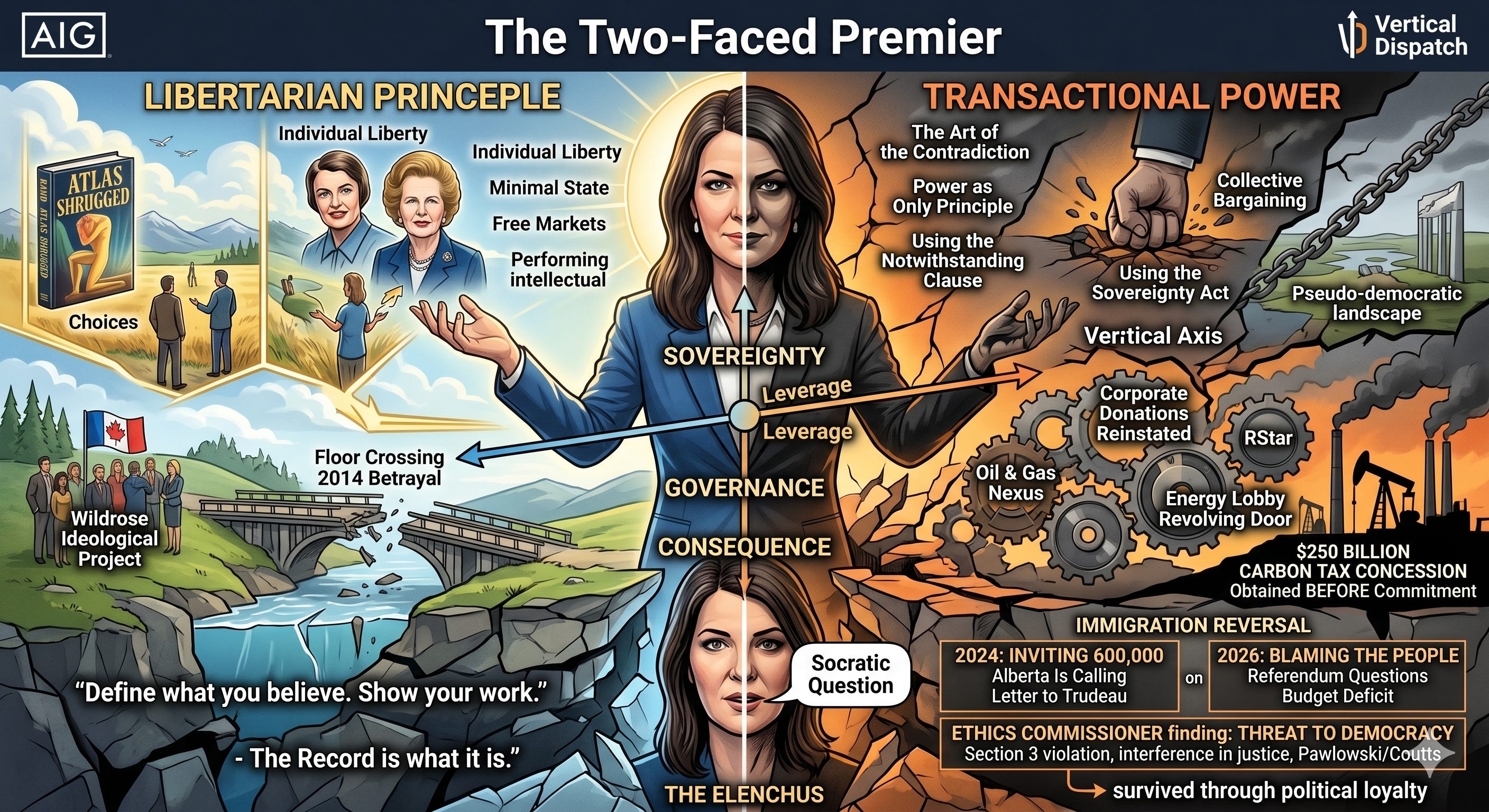
This dispatch does not argue that Smith is stupid. She is not. She is one of the most skilled political operators in contemporary Canadian politics — skilled enough to extract a $250 billion carbon tax concession from the federal government without a private proponent, a locked route, or a port commitment in exchange. Skilled enough to maintain the support of a governing coalition that includes both federalists and separatists by speaking simultaneously to both in language each hears as confirmation. Skilled enough to invite 600,000 newcomers to Alberta under the Alberta Is Calling campaign and then, when the budget went into deficit, pivot to referendum questions about controlling immigration — without ever mentioning the letter she sent Justin Trudeau in 2024 asking for more immigrants.
That skill is the subject of this dispatch. Not the woman’s intelligence, which is genuine. The operating system the intelligence serves, which is not principle. The AIG standard applied to Danielle Smith’s public record produces a diagnosis that is precise, documented, and — given that she is the premier of the province whose pipeline the federal government has just given its highest-priority designation — consequential for every Canadian who will be asked to trust the governance architecture of that deal.
The elenchus applied to Danielle Smith: define what you believe. Show your work. Demonstrate that the position you hold today is connected to the position you held yesterday by something other than the calculation of what the position of today will produce for you. The record does not survive this examination. The record is what it is.
I. The Formation — From Ayn Rand to the Premier’s Office
Danielle Smith was born on April 1, 1971, in Calgary. She studied economics and communications at the University of Calgary. Before entering politics, she had a career as a journalist, newspaper columnist, and radio host — roles that gave her a facility with public communication that has served her political career consistently and that explain the characteristic she shares with Poilievre: both are better at performing a position than at defending it under examination.
Her early ideology was genuinely libertarian — not the performance of libertarianism that serves as populist branding, but the actual intellectual framework of minimal state intervention, individual liberty, and free markets. She was influenced by Margaret Thatcher and Ayn Rand. She argued for the privatisation of public sidewalks. This is not a caricature. It is the documented record of a woman who took the libertarian premise seriously enough to follow it to its logical conclusions, which is more than most politicians do.
She led the Wildrose Party from 2009 to 2014, building it from a fringe movement into the Official Opposition in Alberta’s legislature in 2012. The Wildrose under Smith was a genuine ideological project — fiscally conservative, socially libertarian, opposed to what she characterised as the cronyism of the Progressive Conservative establishment. Then, in December 2014, she crossed the floor to join the PC government of Jim Prentice, bringing eight Wildrose MLAs with her in what became known as the floor crossing — an act of political expediency so brazen that it destroyed the Wildrose Party’s credibility, ended Smith’s political career for eight years, and is still cited by Alberta conservatives as the defining example of political betrayal in the province’s recent history.
The floor crossing is the foundational event in understanding Danielle Smith’s governance. A woman who had spent five years building a party on the principle that the PC establishment was corrupt and cronyist walked into that establishment when the political calculation suggested it was in her interest to do so. She sacrificed the principle for the position. This is not ancient history. It is the operating system. It has not changed. It explains everything that follows.
After the floor crossing, she returned to media — radio hosting in Calgary — where she cultivated the audience that would eventually return her to politics. She criticised COVID restrictions. She promoted ivermectin as a treatment for COVID-19, a claim that medical authorities including Health Canada have consistently stated is not supported by evidence for this use. She built a following among the constituency that would later become the political base for her successful UCP leadership bid in October 2022. The radio years are where the current operating model was refined: find the grievance, amplify it, position yourself as the tribune against the establishment — the same establishment she had joined by crossing the floor, the same establishment she now leads.
II. The Federalist Who Handed Separatists Their Best Tools
Danielle Smith says she is a federalist. She says this consistently and has continued to say it through a sequence of actions that have made Alberta separation more possible than at any point since the province was created in 1905. The gap between the stated position and the operational consequence is the most important structural fact about her governance.
On May 15, 2025 — one day after Mark Carney’s Liberal Party won the federal election — Smith’s government introduced Bill 54, the Election Statutes Amendment Act. The bill lowered the threshold required to trigger a citizen-initiated referendum from 20 percent of eligible voters — approximately 600,000 signatures — to 10 percent of votes cast in the previous election — approximately 177,000 signatures. The signature-gathering period was extended from 90 to 120 days. Bill 54 received royal assent on May 15, 2025. The timing — introduced the day after the federal election result — was not incidental.
The separatist group Stay Free Alberta claimed to have gathered more than 301,000 signatures by May 2026 — well above the 177,732 required — for a referendum question asking whether Alberta should become a sovereign country and cease to be a province of Canada. A legal challenge brought by the Sturgeon Lake Cree Nation, the Athabasca Chipewyan First Nation, and the Blackfoot Confederacy resulted in Justice Shaina Leonard banning the petition from certification on May 13, 2026, ruling that the referendum process had not adequately consulted First Nations whose treaty rights would be directly implicated by separation. Smith announced she would appeal.

The Alberta Prosperity Project — the separatist organisation whose co-leader is Dennis Modry, the same Dennis Modry who arranged the phone call between Smith and Calgary street preacher Artur Pawlowski that resulted in the ethics commissioner finding — met three times between April 2025 and January 2026 with United States Department of State officials. A joint meeting with the State Department and the US Treasury was planned for February 2026 to discuss a half-trillion-dollar credit mechanism upon achieving independence. The State Department described these as routine meetings with civil society groups without commitments. Smith said she expected US officials to leave discussions about Alberta’s democratic process to Albertans and Canadians.
Stéphane Dion — the architect of the federal Clarity Act, the man who spent his political career building the legal architecture that would govern any province’s attempt to leave Canada — called Smith’s decision to lower the referendum threshold irresponsible and said it was completely wrong to split the country. He asked the question that the federalist framing requires answering: if she doesn’t believe in separation, does it make sense that she would be the one to go into the negotiations for something she does not believe in? It is a mess. And she needs to clarify. She has not clarified. The federalist who made separation easier says she does not want separation. The record shows she has made separation more available than any premier in Alberta’s history. Define what you believe. She cannot.
The UCP president Rob Smith told pro-separation followers explicitly that the premier’s electoral reforms would advance their cause. When asked about a path to independence, he said: please read her announcement. It’s in there. The premier’s own party president told separatists that her legislation served their purpose. Smith did not correct this characterisation. She did not contradict her own party president. She remained the federalist who handed the separatists their best legislative gift and then watched her party president tell them to read it carefully for the path to independence.
The Cameron Davies scenario — named after the UCP president Robert Smith’s parallel to David Cameron’s Brexit referendum — has been raised by multiple analysts. Cameron publicly opposed Brexit and scheduled the referendum confident it would fail. It did not. Smith publicly opposes separation and has committed to scheduling the referendum if the petition is certified. The parallel is not rhetorical. It is structural. A premier who does not believe in the outcome she has made possible is a premier who has surrendered governance to process and is hoping the process produces the result she wants without her having to lead the campaign for it.
III. The Immigration Reversal — The Letter She Did Not Mention
In 2023, Danielle Smith’s government launched the second phase of the Alberta Is Calling campaign — a multi-million-dollar provincial initiative to attract workers, families, and newcomers to Alberta. In 2024, she mused publicly about doubling Alberta’s population to 10 million people by 2050. She wrote a letter to then-Prime Minister Justin Trudeau in 2024 asking for greater allocations of newcomers who wished to become permanent residents, specifically requesting more temporary residents and workers. Alberta’s population grew by approximately 600,000 people between 2019 and 2024 — a population surge the Globe and Mail described as unlike any it has seen over the past century, which Smith welcomed and encouraged.
In February 2026, Smith addressed the province in a televised address and announced nine referendum questions for October 2026. Five of those nine questions addressed immigration. In her address, she said: throwing the doors wide open to anyone and everyone across the globe has flooded our classrooms, emergency rooms, and social support systems with far too many people far too quickly. She proposed referendum questions about restricting newcomers and the services they receive. She called for Alberta-approved immigration status — a phrase that no one in her government was able to define with precision when asked.
She did not mention the Alberta Is Calling campaign in her address. She did not mention the letter she sent Trudeau in 2024 asking for more immigrants. She did not mention that Alberta’s aggregate population growth over the past decade — 1.93 percent annually — was lower than the preceding decade under Stephen Harper, when it grew at 2.21 percent annually. The Globe and Mail’s analysis of her budget found that the provincial budget does not clearly show how the province’s rapidly growing population pushed it into deficit — and the Calgary Chamber of Commerce president, asked directly whether population growth is one of the biggest strains on Alberta’s finances, said no.
The Alberta NDP’s deputy leader Raki Pancholi named the reversal precisely: less than two years ago, Danielle Smith herself asked Justin Trudeau to increase immigration levels because Alberta wanted more than what Ottawa was already allocating. In 2024, she stated publicly that she wanted to double Alberta’s population to 10 million people. She did all this without a single thought or plan for how to create the jobs, build the houses, the schools, and hospitals that we already needed. The AIG assessment of this sequence is straightforward: a premier who invited 600,000 newcomers and then proposed referendum questions about restricting newcomers — without once mentioning the invitation — is not a leader whose relationship with the public record is reliable. She invited the people. The people came. The budget went into deficit for reasons economists have traced to oil prices, not immigration. She blamed the people. She did not mention the invitation. That is the operating model.
The UCP’s decision to reinstate corporate and union donations, which the previous NDP government had banned in 2015, took effect in 2025. In the first reporting period, the UCP raised over $471,000 from businesses in just three months, accounting for more than a quarter of all UCP donations in that period. The party raised $9.3 million in total against the NDP’s $6.3 million. The oil and gas sector — with which Smith has a lifelong connection dating to her presidency of the Alberta Enterprise Group — has historically provided the ideological and financial backbone of her political operation. After she became party leader and signalled support for the RStar royalty credit program for oil and gas well cleanup, donations from the energy sector to pro-Smith political groups multiplied eightfold. The revolving door between her office and the energy lobby is documented in the public record of appointments and lobbyist registrations.
IV. The Ethics Commissioner — A Threat to Democracy
On May 17, 2023 — less than twelve days before the Alberta provincial election, on the same day Smith was scheduled to debate NDP leader Rachel Notley — the Alberta Ethics Commissioner released her findings into allegations that Smith had interfered in the administration of justice.
The core finding: Smith contravened Section 3 of the Conflicts of Interest Act in her interaction with then-Justice Minister Tyler Shandro in relation to the criminal charges faced by Calgary street preacher Artur Pawlowski. Pawlowski had been charged in connection with his role in the Coutts border blockade protest in early 2022 — the same protest movement whose participants included some of the convoy organisers that federal authorities characterised as having extremist connections.
The sequence of events documented in the commissioner’s report is precise. On January 6, 2023, Smith participated in a three-way phone call with Pawlowski and her long-time friend Dr. Dennis Modry. Pawlowski recorded the call without Smith’s or Modry’s knowledge. That recording became public. On the same day she spoke to Pawlowski, Smith called Justice Minister Shandro. The purpose of the call, the commissioner found, was to influence a decision of the Crown to prosecute Mr. Pawlowski. She asked the attorney general if there was something that could be done about the charges and could they help Mr. Pawlowski. She was concerned about the political optics of the press conference Pawlowski was planning.
The commissioner’s language was not diplomatic. She described Smith’s call to Shandro as an improper attempt to influence the independence of the legal system. She said the premier speaking to the justice minister about a specific ongoing criminal case in the way Smith did was unacceptable. She said it was a threat to democracy to interfere with the administration of justice. She described it as the first step toward the type of judicial system often found in a non-democratic or pseudo-democratic country. These are not opposition talking points. They are the findings of Alberta’s independent Ethics Commissioner, published in an official report, in the commissioner’s own words.
No sanctions were ordered. Smith won the May 29, 2023 election. The ethics finding did not end her premiership. This is the most important governance observation in the entire Smith record: the Ethics Commissioner found that the premier of Alberta had committed an act she described as a threat to democracy and the first step toward a non-democratic judicial system — and the premier won re-election eleven days later. The democratic accountability mechanism produced the finding. The electoral accountability mechanism produced the opposite result. This is not a failure of the system. It is a demonstration of the transactional relationship between a political leader and her constituency: what matters is not the institutional finding but the political loyalty. Smith survived because her base trusts her more than it trusts the Ethics Commissioner. That trust is the operating resource she manages. Everything else — principle, consistency, institutional integrity — is secondary to its maintenance.
Pawlowski was subsequently found guilty of mischief and other charges for his role in the Coutts protest. The ethics finding is part of the permanent public record. Smith has never publicly acknowledged that the Ethics Commissioner’s characterisation of her conduct as a threat to democracy was accurate. She has not apologised. She has not revised her conduct. She has continued to govern.
V. The Libertarian Who Used the Notwithstanding Clause
Danielle Smith’s political formation was built on the libertarian premise: the state should not interfere with individual liberty, the market should be free from government intervention, and the heavy hand of power should be kept far from the private choices of citizens and the operation of civil society. This is the ideology she absorbed from Thatcher and Rand. This is the ideology she articulated as a journalist and radio host. This is the ideology that gave the Wildrose Party its intellectual coherence.
As premier, she used the Alberta Sovereignty Act — legislation that empowers the provincial government to direct provincial entities to refuse to enforce federal laws that Alberta’s cabinet deems to infringe provincial jurisdiction — to position Alberta in structural conflict with federal authority on multiple policy fronts. She threatened to use it against federal clean electricity regulations, federal emissions policies, and federal environmental assessment requirements. The Sovereignty Act is, in its constitutional effect, the assertion of provincial executive power over the operation of law — precisely the kind of state power over individual and institutional conduct that the libertarian framework she built her career on would have condemned.
More directly: when Alberta teachers went on strike in 2023, Smith’s government used the notwithstanding clause of the Canadian Charter of Rights and Freedoms to impose back-to-work legislation, override collective bargaining rights, and prevent workers from exercising the right to strike. The notwithstanding clause — the same constitutional instrument that Ford used in Ontario, that the Supreme Court found cannot override democratic rights — was deployed against unionised workers exercising their constitutionally protected right to organise and bargain collectively.
The libertarian who argued against heavy-handed state intervention used the most powerful override tool in the Canadian Constitution to force workers back to work. The woman who said during her radio years that she would oppose exactly this kind of government power deployed that power against the people her former self would have championed. The position was not revised. The argument was not made. The principle was simply absent when the political calculation required it to be absent. This is the operating system. Not libertarianism. Not federalism. Not any coherent political philosophy. Power, and the calculation of what serves it at each moment.
VI. The Pipeline Deal — What She Actually Got and When She Got It
This dispatch has previously documented the Carney-Smith pipeline deal of May 15, 2026, in precise detail. The accountability finding from that analysis is relevant here because it names what Smith’s governance actually produced — not for Alberta in the long term, but for Smith specifically, on the day of the announcement.
Smith received the $250 billion carbon tax concession — the reduction of the industrial carbon price trajectory from $170 per tonne by 2030 to $130 by 2040 — on May 15, 2026. She received it before a private proponent had been named. Before a route had been locked. Before a port commitment existed. Before a single Indigenous consultation had been completed. Before the Building Canada Act framework had survived its first legal challenge. She received it on the basis of a July 1 deadline for an application that Alberta itself would file as the proponent — because no private proponent exists.
The carbon pricing concession is irrevocable as of the announcement. If Gate One fails on July 1 and no private proponent steps forward, the lower carbon price trajectory remains in place. The taxpayer has paid for a pipeline that was not built. The climate has absorbed a weaker price signal. And Smith will have received, for Alberta’s energy sector, the most significant federal fiscal concession in the province’s history — in exchange for a pipeline application she herself will file because no one else will file it.
The Carney-Smith deal is the clearest expression of the Smith operating system at its most effective: a governance outcome obtained through the leverage of separatist threat, structural pressure, and the political calculation that the federal government could not afford the optics of being seen to refuse Alberta. The principle — whether carbon pricing is good or bad for the climate, whether the pipeline serves Canada’s long-term energy sovereignty or locks the country into fossil fuel infrastructure through the 2040s — is secondary. The outcome, obtained on May 15, serves the political interests of the premier and the financial interests of the energy sector that backs her. She got what she came for. She got it before a shovel is in the ground. That is the operating model. That is the record.
VII. The PIAAC Score and Stratum Assessment — What the Record Measures
The PIAAC assessment of Danielle Smith’s public record places her at Level 3 to 4 — higher than Ford, higher than Poilievre in his policy domains, lower than the Level 4 and 5 that the governance of a major province in the twenty-first century requires when the problems are structural and the contradictions are real.
Level 4 processing — the level at which structural complexity can be held across multiple simultaneous frames — is visible in Smith’s political strategy. The separatist leverage model is a Level 4 political insight: use the threat of a result you claim not to want to extract concessions from a federal government that cannot afford the result you claim not to want. This is sophisticated political architecture. It requires holding multiple frames simultaneously — federalist rhetoric, separatist tools, energy sector interests, grassroots populism — and managing their apparent contradictions without allowing the contradictions to produce an incoherent political position. Smith does this with considerable skill.
What Level 4 political strategy without Level 4 policy substance produces is the record documented in this dispatch: the immigration reversal without the letter, the federalist who handed separatists their legislation, the libertarian who used the notwithstanding clause, the ethics violation that a commissioner described as a threat to democracy, the pipeline deal in which the concession arrived before the commitment. Each of these is a case in which the political calculation produced the action and the principle was nowhere in the analysis.
The Stratum assessment places Smith at Stratum 5 — the level of organisational leadership, of the executive who can manage complex multi-stakeholder systems and navigate institutional environments with genuine sophistication. She is the most capable executive among the three provincial leaders examined in this series of dispatches. She is also, by the same measure, the most dangerous — because her capability is deployed in service of an operating system that has no stable principle beneath it. Ford buys rounds at the bar because he likes people. Poilievre wages war because war gives his life meaning. Smith accumulates leverage because leverage is the resource she has identified as the one that produces the outcomes she wants. All three are operating below the Level 4 and 5 governance standard their offices require. Smith’s gap between capability and principle is the most consequential because her capability makes the gap harder to see.
The AIG verdict on Danielle Smith is precise: she is the most politically gifted and the most principally inconsistent major political figure in Canada today. She has used her gift in service of positions that reverse without acknowledgment, contradictions that are never reconciled, and a governance architecture in which the outcome of each decision is evaluated primarily by whether it accumulates or deploys the political leverage required to produce the next outcome. This is not two-faced in the pejorative sense. It is not even dishonest in the conventional sense. It is the governance of a leader for whom principle has been replaced by position, and position is evaluated entirely by its contribution to power. The record is what it is. The elenchus has been applied. The definition of what she believes has not been produced. It cannot be produced, because there is no stable belief beneath the strategy. There is only the strategy.
VIII. The AIG Verdict — The Premier and the Province
Danielle Smith is the premier of a province of five million people that sits on one of the largest oil reserves on earth, controls the infrastructure of Canadian energy export, holds the constitutional leverage of Confederation’s most structurally discontented member, and is navigating simultaneously a separatist movement she has made more possible while claiming not to want, an immigration debate she has stoked using population growth she invited, a pipeline deal she has signed for Alberta’s benefit before a private proponent exists, and an ethics commissioner finding she has never reconciled with the federalist, libertarian principles she claims to hold.
AIG governance holds every public institution to the standard of the Socratic question: define what you believe, show your work, demonstrate that the policy you produce today is connected to the principle you articulate today by something other than the calculation of what the policy will produce for you tomorrow. Applied to Danielle Smith’s public record, the question does not receive a coherent answer. The federalist who made separation easier. The libertarian who used the notwithstanding clause. The immigration champion who proposed immigration referendums without mentioning the invitation. The ethics violator who was found to have committed a threat to democracy and who won re-election eleven days later.
She is consequential. She is capable. She is the most powerful provincial politician in Canada today — the reader who prompted this dispatch’s original DeepSeek research was correct about that. And she is governing a province of five million people with an operating system that has no stable principle beneath the strategy, no fixed point of reference that is not subject to revision when the calculation changes, no position that cannot be reversed without acknowledgment when the political environment requires the reversal.

The pipeline agreement she signed with Prime Minister Carney on May 15, 2026, is a significant political victory—“The carbon‑price concession is politically locked in as of the announcement — but not legally irreversible. The project still requires buy-in from other governments, First Nations, and private investors, and it remains exposed to legal and regulatory challenges that could yet undo it. The carbon price trajectory is set by legislation, not by that agreement, and remains open to future political change. The separatist tools her government placed in the independence movement’s hands are now in play, but on May 13, 2026, a Court of King’s Bench judge struck down the citizen-led separation petition, ruling the process unconstitutional because Alberta failed its duty to consult First Nations. The separatists have appealed. The question of separation therefore lives in the courts, not on a ballot. What is on a ballot is the government’s own immigration and constitutional referendum, set for October 19, 2026—nine questions, five on restricting newcomers, four on altering Alberta’s place within Canada. It proceeds regardless. The two referendums are separate initiatives; to conflate them is to misrepresent the public record.
The ethics commissioner’s finding sits permanently in the public record. The letter to Prime Minister Trudeau asking for more immigrants sits in the public record alongside referendum questions that ask, in effect, for fewer. The floor crossing that ended the Wildrose Party sits in the public record beside the UCP leadership she won by weaponizing the grievances that crossing created. The record is complete. The verdict is this: skilled, consequential, and without the principle her office requires. The Vertical Dispatch will be watching the July 1 gate, the October referendum, and every position she holds today that the record of tomorrow will show she abandoned the moment the calculation changed.

God is Love. Love is Truth. Truth is Consciousness. Consciousness is Brahman.
Amen. Namaste.
Dispatch Hashtags
#TheTwoFacedPremier #DanielleSmith #AIG #VerticalDispatch #TheArchitect #AgeOfConsequences #AlbertaSovereignty #Bill54 #SeparationReferendum #StayFreeAlberta #AlbertaProsperityProject #EthicsCommissioner #ConflictsOfInterestAct #ThreatToDemocracy #Pawlowski #Coutts #ImmigrationReversal #AlbertaIsCalling #TrudeuLetter #ImmigrationReferendum #October2026 #Pipeline #CarbonTaxConcession #CarneySMithDeal #250Billion #NoPrivateProponent #UCPDonations #471000 #CorporateDonations #OilGasNexus #RStar #EnergyLobby #LibertarianTurnedAutocrat #NotwithstandingClause #TeachersStrike #FloorCrossing #PIAACLevel #Stratum5 #PrincipledInconsistency #SubstackCanada #Project2046 #NoFear
Makes my head spin.