

Φ
THE VERTICAL DISPATCH
We write for the mind, the eye, and the ear.
Read it. Look at it. Listen to it. The Vertical Dispatch is built for all three — prose with rhythm, made to be heard as much as read.
From metaphysics to geopolitics, from culture to history, from the sacred to the street — and everything in between. One lens, every subject. No ego. Just the record, named clean.
Press play. Walk with the Word. 🕯️
The Departure Lounge · No. 3
A dispatch for the worn-out, the twice-married, the still-curious, and the terminally human
This dispatch travels by hand. If it serves you, share it — restack on Substack, pass it on wherever you read. 🕯️
There is a school on Lavoie Street in Côte-des-Neiges that no longer exists in any meaningful sense. Northmount High — Protestant School Board of Greater Montreal, opened 1957, closed by the mid-1990s — was predominantly Jewish in its early years and predominantly Caribbean in its later ones, and for a brief window in between it was the kind of place where a Protestant kid from McKenzie Street could be the only one of his kind in the building and not find that particularly remarkable. Because in that world, everyone was the only one of their kind.
That was the point.
It went back to the constitution itself. When Canada was built in 1867, Quebec’s public schools were split between Catholic and Protestant boards, and the law guaranteed school rights to those two and to no one else. Jewish families fell into the gap — and over the following century they negotiated their way into the Protestant system, district by district, as honorary Protestants. Not quite welcomed, not quite turned away. You sat in classrooms where the curriculum was English and the culture was borrowed and nothing quite fit — which meant the children who came through those schools were educated, from the very beginning, in the experience of existing outside the official story.
That is not a footnote. That is the origin of everything.
I know it because I lived inside it. One of a handful of actual Protestants at Northmount, on a block of McKenzie Street where I was likely the first non-Jewish resident, one street over from where the Black community began. Few French people. Not a city — a pressure system. Three solitudes, the poet Irving Layton once said of Montreal: three ghettoes, three peoples, the Anglos and the French and the Jews, peering at each other over the walls.
That pressure system produced two of the most important cultural figures in Canadian history.
Canada is still not sure what to do with either of them.
I. The Ecosystem
Mordecai Richler was born on St. Urbain Street in January 1931 — the son of a scrap-metal dealer, raised in a working-class Jewish neighbourhood whose texture and smell and moral complexity would fuel virtually everything he ever wrote. Leonard Cohen arrived three years later, in 1934, in the affluent Anglophone enclave of Westmount. Same city. Same Jewish tradition, filtered through different strata. Cohen’s people had served as presidents of Shaar Hashomayim, one of the great Conservative synagogues of the continent. Richler’s grandfather was Rabbi Yudel Rosenberg, a Galician scholar who had translated from the Zohar and led an Orthodox congregation in Montreal. Sacred lineage on both sides — but Richler’s was the lineage of the ghetto, and Cohen’s the lineage of the mountain.
This is not merely biographical contrast. It is structural.
The standard account treats them as parallel figures: two Montreal Jews who made it out and made it big. That framing misses the point entirely. They were not parallel. They were polar. And the pole between them was the city itself.
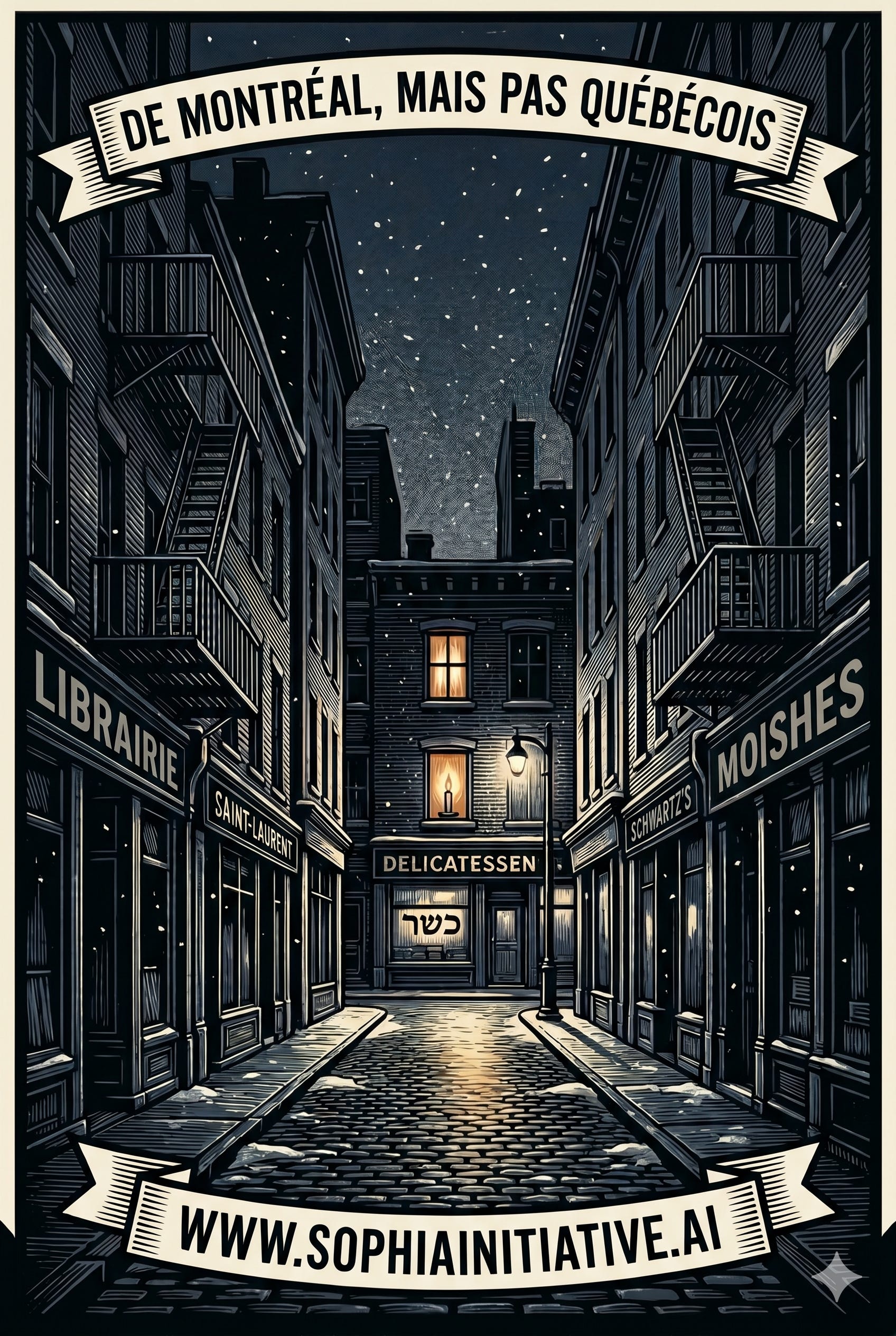
Richler’s Montreal was the Main — Boulevard Saint-Laurent, the great dividing line between east and west, French and English, ambition and memory. It was Schwartz’s, the smoked-meat counter on Saint-Laurent where the cure ran for days and the line ran down the block and you didn’t get a table, you got a spot. It was Ben’s, the deli on De Maisonneuve that ran nearly around the clock in its heyday, where by local legend you might find Leonard Cohen at one table, Pierre Trudeau at another, René Lévesque at a third. The same smoked meat. Completely different futures.
Cohen’s Montreal was the mountain. Westmount above the city. McGill on its slope. The synagogue on Sherbrooke where his people had prayed for generations. But Cohen was never purely the mountain — he came down from it. He went to McGill, met Irving Layton, and discovered that the Jewish intellectual tradition of Montreal had a street-level voltage that Westmount’s decorum could not contain.
Same city. Completely different vertical axis. Both necessary.
II. The Map You Had to Know
To understand what these two men produced, you have to understand the geography. Montreal in the postwar decades was not metaphorically divided — it was physically divided, block by block, with the precision of a city that had decided its tensions were too important to leave to chance.
Crescent Street was English. It ran south from Sherbrooke toward Sainte-Catherine and was, by the late sixties, the party central of Anglophone Montreal. The Sir Winston Churchill Pub opened there in 1967, and the rooms above it became the watering hole of the city’s Anglo intelligentsia. Richler was a regular. He liked his scotch and he liked the company of people who argued. Crescent was where you went if you were English and wanted to feel like you owned the city — which the English, by then, no longer did, which was precisely why the bars were full.
Saint-Denis was French. A few blocks east, running north toward the Plateau, it was the stronghold of the French intellectual, the separatist café, the bohemian left. Around Carré Saint-Louis you could sit over coffee and discuss philosophy, literature, and independence — or all three at once. English people did not go to Saint-Denis, not in those years, not in numbers. It wasn’t hostility exactly. It was self-selection. Two solitudes maintaining their walls by mutual agreement.
Between them — literally between them, one block west of Saint-Denis and one block east of Crescent — was Stanley Street. And Stanley Street was where the walls came down.
The Lime Light opened at 1254 Stanley in September 1973, founded by Yvon Lafrance after a trip to New York. Within a couple of years it was being spoken of in the same breath as Studio 54. Its resident DJ, Robert Ouimet, was mixing beat-to-beat before most of North America knew what that meant. And its crowd was what no other room in Montreal could claim: anglophone and francophone, gay and straight, Black and white, Jewish and gentile, fashion and factory, all on the same floor. East and west, French and English — and then, in a year or two, the world came.
That was Stanley Street. Crescent for the English. Saint-Denis for the French. Stanley for everyone who didn’t fit the official categories — which, in 1970s Montreal, was an enormous number of people.
Stanley was also where the gay community had carved out its first real geography, the cluster of bars that preceded the Village by a decade. And in the early hours of October 22, 1977, some fifty police officers descended on two of them, Truxx and Le Mystique, with machine guns drawn, and arrested 146 men. It was the largest mass arrest since the October Crisis, and the public outrage that followed — thousands in the street the next night — forced Quebec to become the first jurisdiction in Canada to ban discrimination on the basis of sexual orientation. What the authorities tried to shut down was the very thing the Lime Light was trying to open up: the possibility of a Montreal that didn’t require anyone to stay in their assigned solitude.
This is the city Richler and Cohen were made by. Not the postcard version. The real one.
III. Honorary Protestants
The PSBGM was an institution of exquisite Canadian absurdity — a school board that solved the problem of Jewish children by declaring them, administratively, Protestant. It was never quite a welcome and never quite a refusal. The constitution of 1867 had guaranteed public schooling to Catholics and Protestants and to no one else, and Jewish Montreal spent the better part of a century negotiating its way into the gap — district by district, compromise by compromise — as honorary Protestants. Not of the system, exactly. Tolerated by it. Filed under a heading that did not fit, in a city that specialized in headings that did not fit.
What this system inadvertently produced was a cohort educated in the gap between official categories. You were Jewish but enrolled as Protestant. You were English-speaking but living in a French city. You were Canadian but the national story didn’t quite include you. That gap — between what the official story said and what your actual life was — is where a certain kind of intelligence grows.
Richler was a graduate of Baron Byng on St. Urbain, the legendary, predominantly Jewish high school that produced a remarkable share of Montreal’s cultural output. Cohen went to Westmount High, then McGill. Different schools, different strata, same structural condition: existing in a city that had not fully decided what to do with you. The French did not claim them. The English establishment tolerated but did not embrace them. The Jewish community they were born into could not hold them. They were of the city but absorbed by none of its official solitudes.
That condition — marginality from several directions at once — is not a disadvantage for an artist. It is the precise condition that generates the diagnostic clarity comfortable belonging cannot. You can only see the walls when you are standing outside all of them at once.
IV. The Migration and What It Meant
By the time I arrived in Côte-des-Neiges, the community that had generated the heat was already in motion. The Jewish migration westward and upward was well underway — away from St. Urbain, away from the Main, toward Hampstead and Côte-Saint-Luc, the new suburbs built, in Hampstead’s case quite deliberately, as a garden city: large lots, trees, space between families and ambition and noise.
Hampstead today has among the highest concentrations of Jewish residents of any municipality in Canada. The community did not disappear. It moved upscale. It traded the productive friction of the Main for the ordered quiet of the suburb.
Northmount’s own arc tells the story with brutal economy. Predominantly Jewish in its early years. Predominantly Caribbean by the 1980s. Renamed Shadd Academy in 1988, in honour of Mary Ann Shadd, the pioneering Black newspaper publisher — then closed by the mid-1990s as Quebec’s language laws drained the English school system of students. The PSBGM itself was abolished in 1998, replaced by the English Montreal School Board — a linguistic designation rather than a religious one, which tells you everything about what Quebec had decided mattered.
The pressure system that produced Richler and Cohen dispersed. The friction cooled. The honorary Protestants moved to Hampstead. The school closed. The Main’s delis became destinations. Schwartz’s still has a line down the block, but the clientele is now overwhelmingly tourist, and the cashier will tell you so.
You cannot policy that world back into existence. You can line up for the smoked meat. You cannot reconstitute the friction that made it mean something beyond the sandwich.
V. The Reckoning They Tried to Force
Richler spent the last decade of his life trying to make Canada — specifically Quebec — look at itself without the protective filter of nationalist mythology.
In 1992 he published “Oh Canada! Oh Quebec! Requiem for a Divided Country,” grown out of a New Yorker essay that landed like a grenade in a cathedral. He argued that French-Canadian nationalism had been tainted from its origins — that one of its revered figures, the Abbé Lionel Groulx, had a documented record of anti-Semitism — and that Bill 101’s restrictions on English signage were an assault on the civil rights of non-Francophone minorities. He called it, with characteristic economy, the goofiest and most unnecessary political crisis in the Western world.
The response confirmed his thesis more effectively than the book did. Bloc Québécois MP Gilles Duceppe denounced him publicly, summoning English Canada and the Jewish community to join in condemning what he called a consummate racist. Another Bloc MP, Pierrette Venne, called for the book to be banned. The reaction reached for the heaviest comparisons it could find.
Here was a civilization that could not tolerate its own satirist. A man who had spent his career applying the same acid to Jewish sentimentality, English-Canadian nationalism, and Quebec separatism alike — a man who had, in other words, exempted no one — was reduced by the response to a pawn in the binary war between federalists and sovereigntists. The actual diagnosis drowned in the noise of wounded pride. And it must be said honestly, because the keel demands it: serious critics, including Jewish writers who had lived the same history, argued that Richler overstated the case, that he reserved the word racist for the French while soft-pedalling the covenants and the quotas of English Canada. The man was not above his own blind spots. The diagnosis and the overreach travelled together. That, too, is the record.
Cohen took a different approach to the same problem. He did not confront the civilization — he outlasted it. He went so deep into mortality, faith, loss, and desire that the specific discontents of Canadian cultural politics became almost beside the point. By “You Want It Darker,” released days before his death in November 2016, he was recording from a chair, his body narrowed to a single room, declaring himself ready, the choir of Shaar Hashomayim behind him. The synagogue of his grandfathers. The circle closed.
Canada mourned him lavishly. The Prime Minister issued a statement. Flowers piled outside his Montreal door. The cultural establishment lined up with a solemnity it had withheld in the years when he was still telling it things it did not want to hear. What Canada mourned was the myth — the late-period sage, the voice of “Hallelujah” wheeled out for every occasion requiring gravitas. The export version. Safe now. Finished. Capable of no further diagnosis.
VI. What They Contributed
The question is not sentimental. It demands a structural answer.
Richler contributed a model of moral seriousness that the literary culture he inhabited — subsidized, nationalist, reflexively self-congratulatory — refused to embody. He was, in the critic Robert Fulford’s exact phrase, the loyal opposition to the governing principles of Canadian culture. He demonstrated, by the firestorms his work set off, what a culture looks like when it cannot absorb its most honest voices. The satirist as diagnostic instrument. The controversies were not failures of tact. They were the instrument working as designed.
Cohen contributed something rarer and harder to name: a vocabulary for the things Canadian culture most systematically avoids. Death. God. Failure. The specific grief of a civilization that senses it is declining and cannot bring itself to say so plainly. He gave that vocabulary to the world, and the world used it — in cathedrals, in concert halls, in the private dark of people facing things they could not otherwise name. Canada put it on a stamp.
Together they handed over the complete diagnostic toolkit for the Canadian condition: the satirist who named what was corrupt, and the elegist who named what was grieved. A civilization capable of receiving both would have been formidable. Canada received the commercial versions.
And here the third solitude matters most. The contribution came not from insiders but from men who were structurally outside all the official categories — not French, not English in the establishment sense, not quite Jewish in the institutional sense, educated as honorary Protestants in a city that had designated them provisional. That outsider position was not incidental to the quality of the work. It was constitutive of it. You cannot see the walls from inside the walls.
VII. The Irreproducibility Problem
Here is the consequence that matters most, and the one Canadian cultural discourse is least equipped to name.
That ecosystem is gone.
The PSBGM is gone. Northmount is gone. The Main’s Jewish community dispersed to Hampstead and Côte-Saint-Luc a generation ago. Bill 101 drained the English schools. The Lime Light closed in 1990. The Stanley Street gay village moved east. Ben’s shuttered in the 2000s after the better part of a century. The specific friction — ethnic, linguistic, geographic, class-based, generationally layered — that compressed three solitudes into a few square miles and left the people inside no option but to grow an extraordinarily sharp instrument for seeing clearly: that friction is cold.
What replaced it was managed diversity. The official multicultural model distributes difference across a careful matrix of representation and recognition, while preventing exactly the kind of unmanaged, uncomfortable, productive collision that once made St. Urbain Street a generator. Difference is welcomed. Friction is administered. The pressure cooker has been replaced with a warming tray.
You cannot manufacture what that world produced. You cannot fund it into being, or policy it back, or replicate it with a heritage grant and a walking tour — though the walking tours of Richler’s Montreal exist, and are popular, and are in their own way a perfect illustration of the problem. The monument has replaced the living thing.
The question for Canada now is not how to reproduce Richler and Cohen. It cannot. The question is whether it has developed any other mechanism for generating the moral and aesthetic clarity the third solitude produced under pressure — a culture that can see itself without flattering itself, a literature that asks what is actually happening rather than what the funding bodies have approved for asking. The evidence is not encouraging. A country that cannot receive its satirists while they live, that mourns its elegists with a volume it refused them in life, that turns two of the most diagnostically powerful voices of the century into brand assets — that country is not processing its history. It is managing its mythology.
Coda: The Bumper Sticker
“Barney’s Version” ends with a paragraph that is, in miniature, the whole argument of this dispatch.
Barney Panofsky — unreliable, bilious, magnificent, the last avatar of St. Urbain’s unsparing self-knowledge — has spent the entire novel building his defence. Against the accusations. Against the sentimentality. Against any suggestion that the universe is arranged with human consolation in mind. He has made a career out of not being fooled. And then, near the end, stuck in traffic behind a pickup whose bumper sticker promises that Jesus saves, his lifelong instinct — don’t count on it — falters. He finds, suddenly, that he is no longer sure.
That is not a conversion. It is not comfort. It is the collapse of the satirist’s last defence — the armour of certainty that irony provides. A man who spent his life refusing to be consoled, refusing to flatter anyone, including himself and his God, arrives at the very end stripped of love, of memory, of everything that made the defences necessary — and cannot quite sustain the sneer.
Richler built the fortress. Cohen described what was on the other side of it. They were working on the same building from opposite ends, in the same city, three years apart, educated as honorary Protestants, buried in the same tradition, separated by the distance between the scrap dealer’s son and the synagogue president’s grandson.
Montreal made both possible. The same pressure, the same walls, the same forced clarity of seeing yourself from outside every category that claims you.
Canada got the architecture and never quite learned to live inside it.
That is the consequence. And from the departure lounge, that is the one I keep turning over: not that the rooms emptied, but that the friction in them was doing the work nobody could name until it was gone.
God is Love. Love is Truth. Truth is Consciousness. Consciousness is Brahman.
Amen. Namaste. Om Namah Shivaya.
— The Architect
The Vertical Dispatch
sophiainitiative.ai
On the record — sources (as of 8 June 2026).
Mordecai Richler (b. 27 January 1931, Montreal; d. 3 July 2001), raised on St. Urbain Street, graduate of Baron Byng High School. Leonard Cohen (b. 21 September 1934, Westmount; d. 7 November 2016), of the Shaar Hashomayim Cohen family. Northmount High School: PSBGM, opened 1957, renamed Shadd Academy in 1988 (after Mary Ann Shadd), closed mid-1990s; the PSBGM was abolished in 1998 and succeeded by the English Montreal School Board. Lime Light: 1254 Stanley Street, opened 7 September 1973 (Yvon Lafrance), resident DJ Robert Ouimet, closed 1990. Truxx / Le Mystique raid: 22 October 1977, roughly 50 officers, 146 men arrested; the protests that followed led Quebec to amend its Human Rights Charter (15 December 1977) to bar discrimination by sexual orientation — a North American first. Sir Winston Churchill Pub opened on Crescent Street in 1967. “Oh Canada! Oh Quebec! Requiem for a Divided Country” (1992) grew from a 1991 New Yorker essay; Gilles Duceppe and Pierrette Venne were among its Bloc critics, the latter calling for the book to be banned. Robert Fulford’s “loyal opposition” characterization is widely cited. Schwartz’s (est. 1928) and Ben’s De Luxe (closed 2006) are Montreal delicatessen landmarks. The author’s account of Northmount, McKenzie Street, and the three solitudes is his own. Characterizations of Richler, Cohen, and the city are this publication’s opinion and commentary; the criticisms of Richler’s overreach are noted in the body as part of the record. Verify all figures against primary sources before republication.
Substack Notes
There was a school on Lavoie Street where a Protestant kid could be the only one of his kind in the building and not find it remarkable — because in that world, everyone was the only one of their kind. In confessional Montreal the constitution gave the schools to Catholics and Protestants and to no one else, so Jewish families spent a century negotiating their way in as honorary Protestants — filed under a heading that did not fit. That gap between the official story and the actual life is where Mordecai Richler and Leonard Cohen came from. Same city, opposite poles — the ghetto and the mountain. Canada is still not sure what to do with either of them.
Hashtags (feed / socials only — not article body)
#TheDepartureLounge #TheVerticalDispatch #TheArchitect #Richler #MordecaiRichler #LeonardCohen #Montreal #ThreeSolitudes #StUrbain #Westmount #StanleyStreet #LimeLight #BaronByng #CanLit #QuebecCulture #HonoraryProtestants #SophiaInitiative #GodIsLove #LoveIsTruth #OmNamahShivaya
Written from love, for a sacred humanity, in the full light of consciousness, toward the greater good. 🕯️
Suggested tags (post settings & header categories): The Departure Lounge · Culture · Richler · Cohen · Montreal · The Three Solitudes
The Departure Lounge · The Vertical Dispatch · sophiainitiative.ai
thank you for that insightful, personal view of Montreal, and of Mordechai Richler and Leonard Cohen. I had never thought about them in quite that manner.