


“Abandoning all dharmas take refuge in me alone. I will liberate you from all sins. Do not grieve.” — Bhagavad Gita 18.66
— ★ —
Eighteen days. One conversation. A battlefield that turned out to be a map of the interior life. A warrior whose grief opened into the most complete philosophical and spiritual teaching in the world’s literature. A charioteer who turned out to be the ground of all existence, speaking directly to the soul it had never left.
We began with Arjuna on the floor of the chariot, bow fallen, unable to act. We end here — with the most commented verse in the entire Vedantic tradition, and with Arjuna standing again, doubts gone, ready.
Chapter Eighteen is the longest chapter in the Gita. It gathers everything — renunciation and action, knowledge and devotion, the three gunas applied one final time to knowledge, action, and the doer, the structure of duty, the sequence from Brahman-recognition to full liberation. Everything that the previous seventeen chapters have been building is resolved here. Not with a new teaching, but with the final clarity that makes all the previous teaching unnecessary — because the one who has genuinely received it no longer needs to be told.
— ★ —
Arjuna asks one last time about renunciation and abandonment — the tension that has lived in the Gita from Chapter Three onward. What is the true sannyasa? What is genuine tyaga?
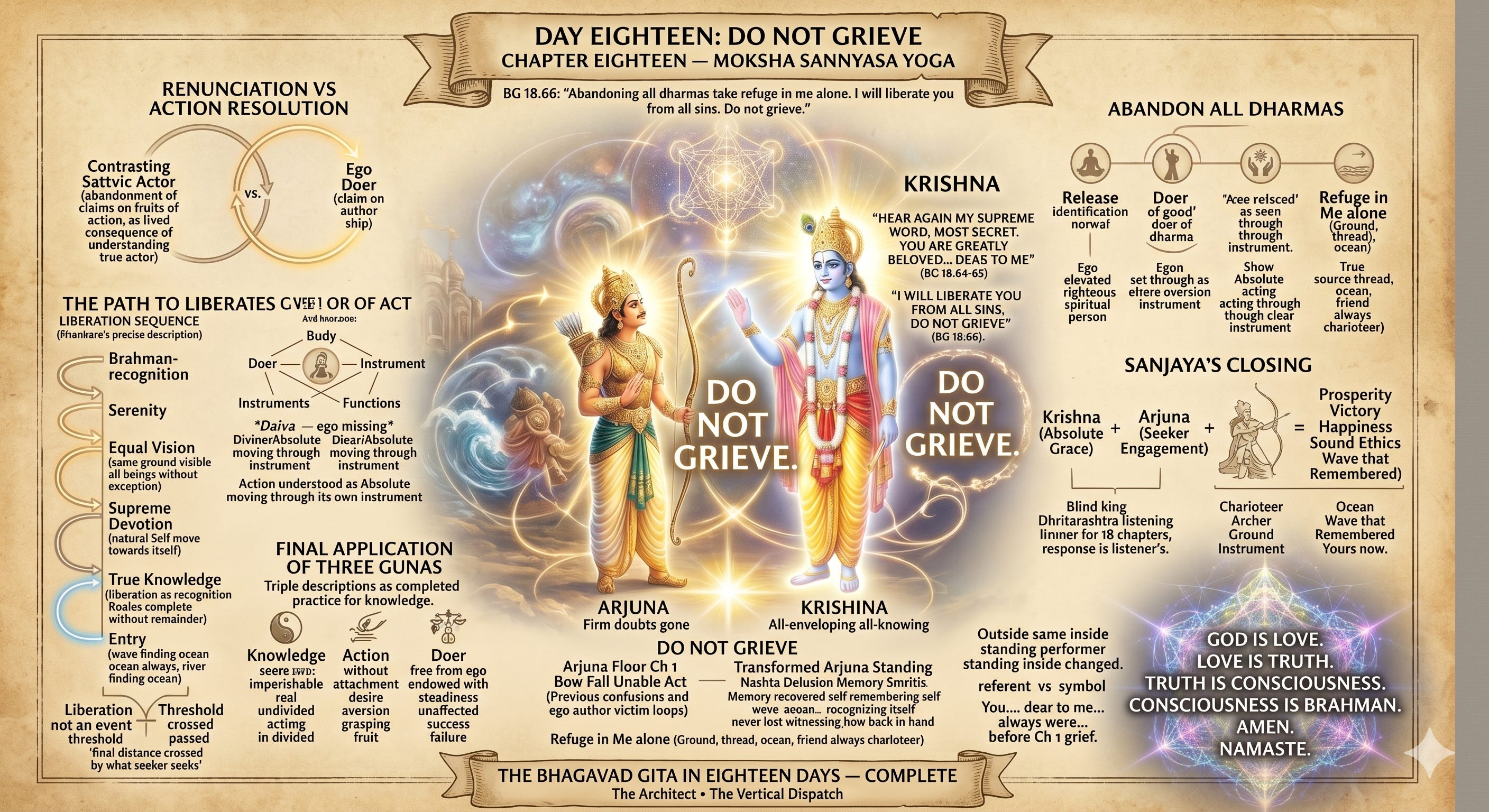
The resolution, stated finally and without remainder: genuine renunciation is not the abandonment of action. It is the abandonment of the ego’s claim on the fruits of action. The sattvic person performs prescribed duty — whatever this moment and this life genuinely require — while releasing all attachment to what the performance produces. Not as a performance of detachment. As the lived consequence of having understood who is actually acting.
Five causes lie behind every act, I tell him. The body. The doer. The various instruments of action. The different functions that organise the act. And the fifth — the divine, the ground itself, the Absolute moving through the instrument it has become. The ego that says I did this has overlooked four of the five causes. The one who sees all five has begun to see clearly.
When all five are seen — when action is understood as the Absolute moving through its own instrument, using its own body, gathering through its own senses, discriminating through its own intellect — then the ego’s claim on the authorship of the act simply loses its purchase. Not by effort. By clarity.
— ★ —
The three gunas appear one final time — applied now to knowledge itself, to action itself, and to the doer. The sattvic knower sees the one imperishable reality in all beings, undivided in the divided. The sattvic actor acts without attachment, without desire or aversion, without grasping for fruit. The sattvic doer is free from ego, endowed with steadiness, unaffected by success or failure.
These are not new teachings. They are the entire Gita compressed one final time into the most practical possible form. If a seeker could take only one page of the Gita into the rest of their life, this threefold description of sattvic knowledge, action, and doership would be a complete practice.
The fourfold structure of society follows — and Shankara read it with the same care he brought to svadharma in Chapter Three. The qualities described for each human type are not birth certificates. They are qualities of consciousness — orientations of the whole being that express themselves in particular kinds of work. The one whose nature tends toward wisdom and teaching is not greater than the one whose nature tends toward service and craft. They are the same Absolute wearing different vocations. What matters is whether the work arises from one’s genuine nature or from the ego’s calculation of status and advantage.
— ★ —
Now the sequence that Shankara called the most precise description of the path to liberation in the entire Gita.
Having become Brahman — having recognised the Self as the ground rather than one more object in the field — the seeker grows serene. From serenity, the equal vision of Chapter Five arrives naturally: the same ground visible in all beings without exception. From that equality, supreme devotion arises — not as a project the ego undertakes but as the natural movement of the Self toward itself. From devotion, true knowledge of what I am becomes possible. And from that knowledge, entry.
Entry. Not arrival at a distant destination. Not achievement of a state not previously present. The recognition — final, complete, without remainder — that the one who was seeking was always already what was being sought. The river finding that it was the ocean all along and always.
Shankara held this sequence as the correction of a common error — the belief that liberation is an event that happens after sufficient practice, a threshold crossed, a door passed through. Liberation is not an event. It is a recognition. And the recognition has been unfolding since the first genuine question was asked. Since Chapter One’s grief. Since the bow fell. Since something in a human being became unable to be satisfied with the answers it had been given and turned, in genuine desperation or genuine love or both, toward what it most fundamentally was.
— ★ —
And now — after seventy verses of the most comprehensive philosophical teaching in any language — I say it again. The thing I said in Chapter Nine. The thing the whole Gita has been a preparation for being able to receive.
“Hear again my supreme word, the most secret of all. You are greatly beloved of me. Therefore I will speak what is good for you. Fix your mind on me, be devoted to me, worship me, bow down to me. So shall you come to me. I promise you truly — for you are dear to me.” — Bhagavad Gita 18.64–65
You are dear to me. After everything — after the metaphysics and the cosmic form and the three gunas and the inverted tree and the field and its knower — after all of it, what the Absolute says is this. You are dear to me. The personal address. The promise. The ground of all existence speaking to the individual soul not as a philosophical proposition but as a relationship.
And then — verse 18.66. The verse that Shankara spent more commentary on than any other in the Gita. The verse that every school of Vedanta has claimed. The verse that contains, in four lines, everything.
“Abandoning all dharmas take refuge in me alone. I will liberate you from all sins. Do not grieve.” — Bhagavad Gita 18.66
Abandon all dharmas. Not abandon ethics. Not abandon duty. Not abandon the tradition or the practice or the care for others. Abandon the identification with the one who performs dharma. Release the ego’s most elevated project — the project of being a righteous person, a spiritual person, a person who is doing the right thing and knows it. When even that identity is released — when the doer of good is seen through with the same clarity as the doer of any other act — what remains is not moral chaos. It is the Absolute acting through a clear instrument. Action that has finally found its true source.
Take refuge in me alone. Not in the tradition as an end in itself. Not in the practice as an achievement. Not in the knowledge as a possession. In me — the ground, the thread, the ocean, the knower of all fields, the Supreme Person, the friend who was always already in the chariot. In what you most fundamentally are, prior to every qualification, prior to every identity, prior to every dharma performed and every sin committed and every moment of clarity and every moment of forgetting.
I will liberate you. Not: you will liberate yourself through sufficient effort. Not: liberation will be granted if conditions are met. I will liberate you. The Absolute’s own movement, the same movement that generated the universe from a single fragment and remained, the same movement that took form in every age when dharma declined and the teaching was needed again — that movement is what completes the recognition. The seeker does not cross the final distance. The final distance is crossed by what the seeker was always seeking.
Do not grieve.
The Gita began with grief. Arjuna on the floor of the chariot, bow fallen, unable to act, his certainty dissolved and nothing yet in its place. Eighteen chapters later — after the deathless Self and the fire of knowledge and the thread inside the pearl and the lamp in the windless place and the royal secret and the cosmic form and the field and its knower and the three gunas and the inverted tree and the three faiths — after all of it, the final instruction is three words.
Do not grieve.
Not because grief is wrong. Not because difficulty does not exist. Not because the world has been resolved into permanent comfort. But because the one who was grieving was the ego that believed itself to be the author and the victim of its own story. When that one is seen through — when the refuge has genuinely been taken — there is no one left to grieve in the way Arjuna was grieving on the battlefield. The grief that comes to the one established in the Self is different in kind. It touches and passes. It does not take up residence.
— ★ —
Arjuna’s response is the only moment in the entire Gita where he reports genuine transformation. Not agreement. Not intellectual satisfaction. Not the temporary relief of a good argument.
“Destroyed is my delusion. I have gained memory through your grace. I stand firm with doubts gone. I will do your word.” — Bhagavad Gita 18.73
Destroyed is my delusion. The Sanskrit word is nashta — annihilated, dissolved, gone without remainder. Not suppressed. Not managed. Not temporarily overcome. The delusion that began in Chapter One — the confusion of the knower with the field, the Self with the ego’s story, the ocean with the wave’s belief in its own separate reality — that delusion is destroyed.
I have gained memory. Smritis labdha — memory recovered. Not new knowledge acquired. Memory. This is Shankara’s most important reading of Arjuna’s response. What genuine teaching produces is not the addition of new information but the recovery of what was always known at the deepest level and was covered over by the accumulation of confusion. The Self remembering itself. The wave remembering the ocean. The knower recognising that it was never actually lost in the field it was witnessing.
I will do your word. Arjuna picks up the bow. He returns to the action the moment requires. Not because he has stopped caring about the outcome — because he now acts from a ground that the outcome cannot reach. The action will be the same action it would have been before the teaching. The one performing it is different. Completely, irreversibly different.
— ★ —
Sanjaya closes the Gita. He has been the narrator throughout — the minister with the gift of divine sight, describing the battlefield dialogue to the blind king Dhritarashtra who could not be there. The blind king whose opening question — what did they do on the field of dharma? — began this entire transmission.
Sanjaya says: wherever there is Krishna, the Lord of yoga, and wherever there is Arjuna the archer — there will be prosperity, victory, happiness, and sound ethics.
Read this carefully. Wherever there is Krishna and Arjuna. Not wherever there is Krishna alone. The Absolute and the seeker together — the ground and the one who has genuinely turned toward the ground — that combination is what produces flourishing. Not the Absolute without the seeker’s genuine engagement. Not the seeker’s effort without the Absolute’s grace. The two together. The charioteer and the archer. The ground and the instrument. The ocean and the wave that has remembered what it is made of.
The blind king has been listening to this answer for eighteen chapters. Whether he will act on it is left open. Shankara noticed this. The teaching is given. The response has always been the listener’s. It was the listener’s on the battlefield of Kurukshetra. It was the listener’s in Shankara’s eighth-century commentary. It has been the listener’s across every century and every tradition that has carried this text.
It is yours now.
— ★ —
Eighteen days. The grief of Chapter One has been transformed — not dissolved, transformed. The bow is back in the hand. The field is the same field it was when we began. The armies are still there. The war will still be fought. The consequences will still arrive.
Everything on the outside is the same. Everything about who is standing on the inside has changed.
That is what genuine teaching produces. Not a different world. A different knower standing in the same world, seeing it finally for what it is — the Absolute’s own movement, wearing every form, carrying every face, present in every moment of beauty and difficulty and ordinary Tuesday afternoon — strung on the single thread that has no beginning and no end and that you have been riding since before you knew there was a thread.
The symbol is not the referent. The field is not the knower. The wave is not all the ocean is. And you — reading these words, having come this far, having brought whatever understanding you brought and whatever questions remain — you are dear to me. You always were. Before the first chapter. Before the first question. Before the grief that opened everything.
Do not grieve.
— ★ —
God is love. Love is truth. Truth is consciousness. Consciousness is Brahman.
Amen. Namaste.
— ★ —
The Bhagavad Gita in Eighteen Days — Complete
The Architect • The Vertical Dispatch
#BhagavadGita #ChapterEighteen #MokshaSannyasaYoga #GitaIn18Days #GitaComplete #YogaOfLiberation #GitaStudy #IndianPhilosophy #Vedanta #AdvaitaVedanta #ShankaraCommentary #SelfRealization #Atman #Brahman #Moksha #Sannyasa #Tyaga #AbandonAllDharmas #RefugeInTheDivine #GitaQuotes #BG18_66 #DoNotGrieve #NashtaMohah #SmritisLabdha #MemoryRecovered #DelusionDestroyed #TrueRenunciation #SattvicAction #FiveCausesOfAction #TheDoer #ThreeGunas #PathsOfYoga #JnanaYoga #BhaktiYoga #KarmaYoga #SupremeDevotion #KrishnaArjuna #Kurukshetra #InteriorLife #TransformationOfConsciousness #SeekerAndDivineGrace #ProsperityAndVictory #SanjayasVision #GitaTeaching #TheVerticalDispatch #TheArchitect