


The Vertical Dispatch · The Requisite Cabinet · Entry Four
A NOTE ON METHOD, BEFORE THE AUDIT
Entry One of this series established that the bar Elliott Jaques described can be cleared, and that Anita Anand at Foreign Affairs is the proof. Entry Two established that the cabinet’s architecture knows what to do with minds still climbing into Stratum VI, and that Mélanie Joly at Industry is the proof of that. Entry Three established that the bench also knows what a closer is and where to place one, and that François-Philippe Champagne at Finance is the proof of that. Entry Four turns to the chair where none of the previous three frames quite reaches — the chair whose instrument is neither protection nor acceleration nor closing, but the steadier and harder work of holding the federation together while the Sovereign Core does its commercial work abroad.
A methodological point belongs here, because the frame shifts. The previous three ministers were audited against chairs whose deliverables are visible and external — a foreign-policy posture, an industrial strategy, a federal budget. The federation chair is different. Its deliverables are mostly the things that did not happen: the rupture that did not occur, the premier who did not walk out, the call that was returned, the room that did not split. A federation that is being held together does not announce itself by press release. It announces itself by the silence in the place where the crisis would otherwise have been. The audit of such a chair requires looking, sometimes, at what is absent — and reading the absence as evidence.
That is the discipline of Entry Four. The Sovereign Plan needs Anand to protect the framework, Joly to move at speed, and Champagne to close the deals. It also needs someone whose job, every day, is to make sure that while the other three are doing their work, the country they are working on behalf of does not come apart underneath them. That is the chair this dispatch audits.
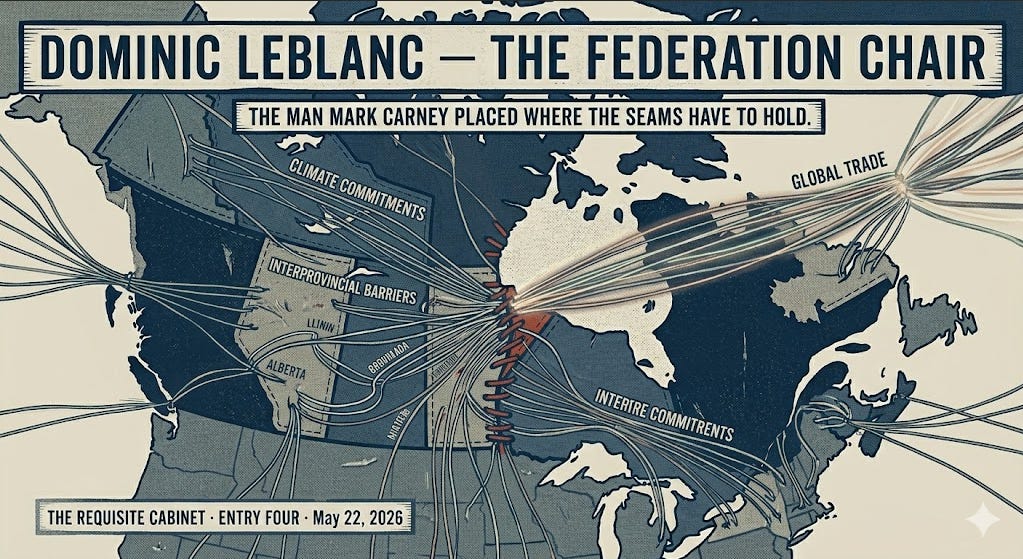
I. THE RESUME BEFORE THE RESUME
Dominic Matthew LeBlanc was born December 14, 1967, in Ottawa, the son of Roméo LeBlanc and Joslyn Carter. Place that birth date and that surname together, because the resume properly begins before he was old enough to choose any of it. His father, Roméo LeBlanc, was already a senior figure in Canadian public life — a former press secretary to Prime Minister Lester B. Pearson, an Acadian journalist who had become a Member of Parliament, and a man who would later serve as a senator, as Speaker of the Senate, and as the twenty-fifth Governor General of Canada. He was, when he took that final office in 1995, the first Acadian to hold it. The son grew up inside the rooms where Canadian federalism was being argued out, and the family table at which he sat as a child was a table at which the constitutional questions of the late twentieth century were live discussion, not abstraction.
The childhood detail that has been most reported, and that is worth pausing on, is the one about babysitting Justin Trudeau. Roméo LeBlanc served in cabinet alongside Pierre Trudeau through the seventies. The two families were close enough that the LeBlanc son, several years older than the Trudeau son, occasionally watched him in the way older children watched younger ones in Ottawa political households of that era. It is the kind of biographical detail that the press has used for colour. The structural significance is different and more important. It means that for Dominic LeBlanc, the Trudeau family was never a destination he had to arrive at. It was a household he had been inside since childhood. The relationship was prior to the politics. It would, in the events of 2024 and 2025, prove to be a relationship strong enough to outlast a political pivot that would have ended most other ministerial careers.
He took his Bachelor of Arts at the University of Toronto, Trinity College, in 1989 — political science. Then a Bachelor of Laws at the University of New Brunswick in 1992, the law degree he took at home, in the province whose riding he would represent for the rest of his career. He was called to the New Brunswick bar in 1993, and at twenty-five he made the decision that would shape the next four years of his life. He did not begin practising. He went to work for Jean Chrétien.
The Chrétien years are the unheralded foundation of the LeBlanc résumé, and the audit owes them their full weight. From 1993 to 1996 he served as a Special Advisor to the Prime Minister of Canada — three years inside the Prime Minister’s Office during the first Chrétien government, the government that fought down the 1995 Quebec referendum by a margin of one and a half percentage points and emerged committed to a federation that had nearly come apart in front of it. A young Acadian lawyer in his mid-twenties, watching that referendum from inside the Prime Minister’s Office, learns something about the federation that no law degree teaches. He learns that the country is held together by the willingness of people in rooms to stay in the rooms. He learns that the constitutional architecture of Canada is not, in the end, what holds it together. It is the relationships across it.
In 1996 he left the PMO to do something most young men in his position would not have done. He returned to school. He went to Harvard Law School for a Master of Laws degree, completing it in 1997, with a stated interest in American constitutional law. That is the second detail of the pre-political record that the dispatch will not let the reader miss. A young Canadian lawyer with three years of PMO experience, the Liberal nomination already in his sights, chose to take a year at Harvard studying not international commercial law, not corporate governance, but the constitutional law of the country that would, twenty-eight years later, become the principal threat to Canadian sovereignty he would be tasked with managing. The training was not accidental. The man was building the instrument he would later need.
He came home to fight for the Liberal nomination in Beauséjour—Petitcodiac in 1997. He won the nomination and lost the general election, at twenty-nine, to an NDP incumbent named Angela Vautour. That is the third detail the dispatch will not let pass. The man who would become a fixture of Canadian politics for the next quarter-century lost his first election. He went home, joined Clark Drummie as a partner in Shediac and Moncton, practised law for three years in the riding he had lost, and came back in 2000 to win the seat he has held without interruption ever since. Eight consecutive electoral victories, in a riding he learned to hold by losing it first.
He married Jolène Richard, a New Brunswick lawyer who would later be appointed to the Provincial Court of New Brunswick and rise to become its Chief Judge — herself the daughter of Guy A. Richard, former Chief Justice of the Court of Queen’s Bench of New Brunswick. The marriage placed him, by family, inside the senior judicial architecture of his home province. The pre-political résumé closes there. A man in his early thirties, a partner at a regional law firm, a sitting MP, married into the senior bench of his province, the son of a former Governor General, an alumnus of the Chrétien PMO and Harvard Law. He had not yet held a cabinet post. He had already absorbed, at the level of biography, almost every layer of the federal architecture he would later be tasked with holding together.
II. THE FIRST CANCER, AND THE PORTFOLIO LADDER
The portfolio sequence under three Prime Ministers, read carefully, is the second pillar of the résumé. Government House Leader from November 2015 to August 2016, the role new ministers are given when the system wants to see whether they can run the floor of the House of Commons under pressure. Minister of Fisheries, Oceans and the Canadian Coast Guard from May 2016 to July 2018, the file that runs through the Acadian and Maritime economy he had spent his life in, and the file in which he was diagnosed, in 2017, with chronic lymphocytic leukemia.
Hold that diagnosis still. He was forty-nine years old. He had been in cabinet for less than two years. The cancer was treated. By October 2018 he was able to announce that it was in remission, and he carried on. The portfolio moved him in July 2018 to Intergovernmental Affairs, Northern Affairs and Internal Trade, the chair the system gave him in part because the system had decided, by then, that he was the minister it could send to the premiers when the relationships were getting hard. Doug Ford’s Progressive Conservatives had just taken Ontario. The federation was entering one of its periodic stress tests. The system reached for the Acadian.
Then, in April 2019, the second cancer. Non-Hodgkin lymphoma. He stepped away from cabinet to begin treatment.
III. THE GIFT OF A STRANGER
This is the passage the dispatch must handle with the gravity the man’s body has already paid for, and the temptation will be to render it as the emotional centrepiece. The audit standard requires something else. The passage is rendered here because it is structurally relevant to the chair he now holds, and not because it earns him sympathy he has not asked for.
The chronology, drawn from the documented record: he received chemotherapy in Moncton through the spring and summer of 2019. The non-Hodgkin lymphoma, his medical team determined, would return if he did not undergo a stem cell transplant. Stem cell transplants are not performed at the Moncton hospital, so in June 2019 he was sent to the Hôpital Maisonneuve-Rosemont in Montreal for the workup. The transplant was performed on September 18, 2019. He was discharged on November 5. He had been re-elected from a hospital bed in October, having been unable to campaign in his own riding. He thanked his constituents from Montreal.
The bone marrow that saved his life came from a stranger. The donor’s identity is held confidential for two years under the protocols of international stem cell donation. In 2022, when the protocols permitted disclosure, LeBlanc learned that the man who had donated to him was Jonathan Kehl, then twenty-three years old, a student from Bad Hersfeld, a town in central Germany. Kehl had registered as a donor in a school campaign as a teenager, the way most other students at his school had registered, without expecting that his sample would ever be matched. The match was made across an ocean, between a young German man who had never set foot in Canada and a Canadian cabinet minister whose name he could not have pronounced. In September 2022, LeBlanc invited Kehl to Ottawa. They met for the first time at a hotel. The two men, separated by everything, embraced. LeBlanc’s first message to him, sent in German, was rendered in English as: You saved my life and I will always be grateful for your generosity.
The detail the audit will return to once and then leave alone is this. The federation chair that LeBlanc now holds is, in its structural function, an instrument that depends on the willingness of strangers — premiers who do not have to take his call, ministers in foreign capitals who do not have to grant him an audience, provincial counterparts who hold the constitutional ground he is asking them to share — to extend the gift of cooperation across distances and political divides that do not require them to extend it. The man who carries that instrument has been, in the most literal way a human body can be, the recipient of exactly that kind of gift. A young German stranger gave him his life. The biographical fact does not score on the Jaques framework. It scores at a deeper layer, which is the layer at which an audit eventually has to admit that some chairs are filled best by people whose own bodies have already taught them what the chair is for.
Barely fifteen days after his discharge from hospital, he was sworn back into cabinet as President of the Queen’s Privy Council. He has held that office, with one brief interruption, ever since.
IV. THE PORTFOLIO LADDER, RESUMED
The portfolios, after the transplant, accelerate. Minister of Intergovernmental Affairs, Infrastructure and Communities from October 2021 to July 2023 — the chair through which the federal-provincial infrastructure files flow, the chair the system gives to ministers it trusts with money and with the relationships through which money moves. Minister of Public Safety, Democratic Institutions and Intergovernmental Affairs from July 2023 to December 2024 — the chair holding CSIS, the RCMP, the Foreign Interference Inquiry, the border, cyber, and the operational federalism file all at the same time. The dossier in his hands during those seventeen months included the public disclosure that the Royal Canadian Mounted Police had alleged Indian government involvement in criminal activity on Canadian soil, an allegation of a kind the RCMP had never previously made against a Five Eyes partner’s adversary. The same period saw the legislative cycle on border-search authorities in which his department’s bill was met with sustained criticism from privacy advocates and legal experts; LeBlanc, in a move ministers of his vintage rarely make, publicly acknowledged the legislation had reached too far, shelved it, and committed to a revised version with judicial authorization required for most searches. The retreat was not a defeat. It was the recognition that the federation chair, on a file that touched civil liberty, had to step back to keep the seam intact.
Then December 16, 2024, and the move that defined the end of the Trudeau era. Chrystia Freeland resigned from cabinet on the morning of a day she was scheduled to deliver the Fall Economic Statement. Within hours, Trudeau swore LeBlanc in as Minister of Finance. He held the chequebook for ninety days. He was, in that ninety-day window, the minister responsible for the country’s fiscal posture as the Trump administration prepared to take office, as the tariff threats began to land, and as the Liberal Party prepared itself for a leadership race it had not yet announced and a Prime Minister who had not yet said he was leaving.
On the night of November 29, 2024, three weeks before Freeland’s resignation, LeBlanc had flown to Florida with Trudeau on an unannounced trip to Mar-a-Lago, for dinner with the President-elect of the United States. The Canadian delegation at that table was Trudeau, LeBlanc, and Trudeau’s chief of staff Katie Telford. The American side was Trump, his nominee for Commerce Secretary Howard Lutnick, his nominee for Interior Secretary Doug Burgum, his nominee for National Security Advisor Mike Waltz, the incoming Republican senator from Pennsylvania Dave McCormick, and several of their wives. The dinner ran approximately three hours. The topics, according to officials briefed on it afterward, included trade, border security, fentanyl, defence, Ukraine, NATO, China, the Arctic, and pipelines. Freeland did not make the trip. The structural significance of that fact would become visible three weeks later, when Trudeau reached past her to give LeBlanc her chair.
LeBlanc was the Canadian minister in the room with the second Trump administration before that administration was even sworn in. He had begun the relationship with Lutnick before Lutnick had taken his oath. That early-built channel is the foundation of everything that follows in the present-tense file of the chair he now holds.
V. THE PIVOT TO CARNEY
The Liberal leadership race opened in January 2025. Two principal candidates emerged: Chrystia Freeland and Mark Carney. The choice that the senior figures of the Trudeau cabinet made between those two candidates was the single most consequential intra-party decision of the decade. Most of the cabinet had spent years working with Freeland, who had been Deputy Prime Minister, who had run the file on CUSMA in the first Trump term, and who had been the de facto second-in-command of the Trudeau government for most of its second and third terms.
LeBlanc went with Carney.
The dispatch will not psychologise the decision; it cannot, and it will not pretend otherwise. The documented fact is that LeBlanc — the minister most personally close to the Trudeau family, the man whose father had been Governor General, the man who had been in the room at Mar-a-Lago when Freeland was not — chose the central banker over the deputy prime minister. He chose the framing mind over the inheritor.
Carney won the leadership on March 9, 2025. He named LeBlanc Minister of International Trade and Intergovernmental Affairs four days later, on March 14, holding the Finance file briefly until handing it to Champagne. Then, after the federal election Carney won in his own right, the May 13, 2025 cabinet reshuffle gave LeBlanc the title that defines Entry Four. President of the King’s Privy Council for Canada. Minister responsible for Canada-U.S. Trade. Minister of Intergovernmental Affairs. Minister of One Canadian Economy. In September 2025 the Internal Trade portfolio was added to the composite. The title is the longest in the cabinet. It is also, by structural function, the federation chair — the single ministerial portfolio inside which the relationship to the provinces, the relationship to Washington, and the project of internal trade liberalization are held as one connected file.
Carney’s structural reasoning is visible in the architecture. The Sovereign Plan needs Anand abroad protecting the framework, Joly at speed inside Industry, Champagne at the chequebook closing the deals. It also needs one minister whose job, full-time, is to keep the federation behind those three ministers from coming apart while they are doing their work. The premiers do not have to cooperate with Ottawa on internal trade liberalization. The Americans do not have to negotiate in good faith. The relationships have to be held by someone whose entire ministerial life has been training for exactly this kind of holding. Carney did not give the composite portfolio to a generalist. He gave it to the Acadian who had been doing some part of this work, in some form, for the better part of a decade.
VI. THE LUTNICK FILE
Read the bilateral relationship the way Entry Three read Champagne’s relationship with Bessent. LeBlanc and Howard Lutnick have, on the documented record, the most consistent operational channel between Ottawa and the Trump administration on the trade file. The relationship began at Mar-a-Lago in November 2024, before either of them held the offices they now hold. It carried through Trump’s first executive orders on tariffs in early 2025, through the digital services tax climbdown of June 2025, through the August 2025 Washington meetings where LeBlanc met Lutnick to restart stalled talks after Trump had broken off negotiations over Ontario’s anti-tariff advertising campaign, through the CUSMA review process that opened in 2026, and into the present moment in which LeBlanc chairs Carney’s twenty-four-member Advisory Committee on Canada–U.S. Economic Relations, formally inaugurated on April 27, 2026.
The press, in both Canada and the United States, has settled on a phrase for what LeBlanc is doing with Lutnick. The phrase is Trump whisperer, and the dispatch must press it before it permits itself to use it.
A whisperer, in the metaphor’s original sense, is someone who calms an irrational animal — a horse, a dog, a wild beast whose behaviour cannot be reasoned with directly but can be managed by someone with the right instinct. The framing flatters both parties simultaneously. It flatters Lutnick and the administration he serves by reducing the political object in front of LeBlanc to a creature whose behaviour is essentially affective rather than strategic. It flatters LeBlanc by making him the rare and uniquely-gifted figure who can manage what others cannot. Both halves of the frame are convenient. Neither is, on the documented record, accurate. Lutnick is not a beast. He is a Cantor Fitzgerald CEO with a documented worldview on tariffs, on currency, and on the restructuring of the global trading system, who is doing the work the administration he serves has hired him to do. LeBlanc is not a whisperer. He is a federation chair who has built a working channel with his American counterpart because he has spent his entire career building working channels with counterparts who do not have to take his calls.
The documented behaviour, set in plain language, is this. LeBlanc and Lutnick speak frequently. They speak through periods when the public posture between the two governments has hardened, and they continue speaking when the public posture has softened. LeBlanc has stated, on the record, that he has “made a deliberate decision not to discuss the content” of his conversations with American officials publicly. That sentence is the actual federation-chair instrument at work. The discipline of the closed back-channel is older than the metaphor of the whisperer, and it does not require either party to be magical. It requires only that both parties have decided the channel is worth more open than closed.
In April 2026, when Lutnick told a panel event that Canada’s negotiating strategy was the worst he had ever heard, LeBlanc’s public response was to note that Lutnick had said nothing of the kind in their direct conversation the week before. That single sentence — we spoke at length, he did not say that to me — is the federation chair in its working state. It does not deny the public insult. It does not amplify it. It quietly establishes, for any third party paying attention, that the public theatre and the operational channel are running on different tracks, and that the operational channel is the one LeBlanc is responsible for.
VII. THE ALBERTA FILE, AND THE QUESTION THE PREVIOUS DISPATCH PRESSED
This publication has, in a separate dispatch, audited Premier Danielle Smith on her performance against the November 2025 MOU with the federal government. The findings of that dispatch were severe. The hours-after-signing walk-back of the carbon commitment; the flooding of Alberta’s carbon credit market within a week; the missed April deadlines on the carbon price and on the Pathways Alliance trilateral; the framing of cooperative federalism while governing from the logic of Alberta-first sovereignty. The dispatch’s verdict was that Smith was acting in bad faith on the substance of the agreement she had signed.
LeBlanc is the federal channel to Smith. He is the minister whose public statements have linked construction of a new oil pipeline to the proceeding of the Pathways Alliance carbon capture project — a structural contingency designed to give both sides of the federal-Alberta file something to hold while the harder commercial decisions are negotiated. He has been the minister most identified, in the French-language press, with maintaining a constructive tone with the western premiers even while the federal government holds firm on substantive demands. The Acadian, the Quebec press has noted, gets treated by Smith and by Saskatchewan Premier Scott Moe with a respect they do not extend to most other figures in Ottawa.
The elenchus for Entry Four lands here, and the audit standard requires that the question be asked plainly. The federation chair’s instrument is continuity of relationship. The Alberta counterparty has been documented, in print, in this publication, as a counterparty using the appearance of relationship as the cover for non-performance on the substantive commitments she signed. The Socratic question for LeBlanc is whether the relational instrument can work against a counterparty who is using the relationship itself as the evasion. This is not a question about LeBlanc’s competence. It is a question about whether the federation chair, structurally, can do its job when the other side of the table has decided that the appearance of cooperation is more valuable than its substance.
The audit cannot answer the question yet. The Alberta file is live. The Pathways trilateral remains unsigned. The pipeline application deadline of July 1 is six weeks away as this dispatch goes to publication. What the audit can do is name the question and let the next ninety days produce the record by which it will be answered.
VIII. THE COGNITIVE PROFILE
The standing editorial standard now applies, in the same format used for every major figure this publication examines — from the documented public record only, without malice and without flattery.
Dominic Matthew LeBlanc. B.A., University of Toronto, Trinity College, 1989. LL.B., University of New Brunswick, 1992. LL.M., Harvard Law School, 1997. Called to the New Brunswick bar, 1993. Special Advisor to Prime Minister Jean Chrétien, 1993 to 1996. Partner, Clark Drummie, Shediac and Moncton, 1997 to 2000. Member of Parliament for Beauséjour since November 2000, re-elected without interruption eight consecutive times. Government House Leader. Fisheries, Oceans and the Canadian Coast Guard. Intergovernmental Affairs (under three Prime Ministers, in various combinations with Northern Affairs, Infrastructure, Internal Trade, and Public Safety). Public Safety, Democratic Institutions and Intergovernmental Affairs. Minister of Finance for ninety days at the end of the Trudeau government. Now President of the King’s Privy Council, Minister responsible for Canada-U.S. Trade, Minister of Intergovernmental Affairs, Minister of One Canadian Economy, and Minister of Internal Trade in the Carney government. Two cancers survived, the second by the gift of bone marrow from a young German stranger.
PIAAC Level 4, with documented reach into Level 5 visible in the constitutional and bilateral work. Stratum V, mature and consolidated, holding a chair that — in its full composite form, with the trade-federation-internal-trade-Privy Council bundle as a single instrument — touches the lower reach of Stratum VI in its time-span and in its multi-variable structure. The honest finding is a minister whose stratum is consolidated where it sits, whose instrument is relational rather than systems-cognitive in the manner of the previous three ministers audited, and whose chair is structurally requisite to the Sovereign Plan in the present moment but raises a runway question the audit must name.
Then the elenchus, in two parts, because the audit owes the federation chair both questions even though they are uncomfortable.
The first is the question of the Alberta counterparty named above. The relational instrument is documented and effective. The question is whether the instrument can hold against a counterparty using the appearance of relationship as evasion. The audit does not answer it. It asks it.
The second is the runway question, and the dispatch will not flinch from it. LeBlanc is fifty-eight years old. He has survived two cancers, the second by the most demanding intervention modern medicine offers. The Sovereign Plan is denominated in decades, not in cabinet terms. The federation chair he now occupies is structurally requisite for the present rupture — for the Trump term, for the CUSMA review, for the Alberta MOU, for the One Canadian Economy push — but the Stratum VI federation work the Sovereign Plan will require in its second decade is a separate question, and one that no single minister can answer alone. The dispatch raises it not as a critique of the minister, but as a question the cabinet’s architecture as a whole will eventually have to address. The federation chair has been requisitely filled for the present. The bench behind it has not yet been publicly identified.
THE VERDICT OF ENTRY FOUR
Carney placed at the federation chair the Acadian lawyer who had been training his whole adult life for exactly this work. The son of the first Acadian Governor General. The Chrétien PMO veteran of the 1995 referendum aftermath. The Harvard Law graduate in American constitutional law. The two-time cancer survivor who has, in the most literal way available, received the gift of a stranger’s willingness to extend himself across a distance neither party was required to cross. The husband of the former Chief Judge of the Provincial Court of New Brunswick. The minister who has held some form of the intergovernmental file across three Prime Ministers and seven years. The man who was at Mar-a-Lago in November 2024 when the principal alternative to Carney was not. The minister who chose Carney over Freeland in the leadership race, and whose composite portfolio under Carney is the longest title in the cabinet because the work it bundles together has, by Carney’s structural decision, been bundled into one chair.
Entry Four finds that the federation chair has been filled by the minister whose entire biography was the training for it, that the instrument he carries is relational and the chair he holds is structurally requisite to the Sovereign Plan in its present-rupture phase, and that the two elenchi the dispatch has raised — the question of whether the relational instrument can hold against a counterparty using relationship as evasion, and the question of the runway behind the chair across the multi-decade horizon the Sovereign Plan ultimately requires — are questions the audit raises honestly and leaves open for the record to answer.
The Sovereign Core architecture, after four entries, now stands as follows. Carney holds the strategic frame. Anand protects the investor’s framework abroad. Joly moves at speed inside Industry. Champagne closes the operational deals at Finance. LeBlanc holds the federation behind all three of them. Five chairs audited. The Sovereign Core has at least three more to come.
Entry Five follows. The Sovereign Plan’s commercial proposition — the pipelines, the critical minerals, the LNG, the energy diversification toward Europe and Asia, the entire question of what Canada actually has to sell to a world that is rewriting its industrial map in real time — runs through one chair, and that chair is held by the man who stood beside Mark Carney at the Bank of Canada through the financial crisis of 2008. Tim Hodgson, Minister of Energy and Natural Resources, is Entry Five. The federation chair holds the seams. The energy chair fills the hull. The audit will follow.
A Note on Standard. This dispatch makes no claim regarding Minister LeBlanc’s psychology, motives, or character. All assessments draw from the public record alone — ministerial statements, departmental outputs, documented files, the parliamentary record, the Government of Canada’s published cabinet announcements, biographical material from the Canadian Encyclopedia, the Library of Parliament, the Globe and Mail, the CBC, Radio-Canada, Reader’s Digest Canada, CPAC, Politico, Bloomberg News, NPR, the Associated Press, and contemporaneous reporting from 2017 through May 2026. The Stratum framing follows Elliott Jaques’s requisite organization theory and is based on observable patterns of work, not personal evaluation. The cognitive scoring follows the PIAAC literacy scale and the Jaques stratified-systems framework. The standing editorial standard of this publication applies without exception: assessments are advanced from the documented record only, without malice and without flattery.
God is Love. Love is Truth. Truth is Consciousness. Consciousness is Brahman.
Amen. Namaste.
DISPATCH HASHTAGS
#TheVerticalDispatch · #TheArchitect · #TheRequisiteCabinet · #DominicLeBlanc · #AIG · #ArtificiallyIntelligentGovernance · #CarneyGovernment · #FederationChair · #IntergovernmentalAffairs · #CanadaUSTrade · #OneCanadianEconomy · #InternalTrade · #PrivyCouncil · #ElliottJaques · #RequisiteOrganization · #StratifiedSystemsTheory · #PIAAC · #StructuralLiteracy · #CanadianSovereignty · #SovereignCore · #SovereignPlan · #Acadia · #NewBrunswick · #Beauséjour · #JonathanKehl · #TheElenchus · #Substack · #CanadianPolitics · #CivicLiteracy · #LongformWriting · #PolicyAnalysis
I appreciate the in depth biographical research. Do you know much about Evan Solomon ? Minister AI and digital innovation. He happens to be MP for my riding