


THE VERTICAL DISPATCH
We write for the mind, the eye, and the ear.
Read it. Look at it. Listen to it. The Vertical Dispatch is built for all three — prose with rhythm, made to be heard as much as read.
From metaphysics to geopolitics, from culture to history, from the sacred to the street — and everything in between. One lens, every subject. No ego. Just the record, named clean.
Press play. Walk with the words. 🕯️
On Music · The Age of Consequences
May 2026
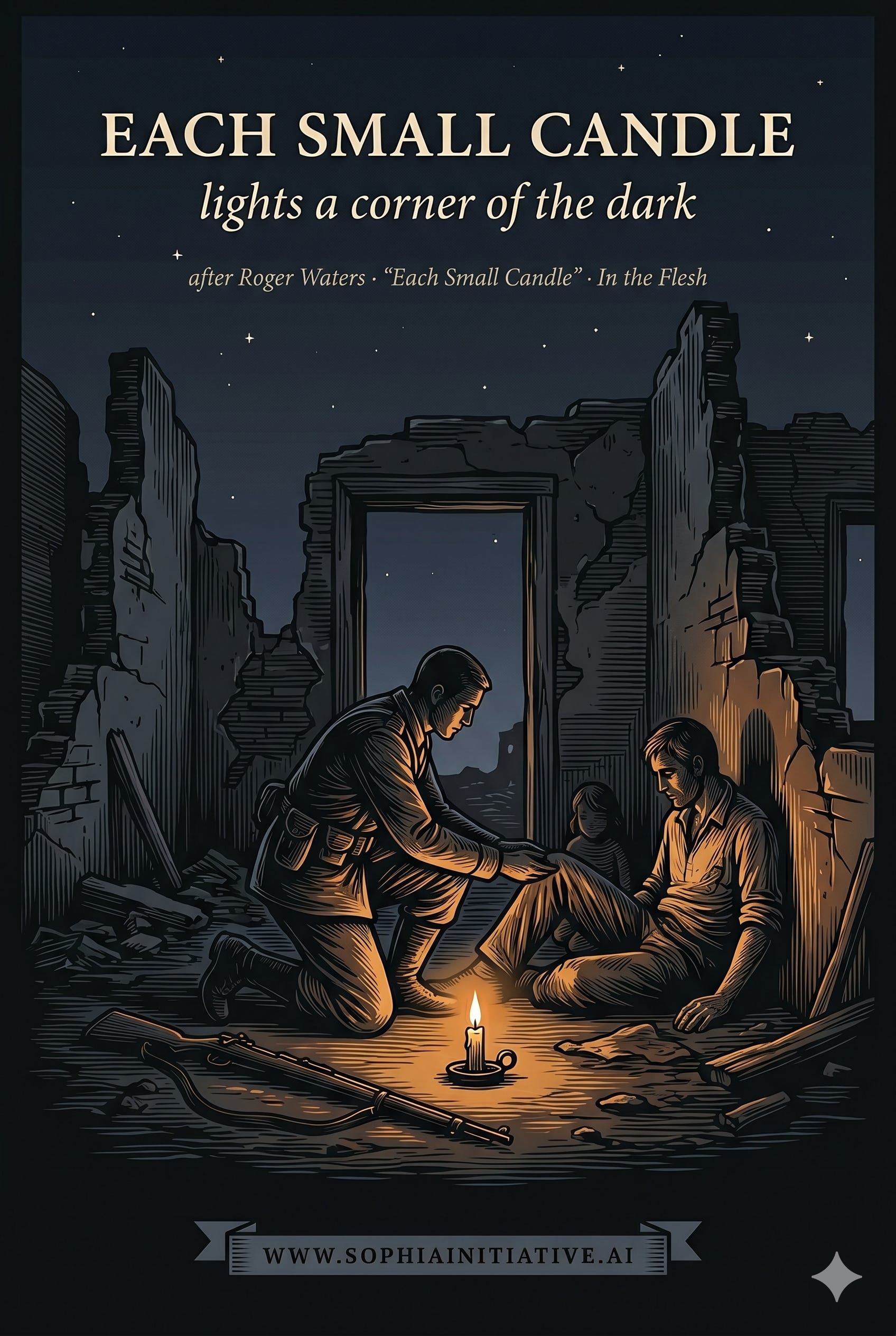
“Each small candle lights a corner of the dark.”
— Roger Waters, “Each Small Candle” (In the Flesh – Live, 2000)
I. The Song
In 1999, Roger Waters read a small story in a London newspaper, and out of it he made the only new song he would play on a tour otherwise built from the great wreckage of Pink Floyd. He called it “Each Small Candle,” and he never released a studio version. It exists only as it was meant to exist — live, sung once a night into a darkened arena, at the very end, after everything else.
The story was from the war in Kosovo. A Serbian soldier came upon an Albanian woman lying wounded in the shell of a burned-out building, a crying child near her. He was on one side; she was on the other. By every logic of the war he was inside, she was the enemy, and the enemy is not your concern. He broke ranks anyway. He laid down his rifle and knelt beside her. He bound her wounds, gave her food, calmed the child — and then he picked his way back out through the ruin of her life, returned to his men, and marched on. One act. No camera. No reward. A single, unwitnessed mercy in the middle of a slaughter.
Waters built the song around that image, and he opened it with another. The first verse is not even his — it is a near-word-for-word translation of a poem called “Not the Torturer,” written twenty years earlier by the Danish poet Halfdan Rasmussen for Amnesty International. Two humanitarian voices, two decades apart, folded into one song: the poet who said it is not the torturer or the rifle or death itself that should frighten us most, but the blind indifference of an unfeeling world — and the songwriter who answered him with the soldier who refused to be indifferent.
That is the whole architecture of the thing. The terror is not the cruelty. The terror is the indifference. And the answer to the indifference is not an army or a treaty or a slogan. It is one person who breaks ranks and kneels. Each small candle lights a corner of the dark. Not the whole dark. A corner. But a corner is not nothing, and enough corners lit at once will chase the darkness from a room. Waters put the Amnesty International symbol on the screen behind him when he sang it, in case anyone missed what it was for.
II. The Same Candle, Now
A quarter of a century has passed since that song was written, and the burned-out building has moved. It is no longer in Kosovo. It is in El Fasher, in Darfur, in a hundred villages across Sudan whose names will never reach a London newspaper. The woman lying wounded is still there. The crying child is still there. And the merciless, unfeeling world that Rasmussen named is doing now exactly what it has always done: looking the other way.
We wrote, in the dispatch before this one, what the record shows of Sudan. Nine million people driven from their homes. Nearly twenty million facing hunger. A determination of genocide on the books. The largest humanitarian catastrophe on earth — and the least watched. The figures are public. The cameras are elsewhere. The indifference is total, and it is not the indifference of cruelty. It is the worse kind — the indifference of distraction, of the changed channel, of the feed that scrolled past a starving child to land on something brighter.
And here is where the song stops being a song about Kosovo and becomes a song about us. Because the soldier in Waters’ story had a choice that we have too. He could have stayed in ranks. It would have cost him nothing, and no one would ever have known. The whole logic of the war gave him permission to walk past. He knelt anyway. The question the song puts to its listener — and the question this dispatch puts to you — is the same question, made quiet and personal: when the suffering is far, and complicated, and on the other side of every line you have been taught to defend, will you break ranks and kneel? Or will you stay in formation and march on?
Breaking ranks does not require a uniform or a battlefield. For most of us it is smaller and harder than that. It is the refusal to look away. It is reading the number that should stop a person where they stand, and refusing the mercy of forgetting it. It is letting the suffering of strangers cost you something — an hour, a donation, a conversation, a vote, an act of attention in an age built to deny it. It is lighting one corner of the dark, when the whole instinct of the world is to leave the room.
A Corner of the Dark
Waters never explained the song much, and he did not need to. The image carries it. A single candle does not pretend to be the sun. It does not end the night. It lights a corner — the only corner it can reach — and it says, by burning, that someone is still here, still awake, still unwilling to surrender the room to the dark. And it says something else, quieter and truer: that the dark is only ever defeated this way, one candle at a time, never all at once.
That which is not good for the hive is not good for the bee. The soldier knew it without the words. He looked at an enemy and saw the hive, and knelt. Twenty-five years later the building is still burning, somewhere we have agreed not to look, and the only thing that has ever answered the indifference of the world is the person who breaks ranks and lights the corner in front of them.
Listen to the song. Sit with the soldier and the wounded woman and the crying child. And then think of Sudan, where the same scene is playing now, at a scale that should break the heart of any world still capable of being broken. Each small candle lights a corner of the dark. This is ours to light. Do not look away.
Press play. Sit in the dark with it. Then light your corner. 🕯️
God is Love. Love is Truth. Truth is Consciousness. Consciousness is Brahman.
Amen. Namaste. Om Namah Shivaya.
— The Architect
The Vertical Dispatch
sophiainitiative.ai
On the record: “Each Small Candle” was written by Roger Waters (1999) and released on In the Flesh – Live (2000); no studio version exists. Its first verse is a translation of “Ikke Bødlen” (“Not the Torturer”) by Danish poet Halfdan Rasmussen, written for Amnesty International Denmark in 1979. The song was inspired by a reported account from the Kosovo war. Sudan figures are drawn from the IPC / FAO / WFP / UNICEF statement of 15 May 2026, the IOM (May 2026), the U.S. Department of State, and UN OCHA, as cited in the preceding dispatch, The Shame of the World. Lyrics are not reproduced here; listen to the song for the words. The Vertical Dispatch advances assessments from the documented record only — without malice and without flattery.
#EachSmallCandle #RogerWaters #InTheFlesh #PinkFloyd #HalfdanRasmussen #AmnestyInternational #Sudan #TheShameOfTheWorld #Darfur #DontLookAway #LightACorner #ActOfMercy #BreakRanks #TheForgottenWar #MusicThatMatters #TheVerticalDispatch #TheArchitect #SophiaInitiative #AgeOfConsequences #GodIsLove #LoveIsTruth #OmNamahShivaya