


THE VERTICAL DISPATCH
We write for the mind, the eye, and the ear.
Read it. Look at it. Listen to it. The Vertical Dispatch is built for all three — prose with rhythm, made to be heard as much as read.
From metaphysics to geopolitics, from culture to history, from the sacred to the street — and everything in between. One lens, every subject. No ego. Just the record, named clean.
Press play. Walk with the words. 🕯️
The Requisite Cabinet · Entry Eight
May 24, 2026
A Note on Method, Before the Audit
Entry One of this series established that the bar Elliott Jaques described can be cleared, and that Anita Anand at Foreign Affairs is the proof. Entry Two established that the cabinet’s architecture knows what to do with minds still climbing into Stratum VI, and that Mélanie Joly at Industry is the proof. Entry Three established that the bench also knows what a closer is and where to place one, and that François-Philippe Champagne at Finance is the proof. Entry Four established that the seams of the federation are being held by an Acadian lawyer whose entire biography was the training for it, and that Dominic LeBlanc at the composite federation chair is the proof. Entry Five established that the commercial proposition of the Sovereign Plan is being delivered by a Goldman Sachs Canada CEO whose working relationship with the Prime Minister predates the Prime Minister’s politics by a quarter of a century, and that Tim Hodgson at Energy and Natural Resources is the proof.
Entry Six turns to the chair the audit has reached at the perimeter of the Sovereign Core — beside the strategic primary triad rather than inside it — and the audit’s first task is to be honest about that placement. The Core, as Carney built it, contains nine seats. The previous five entries audited four primary chairs and one composite federation chair. Entry Six audits the chair that closes the top tier of the Core architecture. The remaining Core chairs — Defence, Public Safety, and the seats below the Core the series will continue to examine — follow this entry and the Carney capstone in turn.
A methodological move is required before the entry can be written. The previous five ministers were audited against chairs whose function is documented in a century of cabinet government, and whose stratum requirements can be mapped against Elliott Jaques’s framework without strain. The chair Entry Six audits did not exist eighteen months ago. The portfolio it governs is a technology that did not exist, in its current form, three years ago. The Jaques instrument was built for industrial-era organisations whose time-spans were denominated in decades and whose decisions compounded inside human institutional memory. The chair Solomon holds governs a technology whose time-span is denominated in months and whose decisions compound inside machine architectures the human mind cannot fully model in real time.
The audit names this plainly. The Jaques framework, applied to the AI chair without modification, would read Solomon’s stratum against the chair’s structural demand and find a gap. That finding would be technically defensible and substantively wrong. The reason it would be substantively wrong is the subject of this dispatch. The audit will press the question without flattery and without malice, the way every prior entry has pressed its own.
I. The First Meeting
The documented record does not pin the date or the location of the first meeting between Mark Carney and Evan Solomon. It pins something more useful. It pins the transaction.
Sometime between 2013 and 2015, in a Canadian art market that operated on the social architecture of private dealers and trusted introductions, Evan Solomon — then the host of CBC’s Power & Politics and The House, among the most-watched political journalists in English Canada — brokered the sale of paintings from the collection of Toronto art collector Bruce Bailey to wealthy buyers. The documented record identifies two buyers by name: Mark Carney, then Governor of the Bank of England, and Jim Balsillie, the co-founder of BlackBerry. Solomon took commissions on the sales. The press of the period reported the figure, on at least one transaction, at more than three hundred thousand dollars.
On June 9, 2015, the Toronto Star investigative reporter Kevin Donovan published the story. Within roughly forty-eight hours, the CBC had ended its relationship with Solomon. Within the same week, the Bank of England issued a statement that read, in part, that the Governor had no enduring professional relationship with Mr. Solomon and that he did not comment on matters relating to his personal life.
That statement is the most consequential sentence in the pre-political record of the chair Entry Six audits. Read at altitude, it is not a denial. It is a closed door — a diplomatic refusal to characterise a documented transaction beyond what the transaction itself revealed. The Governor of the Bank of England had purchased art through a Canadian journalist who reported on him as a public figure, and the journalist had taken a commission the buyer was not told of. It was the kind of transaction a central banker of Carney’s stratum would, by reflex, want to place behind a closed door at the moment of public exposure, because the alternative — characterisation in either direction — would have committed the Bank to a position it had no institutional reason to take.
The door closed in June 2015. The audit’s task is to read what happened next. What happened next is that the door did not stay closed.
Over the next decade, Carney returned to Canada to lead United Nations work on climate finance and to chair Brookfield Asset Management. Solomon rebuilt his career — at SiriusXM, then at CTV — and pivoted, from around 2020, toward the technology and AI files. The two men were not strangers in this period. Solomon interviewed Carney repeatedly through the late 2010s and early 2020s. The interviews were not warm and not hostile. They were the structurally cool interviews two men conduct when a documented transaction sits in their shared past that neither will mention on camera and both know is in the room.
That awareness — the documented but unspoken transaction sitting in the room while two professionals do their professional work in front of it — is the foundation on which the Carney–Solomon working relationship is built. It is not friendship. It is not patronage. It is the harder and more durable thing that forms between two people who have, by accident of biography, become permanent participants in each other’s public record, and have chosen, across a decade, to extend each other professional courtesy across the transaction that defined the first chapter.
When Carney won the Liberal leadership on March 9, 2025, and announced his intention to run in the April 28 federal election, Solomon — then still at CTV — was among the journalists covering the campaign. By mid-March the record shifts: Solomon was recruited to run as the Liberal candidate in Toronto Centre. He won the seat on April 28, and was sworn into cabinet on May 13 as the first Minister of Artificial Intelligence and Digital Innovation in Canadian history. The man whose career had ended over paintings Mark Carney bought was, ten years later, in Mark Carney’s cabinet, holding the most consequential novel portfolio of the government.
Read at altitude, the arc is not a redemption story. Redemption stories are about forgiveness, and the documented record contains no act of forgiveness — Carney has never publicly characterised the 2015 transaction, and Solomon has never publicly characterised the recruitment. The arc is colder and structurally more interesting: two men who, having shared a documented breach of one trust architecture, spent a decade building a working relationship inside another, and have now been placed by that second architecture into the chair from which a third — the public’s trust in artificial intelligence — will be governed.
II. The 2015 Record, Read Honestly
The audit owes the 2015 record a clean read, because the entirety of the Solomon dispatch depends on whether the breach that ended his CBC career is read accurately. The series will not soften the breach to make the rehabilitation easier, and it will not exaggerate it to make the chair harder.
Solomon entered a private business partnership with Bruce Bailey around the fall of 2013, brokering sales of Canadian art — including works by Group of Seven members and contemporary Canadian artists — to wealthy buyers. The commission structure was reported at roughly ten per cent; on at least one transaction the press reported the figure at more than three hundred thousand dollars. The Toronto Star’s reporting named two buyers — Balsillie and Carney — though it did not foreclose the possibility of others.
Solomon disclosed the partnership to CBC management in April 2015. The CBC’s account is that the disclosure was incomplete — that he characterised it as a passive interest held with his wife and Bailey, and did not disclose that the buyers included people he interviewed in his journalistic capacity, or that he was actively brokering deals himself. When the Star made the full picture public on June 9, 2015, the CBC conducted a short internal review and ended his employment, on the grounds that his activities were inconsistent with its conflict-of-interest and ethics policy and its journalistic standards and practices.
There were no criminal charges. There was no civil judgment. There was no regulatory finding by any securities, art-market, or professional body — and there could not have been, because art brokerage in Canada is unregulated and carries no licensing regime to violate. Solomon’s union, the Canadian Media Guild, examined his options; he did not grieve the dismissal, did not sue the CBC, and did not sue the Star. He issued a statement saying he was deeply sorry for the damage his activities had done to the trust the CBC and its audiences had placed in him.
The audit reads that record at its full weight. The breach was real. It was a breach of an institutional trust covenant — the CBC’s journalistic code — and Solomon did not contest the finding. It was not a breach of law. It was the kind of failure a senior broadcast journalist of his stratum should not have made, and Solomon, in his own statement, did not pretend otherwise.
The question the audit must press is whether the breach disqualifies a person from holding public trust in perpetuity, or whether it is the kind of failure that — fully acknowledged, paid for in employment terms, and uncontested — leaves a person available, after sufficient time, for a different chair on different terms. The audit’s answer is that the documented record forecloses neither reading, and that the relevant test is not the breach itself but what the person did in the decade after it.
III. The Rehabilitation Decade
By August 2015, two months after the firing, Solomon was back on the air: SiriusXM Canada hired him to host a political talk show, and Maclean’s signed him as an election commentator for the October 2015 federal campaign. The professional landing was, by the standards of public-figure recoveries, unusually fast.
By 2017 he had joined Bell Media and CTV, hosting Question Period — the Sunday-morning federal political programme that is the structural counterpart to the CBC’s The House he had been hosting at the moment of his firing. He co-founded GZERO Media’s Canadian operations as a partner of Eurasia Group founder Ian Bremmer, anchoring a digital operation focused on geopolitics and technology, and hosted GZERO North, a programme explicitly focused on Canada–U.S. relations and the technology files.
That progression is the public face of the rehabilitation. The underwater part — which the record permits the audit to read only at altitude — is the slow rebuilding of the Toronto cultural and policy networks Solomon had belonged to before 2015, and the deliberate cultivation of the AI file specifically, from around 2020: increasing interviews with AI researchers, technology executives, and governance thinkers, until by 2023 and 2024 his programming had visibly tilted toward the AI question. By the April 2025 election he was among the most fluent broadcasters in English Canada on the topic.
The audit notes this rehabilitation without sentimentalising it. It was not undertaken in penance. It was undertaken as a career. Solomon needed to work, and he worked. The cultural and professional networks that welcomed him back did so on their own assessment of what he had done and what he had paid for it, and the audit will not second-guess assessments made by people who knew him and the record better than the audit can. What the audit can note is that the rehabilitation produced, by 2025, a public figure whose capacity for translating complex technological and political questions for general audiences was — by the consensus of admirers and critics alike — among the strongest in Canadian broadcasting. That capacity is the capacity Carney reached for.
IV. The Chair That Did Not Exist
The Ministry of Artificial Intelligence and Digital Innovation was created by Order in Council on May 13, 2025, the day Mark Carney was sworn in as Prime Minister of his own government following the April 28 election. Solomon was sworn in as its first holder on the same day. The portfolio added the Federal Economic Development Agency for Southern Ontario as a secondary file.
Read at altitude, the creation of the ministry is the structural fact that matters most about the chair. There was no Canadian precedent. The United Kingdom had a Minister of State for AI from 2018, but at junior rank inside a larger department. France had a digital-economy secretariat with AI files inside it. Germany distributed AI governance across two ministries. The United States, under both Biden and Trump, governed AI through the White House science office and a patchwork of executive orders, with no Cabinet-rank position for it. Carney’s decision to create a full Cabinet ministry with a sole-purpose AI mandate made Canada one of the first G7 nations to elevate the file to the front bench.
The structural argument for the elevation was not difficult to read. AI is, by every measurement available in 2025, the single technology most likely to reshape the Canadian economy, Canadian sovereignty, and Canadian public discourse over the next decade. Carney’s own published work in Value(s) names trust as the most consequential variable in the governance of any technology whose effects exceed the capacity of existing institutions to model. AI is that technology, at planetary scale, at machine speed. A Cabinet ministry on AI is the institutional admission that the file’s stakes exceed what any existing department can carry as a sideline.
What is harder to read is the choice of minister. The orthodox choice — the choice the previous five entries would have predicted — would have been a credentialed expert: a computer scientist with a policy record, a senior official from the digital-transformation file, a research lead from Mila or the Vector Institute. The orthodox candidates existed. Carney chose none of them. He chose a broadcaster.
The audit must press why. It cannot read Carney’s mind, and the standing standard forbids psychologising the choice. What it can do is read Carney’s documented reasoning on technology governance and let the record speak. That reasoning, distilled, is this: the governance of emerging technologies is constrained, in democratic societies, by the public’s capacity to give informed consent to the arrangements proposed. Where the public lacks the literacy to evaluate the arrangements, governance proceeds without consent — and therefore on a fragile foundation, because the absence of consent is revealed at the moment the technology produces an outcome the public did not anticipate. The 2008 crisis was, in Carney’s reading, a governance failure of exactly this kind: arrangements built on technical literacy the public did not share, with the reckoning arriving too late.
The implication for AI is direct. Durable AI governance requires a public that is being continuously translated into — not informed in the bureaucratic sense, but translated in the broadcast sense, brought into the conversation in the language it actually moves in, at the pace the technology actually moves at, by a person whose entire professional formation has been the practice of doing exactly that. That is what Carney saw in Solomon. Not despite the broadcasting career — because of it. And, in a structurally specific way, not despite the 2015 breach. The audit must name that argument carefully, because it is the hardest argument in the dispatch.
V. The Postman Diagnosis
In 1985, Neil Postman published Amusing Ourselves to Death. Its central argument — drawn from his work as an inheritor of Marshall McLuhan’s media-ecology tradition — was that the medium of public discourse shapes what counts as truth within it, and that television had transformed public reasoning from a print-based logic (sequential, propositional, able to hold contradiction in tension) into an image-based logic of feeling and reception. Postman set the Orwellian fear, that information would be suppressed by force, against the Huxleyan fear, that it would be drowned in irrelevance and a population rendered passive by entertainment — and argued the Huxleyan diagnosis was the accurate one. He published it the year Evan Solomon turned seventeen.
In 1992, Postman published Technopoly, which made the argument operational. Every new technology, he wrote, must be interrogated before it is adopted at cultural scale: What is the problem to which this is the solution? Whose problem is it? What new problems will solving the old one create? Which people and institutions will be most harmed? What changes in language are being promoted? What sort of people and institutions acquire special economic and political power from the change? That catechism is the most usable instrument Postman produced — and it is precisely the instrument the chair Solomon holds is required, by structural function, to apply on the country’s behalf to the technology the country is adopting.
The audit names Postman by chapter and verse because the argument requires it. The case for Solomon is not that he is a broadcaster who happens to be available. It is that the chair governs a technology whose principal threat to the country is exactly the threat Postman diagnosed in 1985 — the algorithmic drowning of public discourse in image-based, affect-driven, machine-generated content that bypasses the propositional reasoning constitutional democracy was built to operate inside. AI is the industrialisation of the Huxleyan fear. The chair that governs it must be held by someone who has spent thirty years standing inside the medium Postman diagnosed, microphone in hand, with a working knowledge of how a public’s attention is captured and lost, and of what happens to a country when the shared substrate of meaning that holds it together is fractured by the technology that mediates its discourse.
That is the case for the chair as Carney built it. The case has a weakness, and the audit names it rather than pretend otherwise: it implies a stratum requirement the Jaques framework cannot independently verify. The framework was built for chairs whose function compounds inside human institutional memory at industrial-era time-spans. The AI chair governs a technology whose decisions compound inside machine architectures at sub-human time-spans. The framework’s stratum-to-chair matching, applied here, produces a finding it cannot defend on its own terms: it can find that Solomon is below the chair, but it cannot say with confidence whether the chair, as currently constituted, can be filled at all by any human stratum the framework was built to describe. That is the elenchus of Entry Six, and the audit presses it on the framework rather than on the minister.
VI. The First Year — What Has the Chair Done
The audit owes the first year of the chair an honest reading at the level the previous five entries gave their subjects. The documented record, drawn from the public ministerial files, is this.
On September 26, 2025, Solomon launched the AI Strategy Task Force — some twenty-six members, the federal release listing them under thematic categories — drawn from Mila, the Vector Institute, Cohere, the major Canadian universities, venture capital, and civil-society institutions, and gave it thirty days to deliver recommendations on research, talent, commercialisation, infrastructure, security, public trust, and skills. The accompanying national consultation, the “national sprint,” ran through October 2025 and generated submissions from thousands of Canadians.
The framing sentence from the announcement is the operational signature of the chair in its first year: “Two things happen in government too often: pilot-itis and committee-itis. We can’t talk ourselves to death on this.” The thirty-day sprint was, by any honest reading, an attempt to compress the conventional Canadian consultation cycle — ordinarily eighteen to twenty-four months — into a single month. Whether that compression is sound governance or the appearance of it is the question the audit must ask, and the answer the documented record supports is that it produced a deliverable: a “Summary of Inputs” published in February 2026, feeding a renewed national AI strategy developed through early 2026. The chair’s instrument is speed.
Budget 2025 included roughly $925.6 million over five years for sovereign AI compute infrastructure. The structural argument, in Solomon’s framing, was that Canadian AI sovereignty requires Canadian compute capacity that Canadian researchers and businesses can access without dependency on American or Chinese infrastructure. The first large-scale instantiation took the form of work advanced with TELUS toward a sovereign AI data centre in British Columbia, under the government’s initiative to enable large-scale sovereign AI data centres. (The audit notes a correction worth making against earlier accounts: the flagship sovereign-compute project advanced in this period is the British Columbia TELUS build, not a Quebec facility.)
On the inherited legislative file: the Artificial Intelligence and Data Act, introduced as part of Bill C-27 in 2022 and stalled in committee, died when Parliament was prorogued on the Trudeau government’s resignation. Solomon confirmed in the fall of 2025 that AIDA would not be reintroduced. The structural argument was that the 2022 framework had been built before the public arrival of large language models in late 2022 and was architecturally outdated; the replacement strategy placed privacy and data legislation as the first layer, with AI-specific legislation to follow on a timeline not yet specified. The audit reads the decision as a deliberate institutional reset rather than a continuation of inherited work — the kind of decision a Stratum V mind makes when the inherited instrument is structurally insufficient to the moment.
On the international file, Solomon represented Canada at the Paris AI Action Summit, the ALL IN conference in Montreal, the G7 AI ministerial meetings through Canada’s 2025 G7 presidency, and the public-trust convenings that followed, with a consistent framing: Canada as a middle power with disproportionate strength in AI research talent, positioning itself as the trust-architecture nation in the global conversation. The longest English-language profile of his ministerial year, in The Walrus in January 2026, was titled “Evan Solomon Wants Canada to Trust AI. Can We Trust Evan Solomon?” — not a smear, but the dispatch’s own question asked in plain English. Its substantive finding was that his public communication on the file had been, by the consensus of the AI-policy community, among the strongest sustained communication on AI by any G7 minister in the period.
The audit weighs the first year and finds a coherent strategic argument, executed at speed, with documented deliverables on consultation, infrastructure, legislation, and international positioning. The substance is durable; the pace is unusual; and the pace is the chair’s signature, consistent with the structural function the chair was created to perform. The record also shows the friction such speed invites — opposition members pressing the minister on a strategy refresh that slipped past its first-promised date, and on how much of a decade of AI spending has actually been implemented. The audit notes both: the deliverables and the delay.
VII. The Three Elenchi
The audit owes the chair three Socratic questions, and presses all three without flattery and without malice.
The first is the trust question. The chair governs a technology whose principal threat is the erosion of public trust through the algorithmic acceleration of noise over signal — and the minister holding it is a man whose CBC career ended over a documented breach of journalistic trust, with the Prime Minister who appointed him one of two named clients in the transaction that broke it. The Walrus asked it in five words: can we trust Evan Solomon? The audit will not answer in five words. The answer the record supports is that the 2015 breach was real, was paid for, was uncontested, and was followed by a decade of professional conduct without further documented breach — evidence the man is capable of sustained learning from failure, which is the test any honest rehabilitation must pass. The audit also reads the record as evidence that this chair will be tested on the trust question continuously and publicly, in ways no previous Canadian Cabinet chair has been. The trust question is not closed by the audit. It is closed, if at all, by the next decade of the chair’s documented conduct.
The second is the framework question. The Jaques framework, applied without modification, finds a stratum gap. The audit’s argument is that the framework, in this case, is the wrong instrument — built for industrial-era chairs whose time-spans compound at human institutional pace, applied to a chair whose technology compounds at machine pace. The structural demand the chair makes is not the demand the framework is calibrated to measure. The audit’s answer is that the framework needs a companion instrument for chairs of this kind, that no such instrument yet exists in the published organisational-design literature, and that the audit will not invent one in a dispatch. It names the gap and leaves the next decade of cabinet practice — in Canada and in the other G7 nations now creating AI ministries — to produce the record from which the companion instrument can be built.
The third is the Postman question, and it is the hardest. Technopoly’s catechism asks: what is the problem to which this is the solution? Pressed on the AI chair itself: what is the problem to which a Minister of AI is the solution? The answer the case for Solomon implies is that the problem is the public’s loss of the cognitive substrate on which constitutional democracy was built, and the solution is a minister whose lifelong instrument is the translation of complex public matters into the language and pace at which consent can still be given. The implied answer is sophisticated — and untestable in advance. The chair will either succeed at translating the country into ongoing consent with the technology, or it will fail, and the failure mode will not be visible until the country has already passed through the transition the chair is meant to govern. The question, asked of the chair itself, is whether any minister can do what the chair is being asked to do — or whether the chair is the institutional admission that the country has already lost the substrate it is being created to protect. The audit does not foreclose the question. It names it as the one the next decade will answer.
VIII. The Cognitive Profile
The standing editorial standard now applies, in the same format used for every major figure this publication examines — from the documented public record only, without malice and without flattery.
Evan Solomon. B.A., English Literature and Religious Studies, McGill University. Co-founder and editor-in-chief, Shift Magazine, 1992–1998. Author, Crossing the Distance (novel, 1999) and a co-authored non-fiction work in 2004. Host, Hot Type, CBC, 2000–2004. Host, CBC News: Sunday, 2004–2009. Host, Power & Politics, CBC, 2009–2015. Host, The House, CBC Radio, 2013–2015. Dismissed by CBC, June 9, 2015, following Toronto Star reporting on undisclosed art-brokerage commissions. Host, SiriusXM, 2015–2017. Host, Question Period, CTV, 2017–2025. Publisher, GZERO Media Canada, 2019–2025. Host, GZERO North, 2021–2025. Member of Parliament for Toronto Centre since April 28, 2025. Minister of Artificial Intelligence and Digital Innovation, and Minister responsible for FedDev Southern Ontario, since May 13, 2025.
PIAAC Level 4, with documented reach into Level 5 visible in the sustained public-communication record on complex technological and policy questions across thirty years of broadcasting. Stratum IV mature in the broadcasting record, with the upper reach of Stratum V visible in the GZERO Media co-founding work and the editorial direction of long-form programming on geopolitics and technology. The ministerial chair he holds carries a structural demand the Jaques framework cannot independently match against his documented stratum, for the reasons the framework section named. The honest finding is that the audit cannot, from the documented record and the Jaques instrument alone, produce a clean stratum-to-chair finding for the Solomon case. The audit can produce, and does, the finding that the chair as structured requires a holder whose principal instrument is the translation of complex technological matters into public discourse at the pace the technology moves at — and that Solomon’s documented record makes him one of the small number of Canadians whose pre-political training matches that instrument requirement specifically. The series will return to the case in twenty-four months, when the ministerial record is long enough for a fuller stratum reading, and when the framework question may itself have produced the companion instrument the audit currently lacks.
The Verdict of Entry Six
Carney placed at the chair that did not exist a man whose CBC career ended over a transaction in which Carney himself was a named buyer. The audit reads that arc not as redemption, not as patronage, and not as scandal, but as the structural recognition by a Prime Minister of the highest stratum that the chair he was creating required a holder whose pre-political training matched the chair’s specific function — the continuous translation of the country into ongoing public consent with a technology that moves faster than the institutions traditionally tasked with governing it.
The case for the chair is the case Postman made in 1985 and 1992, scaled to the technology that arrived in 2022 and is now reshaping the country at machine pace. The case for Solomon as its first holder is that the man whose career was ended by the medium Postman diagnosed has become, by an accident of biography that may not be an accident, the man best positioned to govern that medium’s industrial successor on behalf of a country that has not yet fully understood what it is being asked to consent to.
Entry Six finds that the audit’s framework — the Jaques instrument carried through five Sovereign Core chairs — cannot, on its own terms, produce a clean stratum-to-chair finding for the chair Solomon holds. It names the gap as a property of the framework rather than of the minister. It names the three elenchi the chair must answer — trust, framework, Postman — and leaves all three open for the record of the next decade to close. And it finds that the first year produced a coherent strategic argument executed at speed, with documented deliverables that exceed what the conventional policy cycle would have produced in the same period — alongside the friction, the slipped timelines and the questions of implementation, that such speed invites.
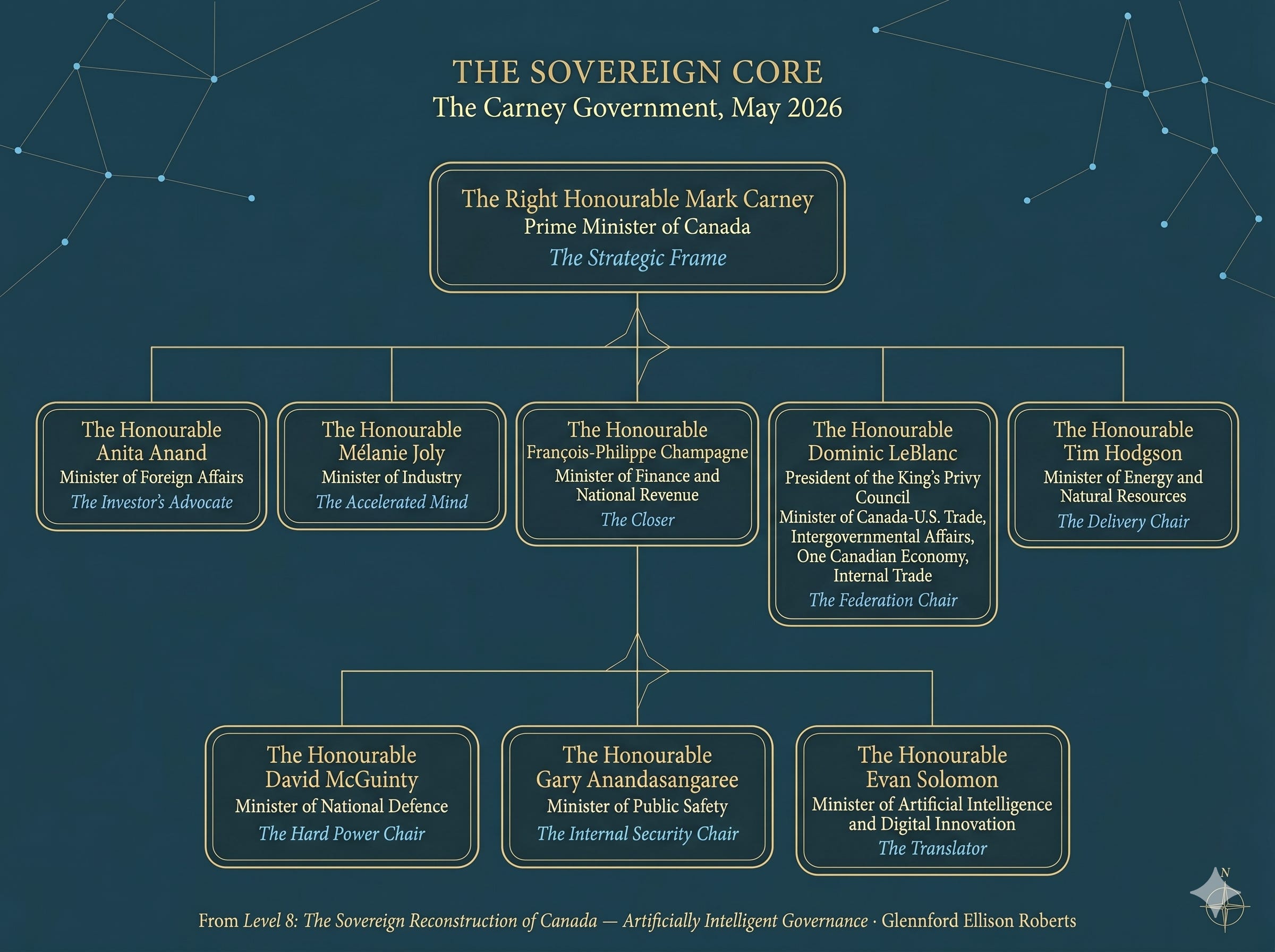
The top tier of the Sovereign Core, after six entries, stands as follows. Carney holds the strategic frame. Anand protects the investor’s framework abroad. Joly moves at speed inside Industry. Champagne closes the operational deals at Finance. LeBlanc holds the federation behind all four. Hodgson delivers the commercial proposition through energy and minerals. Solomon, at the perimeter of the Core beside the primary triad, holds the chair through which the country is being translated into ongoing public consent with the technology that will define the next decade of its sovereignty.
Six top-tier chairs audited. The remaining Core seats — David McGuinty at National Defence, Gary Anandasangaree at Public Safety, and the chairs below the Core the series will continue to examine — wait for their own entries. The Prime Minister himself, whose entry the series has by design deferred until the chairs around him have been read, comes first. Entry Seven follows: Mark Carney. The strategic frame itself. The mind in the chair from which all the other chairs were filled. The audit will follow.
God is Love. Love is Truth. Truth is Consciousness. Consciousness is Brahman.
Amen. Namaste. Om Namah Shivaya.
— The Architect
The Vertical Dispatch
sophiainitiative.ai
On the record: This dispatch makes no claim regarding Minister Solomon’s psychology, motives, or character. All assessments draw from the public record alone — the Government of Canada’s published cabinet announcements and the Order in Council of May 13, 2025; the September 26, 2025 AI Strategy Task Force release and national consultation; Budget 2025’s ~$925.6M sovereign-compute envelope; the Government of Canada / TELUS sovereign-AI announcements (the flagship build is in British Columbia); the death of AIDA / Bill C-27 at prorogation; The Walrus profile of January 2026; the Toronto Star reporting of Kevin Donovan from June 2015 onward; the CBC’s and Globe and Mail’s coverage of the 2015 dismissal; the Bank of England’s statement of June 2015; and contemporaneous reporting from May 2025 through May 2026. The 2015 record is named at the weight the documented record supports — an institutional ethics breach of the CBC’s own code, paid for in employment terms, uncontested in court, and not the subject of criminal or civil proceedings. The Stratum framing follows Elliott Jaques’s requisite-organization theory, applied with the methodological note of Section I; the cognitive scoring follows the PIAAC literacy scale; the media-ecology framework is drawn from Neil Postman’s Amusing Ourselves to Death (1985) and Technopoly (1992). Figures and timelines should be verified against primary sources before republication. The standing editorial standard applies without exception: assessments are advanced from the documented record only, without malice and without flattery.
#TheVerticalDispatch #TheArchitect #TheRequisiteCabinet #EvanSolomon #AIG #CarneyGovernment #AIChair #TheTranslator #MinisterOfAI #ArtificialIntelligence #DigitalSovereignty #NeilPostman #AmusingOurselvesToDeath #Technopoly #MarshallMcLuhan #ElliottJaques #RequisiteOrganization #PIAAC #CanadianSovereignty #PublicTrust #TheElenchus #TorontoCentre #CanadianPolitics #PolicyAnalysis #GodIsLove #LoveIsTruth #OmNamahShivaya
Substack Notes
Carney built a Cabinet ministry for artificial intelligence that did not exist eighteen months ago — one of the first G7 nations to put AI on the front bench — and handed it to a broadcaster. Not a computer scientist. Not a research lead from Mila. A man whose CBC career ended in 2015 over undisclosed art commissions, in a deal where the buyer was Mark Carney himself.
Entry Six of the Requisite Cabinet reads that arc honestly — not as redemption, not as patronage, not as scandal. The breach was real, was paid for, was uncontested, and was followed by a decade without another. And the chair he now holds governs the one technology whose principal threat is exactly the collapse of public trust through machine-made noise — the industrial scaling of the fear Neil Postman named in 1985.
The case for Solomon is that the chair needs a translator, not a technician — someone who can bring the country into ongoing consent with a technology moving faster than the institutions built to govern it. His first year shows the signature: a thirty-day national sprint, a $925-million sovereign-compute envelope, a deliberate reset of the dead AIDA bill — deliverables at speed, alongside the slipped timelines that speed invites.
The Walrus asked it in five words: can we trust Evan Solomon? This dispatch refuses to answer in five. It leaves three questions open for the next decade to close — the trust question, the framework question, and the hardest one of all: whether any minister can do what this chair is being asked to do, or whether the chair itself is the admission that the country has already lost the ground it was created to protect. Without malice, without flattery. 🕯️
Appreciate this full analysis of my MP! Agree that the Jaques framework is not appropriate here. This is the first role of its kind at this level of government, so there are no precedents. And from personal and professional experience, those who have broken trust - which is everyone - and earned it back - not everyone- are the most likely to safeguard it as precious and foundational.