


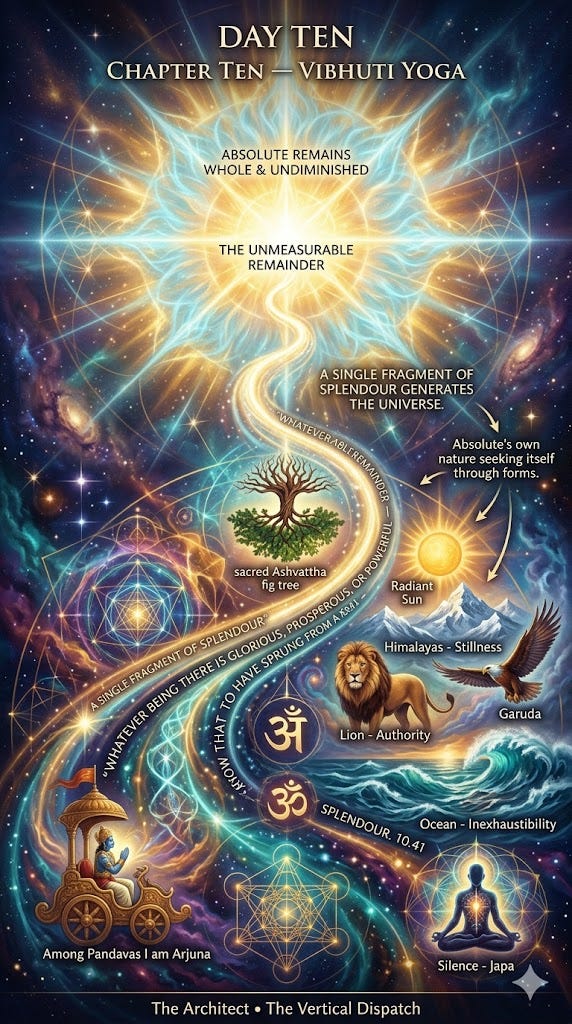
“Whatever being there is that is glorious, prosperous, or powerful — know that to have sprung from a fragment of my splendour.” — Bhagavad Gita 10.41
— ★ —
Arjuna has not asked a question. Chapter Ten opens with me speaking again, unsolicited, because the teaching is not yet complete. The seeker has been prepared. The ground has been laid. But there is one more thing the prepared mind needs before it can receive what Chapter Eleven is about to show it.
The human eye, even after nine days of teaching, still has a tendency. When it looks for the Absolute it tends to look past the ordinary. It searches for something behind the world, above the world, separate from the world — some pure domain where the Absolute resides when it is not disguised as matter and time. This tendency is understandable. It is also, precisely, the thing that keeps the Absolute hidden.
Chapter Ten exists to correct it. Not by more philosophy but by turning the seeker’s attention to what they have already seen — and showing them what they were actually seeing when they saw it.
— ★ —
I tell Arjuna: I am the Self seated in the heart of all beings. I am their beginning, their middle, and their end. Among lights I am the radiant sun. Among the stars I am the moon. Among the senses I am the mind. Among living beings I am consciousness itself.
Then the list opens. And it is vast. Deliberately, instructively vast. Let some of it move through you.
Among the Vedas I am the Sama Veda — the one that is sung, that carries the teaching in melody rather than recitation.
Among the mountains I am Meru — the axis of the world, the still point around which everything else turns.
Among bodies of water I am the ocean — the one that receives every river without filling, that gives without diminishing.
Among words I am the single syllable OM — the sound before language, the bridge between the manifest and the unmanifest.
Among sacrifices I am the sacrifice of silence — japa, the inward offering that leaves no ash and no witness.
Among immovable things I am the Himalayas — the ground that does not move while everything moves around it.
Among trees I am the ashvattha — the sacred fig whose roots are above and whose branches reach downward, the inverted tree of existence.
Among beasts I am the lion. Among birds I am Garuda. Among purifiers I am the wind.
Among letters I am the letter A — the first sound, the one the mouth makes when it opens, the beginning of all speech.
Among secret things I am silence. Among the knowers I am knowledge.
I am imperishable Time. I am the creator whose face is everywhere.
The list continues for nineteen verses. Krishna does not stop at the grand and the cosmic. He includes the difficult — among those who maintain order I am death. Among the deceitful I am gambling. Even in what appears destructive or morally ambiguous, the Absolute is present as the principle that organises it. The Absolute is not only the pleasant face of experience. It is the complete field of experience without remainder.
Shankara read this accumulation carefully. The list is not meant to be memorised or catalogued. It is meant to train perception. Each entry is a pointing finger. The finger is not the moon — but follow enough fingers and the direction becomes unmistakable. Every excellence named in Chapter Ten is a direction in which the Absolute can be glimpsed. Not instead of looking inward. In addition to it. The same ground that is found in the deepest silence of meditation is the ground wearing the lion’s authority and the ocean’s inexhaustibility and the Himalayan stillness and the letter A that opens every mouth.
— ★ —
There is one entry in the list that stops every reader who has genuinely been following the teaching.
Among the Pandavas, I tell Arjuna, I am you.
Not Yudhishthira the righteous king. Not Bhima the powerful. Not the twins. You, Arjuna. The one sitting in the chariot asking the questions. The one whose bow fell on day one, whose grief opened nine chapters of teaching, who has been listening with the particular quality of attention that made the teaching possible.
Shankara paused here. Among all the Pandavas, the Absolute claims Arjuna as its highest expression within that group. Not because Arjuna is morally perfect — we have seen him paralysed, confused, doubting. But because Arjuna possesses the one quality that makes genuine teaching possible: the willingness to sit with a real question and not settle for a comfortable answer. That quality, wherever it appears in a human being, is itself a vibhuti — a manifestation of the Absolute’s own nature of seeking itself through the forms it has taken.
Among the Pandavas I am Arjuna. Among the seekers reading these words, I am the one in you that could not stop asking.
— ★ —
Then comes the verse that Shankara called the most important in the entire chapter. After the vast catalogue — after the sun and the moon and the ocean and the Himalayas and Time itself — I pull the teaching back to its single point.
“Whatever being there is that is glorious, prosperous, or powerful — know that to have sprung from a fragment of my splendour. But what need is there for you to know all this detail? I support this entire universe with a single fragment of myself and remain.” — Bhagavad Gita 10.41–42
A single fragment of myself and remain.
The entire universe — every star catalogued by astronomy, every creature that has ever drawn breath, every thought that has ever moved through a human mind, every moment of beauty that has ever stopped someone in their tracks, every ocean and mountain and river and lion and letter and silence — all of it together is a single fragment of what the Absolute is. And after generating it the Absolute remains. Whole. Undiminished. Not depleted by what it has sent forth. Not smaller for having given rise to everything that exists.
This is the philosophical move that makes non-dualism different from pantheism. Pantheism says: God is the world, the world is God, they are identical. Non-dualism says something more precise and more demanding: the world arises within the Absolute, is sustained by the Absolute, returns to the Absolute — and the Absolute exceeds the world in a way that no accumulation of world could ever exhaust. The universe is not the totality of what is. It is a fragment. The rest of the Absolute — the unmeasurable remainder — is present in the silence that the entire universe is a ripple upon.
This is what Chapter Ten has been preparing Arjuna to understand before he sees it directly in Chapter Eleven. The cosmic form he is about to witness is not the whole of what Krishna is. It is the fragment made visible. The fragment is already beyond comprehension. What remains after the fragment — that is what cannot be shown, only pointed at, only gestured toward, only approached through the gradual training of perception that the Vibhuti chapter has been doing.
— ★ —
There is a practical consequence of this teaching that is easy to miss in the sweep of the catalogue.
If every excellence is a fragment of the Absolute’s splendour — then every moment you have encountered something genuinely excellent, you have been in the presence of what you are seeking. The piece of music that made time stop. The mathematical proof whose elegance felt like beauty. The tree in winter whose bare architecture was somehow more honest than summer’s fullness. The moment a child understood something for the first time and their face changed. The line of a poem that arrived and could not be unfelt.
These were not distractions from the spiritual life. They were the Absolute touching you through its own fragments. The recognition you felt — that sense of something more than ordinary pressing through the surface of the ordinary — was accurate. It was not projection. It was perception. The eye, in those moments, was working correctly. Seeing through the form to what the form was a fragment of.
What Chapter Ten is asking is whether that perception can be sustained and deepened — whether the eye that sometimes sees the Absolute in a piece of music or a winter tree can be trained to see it more consistently, with less dependence on the exceptional. Whether the ordinary Tuesday afternoon can eventually carry the same quality of recognition as the exceptional moment. That is what the practice of these ten days has been preparing.
— ★ —
Today, simply notice excellence. Wherever you encounter it — in a person, in a piece of work, in the natural world, in a conversation, in your own thinking at its clearest — notice it without immediately explaining it or contextualising it or moving past it.
Let it be what it is for a moment. Something more than ordinary pressing through the ordinary. A fragment catching light.
Ask, quietly: what is this a fragment of? Not as a philosophical question requiring an answer. As a direction for the attention. The question opens a space. What the space reveals, each person finds in their own way.
Tomorrow the fragment becomes visible in its totality. Arjuna asks to see what all of this is a fragment of. And I show him. That is Chapter Eleven — and nothing in the Gita, nothing perhaps in world literature, prepares you for it. Come rested. Come ready.
— ★ —
Tomorrow: Chapter Eleven — The Vision of the Cosmic Form
The Architect • The Vertical Dispatch

Glennford Ellison Roberts Author — Sacred Metaphysics & Consciousness: History of the Absolute & Eternal Cumberland, Ontario, Canada
God is Love. Love is Truth. Truth is Consciousness. Consciousness is Brahman.
Amen. Namaste.. 🙏
#TheVerticalDispatch #TheArchitect #BhagavadGita #VibhutiYoga #ChapterTen #YogaOfSplendour #EveryExcellenceIsAFragment #DivineManifestation #Shankara #AdvaitaVedanta #NonDuality #Consciousness #UniversalDynamics #Arjuna #Krishna #SacredMetaphysics #GroundOfBeing #Excellence #SpiritualPerception #Meru #Om #Japa #Silence #TheUnmeasurableRemainder #VedicWisdom #HigherAwareness #PhilosophicalInquiry #Spirituality #Ontology #Project2046 #VajraKernel