

Φ
THE VERTICAL DISPATCH
We write for the mind, the eye, and the ear.
Read it. Look at it. Listen to it. The Vertical Dispatch is built for all three — prose with rhythm, made to be heard as much as read.
From metaphysics to geopolitics, from culture to history, from the sacred to the street — and everything in between. One lens, every subject. No ego. Just the record, named clean.
Press play. Walk with the word. 🕯️
This dispatch travels by hand. If it serves you, share it — restack on Substack, and pass it on wherever you read. 🕯️
The Age of Consequences · Canadian Geopolitical Analysis
As of June 23, 2026
“Nothing can be changed until it is faced.”
— James Baldwin
There is a great deal of motion on Parliament Hill this summer. Before the noise names it for you, here is the shape of it: how a seat comes open tells you what the seat was for, and this season every kind of opening is on display at once.
The raw count first. Six members of Parliament will not return to the House in September. Ten by-elections have run or are pending across the life of this Parliament. Five members crossed the floor without a single vote being cast. And a government elected to a minority now governs, for the first time in Canadian history, as a majority assembled between general elections rather than at one.
The easy story writes itself: a Prime Minister clearing the bench, stamping his own cabinet, playing the majority game from day one. The temptation is to read every empty chair as something he did. It is a clean line, and it is, on the record, not quite true — the truer version is more interesting. The seats did not empty because one man swept the deck. They emptied in five distinct ways, for five distinct reasons, and the Prime Minister has mostly been filling holes left by others rather than digging them himself. A seat empties for one of five reasons, each with its own geometry, and a sixth mechanism changes the House while emptying no seat at all. What follows is that geometry, because it tells you more than any headline about who holds power and how they came to hold it.
A seat can be a career, a lever, a stepping-stone, or a parting gift. The reason it empties is the tell.
The First Door: Called Up and Out
Some members leave because a larger chair opens elsewhere. Jonathan Wilkinson, the Liberal member for North Vancouver—Capilano, is departing to become Canada’s ambassador to the European Union in Brussels. Bill Blair vacated Scarborough Southwest on appointment to a senior diplomatic post in London. Steven Guilbeault, the Liberal member for Laurier—Sainte-Marie, has said he intends to resign during the summer to pursue climate work outside parliament. These are not departures of defeat. They are lateral moves into chairs that, in each person’s telling, fit better than the one they held. The record gives us the destination in each case; we need not guess at the motive, because the motive is stated and the posting is public.
The Second Door: Relocated to Another Arena
A second group is not leaving politics at all — it is moving politics to a different building. Simon-Pierre Savard-Tremblay, formerly of the Bloc Québécois, will run provincially for the Parti Québécois. Alexandre Boulerice, who stepped out of the federal New Democrat caucus to sit as an Independent on April 27, 2026, will carry the Québec solidaire banner in the provincial riding of Gouin. Nathaniel Erskine-Smith, the Liberal member for Beaches—East York, is seeking a provincial seat in Ontario. Each is trading a federal arena for a provincial one where they see a live contest. Boulerice is the most instructive to read precisely: the last sitting survivor in the Commons of the 2011 Orange Wave from Quebec, he crossed to no one — his exit is not a defection to a rival but a homecoming to provincial politics. The distinction matters, and we will return to why.
Five members changed the colour of the House without asking a single voter. Six will change it only by asking.
The Third Door: Left the Field
The third door is retirement — the member who has given what they had and steps away. The lone candidate for this door among the summer six is Cathay Wagantall, the Conservative member for Yorkton—Melville since 2015, who will make her resignation official on August 31. Here discipline is required, because this is where a tempting story outruns the record. It would be neat to read her exit as a veteran losing faith, no longer seeing her party near power. The neat reading is, on her own words, contradicted: in her departure statement she said she supports the Conservative leader and believes he will be the next prime minister. She gave no reason for moving her departure date earlier than she had previously planned.
So we hold two things at once. It is possible — and we mark it plainly as a possibility the record neither confirms nor forecloses — that a long-serving member, four election cycles in, accelerating her exit under a government she calls hostile, is simply done. It is equally on the record that her stated reason is confidence, not defeat. The honest position is to leave the timing an open question and hand it to you, rather than to manufacture a verdict the facts do not supply. The smaller claim survives the hostile reader; the larger one does not.
The Fourth Door: The Seat as Instrument
The fourth door is the most revealing, and it belongs to a by-election already concluded. In 2025, Damien Kurek, who had just won Battle River—Crowfoot in Alberta with better than eighty per cent of the vote, resigned the seat for a single purpose: to open a vacancy so that Conservative leader Pierre Poilievre, who had lost his own Ottawa-area seat of Carleton in the general election, could re-enter the House. Poilievre won the August 18 by-election handily — against, it should be noted, the largest candidate field in Canadian federal history, more than two hundred names on the ballot. Then the maneuver completed its arc: the party has since confirmed that Poilievre will not run Battle River—Crowfoot in the next general election, that Kurek will take the seat back, and that the leader will run somewhere not yet disclosed.
This is not a departure in the ordinary sense. The seat here is neither a career nor a stepping-stone to another arena; it is a lever, vacated and reoccupied by design, passed between two men as a tool of leadership continuity. None of it is unlawful; what is unusual is the candour of the design, carried out in the open rather than concealed. Name it without a character verdict: the conduct on the record is that a safe seat was moved like a piece on a board, twice, to keep a leader in the House after the voters of his own riding had removed him. Whatever one thinks of it — and reasonable people will differ — it is a fifth thing a seat can be, distinct from the other four.
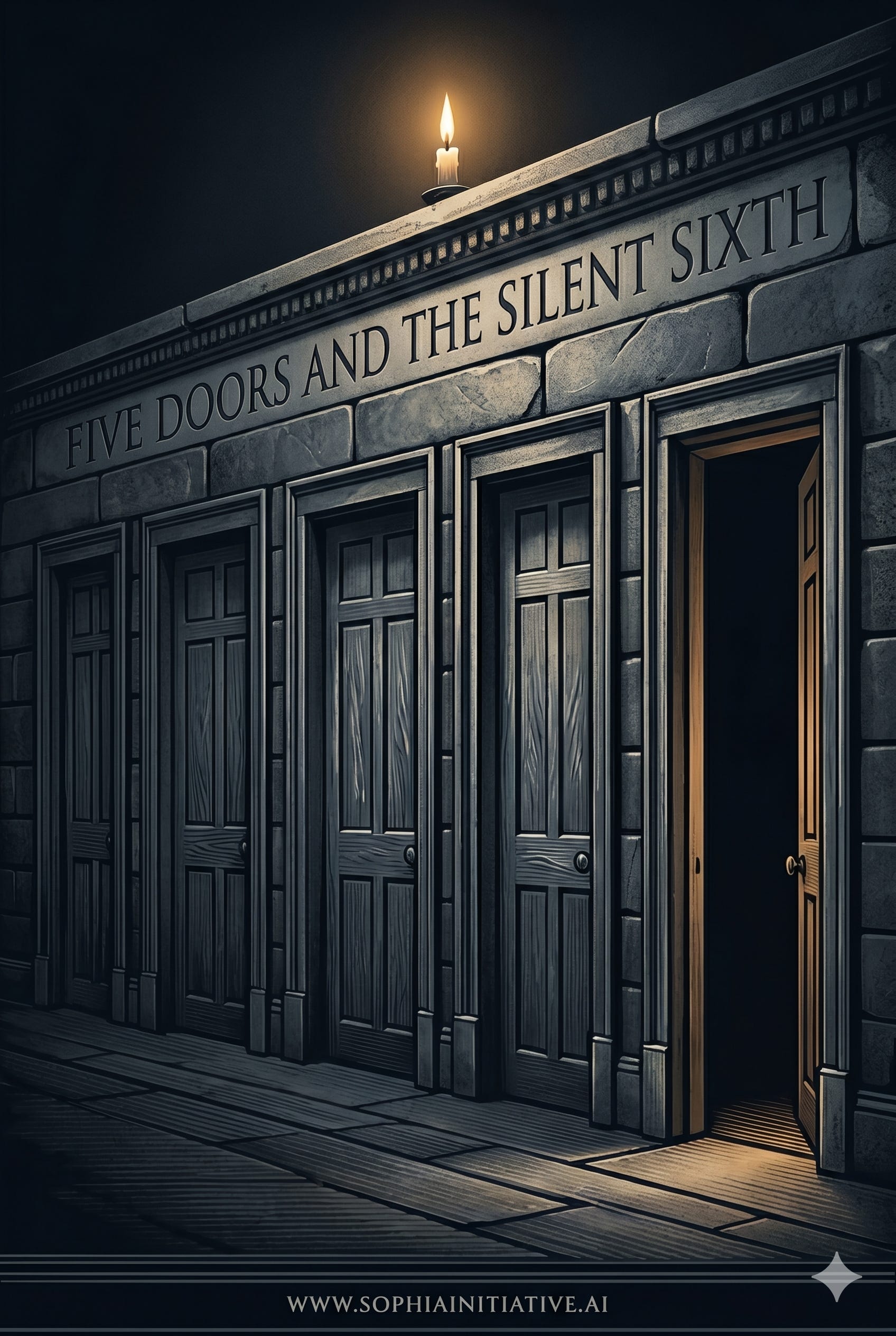
The Fifth Door, and the Silent Sixth
Gather the doors. The called-up leave for a larger chair. The relocated leave for another arena. The retired leave the field. The instrument never really leaves — the seat itself is moved. And underneath all four runs a fifth mechanism that empties no seat at all: the floor-crossing. Five members changed the colour of the House this Parliament without a by-election — a New Democrat to the Liberals, and four elected as Conservatives joining the governing party. No vacancy, no campaign, no ballot. The voters who sent those members to Ottawa under one banner watched them sit under another, with no say in the matter.
This is the quiet engine of the majority, and it is the heart of the legitimacy quarrel now playing out. The constitutional ground is settled and worth stating plainly: in the Westminster system an MP holds the seat individually and may sit under any party label or none, owing their place to the House and their constituents rather than to the banner they ran under. That doctrine is what makes a floor-crossing lawful — and it is also precisely what the quarrel is about. The Conservative leader calls the result a majority built through backroom deals with politicians who betrayed those who elected them. The government answers that the by-elections to come will let the affected ridings speak, and that the only way the Liberals fall back to a minority is to lose all six pending races; one win preserves a technical majority. Both cases deserve to stand at full strength, because both are partly right. A floor-crossing is legal, and it is also a banner-switch no voter authorized. A by-election is the honest remedy, and it is also a contest the government has wide latitude to time. The reader, not the writer, should weigh them.
The chair of a governing Prime Minister demands the longest horizon in the system. The question the record lets us ask is whether the conduct has the shape the chair requires.
The Chair, Not the Man
It is fashionable to say the Prime Minister has played from day one as though he held a majority. The record complicates the claim. When Chrystia Freeland left University—Rosedale in January — to advise Ukraine’s president and, by July, to lead the Rhodes Trust at Oxford — the Prime Minister said plainly that he had not asked her to stay, even to shore up a fragile minority, and that the riding’s voters would decide who to send back. A man playing the majority game from the first day holds his minority votes close; he does not wave a senior one out the door and trust the by-election to sort it. The conduct looks less like seizing a majority than declining to cling to a minority. The majority arrived by accumulation — crossings, a court-ordered re-vote in Terrebonne, three by-election wins in April — not by a single day-one stroke.
There is a frame worth using here, provided it is used honestly. The office of Prime Minister with a working majority is, in the language of requisite organization, a Stratum VI to VII chair: it demands the longest time-horizon and the widest complexity any role in the system carries. In practice that means holding a horizon measured in years rather than news cycles — a trade-and-security posture toward the United States, an energy and climate transition, a defence-spending arc — decisions whose consequences land long after the headlines that announced them have faded. That long horizon is a property of the chair, not a measurement of the soul who occupies it. We do not pronounce any individual’s inner stratum, and we do not explain away a leader’s choices as the inevitable output of what he privately is. We ask the only question the record permits: does the conduct in the chair — the willingness to let seats go to by-election, the accumulation rather than the seizure, the long game over the short — have the shape that chair requires? That question is answerable from the public record. The verdict on the man’s character is not ours to issue, and we do not issue it.
Let the Truth Run Its Course
A Parliament is remaking itself between elections, and it is doing so through five distinct doors and one silent mechanism, each with its own logic and its own claim on legitimacy. The Trudeau-era front bench is dispersing in every direction at once — to Brussels and London, to Oxford, to Quebec City and Queen’s Park, to the climate fight and to the quiet of private life. This is a generational handover as much as a political one: the figures who defined a decade of Liberal government are leaving the stage together, and the chairs they vacate are being filled by those who remain. Call that cabinet renewal if you like, but name it as consequence, not as a motive pinned on one man. The honest sentence is the smaller one, and it is the one that holds: the old guard is leaving, and the chairs are being filled by those who stay.
So let the truth run its course. It need not be hurried, and it need not be inflated. The record, named clean and dated honestly, is heavier than any verdict we could manufacture on top of it. Read the wave, set the boat at the angle, and let the people aboard glide safe over it.
God is Love. Love is Truth. Truth is Consciousness. Consciousness is Brahman.
Amen. Namaste. Om Namah Shivaya.
— The Architect
The Vertical Dispatch
sophiainitiative.ai
On the record. Seat standings, vacancies, and resignation dates are as of June 23, 2026, and are volatile; verify current figures before republication. Six MPs have signalled departures over summer 2026: Jonathan Wilkinson (North Vancouver—Capilano, Liberal) and Simon-Pierre Savard-Tremblay (Saint-Hyacinthe—Bagot—Acton, formerly Bloc) officially resigned June 19/20, 2026; Steven Guilbeault (Laurier—Sainte-Marie), Nathaniel Erskine-Smith (Beaches—East York), and Alexandre Boulerice (Rosemont—La Petite-Patrie, Independent, formerly NDP) have announced intent but not formalised dates; Cathay Wagantall (Yorkton—Melville, Conservative) is set for August 31, 2026. Boulerice left the NDP caucus to sit as an Independent on April 27, 2026, and stated continued common cause with the party; he is not crossing to another federal party. Wagantall stated support for the Conservative leader and gave no reason for advancing her departure date; the despair reading of her timing is identified in this piece as a possibility the record does not confirm. The Battle River—Crowfoot by-election (Aug. 18, 2025) followed Damien Kurek’s resignation to allow Pierre Poilievre, who lost Carleton in the 2025 general election, to re-enter; Poilievre won with roughly 81 per cent against a record field of more than 200 candidates; the party confirmed in January 2026 that Kurek will reclaim the seat next election and Poilievre will run elsewhere, undisclosed. The April 13, 2026 by-elections (University—Rosedale, Scarborough Southwest, Terrebonne) delivered Liberal majority status; Terrebonne followed a Supreme Court annulment of a one-vote result over a mail-in ballot error, not a cabinet departure. Chrystia Freeland resigned University—Rosedale effective Jan. 9, 2026, for an unpaid advisory role to Ukraine’s president, having already left cabinet and announced she would not seek re-election; she becomes CEO of the Rhodes Trust in July 2026. Bill Blair’s diplomatic appointment (High Commissioner to the United Kingdom) is reported in secondary coverage and should be confirmed against the primary appointment notice for exact title and date before republication. The count of five floor-crossers (one ex-NDP, four ex-Conservative) is drawn from press tallies; individual names beyond Lori Idlout, Marilyn Gladu, and Chris d’Entremont should be verified individually before republication. The Stratum VI–VII characterisation refers to the requisite complexity of the office, not to any measurement of an individual’s capacity. No figure herein is disaggregated by race or group. Errors and omissions excepted; corrections will be made on notice. Verify against primary sources before republication.
Suggested tags:
Canadian politics, by-elections, House of Commons, Mark Carney, Pierre Poilievre, floor-crossing, parliamentary majority, cabinet renewal.
Substack Notes
A Parliament is quietly remaking itself between elections — and how it is doing so says more about Canadian power than any headline. Six MPs are leaving the House this summer. Five already crossed the floor without a vote. One safe Alberta seat was passed between two men like a chess piece to keep a leader in Parliament after voters removed him. This dispatch sorts every departure by the one thing that cannot be faked: where the member actually went.
The clean story — a Prime Minister clearing the bench to stamp his cabinet — does not survive the record. The truer story is stranger: a Trudeau-era front bench dispersing in every direction at once, to Brussels, London, Oxford, Quebec City and Queen’s Park, while a new government fills the holes left behind. Five distinct doors, one silent mechanism, and a single honest question about the chair of power itself.
We name no character verdicts and read no private minds. We mark one tempting story — a veteran Conservative’s motive for leaving — as a possibility the record does not confirm, and hand the open question to you. We let the legitimacy quarrel between the government and the opposition stand at full strength on both sides, because both are partly right. The reader weighs it; the writer does not weigh it for them.
If you want the record named clean and dated honestly, without ego and without spin, this is the boat and this is the keel. Read it, and pass it on. Written from love, in service of the record. Walk with the word. 🕯️
#TheVerticalDispatch #TheArchitect #SophiaInitiative #CanadianPolitics #ByElections #HouseOfCommons #MarkCarney #FloorCrossing #GodIsLove #LoveIsTruth #OmNamahShivaya
The factual matter in this Dispatch is drawn from the public record. All characterizations, inferences, and conclusions are opinion, interpretation, and commentary, offered for analysis, reflection, and public-interest discussion. No assertion is made regarding the private intentions, state of mind, or character of any individual. Readers should evaluate all statements independently and draw their own conclusions.