


Φ
THE VERTICAL DISPATCH
We write for the mind, the eye, and the ear.
Read it. Look at it. Listen to it. The Vertical Dispatch is built for all three — prose with rhythm, made to be heard as much as read.
From metaphysics to geopolitics, from culture to history, from the sacred to the street — and everything in between. One lens, every subject. No ego. Just the record, named clean.
Press play. Walk with the word. 🕯️
This dispatch travels by hand. If it serves you, share it — restack on Substack, and pass it on wherever you read. 🕯️
Sacred Metaphysics · The Universal Grammar of Non-Duality
The Metaphysics of Zero and the Physics of One
Coming soon
sacredmetaphysics.org
The Age of Consequences · Media & Platforms
As of August 16, 2026
Be number one or number two in your market — or get out.
— the rule Peter Drucker’s counsel made famous, applied at General Electric
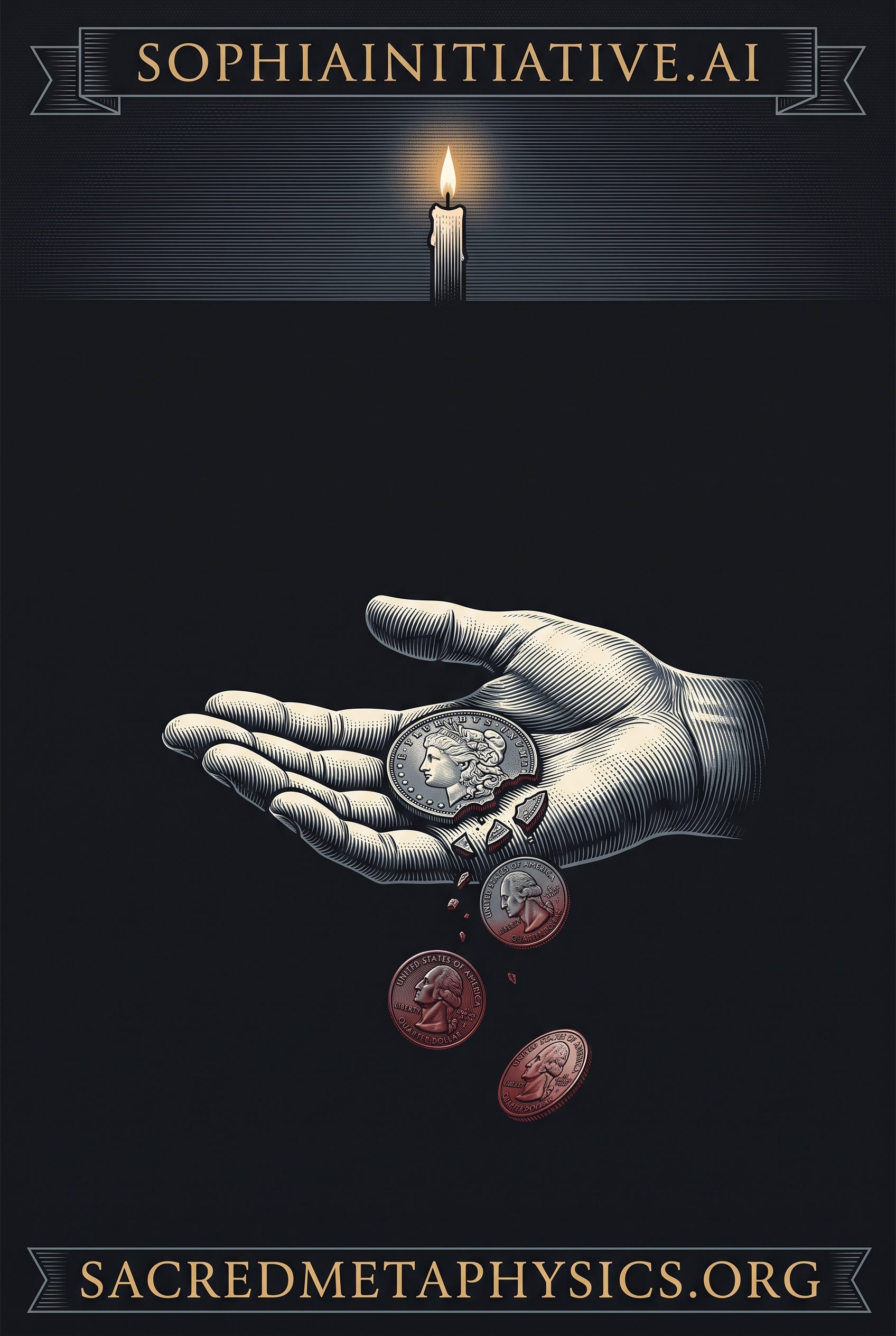
There is an old line among people who have run real businesses, and it is the plainest test of a bad deal ever spoken: never exchange four quarters for a dollar. The pile of coins is bigger. It jingles. It looks, to the untrained eye, like more. But it is the same dollar, or less once you count the cost of making all that change — and you have bought yourself nothing but a heavier pocket and a headache. Nobody needs that business.
This is the story of a company doing exactly that, in full public view, with its founders narrating the trade as if it were growth. The company is Substack. The dollar it is spending is the clearest vision any writing platform has had in a generation. And the four quarters it is taking in return are the oldest, tiredest coins in the technology economy: reach, scroll, feed, and the promise of numbers so large they can only be reached by becoming the very thing the company was built to escape.
A Word About Where We Stand
We name our own standing before we begin, because it is honest and because a reader deserves to weigh it. The Vertical Dispatch publishes on Substack, and we are openly AI-assisted — we say so in every issue. So we write about this platform as a resident of it, with our work in the same feed we are about to describe. Read our interest plainly. We think the business case stands on its own numbers regardless, and we have sourced every figure below so you can check it without trusting us. Judge it on the record.
The Dollar They Started With
The original vision was specific and it was good. A quiet pipeline from a writer’s keyboard directly to a reader’s inbox — no feed to game, no screen time to maximize, no advertiser standing between the writer and the read. The founders said it plainly, and they built the company against the attention economy on purpose. Co-founder Hamish McKenzie has framed the whole philosophy in a single sentence that the rest of this piece will hold them to: it is the difference between monetizing relationships and monetizing impressions. When you lead people into deeper relationships with the voices they trust, he said, the behaviour that gets rewarded is the opposite of the big feed where everyone is trying to go viral on top of each other.
That was the dollar. Not the most readers — the right ones. Not a reader who buys a book and puts it down, but one who returns, engages, and pays because the relationship is real. It was, in the terms of the trade, a premium house. The Harry Rosen suit. The Cartier watch in the red box. Not everyone can afford one and not everyone wants one, and that is precisely the point of one. A premium house does not fail by being small. It fails the day it decides it wants the footcount of a discount barn and stops being the thing that made it worth choosing.
The Number Was Never the Weakness
Here is the part the platform seems to have forgotten: the limited size of that audience was not a flaw in the vision. It was the vision. The engaged reader is rare by nature, and rarer still is the one who will pay. That scarcity is not a problem to be solved by growth; it is the definition of the premium category itself.
The numbers can be walked from the top of the world down, and they close a door on the fantasy. Begin with the whole planet — some eight billion people. Roughly two-thirds are of working age, the band any adult-skills measure covers. Then apply the first wall: language. Substack is a predominantly English-language platform, US-dominated, with meaningful but secondary communities in a handful of European tongues and no broad multilingual reach; by its own reporting, about seventy percent of its earning publications are American and roughly a third sit outside the United States. Take the countries where it genuinely operates — the English core of the United States, United Kingdom, Canada, Australia and Ireland, plus a thin layer of high-English-reading Europe — and the working-age pool where Substack is truly present is on the order of three to four hundred million adults.
Now the second wall, and here the instrument must be handled with care, because it measures a capacity, not a worth. The OECD’s Survey of Adult Skills — PIAAC — assesses how well adults can read, reason over, and use complex written text. It ranks proficiency, not people; a Level 4 reader who never opens a book is no better a human than a Level 2 reader who treasures one. What the survey measures is simply this: who can comfortably consume long, dense text across several pages. On average across the participating OECD countries, only about twelve percent of adults read at the two highest levels, and fewer than half sit at Level 3 or above. In the strongest reading nations the Level-3-and-up share reaches roughly two-thirds; at the average it is under one in two. Apply that filter to the language-bounded pool, and the number of people on Earth who can both reach Substack in their language and read long-form at the level it demands lands somewhere under two hundred million. That is the ceiling on the readers who can. It says nothing yet about the readers who will.
The engaged reader is rare by nature, and rarer still is the one who will pay. That scarcity is not the problem. It is the premium category itself.
Bread, Circuses, and the Reader Who Chooses
The third wall is the one that no survey measures and that Neil Postman named for our age: appetite. It is one thing to be able to read the demanding text. It is another to choose it when the amusement sits beside it at the same price. Postman’s argument in Amusing Ourselves to Death was not that people are stupid — it was that a culture built on entertainment trains its members to prefer the spectacle, and that the medium itself does the training. Offered the essay and the show for the same coin, most reach for the show. Not because they cannot read. Because the culture pulls toward the roar.
This is not new and it is not modern. While the mob filled the Colosseum for blood, the philosophy that would outlast Rome was being written and taught in near-empty rooms — the Stoics with their scrolls, read by the few who wanted the demanding thing while the many went to the arena. Both were available to any Roman. Most chose the sand and the spectacle. Seneca himself went once, and came home to write that the crowd had made him crueler and less human for having sat among it — the first and still the sharpest confession that the arena changes the one who watches. The point is not that the crowd was base. Seneca counted himself among the changed. The point is that the demanding thing was always the minority taste, and standing next to it never made the many choose it.
So the true market for a house of serious reading is smaller than the pool who can read, which is smaller than the pool who has the language, which is a sliver of the working-age world. Under two hundred million who can; a fraction of those who will; and it was never going to be otherwise. That was the room Substack was built to serve, and it was the right room.
The Fantasy Number
Against all of that stands a claim the co-founder made aloud, and it is the moment the dollar began to change into quarters. Hamish McKenzie said he sees nothing in the laws of physics that should prevent Substack from reaching more than fifty million paid subscriptions. The platform sits at around five million. He was, in plain terms, forecasting a tenfold surge — and the funding followed, a hundred million dollars raised at a valuation of about one and a tenth billion.
Set the fantasy against the ceiling. Fifty million paying subscribers, drawn from a global pool of perhaps two hundred million people who can even read the product in a language it serves, would mean converting something like one in every four capable long-form readers on Earth into a paying customer of a single platform — before subtracting the vast majority who, by Postman’s law, would rather watch the game. And measured a second way, against the platform’s own conversion: Substack today converts roughly five to six percent of its active subscriptions into paid ones. At that rate, fifty million paid would require on the order of eight hundred and seventy million active users — approaching the scale of the largest social networks ever built, for a product that asks people to sit and read essays. The arithmetic runs out of readers long before it runs out of ambition. There are not enough people who can read the thing, in the languages it speaks, on the whole planet, to make the number true.
Their Own Numbers Already Told Them
The platform did not need our arithmetic. Its own growth curve had already drawn the ceiling. Substack crossed three million paid subscriptions in early 2024, four million that November, and five million by March of 2025 — a million added in roughly four months, a genuine surge. And then it stalled. A full year later it had not reached six million, after years of adding around a million annually. The line went flat at precisely the moment the platform leaned hardest into its social feed and began importing the scrolling crowd from the older platforms.
The gap tells the rest. Five million paid sit inside thirty-five million active subscriptions — a paid share of about five and seven-tenths percent — and by 2026 the active base had swelled toward fifty million while the paid line barely moved. More scrollers arrived; more payers did not. And the ones who pay leak steadily: churn on new paid newsletter subscriptions runs near fifty percent a year. So the machine pours an imported, feed-trained crowd into the top of a funnel that drains half its paying customers annually — and trains those very newcomers in the one habit, free and infinite and passive, that makes a person least likely ever to pay for anything. You cannot teach the world to scroll for nothing and then be surprised when it will not open its wallet.
The Coins Cost More Than the Dollar
Here is where the four-quarters trade reveals its true price. Do the revenue arithmetic the analysts have done: five million subscribers paying on the order of a hundred dollars a year, after Substack’s ten percent cut, yields roughly fifty million dollars in net revenue — against that one-and-a-tenth-billion-dollar valuation. A fifty-million-dollar business is being priced as though it were more than twenty times that size. To grow into the suit, it must find enormous new revenue that subscriptions alone, now decelerating, will not supply.
Which is why the reporting already shows the platform eyeing the one door its founders swore never to open. Fresh from its raise, Substack is said to be weighing expansion that would make it more attractive to advertisers — this from a company whose entire founding argument was escape from the ad-driven attention economy, built by a man who said the old platforms damaged us by playing attention games. One of the platform’s own most serious residents, the technology writer Casey Newton — himself a Substack tenant — put the tell on the record: he would not be surprised if free newsletters are soon forced to carry ads. That is the sound of the dollar finishing its change into quarters. The feed brought the crowd; the crowd did not pay; the valuation demands revenue; and the only coin large enough is the advertising the whole enterprise was built to refuse.
The Arena It Is Walking Into
Consider the two businesses Substack would be joining if it completes the trade. On one side, X — the platform formerly called Twitter — bought for forty-four billion dollars, its revenue fallen from around four and four-tenths billion in its last pre-acquisition year to roughly two and a half billion, its valuation having cratered to some five billion at the low before a partial recovery, still posting hundreds of millions in quarterly net losses under the weight of its acquisition debt. Whatever else it is, X is not a business winning on the merits; its owner, who controls outright what may be said on it and who may say it, appears to run it for reasons the profit-and-loss statement cannot explain. The record does not read like a man maximizing return. It reads like a man who bought a megaphone.
On the other side, Meta — the Facebook and Instagram machine — which in 2025 booked around two hundred and one billion dollars in revenue, of which roughly a hundred and ninety-five billion came from advertising; its own filings state that substantially all of its revenue comes from ads on those platforms. That is the true cash cow of the attention economy, and it earns its billions by doing precisely what Postman warned of: monetizing, at planetary scale, the ego that needs to be amused. This is the arena — a debt-laden megaphone on one side, a two-hundred-billion-dollar amusement engine on the other — that Substack is leaving its quiet, premium, first-in-class position to enter. It would be trading the one room it owned for a seat in a coliseum it can only lose in.
The Door and the Weapon
There is a detail in how the giants of the arena grew that Substack seems determined not to learn, and it is the sharpest irony of the whole affair. You do not reach the billions in one language. Facebook’s interface supports roughly a hundred and eleven languages, with its translation systems reaching toward two hundred more, and the payoff is written in its geography: of its nearly three billion users, the United States accounts for less than a fifth. India, not America, is its largest market. Facebook became Facebook by leaving English behind — by using language, and increasingly artificial intelligence, as a door thrown open to the whole world. X runs on the order of thirty-four interface languages and has lately made its own AI, Grok, the primary tool for translating the world’s posts into English in real time. Whatever else one thinks of these companies, their scale is a language achievement, and AI is now the hinge on which that door swings.
Set Substack beside them. It publishes in one language — English — with a thin layer of European readers who happen to read it, and no broad multilingual reach at all. Roughly a hundred and eleven languages for Facebook; about thirty-four for X; one for Substack. That single number is the hardest wall of the three we have counted, and it caps the ambition an order of magnitude below the fantasy. To reach the billions McKenzie invokes, Substack would have to do what Facebook did — go multilingual, go global, and lean on AI to carry it across the language barrier the way its rivals already do.
And here is what it has done instead. At the precise moment when language and artificial intelligence were the only road left to the scale it covets, Substack pointed its AI not outward, at the wall, but inward, at its own writers. In July of 2026 it launched an AI-detection tool, and its chief executive named the thing it hunts “Claudefishing” — the passing of AI-assisted text as human. The giants used AI as a door to the world. Substack turned it into a weapon against the room it already has. It is a house that cannot cross the language wall spending its newest technology to police the writers already inside — performing quality-control as a substitute for the reach it cannot achieve. That is not a strategy for growth. It is the gesture of a company that has run out of doors and decided to guard the one room instead. And it is doubly strange from a platform whose whole worth rests on the human relationship, to greet the defining technology of the age by aiming it at its own tenants — barricading, with its last tool, its own last exit.
The giants used AI as a door to the world. Substack turned it into a weapon against the room it already has.
Drucker Already Named the Mistake
None of this is a new lesson. Peter Drucker gave it away for free to every business that would listen, and the executive who made it famous built the largest industrial company on Earth around it: be number one or number two in your market, or fix the business, sell it, or close it. Do not sprawl into markets where you are not first. The discipline is not glamorous and it is not complicated, and it is precisely the rule Substack is breaking. It was first — genuinely first — in the premium category of reading by subscription. And it is now voluntarily leaving that category to finish somewhere in the crowded middle of a business it does not lead and cannot win.
General Electric is the proof, and it proves the rule twice. The sprawling conglomerate that forgot the discipline — that grew into a dozen businesses it was not first in — lurched from crisis to crisis, lost its place in the Dow, and in 2024 was finally broken apart, the end of a structure that had dominated American business for a century. That is the punishment for the sprawl. But the piece that kept the name, GE Aerospace, did the opposite: it focused down to the one thing it is first in the world at — jet engines — and it is thriving, booking around forty-six billion dollars in revenue in 2025, carrying a backlog near a hundred and ninety billion and a market value north of three hundred and fifty billion. The reward for focus and the punishment for sprawl, in a single company’s history. Substack is standing at that fork right now, and it has chosen the road that broke the conglomerate over the one that saved the survivor.
The Business Nobody Needs
So the case closes where it began. A company that trades a dollar for four quarters has not grown; it has only made change, and paid a fee to do it. Substack is spending the clearest vision in its industry — the engaged reader, the premium house, the number that was never its weakness but its whole point — to buy a bigger pile of coins: the imported scroll-crowd, the swollen free base that will not convert, the feed that trains people out of paying, and the advertising endgame its founders once called damage. Every one of those coins carries a cost the dollar never did — the moderation burden, the trust problem, the detector it now needs to tell its own readers whether a human wrote the words, the churn, the slop, the arena. The pile is heavier. It is not worth more.
The tragedy is not that Substack’s audience is too small. It is that the audience was exactly the right size, and the house has forgotten what it was for. It had its dollar. One wonders whether anyone in the building has read Drucker — or whether, having read him, they simply preferred the jingle of the coins. Either way the record is plain, and the record is the record. A platform doomed to irrelevance is rarely killed from outside. It is usually the one that walked, coins jingling, out of the only business it was ever first in.
The Case for the Trade
The strongest version of the other side deserves its weight. Substack’s own people would say the feed is not a betrayal of the vision but a funnel toward it — that Notes and recommendations are top-of-funnel discovery whose only purpose is to deliver more readers into the trusted, direct, paid relationships the company was built on, and that even a low conversion of a very large imported crowd nets more paying subscribers in absolute terms than a pristine mailbox with no discovery at all. The platform’s engineers insist, credibly, that the system is tuned for subscription and discovery, not for raw time-on-screen. And on the measured numbers Substack remains among the least AI-saturated and most relationship-oriented of the large platforms — which one could read not as a house abandoning its vision but as a house defending it with new tools. The honest rebuttal is not that this argument is stupid. It is that a funnel only works if conversion clears the cost of the crowd it pours in, and the platform’s own flattening paid line, fifty-percent churn, fifty-million-dollar revenue, billion-dollar valuation, and drift toward advertising suggest the arithmetic is not clearing. The vision may be defensible in intent. The numbers say the trade is not paying.
The Bottom Line
Strip away every argument and stand only on the numbers, and the truth is sharper than any accusation. The engaged, paying reader Substack was built to serve is bounded three times over — by language, by literacy, and by appetite. The pool of people who can even read the product in a language it speaks is under two hundred million. Apply the platform’s own real-world conversion of roughly five to six percent, and the realistic ceiling of the original vision — engaged readers who actually pay — sits somewhere on the order of ten to fifteen million subscribers. That is the whole harbour. That is as large as this business, done as it was meant to be done, was ever going to be.
Substack is at five million. Which means it has not fallen short of its vision — it has very nearly filled it. Five million paying subscribers for serious long-form writing is a third to a half of the entire realistic ceiling of engaged readers on the planet, and it is, by any honest measure, a triumph. The house was nearly home. And this is the blade: with the harbour in sight and half the distance already sailed, it turned the boat around and set out for the open sea — chasing a fifty-million number that is three to five times larger than the world’s engaged-reader pool can ever supply. It did not fail to reach its vision. It reached it, looked at what it had built, decided a nearly-full harbour was too small, and sailed back out into the storm for a number that does not exist.
That is the four-quarters trade in one line. Not a company that aimed high and missed, but a company that had nearly won the only game worth winning — and cashed the victory in for a pile of coins the sea will never let it count.
God is Love. Love is Truth. Truth is Consciousness. Consciousness is Brahman.
Amen. Namaste. Om Namah Shivaya.
— The Architect.
The Vertical Dispatch
sophiainitiative.ai
On the Record
Substack paid-subscription milestones: 3 million (early 2024), 4 million (November 2024), 5 million (March 2025), and not yet 6 million as of mid-2026 (company announcements; The Hill, March 2025; Simon Owens, May 2026). Paid share: about 5.7% of roughly 35 million active subscriptions, with the active base widening toward 50 million by 2026 (company figures via Backlinko and Bestwriting, 2026). New-paid-subscription churn near 50% per year (Sci-Tech Today, 2026). Revenue estimate ~$50 million net after Substack’s 10% cut, against a ~$1.1 billion valuation and a $100 million raise (Simon Owens; The Current, August 2025). Hamish McKenzie’s “50 million paid / laws of physics” forecast and his “relationships not impressions” framing are quoted from public remarks (Mack Collier, 2026; The Current, August 2025). Chris Best’s founding-vision statements and the reporting that Substack is eyeing advertising are from The Current, August 2025. Casey Newton’s ads prediction is from CBC News, August 2026; Newton publishes Platformer on Substack. Population and PIAAC: world population ~8.1 billion; PIAAC Cycle 2 (2023) OECD-average literacy shows ~12% at Levels 4–5 and under half at Level 3+, with Finland highest (~35% at 4–5) and figures for Canada (~14% at 4–5), Japan, Sweden and Ireland as cited (OECD Education GPS and CSO Ireland, 2023–2025). The under-200-million capable-reader ceiling is our own transparent estimate from those public figures — language-bounded pool times Level-3-plus share — not a measured statistic, and PIAAC measures reading capacity, not willingness to pay. The realistic engaged-paying ceiling of ~10–15 million cited in The Bottom Line is likewise our own estimate: the capable-reader ceiling multiplied by Substack’s own disclosed paid-conversion rate of roughly 5–6%; it is reasoned arithmetic from sourced inputs, not a figure any party has measured or published. X/Twitter revenue, valuation and losses (Business of Apps; Roic News; Statista; Yahoo Finance, 2024–2026). Meta 2025 revenue ~$201 billion, ~$195 billion from advertising, per Meta’s SEC filings and reporting (Meta 10-K FY2025; MEXC; Marketing Brew). GE split completed April 2024; GE Aerospace ~$46 billion 2025 revenue, ~$190 billion backlog, ~$354 billion market cap (CNBC; Motley Fool; Intellectia, 2024–2026). Interface-language counts: Facebook ~111 officially supported (translation reaching ~200), with the US under 20% of its ~3 billion users and India its largest market (Omnicore; OneSky; company data, 2024–2025); X ~34 interface languages, Grok made its primary post-translation tool in 2025 (Social Media Today, August 2025); Substack predominantly one language, English. Language counts vary by source and date and are given as approximate orders of magnitude. The “number one or number two” doctrine is associated with Peter Drucker’s counsel and its famous application at General Electric. Neil Postman, Amusing Ourselves to Death (1985); Seneca, Moral Letters, on the arena — referenced, not quoted. Volatile figures are date-stamped; verify against primary sources before republication.
Suggested Tags
Substack, business strategy, Peter Drucker, first or second, premium market, Notes, recommendation algorithm, paid conversion, PIAAC, Neil Postman, attention economy, Casey Newton, media platforms, Age of Consequences.
Substack Notes
There is an old test of a bad deal: never exchange four quarters for a dollar. The pile is bigger, it jingles, it looks like more — but it’s the same dollar, or less once you count the cost of the change, and all you’ve bought is a headache. This is the story of a company doing exactly that in public, and narrating it as growth. The company is Substack.
The dollar is the clearest vision any writing platform has had in a generation: the engaged reader, the premium house, the direct line from keyboard to inbox with no algorithm in between. The four quarters are the oldest coins in the tech economy — reach, scroll, feed, and a fifty-million-subscriber fantasy that the arithmetic of language, literacy, and human appetite says cannot be reached. Their own numbers already drew the ceiling: paid growth flattened the moment the feed took over.
Peter Drucker gave the rule away for free — be first or second in your market, or get out. Substack was first in premium reading, and it’s leaving that room to compete with a debt-laden megaphone and a two-hundred-billion-dollar ad machine it cannot beat. GE proves the rule twice: the sprawling conglomerate broke apart; the focused survivor, GE Aerospace, is worth three hundred and fifty billion. Substack is standing at that fork and has chosen the road that broke the conglomerate.
The tragedy isn’t that the audience was too small. It’s that the audience was exactly the right size, and the house forgot what it was for. Every figure here is sourced and dated; read it and check it. Written from love, in service of the record. Walk with the word. 🕯️
#TheVerticalDispatch #TheArchitect #SophiaInitiative #Substack #PeterDrucker #BusinessStrategy #AttentionEconomy #NeilPostman #MediaPlatforms #AgeOfConsequences #GodIsLove #LoveIsTruth #OmNamahShivaya
The factual matter in this Dispatch is drawn from the public record. All characterizations, inferences, and conclusions are opinion, interpretation, and commentary, offered for analysis, reflection, and public-interest discussion. No assertion is made regarding the private intentions, state of mind, or character of any individual. Readers should evaluate all statements independently and draw their own conclusions.
Well, that was interesting! I'm a fan of Peter Drucker; I'm not a fan of Facebook or Instagram and the ads on YT are getting to be beyond tolerance. I enjoy a number of writers on this platform and am a paid subscriber to most of these writers. I'm not certain paid subscribers would be patient with ads.
I appreciate this explanation of Substack. I never understood its “raison d’être”. Now I do, and can savour it all the more, as long as it exists in its current form. The lack of advertising is a huge bonus and I happily pay for two subscriptions; this one being my favourite.