


The Vertical Dispatch · The Requisite Cabinet · Entry Three
A NOTE ON METHOD, BEFORE THE AUDIT
Entry One of this series found that the bar Elliott Jaques described can in fact be cleared, and that Anita Anand at Foreign Affairs is the proof. Entry Two found that the cabinet’s architecture also knows what to do with minds still climbing into Stratum VI, and that Mélanie Joly at Industry is the proof of that. Entry Three turns to the chequebook, because no audit of a Sovereign Plan is honest without an audit of the man holding the country’s money.
A second methodological point belongs here. Stratum is built by the density of consequential decisions a minister is forced to carry. There is, however, a particular kind of capacity that is not built inside government at all. It is built by spending two decades sitting across a table from people moving real capital — capital that does not care about your good intentions, your political philosophy, or your country of origin. The mind that emerges from that training is a different kind of mind than the one that emerges from law school, from the academy, or from a long political apprenticeship. It is more pragmatic. It is more transactional. It is less ideological. It closes.
This is the mind in the chair Entry Three audits. The question is whether that mind is the right mind for what the chair now demands.
I. THE RESUME BEFORE THE RESUME
François-Philippe Champagne was born in 1970 in Greenfield Park, Quebec. His parents divorced when he was a child; he spent his weeks in Sainte-Foy with his mother and his weekends in Shawinigan with his father, a local entrepreneur who built and ran a water-treatment company. At fifteen he moved permanently to Shawinigan to attend the Cégep de Trois-Rivières. The childhood was bilingual, regional, and rooted in a working industrial Quebec town of fifty thousand people. The pre-political record is not a Montreal record. It is a Mauricie record. That matters later.
He took his law degree at the Université de Montréal, then a Master of Laws at Case Western Reserve in Cleveland, Ohio, on scholarship. He did not return to Canada. Instead he stayed in Cleveland, working for Bailey Controls, an industrial-automation firm. When Bailey was acquired by the Italian conglomerate Elsag, he moved to Genoa. When Elsag was acquired by the Swiss-Swedish giant ABB, he moved to Zurich. He learned Italian operationally, which is to say he learned to negotiate in it, not to read poetry.
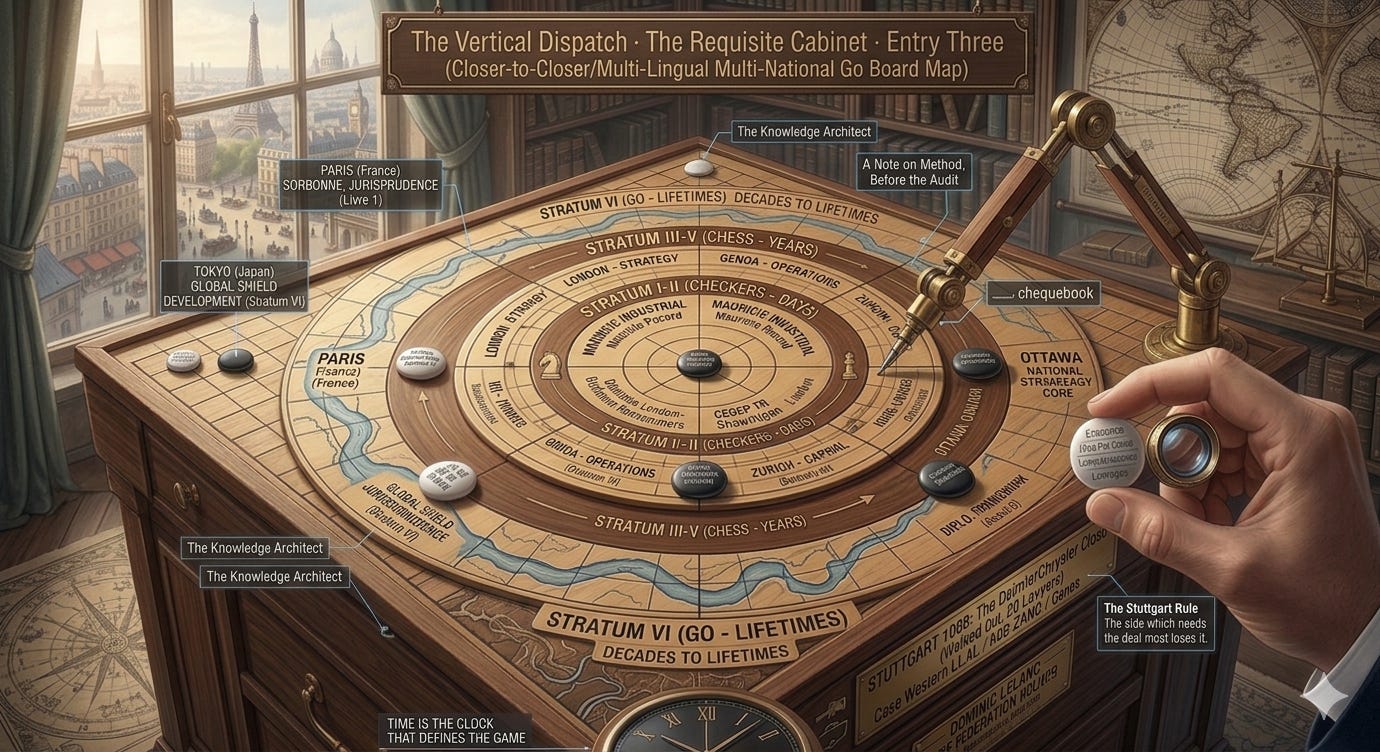
The story he tells about himself begins in 1999. He was twenty-nine, working for ABB, sent to Stuttgart to close a five-hundred-million-dollar contract with DaimlerChrysler. He had been told the German side would bring four lawyers. They brought twenty. He told the room that either sixteen of them left or he did. Sixteen left. The deal closed. The story has been retold so many times in the Canadian business press that it has become its own kind of credential, and the credential is not the deal itself but the disposition the deal revealed. He was, at twenty-nine, a man who would walk out of a room rather than be outnumbered in it.
In 2008 he joined Amec PLC in London as Director of Strategic Development. The next year the World Economic Forum named him to its Young Global Leaders cohort, alongside Anderson Cooper and Leonardo DiCaprio. He spoke three languages by then — French, English, Italian — at the operational level required to run multi-jurisdictional commercial files. He had spent fifteen years moving through the chairs of European industrial capital. He had not yet held a Canadian elected office of any kind.
The Anand dispatch located its subject’s centre of gravity in protection. The Joly dispatch located its subject’s centre of gravity in acceleration. Champagne’s centre of gravity, at this point in the record, has not yet declared itself. The man is still moving. The pattern is still forming. The pre-political record is the record of a closer — but a closer of what kind, and for whom, is the question the rest of the dispatch will press.
II. THE RETURN
In 2009, while still in London, Champagne told a Globe and Mail interviewer that he intended to come back to Canada to seek elected office. He cited Jean Chrétien as his model — another, in Chrétien’s famous self-description, little guy from Shawinigan. In 2013 he quit Amec, moved back to Mauricie, and spent two years campaigning full-time for the Liberal nomination in Saint-Maurice—Champlain, the riding Chrétien had represented for four decades. The sitting Liberal MP, Lise St-Denis, was not consulted. The nomination was won. The seat was taken in 2015 with just under forty per cent of the vote.
That decision is worth pausing on, because it is a decision the documented record cannot fully explain. A man who has spent twenty years closing capital deals in Genoa, Zurich, and London does not, on the ordinary curve, walk away from that career to spend two years door-knocking in a riding of fifty thousand people. He does so when he has decided that the next chair he wants to occupy is not in a corporate boardroom but in a national parliament. The DaimlerChrysler story tells you something about the man at twenty-nine. The decision to come back in 2013 tells you something different — that the man at forty-three had already decided the closing he wanted to do for the rest of his life would be done on behalf of a country, not a balance sheet.
That is not a complete answer to the question of motive. The audit does not require one. The audit requires only that the documented decision be read at the altitude it was made.
III. THE PORTFOLIO LADDER
Five major portfolios in eight years across three governments. Read in the order they came.
Minister of International Trade, January 2017 to July 2018. He inherited the chair four months after Donald Trump won the first time. By February of 2017 the new American administration had told the Canadian one that NAFTA, as it existed, was finished. For seventeen months Champagne carried the trade file through what was then the worst Canada-United States economic crisis in a generation. NAFTA did not survive in the form it had taken in 1994. CUSMA — the agreement that replaced it — did survive, and it did so in part because the Canadian negotiating room was being run by a minister who had spent two decades negotiating against larger counterparts. Chrystia Freeland was the public face. Champagne, before her elevation to that file, was the chair that built the early defence.
Minister of Infrastructure and Communities, July 2018 to November 2019. The infrastructure file in Canada at that period was almost entirely a coordination problem — federal money, provincial gatekeepers, municipal delivery. The portfolio is the one most Liberal ministers either grow inside or get devoured by. He grew. The Infrastructure Bank was operationalised under his chair. The regional development pipelines began moving.
Minister of Foreign Affairs, November 2019 to January 2021. Fourteen months that contained the entire arrival of COVID, the closure of the Canada-United States border for the first time in modern memory, the early stages of the Two Michaels file with Beijing, the assassination of Qassem Soleimani and the Iranian downing of Flight PS752 with fifty-seven Canadians aboard, and the establishment of the Five Eyes COVID-vaccine procurement coordination. He held the chair through it. The Two Michaels were not yet home. The PS752 file was not yet closed. But the chair was held, the alliances were maintained, and the bilateral diplomatic infrastructure was intact when he handed it to Marc Garneau in January of 2021.
Minister of Innovation, Science and Industry, January 2021 to March 2025. Four years and two months. The longest single tenure of any modern Canadian Industry Minister. He used it to do something specific. He went after every multinational electric-vehicle manufacturer he could reach, and he closed. Stellantis in Windsor. Volkswagen in St. Thomas. Honda in Alliston, an eleven-billion-dollar EV-and-battery base. Northvolt in Saint-Basile-le-Grand, before its collapse. Umicore in Kingston. The deals were not all final, and the Trump tariff regime that returned in 2025 has now placed many of them under structural stress. But the man holding the Industry chair at the precise moment continental industrial policy was being rewritten — and rewritten in Beijing as much as in Washington — was a man whose entire pre-political training had been in closing exactly this kind of file.
Then, in March 2025, the chequebook itself.
IV. THE MOVE TO FINANCE
On March 14, 2025, Mark Carney named Champagne the forty-second Minister of Finance of Canada, and the second francophone ever to hold the office, after Chrétien himself. Two months later, on May 13, the dual portfolio of Minister of National Revenue was added to the file. The Anand dispatch on Foreign Affairs read that move as protection of the investor’s framework. The Joly dispatch on Industry read that move as the deployment of accelerated decision-making capacity. The Champagne move requires its own reading.
Carney is a former Bank of Canada governor and a former Bank of England governor. He is, by training and by stratum, the most monetarily literate Prime Minister in modern Canadian history. He does not need a Finance Minister to be the country’s economist-in-chief, because the country already has one in the chair above. He needs a Finance Minister who can do something else.
He needs a Finance Minister who can close the room.
That is what Champagne has spent his life doing. Stuttgart 1999. CUSMA 2018. The Honda deal in 2024. The Bessent meeting in Banff in May 2025. The Beijing trip in April 2026. The Washington meetings in April 2026. The G7 chair throughout 2025. Every one of those rooms had the same structure — a counterparty larger than Canada, a clock running, and a closer in the Canadian chair whose entire training had been in walking out of rooms where the numbers did not work. Carney did not place an economist at Finance. He placed a closer at Finance, and reserved the economist function for himself.
The arrangement is unusual. It is also structurally precise. The Prime Minister sets the strategic frame. The Finance Minister closes the operational deals that the frame requires. That is how a country built for a Trump-era trading environment actually moves capital.
V. THE BUDGET, READ STRUCTURALLY
On November 4, 2025, Champagne tabled Budget 2025 — Canada Strong. The slogan was a campaign inheritance. The document itself was something more interesting. A 486.9-billion-dollar expenditure envelope. A 78.3-billion-dollar projected deficit. A 51-billion-dollar, ten-year infrastructure fund. A 17.2-billion-dollar provincial-territorial infrastructure transfer with matching requirements attached. A G7-leading low net debt-to-GDP ratio of 13.3 per cent. A G7-second-lowest deficit-to-GDP ratio. A commitment to two per cent of GDP on defence by 2026, meeting the NATO floor for the first time in modern Canadian memory. A fifteen per cent reduction target in program-spending across ministries, requested by the Finance Minister directly. A five-billion-dollar commitment over seven years to commercial corridors toward Europe and Asia. The luxury tax on aircraft and yachts, abolished. The Underused Housing Tax, eliminated.
The opening line of his budget speech was not a fiscal sentence. It was a geopolitical one. He told the House that the world was undergoing a series of fundamental shifts at a speed, scale, and scope not seen since the fall of the Berlin Wall — that the rules-based international order and the trading system that had powered Canadian prosperity for decades were being reshaped, threatening Canadian sovereignty, prosperity, and values. He framed the budget as a sovereignty document before he framed it as a spending document. That framing is the structural argument of Budget 2025, and everything else in the document is a corollary of it.
Le Devoir’s analysis questioned whether the budget was truly generational, noting that of the nearly 280 billion in promised capital investment, only 32.5 billion was new money beyond what had been previously planned. Quebec Finance Minister Eric Girard publicly called the federal envelope insufficient. The Léger poll one week after tabling found 37 per cent of Canadians reading the budget negatively against 30 per cent positively. The Conservative and Bloc opposition voted against. The NDP, with one Quebec defection from Alexandre Boulerice, voted for. The budget passed on November 17, 2025.
The honest editorial reading of Budget 2025 is that it is a document written by a man whose first instinct, in any room, is to close the deal in front of him rather than to perfect the document on the table. The framing is geopolitical. The arithmetic is conservative by international comparison. The internal austerity is real. The investment envelope is large but contains less new money than the rhetoric implied. The provincial transfers are conditional. The defence floor is met. The luxury tax is gone. The Underused Housing Tax is gone. The Quebec Finance Minister is unhappy. The Anglo-business press is broadly content. The Bloc voted against. The Conservatives voted against. The NDP voted for. The government survived its first confidence vote with room to spare.
That is what a closer’s budget looks like. It is not the budget the academic left would have written. It is not the budget the doctrinaire right would have written. It is the budget that gets the room to the next room — and the next room, for Champagne, is in Washington.
VI. THE WASHINGTON FILE
In the fourteen months he has held Finance, Champagne has built one operational relationship that matters more than any other. It is with United States Treasury Secretary Scott Bessent.
The two met first in Banff in May 2025, during Canada’s hosting of the G7 finance ministers — an event Champagne chaired. The bilateral was the headline meeting of the gathering, by the explicit framing of the Canadian and American sides. Reuters reported afterward that both ministers described the meeting as productive. Champagne said, in his characteristic register, that they got along very well. Bessent said he had had a very productive day. Those are diplomatic phrases. They are also closer phrases. The meeting was the opening move of what has become the principal economic conversation between Ottawa and Washington under the second Trump administration.
Champagne and Bessent have spoken repeatedly since. The June 2025 phone call after Canada rescinded the digital services tax — at Trump’s direct demand — was Champagne-to-Bessent. The G7 finance work through 2025 was anchored by their bilateral channel. The April 2026 Washington meetings, where Champagne participated in the G7 and G20 finance ministerial meetings alongside the IMF and World Bank Spring Meetings, were Bessent’s room. The Beijing trip Champagne made earlier that same month — building on the Carney-Xi summit of January 2026 that secured the 49,000 Chinese EV import quota in exchange for canola-meal tariff relief — is the other half of the same hand. The closer is moving between Washington and Beijing because the Sovereign Plan requires the chair to move between Washington and Beijing.
The relationship with Bessent is, in the documented record, the most consequential operational relationship the Canadian Finance Minister has ever held with a sitting United States Treasury Secretary in a non-crisis period. It is not warm in the personal sense. It is functional in the closer sense. Bessent has continued to publicly call Alberta a natural partner for the United States. Champagne has continued to publicly insist that Canada is the country paying the lowest price to enter the American market. Both sentences are true. Both sentences are positions. The closers are working the positions.
VII. THE COGNITIVE PROFILE
The standing editorial standard now applies, in the same format used for every major figure this publication examines — from the documented public record only, without malice and without flattery.
François-Philippe Champagne. LL.B., Université de Montréal. LL.M., Case Western Reserve University School of Law, on scholarship. Twenty years in continental and global industrial capital — Bailey Controls, Elsag, ABB, Amec PLC. Trilingual operational fluency in French, English, and Italian. Closer on a five-hundred-million-dollar DaimlerChrysler contract at twenty-nine. World Economic Forum Young Global Leader at thirty-eight. Member of Parliament for Saint-Maurice—Champlain since 2015. Five federal cabinet portfolios in eight years — International Trade, Infrastructure, Foreign Affairs, Innovation Science and Industry, and now Finance with National Revenue attached. Forty-second Minister of Finance of Canada and second francophone to hold the office. G7 finance chair throughout 2025. Author of Budget 2025 — Canada Strong, passed in November 2025.
PIAAC Level 4, with documented reach into Level 5 visible in the multi-jurisdictional negotiation record and the G7 finance chair work. Stratum V, mature and consolidated, with the specific Stratum VI reach that is built by twenty years of operational negotiation at continental capital scale before entering politics. That kind of reach is rare in the Canadian political class because the Canadian political class is, by its dominant pipeline, built from law school and the public service rather than from European industrial corporate negotiation. Champagne is the exception that proves the structural point.
The honest finding is a minister of established Stratum V capacity, with the lower reach of Stratum VI now consolidating, placed in a chair where the structural function is the closing of operational economic deals on behalf of a country whose Prime Minister has reserved the strategic frame to himself. The arrangement is requisite. The minister is closing. The Prime Minister is framing. The Sovereign Plan moves.
Then the elenchus, because an audit that produces only favourable findings has not been an audit. The Socratic question for Champagne is the question every closer eventually faces. The capacity to close is documented. The discipline of choosing when not to close is the harder discipline, and the documented record on it is thinner.
The 1999 Stuttgart story is told as a triumph of nerve. It is also a story about a young man who understood that the side which most needs the deal loses the deal. The question for Champagne at Finance, in 2026, is whether he can apply that same instinct to the United States. The Bessent relationship is functional. The G7 chair was well-run. The budget passed. The Beijing trip happened. The Washington meetings happened. The corridors money is moving. These are closes. But the Sovereign Plan is not, in the end, a series of closes. It is a single long position taken across a generation, in which the willingness to walk out of a room is occasionally more important than the willingness to close it.
The Stuttgart story ends with the closer keeping the room. The Sovereign Plan may, at some future moment, require the closer to leave it. The audit will return to that question when the record on it is fuller. For now, the documented capacity is there. Whether the documented discipline is there as well is the question the next twenty-four months will answer.
THE VERDICT OF ENTRY THREE
Carney placed at the chequebook a minister whose entire pre-political life was spent closing capital deals at continental scale on behalf of someone else, and whose entire political life since 2017 has been spent closing on behalf of Canada. That is not a Finance Minister in the post-war Canadian mould. It is a Finance Minister built for a Trump-era international economic environment in which the trade frame is being rewritten in real time, the multilateral order is contested, and the relationship with the United States Treasury is the single most consequential operational economic file the country has. Entry Three finds that the arrangement is structurally precise. The Prime Minister holds the strategic frame. The Finance Minister closes inside it. The Industry Minister moves at speed. The Foreign Affairs Minister protects the investor’s framework. The Sovereign Core is a four-minister architecture, and each minister is requisite to the chair.
Entry One asked whether the bar could be cleared. Entry Two found that the bench knows what to do with minds still climbing. Entry Three finds that the bench also knows what a closer is, and where to place one — and that the placement is not theatre. It is operation.
Entry Four follows. The Sovereign Plan needs a federalism chair, because the next ninety days will be played on the Alberta board as much as on any other, and the question of who is structurally positioned to hold the federation together while the Sovereign Core does its commercial work is the question Entry Four will press. Dominic LeBlanc at Public Safety and Intergovernmental Affairs is the chair. The audit will follow.
A Note on Standard. This dispatch makes no claim regarding Minister Champagne’s psychology, motives, or character. All assessments draw from the public record alone — ministerial statements, departmental outputs, documented files, the parliamentary record, the November 2025 budget document, and publicly available biographical information from Canadian, Quebec, and international press including Le Devoir, La Presse, the Globe and Mail, the CBC, Reuters, and the Department of Finance Canada. The Stratum framing follows Elliott Jaques’s requisite organization theory and is based on observable patterns of work, not personal evaluation. The cognitive scoring follows the PIAAC literacy scale and the Jaques stratified-systems framework. The standing editorial standard of this publication applies without exception: assessments are advanced from the documented record only, without malice and without flattery.
God is Love. Love is Truth. Truth is Consciousness. Consciousness is Brahman.
Amen. Namaste.
DISPATCH HASHTAGS
#TheVerticalDispatch · #TheArchitect · #TheRequisiteCabinet · #FrançoisPhilippeChampagne · #AIG · #ArtificiallyIntelligentGovernance · #CarneyGovernment · #Budget2025 · #CanadaStrong · #MinisterOfFinance · #G7 · #CUSMA · #Bessent · #ElliottJaques · #RequisiteOrganization · #StratifiedSystemsTheory · #PIAAC · #StructuralLiteracy · #CanadianSovereignty · #SovereignCore · #SovereignPlan · #TheCloser · #TheElenchus · #Shawinigan · #Quebec · #Substack · #CanadianPolitics · #CivicLiteracy · #LongformWriting · #PolicyAnalysis
Wow. Excellent report. Thank you for the audio version.