

Age of Consequences · Glen Roberts, The Architect
Orwell. Bradbury. Battersea. The toilet doctor. The podcast. The crisis that revealed us.
I. The Building With Four Chimneys
Orwell needed a monument. He gave the Ministry of Truth a body — a white pyramid of glittering concrete, three hundred metres high, dominating the London skyline. He was writing in 1948. The Cold War was hardening. The Soviet rewrite of history was operating at industrial scale. He needed something the eye could fix upon as the physical seat of manufactured consensus.
He chose Battersea. Consciously or not, the four great chimneys of Battersea Power Station — what Londoners called the Four Sisters — were the visual grammar of institutional power on the Thames. A cathedral of industrial England. Decommissioned. Purchased. Transformed.
Into the European headquarters of Apple Inc.
The company that placed a glass rectangle in every pocket. The device through which the Ministry now conducts its primary operations — not by force, not by surveillance alone, but by something Orwell only partially anticipated: the willing, eager, twenty-four-hour participation of the population in its own informational management.
This is not metaphor. This is real estate. Prophecy fulfilled in brick, steel, and a Genius Bar on the ground floor.
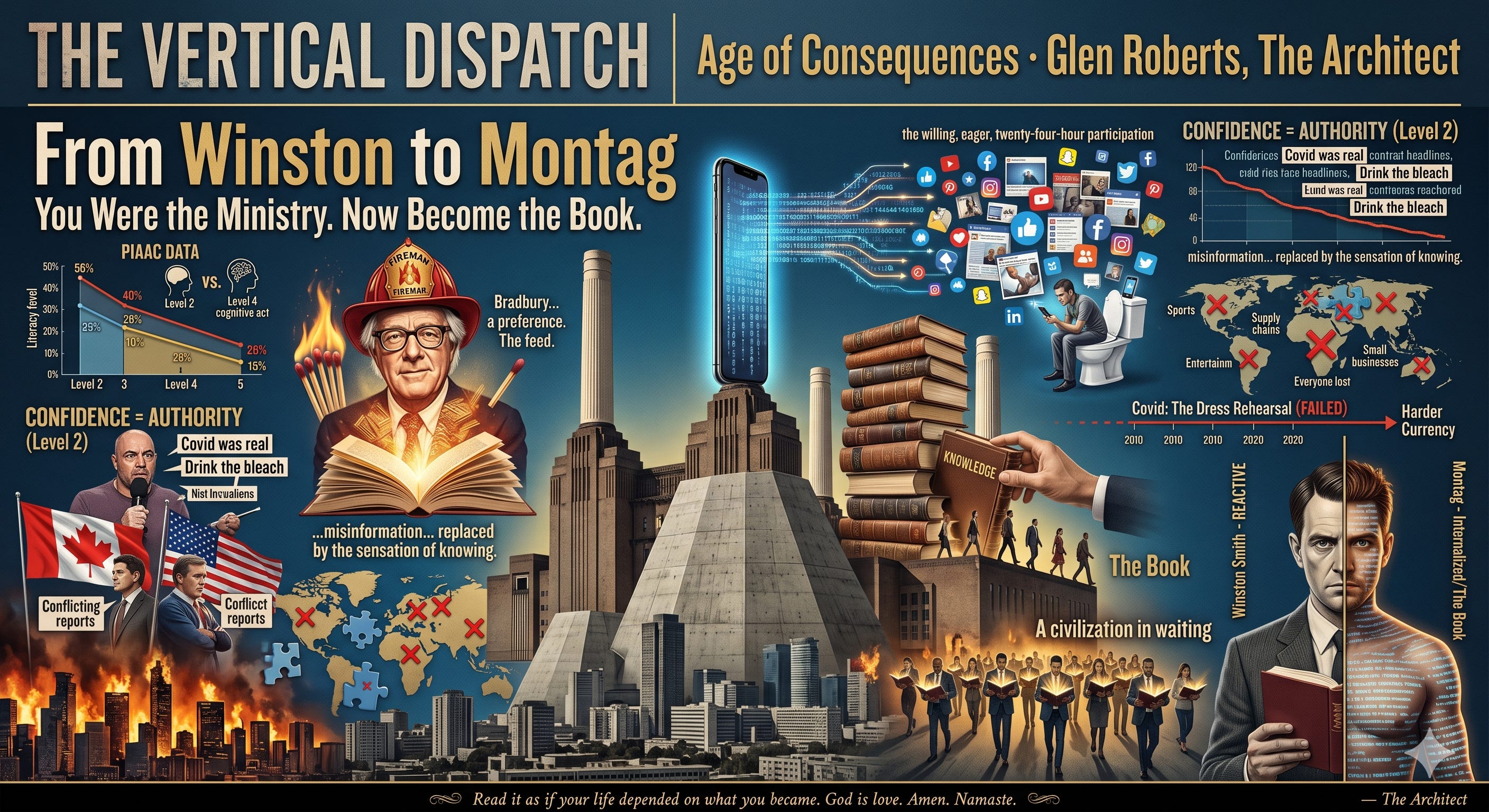
Orwell imagined the Ministry as a building. History gave him one — and handed the keys to Silicon Valley.
II. The Arithmetic of Oceania
In Nineteen Eighty-Four, the proles are eighty-five percent of the population. The Party does not surveil them with the same intensity it reserves for Party members. Winston briefly sees hope in this — the numbers alone, if the proles could become conscious, would be sufficient to overturn everything.
He is right about the arithmetic. He is wrong about what consciousness requires.
The PIAAC data — the Programme for the International Assessment of Adult Competencies, the most rigorous global audit of adult literacy ever conducted, updated across thirty-one nations in December 2024 — places empirical weight beneath what Orwell intuited as fiction.
49% of adults in Canada read at PIAAC Level 2 or below.
54% of adults in USA read at PIAAC Level 2 or below.
59% of adults in Ireland read at PIAAC Level 2 or below.
18% of OECD adults cannot reach the basic proficiency threshold in any measured domain.
6% of South Korean adults — in a high-performing system — reach Levels 4 and 5.
2% globally. Two percent of the adult human population reads at the level required to fully evaluate an empirical claim.
Level 2 is the capacity to locate information in a short text and draw a simple inference. It is not the capacity to hold two contradictory propositions simultaneously and determine which is true. It is not the capacity to evaluate a source’s institutional interest, track a logical inversion, or detect when a definition has been quietly changed beneath your feet.
Those capacities live at Levels 4 and 5.
Winston Smith’s crime was a Level 4 cognitive act. He could remember that Oceania had once been at war with Eastasia. He could hold that memory against the current claim and know the current claim was false. The Ministry’s terror was not that he might organize a rebellion. It was that he could perform that comparison at all.
You do not need to burn the past. You need only ensure the population cannot hold the past and the present in the same thought at the same time.
III. Beatty Was Right. This Is the Harder Truth.
Ray Bradbury gave us Montag — and also his captain, Beatty, who is the more dangerous character because he is the more honest one. Beatty has read everything. He chose the fire anyway.
His argument, delivered with the cool precision of someone who has made peace with what he is doing, runs like this: the people asked for this. Media accelerated. Attention shortened. Competing voices demanded the removal of anything that caused discomfort. Publishers simplified. Schools stopped assigning difficulty. And the firemen arrived to formalize a cultural process that was already complete before the first match was struck.
This is the part that cuts. Bradbury is not describing a coup. He is describing a preference. A civilization that chose the narcotic of confirmation over the labour of complexity — and then built institutions to make that choice permanent and the alternative progressively inaccessible.
The PIAAC 2023 results confirm that literacy scores across the OECD are not holding. They are declining. The United States scored lower in 2023 than in any previous cycle. Across Europe, meaningful improvement was recorded only in Finland and Denmark. Everywhere else — stable at best, falling.
Beatty’s firemen did not cause this. They inherited it. They manage it. The management is called the feed.
Bradbury did not write a warning. He wrote a diagnosis. The distinction matters now that the symptoms have become the system.
IV. The Toilet Doctor and the Podcast Prophet
We must speak plainly about Covid. Not about the virus — the virus was real, the mortality real, the suffering real and still being counted. About what happened to epistemology. About what the crisis revealed that was already there, waiting.
In the space of weeks, every person with a smartphone became a virologist. This is not an insult — it is a precise description of what Level 2 literacy does under conditions of existential fear. The need for an answer, any answer, is not weakness. It is biology. But the result was a population sharing half-understood fragments with the confidence of specialists, with zero epistemic accountability, and with the algorithmic wind of the platform fully behind them.
The governments contributed to this. Let the record show it directly. In Canada, Tam said one thing, the provinces said another, the political leadership threaded a needle that changed shape weekly. In the United States, the institutional voice was not just inconsistent — it was at moments actively wrong, and wrong in ways that handed ammunition to every contrarian with a microphone. Mixed messages at the top collapse trust at the bottom. That is not conspiracy. That is the predictable consequence of real-time decision-making under genuine uncertainty — which is itself the most important sentence in this dispatch.
The governments were acting in real time. With incomplete data. Under conditions no institution on earth was fully prepared for. That is the honest baseline. It does not excuse every decision. It does not sanctify every mandate. But it is where an empirically honest evaluation must begin — and the vast majority of the criticism that flooded the platforms did not begin there.
It began with Joe Rogan.
Or someone like him. The celebrity. The influencer. The comedian with thirty million listeners who discovered that contrarianism feels like courage and that confidence, at Level 2, is indistinguishable from authority. Drink the bleach. Take the horse dewormer. Just asking questions — which were not questions but conclusions dressed in the syntax of inquiry, delivered with the absolute assurance of someone who has never been wrong because he has never been required to show his working.
Here is the mechanism, stated without flinching: a population that cannot evaluate an empirical claim cannot distinguish between a credentialed expert and a confident celebrity. Confidence reads as authority at Level 2. The platform rewards velocity and emotional heat over rigour. The influencer optimizes for both. The result is not misinformation — it is something more structurally dangerous: the systematic replacement of the capacity to know with the sensation of knowing.

Confidence reads as authority at Level 2. The platform rewards velocity. The influencer optimizes for both. What is lost is the capacity to know — replaced by the sensation of knowing.
V. The Conspiracy That Ate Itself
Now take the conspiracy seriously. Not to dismiss it — to follow it to its logical conclusion.
If the pandemic was engineered. If the lockdowns were coordinated control. If the vaccines were weaponized. If the entire apparatus of global public health was a synchronized operation of elite power — then what did that operation actually require?
Every professional sports league on earth, simultaneously shutting down. Every entertainment industry. The entire global supply chain fracturing in ways that cost the architects of this alleged conspiracy trillions of dollars in lost revenue. Small business owners on every continent losing everything — not as collateral damage but as deliberate sacrifice. Governments of opposing ideologies, hostile intelligence services, competing pharmaceutical corporations, and the entire international scientific community moving in perfect lockstep across language barriers, cultural divides, and centuries of institutional rivalry.
Everyone lost. The billionaires lost. The governments lost legitimacy they have not recovered. The supply chains lost resilience that has not been rebuilt. Society lost something in the fabric of trust between people that no subsequent narrative has repaired.
If that was orchestrated, the architects possessed a coordination capacity indistinguishable from divine omnipotence — and chose to deploy it in a way that impoverished themselves along with everyone else. And somehow the proof of this operation was discoverable by a podcaster in Austin, Texas, but not by the intelligence services of China, Russia, or any of the dozen governments with every institutional interest in exposing it.
The conspiracy theory, taken with full seriousness, requires more faith than the institutional incompetence explanation. Not less. More. The incompetence explanation is uncomfortable because it means no one is in control. The conspiracy explanation is comfortable because it means someone is — which is, at Level 2, a more bearable universe to inhabit.
And here is where the blade turns all the way around.
If you distrust your government — good. Healthy. Democratic. Essential. The question is what you did with that distrust. Did you read? Did you study? Did you go to the primary data, the peer-reviewed literature, the actual epidemiological record? Did you build the epistemic infrastructure required to mount a credible challenge to institutional authority?
Or did you screenshot a tweet and share it from the toilet?
Because if the answer is the latter — and for the overwhelming majority it was — then the distrust did not produce accountability. It produced noise. And the noise served the Ministry more efficiently than compliance would have, because it made the very concept of shared truth appear impossible, and in that impossibility, the only remaining authority is whoever shouts loudest.
If you want to blame the government, blame them for your education. That is the legitimate grievance. The school that did not teach you to evaluate a source. The system that produced a population that cannot distinguish a peer-reviewed study from a podcast episode. The curriculum that optimized for compliance and credentialing and left out the one thing that would have made you dangerous to power in the right way: the ability to think.
Blame the government for your education. That is the grievance that holds — because it is the one with empirical support, and it is the one they cannot answer.
VI. The Dress Rehearsal Is Over
Here is the question that makes everything else consequential.
If a respiratory virus — a genuine crisis, unprecedented in living memory, but still a crisis that left the infrastructure intact, the lights on, the water running, the internet connected — if that produced the epistemic collapse we witnessed between 2020 and 2023, what happens when the crisis is of a different order entirely?
What happens when it is not a virus but a war? Not a war on a distant screen but on a proximate street. When the sacrifice required is not a mask, not a vaccine, not a closed restaurant — but a son. A daughter. A neighbourhood that no longer exists by Tuesday morning.
A population that could not agree on basic epidemiological facts. That fractured along tribal lines over a respiratory illness. That outsourced its epistemology to celebrities and its courage to outrage. That learned during Covid not to trust institutions — but also did not learn to replace institutional trust with genuine knowledge, only with the performance of scepticism. That population is not ready.
The precessional cycles do not wait for readiness. The force dispositions of every major power on earth right now do not suggest that the hard question is coming eventually. They suggest it is already in transit.
Covid was the dress rehearsal. We failed it — not the virus, not the lockdowns, not the vaccines. We failed each other. We failed the common good, which requires, as its minimum condition, the willingness to sacrifice for something larger than the self and the capacity to evaluate whether the sacrifice is being asked for legitimate reasons. Both of those failed simultaneously. And the bill for that failure will be presented in a harder currency than we have ever been asked to pay.
Covid was the dress rehearsal. We failed it. Not the virus. Each other. The bill will arrive in a harder currency.
VII. You Were Winston. Now Become Montag.
Here is the difference between them. Winston Smith remembers the truth. He holds the old version of the past against the new one and knows which is real. He writes it in a diary he hides in a corner where the telescreen cannot reach. He is brave and he is doomed and his tragedy is that he wakes up inside a system that has already decided the outcome. He is reactive. The diary is an act of love and it is too late.
Montag burns first. He is the Ministry’s most willing instrument before he becomes its enemy. He torches the books with professional satisfaction, proud of his work, comfortable in his purpose. And then one night a girl named Clarisse asks him if he is happy — seventeen years old, walking in the rain, looking at things — and the question lands like a splinter that will not come out.
He starts reading what he burns.
That reading does not give him better arguments. It does not turn him into a superior debater or a more confident poster. It restructures him. It changes the substrate of the person doing the reading. And when the fire comes for his own house, he does not run as a man who has escaped the Ministry. He walks into the river as a man who has become something the Ministry cannot burn — because he has internalized what the books contained. He does not carry the book. He is the book.
This is what reading at Levels 4 and 5 actually does, when it is pursued for the sake of knowledge itself — not for ammunition, not for a better social media argument, not for the credential. It does not inform you. It restructures you. The person who has genuinely read — not consumed, not scrolled, not listened to a podcast while doing something else, but read, with attention and resistance and the willingness to be changed — that person is the one jurisdiction the Ministry takes last and never fully holds.
You began this dispatch as Winston. Privately uneasy. Feeling the vertigo of a comparison you couldn’t quite name. Sharing the approved narrative because the social cost of not sharing it was too high. Living inside the system and knowing, somewhere below the threshold of speech, that something was wrong.
The call is not to keep the diary. The diary is Winston’s move and Winston loses.
The call is to become Montag. To pick up what you were burning — or ignoring, which is the modern equivalent — and read it. Not to win. Not to be right. For the sake of what knowledge does to the person who genuinely pursues it. For the sake of being the kind of person who, when the harder crisis arrives, has something inside that cannot be overwritten by the next confident voice on the platform.
Winston kept the diary. Montag became the book. Only one of them survived what was coming.
Coda. The Four Sisters Still Stand
Go to the Apple Store at Battersea Power Station. Look up at the chimneys. The building is beautiful now — restaurants, apartments, a concourse of polished stone. The four stacks are illuminated at night. The Genius Bar is inside, staffed by people in blue shirts who will help you with your device.
Orwell’s Ministry of Truth — in the novel — is described as supplying the citizens of Oceania with every conceivable kind of information, instruction, and entertainment. From birth to death. Cradle to grave.
The device in your pocket does this. Every conceivable kind of information, instruction, and entertainment. From morning alarm to midnight scroll. The Ministry was never a government building. It was always a distribution architecture for consensus reality — and it works best, it has always worked best, when the population operates it on the Ministry’s behalf without being asked.
Montag walked out of the burning city carrying nothing but what he had memorized. The network of book-people he joins in the fields outside — each one a different text, held entire in a single human mind — is not a library. It is a civilization in waiting. Resistant to fire because it is not made of paper. Resistant to the platform because it does not live there.
Put down the phone.
Pick up the book — any book that asks something of you, that does not confirm what you already believe, that leaves you changed rather than satisfied.
Read it the way Montag read. As if your life depended on what you became in the process.
Because the dress rehearsal is over. And what is coming will not ask how many followers you had.
It will ask what you are made of.
God is Love. Love is Truth. Truth is Consciousness. Consciousness is Brahman.
Amen. Namaste.
#BecomeTheBook #MinistryOfTruth #PIAAC2023 #AgeOfConsequences #FromWinstonToMontag