


“Context is all.”
— Margaret Atwood, The Handmaid’s Tale
The CanLit Files · Glen Roberts, The Architect
Last dispatch we read the writer. This dispatch we read what happened to her book.
The previous CanLit Files entry argued that Margaret Atwood’s discipline — the habit of reading every document as the work of an interested narrator, the method that connects Alias Grace and Oryx and Crake across the timeline — is the single most important cognitive instrument the Canadian literary tradition has produced. The dispatch closed with a cliffhanger. A satirical short story Atwood had published in August 2025 ended with the Premier of Alberta in a nice new blue dress, with no job, in Gilead. That sentence had a sequence behind it. This dispatch is the sequence.
What follows is the public record of how a provincial government in Canada spent five months between July 2025 and January 2026 producing the administrative removal of The Handmaid’s Tale from public school libraries, walking back the order under public pressure, and then removing the graphic novel adaptation of the same book anyway. The sequence is documented. The premier is named. The minister is named. The dates are public. The Atwood response is public. This is not interpretation. This is what happened, in the order it happened, in the country the writer was born in, the year after the country awarded her another medal.
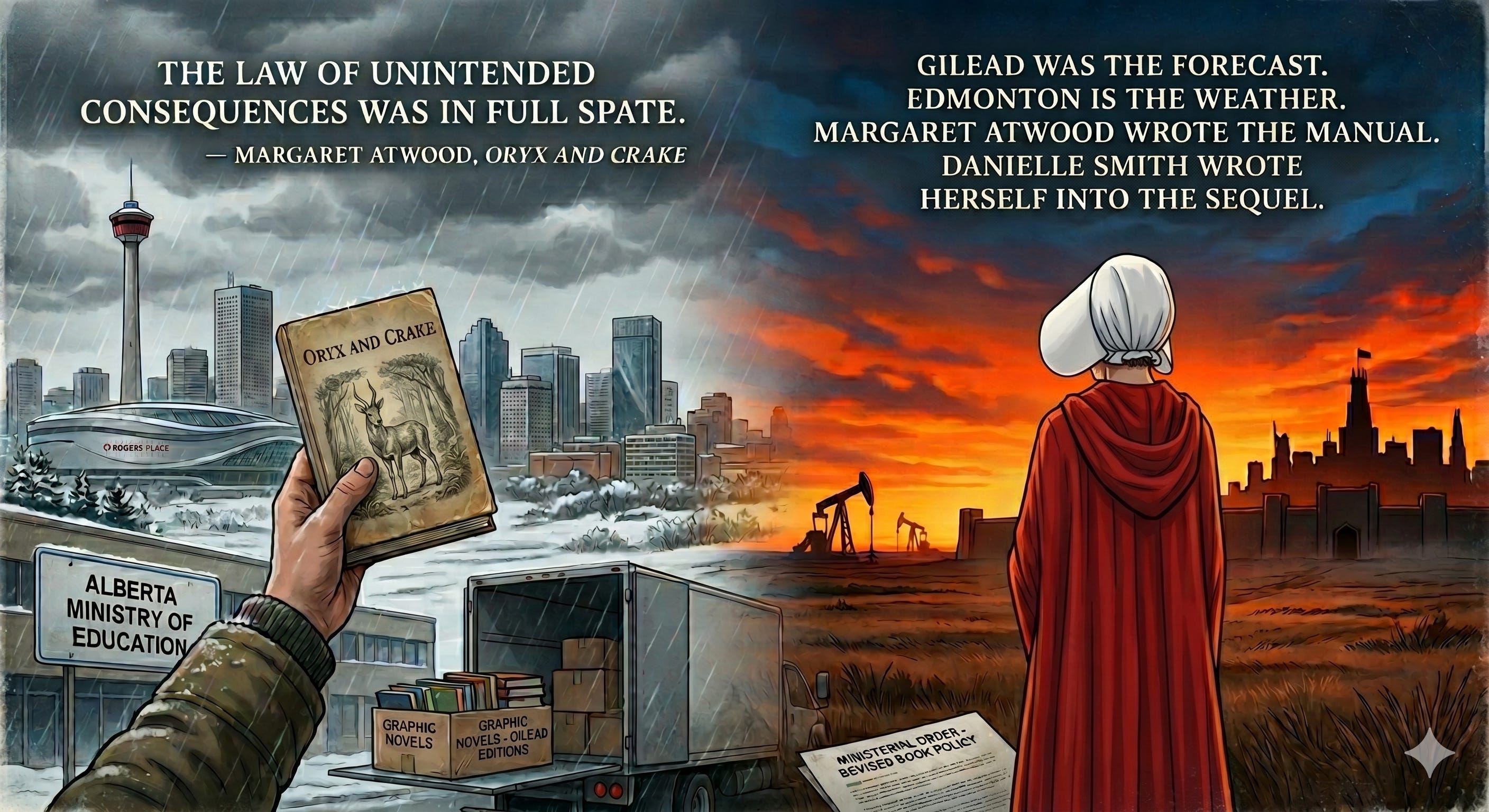
I. The Five Stages of the Alberta Demonstration
Stage one. July 10, 2025. Alberta’s Minister of Education, Demetrios Nicolaides, issues a ministerial order requiring the removal from school libraries of any material containing explicit sexual content, including written passages. The compliance deadline is October 1. The order is broad. The criterion of written passage is the operative phrase. Any literature that includes a written depiction of a sexual act is, by the plain reading of the order, in scope.
Stage two. August 28, 2025. CBC News obtains and publishes an internal Edmonton Public School Board list of more than two hundred titles assembled for removal under the ministerial order. The list includes The Handmaid’s Tale, Brave New World, I Know Why the Caged Bird Sings, The Perks of Being a Wallflower, The Color Purple, The Godfather, Jaws, and works by Alice Munro and Ayn Rand. Books with 2SLGBTQ+ themes are heavily represented. The board chair states publicly that the board opposes the policy and that division staff have worked over the summer to ensure that only books that directly meet the criteria in the ministerial order are on the list. In other words: we are not enthusiasts. We are complying.
Stage three. August 31, 2025. Three days after the list goes public, Margaret Atwood publishes a satirical short story on social media. She introduces it with the line: here is a piece of literature by me, suitable for seventeen-year-olds in Alberta schools, unlike — we are told — The Handmaid’s Tale. Sorry, kids; your Minister of Education thinks you are stupid babies. The story describes two perfect children, John and Mary, who never have bodies, never have sex, produce five perfect children without sex, ignore the poor, abandon the teachings of Christ, and practice selfish rapacious capitalism because they worship Ayn Rand. The story ends with the line: while they were doing that, The Handmaid’s Tale came true and Danielle Smith found herself with a nice new blue dress, but no job. The end.
Stage four. September 9, 2025. Premier Danielle Smith’s government revises the ministerial order. The phrase written passage is removed. The phrase visual depiction is substituted. The new order applies only to graphic images, not to text. Smith characterizes the original Edmonton Public Schools list as vicious compliance. The premier who appointed the minister who signed the order is now publicly criticizing the school board that implemented the order for implementing it the way the order was written. The compliance deadline is moved to January 5, 2026.
Stage five. January 5, 2026. The revised order takes effect. By March 2026, CBC reports that Alberta school divisions including Edmonton Public Schools have removed at least one hundred and sixty titles from shelves to comply with the visual-depiction rule. Among the titles boxed away in storage are the graphic novel adaptation of The Handmaid’s Tale and the graphic novel adaptation of George Orwell’s 1984. Two illustrated versions of the two most-cited novels of dystopian state control in the English language, removed from Alberta public school libraries, in compliance with a provincial order, signed by a premier who has explicitly stated that the classics should remain available.
The state did not ban The Handmaid’s Tale. The state revised the law specifically to permit The Handmaid’s Tale. And then the state removed the illustrated edition of The Handmaid’s Tale anyway, because the illustrated edition contains images, and the new order is about images, and the order is the order, and someone, somewhere, made a determination.
Five months. No tanks. No coup. An order signed in July. A list assembled in August. A revision drafted in September. A compliance deadline in January. A title boxed in storage by March. This is what Atwood spent forty years describing. The administrative procedure that arrives one Tuesday at a time.
II. What Atwood Saw in Seventy-Two Hours
The first CanLit Files dispatch made the literary case for Atwood’s method. This dispatch makes the operational case. The two are the same case. The method is the operational instrument.
Reading at the level Atwood wrote means asking, of any document, two questions in sequence. Who wrote this? What did they need it to mean? The Alberta ministerial order is a document. It was written by the office of the Minister of Education. The minister needed it to mean that the government was protecting children. The plain reading produced a list that included The Handmaid’s Tale. The list became public. The premier needed the order to no longer mean what its plain reading produced. The order was revised. The new reading produced the removal of the graphic novel adaptation instead. The premier needed the new outcome to also be acceptable. The premier said the classics should remain available. The graphic novel was in storage by March.
Every stage of that sequence is the production of a document by an interested narrator who needed the document to mean what the political moment required it to mean. Atwood saw the whole sequence in the first stage. She saw it because she has been reading documents like this for forty years. She wrote the response in seventy-two hours because the response was already inside the method. The discipline of Alias Grace is the discipline of reading the prison chaplain’s file on a young woman, and the discipline of Alias Grace is the discipline of reading the Alberta ministerial order on a list of two hundred books. Same instrument. Different document. Same writer.
This is why piece one of this series existed. Without the method, this dispatch reads as a partisan complaint about a school library policy. With the method, this dispatch reads as the case study of why the method matters. The reading public that has retained Atwood’s training is the reading public capable of seeing what just happened in Alberta. The reading public that has not is the public the minister was writing the order for.
III. Vicious Compliance
The most revealing phrase in the entire Alberta sequence belongs to the premier herself. On September 9, 2025, Danielle Smith characterized the Edmonton Public School Board’s 200-title list as vicious compliance.
Read the phrase carefully. It is a confession disguised as an accusation.
Compliance is the response of a subordinate institution to a directive from a superior authority. The Edmonton Public School Board complied with a ministerial order signed by the minister appointed by the premier. The board’s chair stated publicly that the board did not support the policy but had a legal obligation to implement it. The board produced a list using the criteria the order specified. The list was assembled by professional staff working over the summer. The list was, by every available standard of administrative practice, compliance.
The premier, asked to defend the order her minister had signed, did not defend the order. She attacked the institution that had complied with it. She added the modifier vicious to compliance. The implication was that compliance itself was the offence — that the school board should have understood the order to mean something other than what the order said, and that producing a list that took the order at its plain meaning was an act of malice against the government.
This is the operating model The Vertical Dispatch documented at length in the dispatch titled The Two-Faced Premier. The verdict there was: skilled, consequential, and without the principle her office requires. The verdict here is the same, in literary translation. A premier who signs an order through her minister, watches the order produce its predictable consequences, and then attacks the institution that produced the consequences for producing the consequences is a premier whose relationship to the public record is the relationship Offred is required to maintain with the public record of Gilead. The order said what it said. The order did not say what it said. Both are true depending on what the premier needs the order to have said at any given moment.
Atwood’s entire career is the documentation of this exact pattern. She did not need to write a literary response to Smith. She had already written it. The response was the 1985 novel. The response was the 1996 novel. The response was the 2003 novel. All Atwood had to do in August 2025 was write a satirical short story in seventy-two hours, name the premier, and let the existing forty years of work carry the weight.
Coda. The Blue Dress, No Job
Read Atwood’s closing sentence the way Atwood writes closing sentences.
While they were doing that, The Handmaid’s Tale came true and Danielle Smith found herself with a nice new blue dress, but no job. The end.
Blue is the colour of the Wives in Gilead. The Wives are the women at the top of the hierarchy in the novel’s social order. They are kept in luxury. They are denied agency. They are decorative and useless and, in the novel’s closing chapters, increasingly discarded by the regime when the regime no longer requires them. The Wives are not the architects of Gilead. They are the women who collaborated with the architects in exchange for status and were rewarded with the status and stripped of everything else.
The Premier of Alberta, in Atwood’s ending, does not become Offred. Offred is the Handmaid — the woman the regime is using and abusing and against whom the reader’s sympathy is mobilized. The Premier of Alberta is not given that ending. She is given the Wife’s ending. The blue dress is the costume. No job is the punchline. The collaborator wearing the uniform of the system she helped install, after the system no longer needs her.
That sentence was written by an eighty-five-year-old novelist in seventy-two hours. It was published on a social media account. It was read by everyone in Canadian literary circles within a week. It was not read by the office of the Minister of Education, which proceeded with the revised ministerial order, which produced the removal of the graphic novel adaptation of the book the sentence is quoting from, four months later.
The book is still on the shelves in adult libraries. The illustrated edition is in storage. The author is eighty-six. The premier is governing. The country is still here.
Next dispatch in the CanLit Files: the snowball with the stone in it. Robertson Davies, the small Ontario town that runs the country, and the Jungian shadow under the surface of every Canadian institution. The series continues.
God is Love. Love is Truth. Truth is Consciousness. Consciousness is Brahman.
Amen. Namaste.
#GileadIsTheWeather #CanLitDispatch #ViciousCompliance #AlbertaBookBan #TheBlueDress #TheTwoFacedPremier #ReadAtwood #AgeOfConsequences #TheArchitect
Red is the colour of the new $280,000 carpet in Danielle Smith's office. She walks on it. What else would she do? Tell us about the colour red in The Handmaid's Tale.
https://globalnews.ca/news/11161871/alberta-government-rug-premier-office-cost/
Tell us about fine china in the novel. Didn't Serena Joy like China?
I wonder if Margaret Atwood was thinking of the lyric "devil with the blue dress on" when she picked the colour for the wives' status uniform. Or maybe she was parodying Royal Blue...