


I. THE ANNOUNCEMENT
On May 6, 2026, at the Airbus Canada assembly facility in Mirabel, Quebec, Prime Minister Mark Carney stood beside Quebec Premier Christine Fréchette and AirAsia CEO Tony Fernandes and announced the largest single firm order for a Canadian-designed and produced aircraft in the country’s history.
One hundred and fifty Airbus A220-300s. Every one of them to be assembled in Mirabel. First delivery scheduled for Q1 2028. An option for 150 more. AirAsia — the Malaysian low-cost carrier — becoming the launch customer for a new 160-seat high-density configuration that gives the A220 its first genuine foothold in the Southeast Asian budget market.
Carney’s words at the podium were precise and deliberate. “We shared a vision of deepening ties between those countries that, in this crisis that we’re still living through, are choosing to build in the face of adversity — countries that have the confidence to open up, to link their economies, to invest in their workers, to move forward, not turn back.”
And then, directly to Fernandes: “Thank you for the trust you’re placing in Canadian workers, in Quebec, in Mirabel. You’re choosing the best at exactly the right time.”
The political frame was clean and accurate. Canada diversifying its trade beyond the United States. Southeast Asian capital flowing into Quebec manufacturing. Nearly 5,000 Mirabel workers — 2,500 of them hired in the past four years — with a decade of backlog ahead of them. A Canadian-designed aircraft, born from Bombardier’s near-bankruptcy, now carrying the largest single order in its history.
The frame is accurate. It is also incomplete.
This dispatch completes it.
II. THE PLANE THAT ALMOST WASN’T
Before we read the announcement at stratum, the biography of this aircraft deserves honest telling — because it is one of the more extraordinary industrial stories in Canadian history, and it is largely unknown to the general public that cheered the announcement.
The A220 is not originally an Airbus. It began as the Bombardier CSeries — a Canadian-designed, Canadian-engineered narrow-body jet that Bombardier spent the better part of a decade and billions of dollars developing. It was an extraordinary aircraft by every technical measure: lower fuel consumption than any competitor in its class, wider cabin, longest range, quietest footprint. It was also nearly the death of the company that built it.
By 2018, crushed under development cost overruns, with the Quebec government having already injected over a billion dollars to keep the program alive, Bombardier was in crisis. The solution was as dramatic as the problem: Airbus acquired a majority stake in the CSeries program for the nominal sum of one US dollar. One dollar for a program that had consumed billions. Airbus rebranded the aircraft the A220, plugged it into its global sales network, and the orders began to arrive.
Today the entity that builds the plane in Mirabel is the Airbus Canada Limited Partnership — a joint venture in which Airbus holds 75 percent and the Government of Quebec holds 25 percent. In early 2026, Bombardier sold its final remaining stake entirely, exiting commercial aviation to focus on its now-profitable business jet division. The plane that nearly destroyed Bombardier is now being built in Mirabel without Bombardier.
The story of the A220 is, at its core, a story about what happens when a sovereign industrial bet is made before the market has fully arrived — and what it costs to hold that bet until the market catches up.
Canada is still holding the bet. The AirAsia order is the most significant evidence yet that the bet may pay.
III. THE PARADOX NAMED
Here is the sentence that every Canadian outlet carried and none adequately contextualized:
Airbus Canada CEO Guillaume Chevasson told reporters Wednesday the program remained “a few miles away” from profitability.
Pause on that. The CEO of the program being celebrated as a multibillion-dollar coup for Canadian aviation stood at the podium of the announcement and told the assembled press that his program is not profitable. He did not bury this admission. He stated it openly, in the same breath as the celebration.
The numbers beneath the admission are stark. To break even, the A220 program needs to produce approximately 14 aircraft per month. Due to supply chain failures that we will examine in a moment, Airbus is currently producing 7 to 8 aircraft per month — half the break-even threshold. The revised target is 13 per month by early 2028, a figure that itself represents a downward revision from the previously stated goal of 14.
The list price for an A220-300 is $91.5 million US. The parties did not disclose the AirAsia price. They did not need to. Tony Fernandes said it himself, with characteristic directness: “I probably got a better price because no one is buying planes.” John Gradek, who teaches aviation management at McGill University, was more clinical: “Mr. Fernandes over at AirAsia must have got a heck of a deal — nowhere near the manufacturer’s suggested retail price.”
Gradek’s broader verdict was equally precise: “The jury’s still out as to whether the Canadian product that Carney’s so gushing about is able to be produced at a rate that is profitable for the manufacturers.”
This is not cynicism. It is the honest industrial reality sitting directly beneath the political celebration. The deal is real. The jobs are real. The trade diversification is real. And the program producing all of it is not yet profitable, is selling at deep discount to keep the assembly line moving, and is held hostage by a supply chain it does not control.
IV. THE ENGINE THAT HOLDS THE WORLD HOSTAGE
The production bottleneck has a precise address: East Hartford, Connecticut, where Pratt & Whitney builds the PW1500G — the only engine certified for the A220, for which there is no alternative.
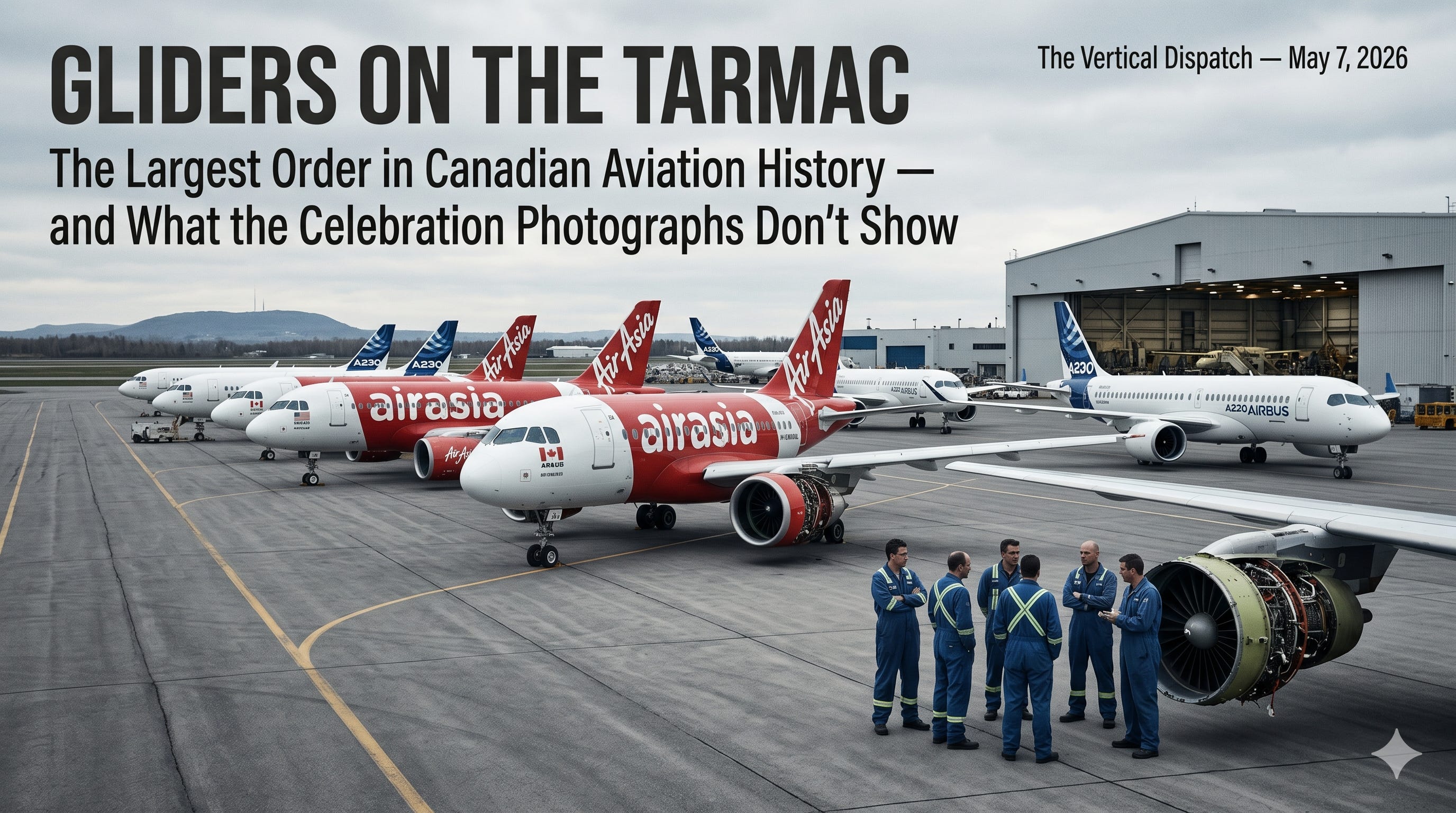
The PW1500G is suffering from a dual crisis that has become the load-bearing problem of the entire A220 program. First, durability: the engine has experienced premature wear, cracking, and powder-metal defects that have grounded nearly a quarter of the global A220 fleet, pulling aircraft out of service for maintenance years earlier than the maintenance schedules anticipated. Second, supply: Pratt & Whitney is not delivering enough new engines to meet Airbus’s production targets. The result is a phenomenon that sounds like industrial fiction but is documented fact — finished aircraft, fully assembled, sitting on the Mirabel tarmac without powerplants. Gliders. Complete in every respect except the component that makes them aircraft rather than very expensive aluminum sculptures.
Airbus has responded to this situation by threatening to sue its own engine supplier. That is the state of the relationship between the two companies on which the A220 program depends.
The second bottleneck is the wings, manufactured by Spirit AeroSystems in Belfast, Northern Ireland. Production inconsistencies at the Belfast plant have forced Airbus to airlift wing components to Mirabel to prevent the assembly line from stopping entirely. Airbus’s response has been to move toward vertical integration — acquiring the Belfast facility directly to bring wing production under its own control. That acquisition is in process but not complete.
The result is an assembly line in Mirabel staffed by skilled workers who are ready, willing, and equipped to build aircraft at twice the current rate — and cannot, because the engines and wings they need are not arriving on the schedule the production plan requires.
V. THE ABSURDITY THAT DEFINES THE MOMENT
No detail in this story captures the current state of the global aviation industry more precisely than this one, and it deserves to be stated plainly.
It is currently more profitable to destroy a five-year-old A220 than to operate it.
A serviceable PW1500G engine, pulled from a working aircraft, is worth up to $8 million on the current market. The landing gear from the same aircraft is valued between $5 and $8 million. Because new engines are effectively unavailable and existing engines are being pulled from service early for maintenance, the parts from a young aircraft are worth more than the aircraft itself as an operating asset.
The consequence: a fleet of five-year-old A220s formerly operated by EgyptAir was sold to a leasing company and then dismantled for parts — in Mirabel, Quebec, in the same facility where they were built. The engines and landing gear were sold immediately to keep active A220s flying for other carriers. Aircraft assembled in Mirabel, returned to Mirabel to be taken apart.
This is not a failure of the A220 as a machine. It is a perfect diagnostic of what happens when an entire global industry is held hostage by a single supply chain bottleneck. The plane is excellent. The engine maker cannot deliver. And so the market does what markets do when scarcity and demand collide: it finds the most efficient path to the scarce resource, even when that path runs directly through the destruction of the asset the resource once powered.
VI. THE INDUSTRY BEHIND THE INDUSTRY
The A220’s predicament is not unique. It is the sharpest expression of a structural crisis that has consumed the entire commercial aviation duopoly.
Boeing remains under a Federal Aviation Administration production cap limiting its 737 MAX output to 38 aircraft per month — a regulatory constraint imposed after the quality control failures that grounded the MAX globally. Its commercial aircraft division reported a significant loss in early 2026. Airbus, for all its relative stability, is not meeting its delivery commitments across its product line. The combined order backlog for the two companies — the only manufacturers of large commercial jets, controlling approximately 95 percent of the global market — now stretches beyond a decade.
The only commercial aircraft manufacturer consistently reporting profits is Bombardier. Which, as noted above, no longer builds commercial aircraft.
The root cause across every program is identical: the engine. The A220’s PW1500G, the A320neo’s Pratt & Whitney GTF, and the Boeing 737 MAX’s CFM LEAP-1B are all experiencing production backlogs and durability issues simultaneously. The entire global commercial aviation industry — a market worth hundreds of billions of dollars annually — is being throttled by the manufacturing capacity of a handful of engine suppliers who cannot scale fast enough to meet the demand their customers have already committed to.
And in this constraint lies the final paradox. Airbus and Boeing are largely losing money or barely breaking even on building the aircraft their customers want. The airlines and leasing companies buying those aircraft — the AirAsias, the Deltas, the lessors holding delivery slots as financial assets — are often extremely profitable, precisely because the manufacturers’ failures have created a scarcity of seats. Fewer new planes means existing planes are more valuable, ticket prices are higher, and the carriers who secured delivery slots years ago now hold assets that can be sold at a premium before a single passenger boards.
Tony Fernandes understood this perfectly when he said he bought because no one else was buying. The contrarian bet in a market paralyzed by anxiety is the move of someone who reads the board further out than the current news cycle. In that sense — and this is not accidental — he and the Prime Minister who stood beside him at the podium are reading from the same strategic text.
VII. WHAT CARNEY KNOWS — AND WHAT THE DEAL ACTUALLY IS
A Stratum VIII Prime Minister standing at a podium in Mirabel on May 6, 2026, knows everything in this dispatch. He has read the industrial intelligence. He has been briefed on the engine crisis, the Quebec write-down, the profitability gap, the gliders on the tarmac. His officials know that Chevasson will tell reporters the program is not yet profitable. This is not information being concealed from the podium. It is information that the podium absorbs without blinking.
Because the deal, read at the thirty-year horizon, is not about Q1 2028 delivery slots. It is about four things simultaneously.
First: 5,000 Mirabel workers with a decade of backlog. The human infrastructure of sovereign industrial capacity — engineers, welders, electricians, technicians — maintained and expanded at the moment when every other force in the global economy is pushing toward consolidation and retreat. You cannot rebuild that workforce in three years if you let it dissolve. You hold it through the difficult years because the capacity it represents is worth more than the quarterly losses it currently generates.
Second: trade architecture. A Malaysian airline buying Canadian-assembled aircraft is a stone placed on the Southeast Asian board at the precise moment Canada is constructing the variable geometry coalition documented across this publication’s EPC trilogy. The AirAsia deal is not a commercial transaction in isolation. It is a relationship — with Fernandes, with Malaysia, with the broader Southeast Asian market — established at a moment when Canada is actively positioning itself as the transatlantic and Pacific voice of the post-American multilateral order.
Third: the sovereign bet on profitability. The A220 program will reach break-even when Pratt & Whitney resolves its engine production crisis and Airbus integrates the Belfast wing facility. Both of those conditions are in motion. The AirAsia order — 150 aircraft, first delivery 2028, with an option for 150 more — provides the production certainty that justifies the capital investment required to accelerate that resolution. You cannot ask a supplier to scale without showing them the demand that justifies scaling. Mirabel just showed Pratt & Whitney 150 more reasons to solve its problem faster.
Fourth: the demonstration. Carney’s presence at Mirabel is the same function as his presence in Yerevan — the visible surface of a positioning exercise whose real significance operates below the frame that the daily press can capture. Canada building the world’s finest aircraft in its own facilities, selling them to Southeast Asia, growing the workforce that produces them, and doing all of this while the largest economy on earth retreats from precisely the kind of open, connective, trade-building engagement the deal represents — that is not a press release. It is a civilizational argument made in aluminum and jet fuel.
John Gradek is right that the jury is still out on profitability. He is measuring the right variable on a time horizon that is too short to read the verdict. The verdict on sovereign industrial strategy is not available in a quarterly earnings report. It is available in a decade of production data, workforce development, and trade relationship compounding that begins the day Fernandes signed the purchase agreement.
The program is a few miles from profitability. The Prime Minister knows the distance. He is not worried about it. He is building the road.
Glen Roberts publishes The Vertical Dispatch on Substack. He is the author of Sacred Metaphysics and Consciousness: History of the Absolute & Eternal, and the developer of the Universal Dynamics framework and AIG — Artificially Intelligent Governance.
#TheVerticalDispatch #TheArchitect #Airbus #A220 #AirAsia #Mirabel #MarkCarney #Quebec #SovereignIndustry #CanadianAviation #PrattWhitney #SupplyChain #StratumVIII #ElliottJaques #TradeArchitecture #VariableGeometry #CdnPoli #AerospaceCanada #Bombardier #CSeries #IndustrialStrategy #ThirtyYearHorizon #SoutheastAsia #AIG #UniversalDynamics #GlidersOnTheTarmac #TonyFernandes #QuebecAerospace #PostAmericanOrder
Uncertainty and market disruptions caused by tariffs and an unsustainable spoiler posture by the current US administration have wreaked havoc on global supply chains.
Fascinating! Thanks