


Φ
THE VERTICAL DISPATCH
We write for the mind, the eye, and the ear.
Read it. Look at it. Listen to it. The Vertical Dispatch is built for all three — prose with rhythm, made to be heard as much as read.
From metaphysics to geopolitics, from culture to history, from the sacred to the street — and everything in between. One lens, every subject. No ego. Just the record, named clean.
Press play. Walk with the Word. 🕯️
The Departure Lounge
A dispatch for the worn-out, the twice-married, the still-curious, and the terminally human.
“Nothing can be changed until it is faced.”
— James Baldwin
This dispatch travels by hand. If it serves you, share it — restack on Substack, pass it on wherever you read. 🕯️
Last night I almost didn’t press play.
The film was The Order — Jude Law as the FBI man, the Pacific Northwest in 1983, a band of young men who decided their grievance deserved a country of its own and started robbing banks to buy one. I hovered over the button the way you hover over a hot stove you have touched before, because I knew what was coming. I had been in that room. Mississippi Burning put me in it almost forty years ago, and some films do not show you things so much as hand you a weight and watch to see if you can still carry it. I pressed play. I carried it. And I slept badly, which is the correct response, and the one the algorithm will never optimize for.
Then this morning I took the dog out and the walk ran long, the way the good ones do, and it carried me through the Cumberland Village Heritage Museum — the old buildings standing in the early heat, the kind of shimmer that comes up off a wooden porch in June. And there she was. Scout. Standing in the heat of a southern summer that never happened anywhere near the Ottawa River, in overalls, squinting at things adults had stopped being able to see. To Kill a Mockingbird does that: it stations a child inside you, permanently, and the child reports for duty whenever the air is right.
So the lounge gets this dispatch today, and it is the one I have been circling for some time, because it is the one about hate and love. And I cannot write it honestly — the keel will not allow it — unless I begin with the part where the hate was mine.
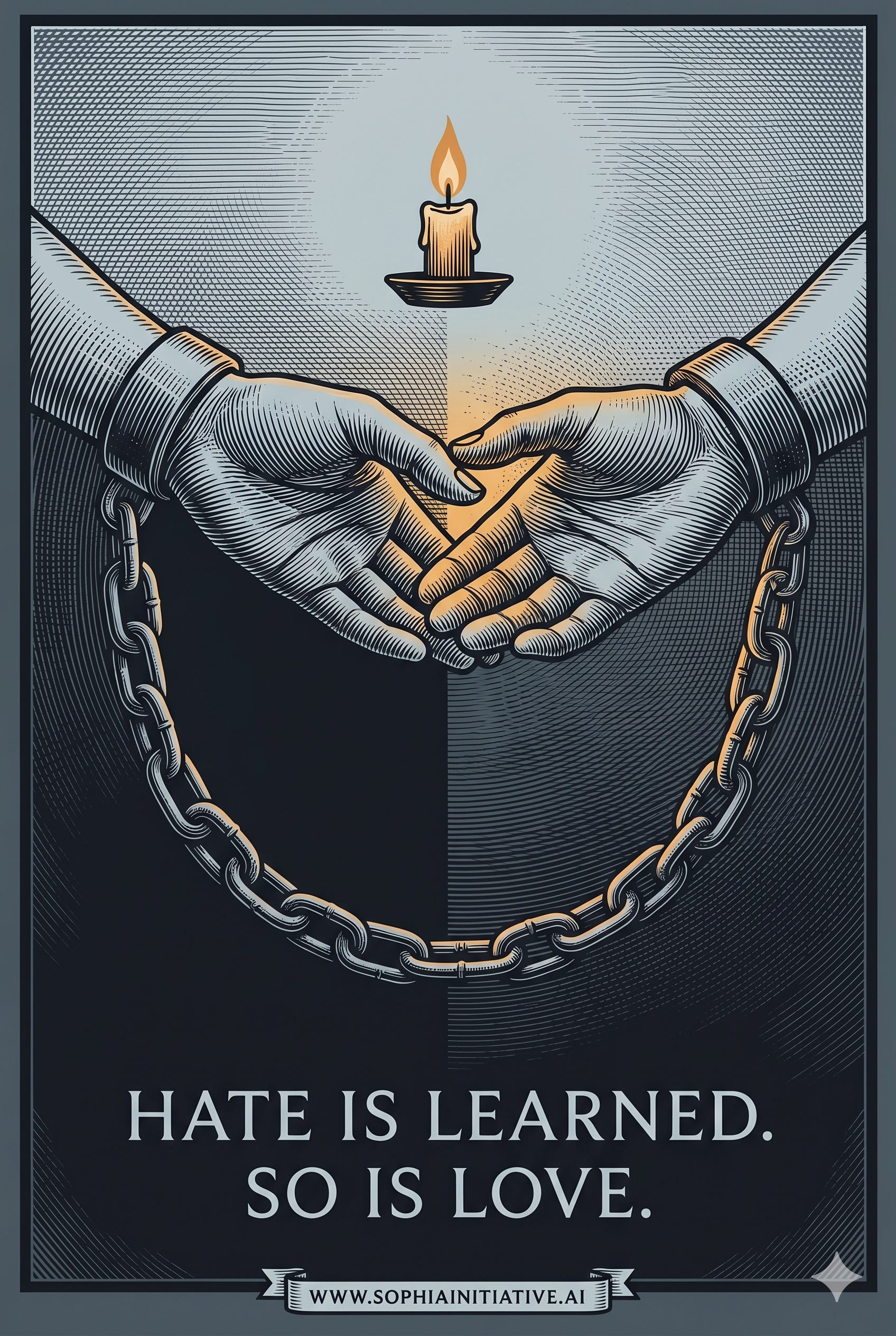
The Word
Grade three, maybe grade four. The Protestant School Board of Greater Montreal, which without meaning to was running one of the early experiments in what we now call multiculturalism — a handful of WASP kids like me dropped into classrooms full of Jewish kids and Black kids, nobody calling it a program, nobody writing a grant proposal, just the city being the city. In that classroom was a boy named Freddy. He was my friend. And he was an athlete the way some kids just are — the kind of effortless, lit-from-inside physical grace that the rest of us watched from the middle of the pack with our shirts untucked.
I could not compete with him. And one day, small and stung about it in the way only a small boy can be stung, I reached for a weapon. The culture had left one lying around, the way it always does, pre-loaded and within arm’s reach of a child. I threw a word at my friend. Sixty years on, the memory will not certify which word it was — the animal one, or the other one, the one I will not put on this page. It may have been either. It came back to me on the walk this morning, surfacing the way the buried things do, and I am not going to argue with it or dress it up.
Here is what I notice now, from the lounge, that I could not have noticed then. The hate was not the engine. The envy was. A boy who felt small reached for the nearest thing that would make another boy smaller, and the culture — the same culture that gave me Mockingbird, the same one that would later give me Sidney — had thoughtfully supplied a word with somebody’s skin already loaded into it. I supplied the smallness. The culture supplied the ammunition. Both of those things are true, and neither one excuses the other, and a man who tells you only one half of that is selling something.
I will not stand here and certify my own record clean. That is not how the facing works. Baldwin’s discipline is that you turn and look, and then you let what you saw stand there without a lawyer. What I can tell you is what happened next.
The Teacher
She caught it. The teacher — and I am ashamed that the word came back before her name did, which tells you something true about memory and debt — heard what I said, and she did the thing that nobody budgets for and no metric will ever capture. She did not destroy me. She did not look away. She called the moment what it was, in front of me, and then she did something stranger: she credited me with the lesson. She treated a small boy’s ugliness as a thing he could be walked back from, because she believed there was a boy worth walking back. Correction, delivered with belief in the kid. Two minutes of a working day in a Montreal classroom, sometime around 1965.
I have written in this series about the Third Room — the distributed infrastructure of belonging that we let close, room by room, while we were busy buying things. Let me add this to the inventory of what those rooms were doing. They were staffed. There were adults stationed in them — teachers, coaches, the barber, the woman who ran the canteen — who caught these moments before they hardened into character. Nobody called it moral infrastructure. It was just Mrs. Somebody, doing her job, on a Tuesday. No algorithm will ever do for a child what she did for me, because the algorithm’s business model is to give the boy more of what he already feels.
The Rooms
And the rooms kept working on me, because that is what rooms do.
My best friend in grade school — not one of several, not a composite, the best friend, the one whose house you walk to without phoning first — was Ronnie, who was Black. My best friend at Montreal High was Stanley, who was Jewish. I am not entering these men into evidence; they were not exhibits, they were my friends, and the friendship was the ordinary kind, made of comic books and arguments and the long unsupervised afternoons that childhood used to consist of. But notice the architecture underneath the ordinary. The same culture that had left the word lying around for me also kept putting me in rooms with the very kids the word was built against — the schoolyard, the classroom, the street between our houses — and the rooms did their slow, unglamorous, load-bearing work. Proximity won. It usually does, when it is allowed to happen.
That is the keel line of this whole series, walking around in one small boy: culture is not your friend, and culture was the only friend I had. It handed me the slur, and it handed me Ronnie. It built the wall, and it built the schoolyard where the wall came down. Both true at once. The adult reckoning is to hold both halves without dropping either.
And I have lived long enough to watch the words themselves keep changing under us — coloured, Negro, Black — each one retired in my own lifetime, each retirement an honest attempt to get the language to stop carrying what the old word carried. The vocabulary kept moving. The thing the vocabulary was circling — the us and the them — has been slower to move. The Order, last night, was there to remind me how much slower.
Vienna
Now the part of this I did not earn, the inheritance that arrived without a receipt.
My mother was in Vienna during the Second World War. She saw, at the source, at street level, what hate builds when it is permitted to compound — what the us-and-them looks like once it has a uniform, a filing system, and the full cooperation of the neighbours. She did not lecture me about it. That was not her way. What she gave me instead was an absence: the hate simply was not passed down. It stopped with her. No sermon, no curriculum — just a household where the thing was not in the air, demonstrated daily by a woman who had breathed the real thing and declined to exhale it onto her children. Some inheritances are objects, and I have written about those — the teacup, the records, the weight we carry off the carousel. And some inheritances are the things that were deliberately not handed to you. She broke a chain quietly, and quiet chain-breaking is, I have come to believe, most of how the world actually improves.
Roger Waters — and I learned only lately that he lifted his best images, by his own cheerful admission, from Tang dynasty poets by way of a Penguin paperback — gave my generation a picture I have carried for sixty years: love as the shadow in which the wine does its ripening. Twelve centuries from a Chinese poet to an English bass player to a Montreal kid’s record player, and the image still holds, because it is true. Love is not the bright thing in that picture. Love is the dark, patient, sheltering thing — the cellar, not the chandelier — and what ripened in my mother’s shadow was me.
The Counter-Curriculum
Because here is the other half of the ledger, and the lounge insists on full ledgers. The same culture that armed a jealous eight-year-old spent my entire boyhood running a counter-curriculum at me, and the dean of the faculty was Sidney Poitier.
Look at what the screen was actually doing while we sat in the dark. The Defiant Ones, 1958, black and white: two convicts — Sidney and Tony Curtis — chained wrist to wrist, who hate each other until the chain teaches them otherwise. It is the Third Room thesis rendered in literal iron: you cannot run from a man you are shackled to, and given enough miles, you stop wanting to. Lilies of the Field, 1963: Homer Smith, an itinerant handyman who stops for radiator water and gets out-stubborned into building a chapel for a band of German-speaking refugee nuns. The Mother Superior who out-stubborns him was played by Lilia Skala — and here is a detail I did not know until this week, the kind the record hands you as a gift: Skala was Viennese. Fled the Nazis in 1939, after bribing the guards of a Viennese prison with the family valuables to get her Jewish husband out. My mother’s Vienna was standing right there in the frame, in a wimple, in the Arizona desert, the whole time. For that film Sidney became the first Black man ever to win the Academy Award for Best Actor. The word the picture ends on — and I am giving nothing away — is amen.
Then 1967 — and hold on to your boarding pass, because he made three that year. Three. The first was To Sir, with Love, and it is the one that closes a loop this piece opened back in that Montreal classroom: Sidney in the teacher’s chair. Mark Thackeray, facing down a roomful of white working-class kids in London’s East End — in swinging London, mind you, the very capital of the Beatles’ empire — and doing for them precisely what Mrs. Somebody did for me: correction, delivered with belief in the kid. And the story was true. E. R. Braithwaite, who wrote the book the film came from, was an engineer from British Guiana who could not get an engineering job in postwar London because of his skin, so he took the teaching post instead — the door slammed in his face became the door he held open for a generation of other people’s children. The kids in the era of the Beatles understood exactly what they were being given: Lulu’s title song — a Scottish teenager singing her thanks to a Black teacher — sat at number one in America for five weeks and finished as the best-selling single of the entire year. In Sgt. Pepper’s own year. That was the transaction of a generation, and the generation, for once, paid up.
The second was In the Heat of the Night — Virgil Tibbs in a Mississippi town that did not want him, and the moment in the greenhouse when the slap comes back across the old man’s face, and every theatre in North America held its breath, because the screen had never permitted that before. And the third was Guess Who’s Coming to Dinner, the gentlest of the whole curriculum — no chain, no slap, just a dinner table, which is to say a room, where two families have to sit down and look at one another until the looking becomes seeing. Spencer Tracy filmed his closing speech about love while he was dying, a few minutes a day, Katharine Hepburn weeping in the frame for real because she knew — and seventeen days after his last scene, he was gone. The studio had filmed a man’s actual farewell and released it as fiction.
And one more thing about that film, which I did not arrange and could not have. It finished shooting just before the Supreme Court of the United States struck down the laws against interracial marriage — Loving v. Virginia, decided June 12, 1967. I am writing this dispatch on June 12, 2026. Fifty-nine years to the day. The lounge does not believe in coincidence so much as it believes in paying attention.
The Gift Nobody Owed Us
So what was Sidney doing, all those years, picture after picture, with that patience that some critics in his own era held against him? Here is where I want to set the thing down carefully, because it is the heaviest item in the piece and it deserves two hands.
It would be easy — and wrong — to say his role was to teach white people the error of us and them. Easy, because that is in fact what happened in a million dark theatres, mine included. Wrong, because it quietly hands the wronged party the job of educating the people who wronged them, and that is a burden, not a role. Nobody owed white America the patience of Virgil Tibbs or the grace of Homer Smith. Nobody owes the people who built the wall a guided tour of it.
What those men gave was a gift. Grace, freely extended, at a cost the audience never had to pay. The dignity, the restraint, the willingness to stand in the room and be seen — that was not a debt being serviced. It was generosity on a scale I did not understand until I was old enough to know what it costs to keep your composure in a room that has already decided what you are. And what the gift opened, in the boy in the seat, was the chance — only the chance — to recognize the error. The recognition was our work to do. They gave us the light to do it by.
And recognition is where everything begins, because the order of operations here is fixed and no one has ever managed to run it backwards: recognition, then forgiveness, then healing. You cannot be forgiven for a thing you will not admit you did. There is no healing without forgiveness, and no forgiveness without the facing — Baldwin again, always Baldwin, standing at the door of this series checking the tickets. A debt collected heals nothing; the books just balance and the cold remains. But a gift received — forgiveness that was never owed, extended anyway — that can heal almost anything. That is precisely what makes it sacred, and I do not use the word loosely.
I know a little about the chair this work is done from. It is the same chair in every tradition — the priest hears the thing confessed, the rabbi sits with the mourner, the physician receives the symptom no one else has been told. I have sat my own version of it, the long nights in hospital rooms, and I can report from the chair that the one sitting in it is doing the heaviest work in the room: receiving what is faced, without flinching, so that the facing can finally happen. Sidney sat that chair for an entire civilization, in seat after seat, for forty years, and called it acting.
So this is what I owe — what one white-haired WASP from the Protestant School Board owes, stated plainly at the gate. I owe Freddy an apology that is sixty years late and has no address to be sent to, so I am leaving it here, on the record, where late apologies go. I owe a teacher whose name I have lost a debt I can only pay forward. I owe Ronnie and Stanley the testimony that the rooms worked, that proximity wins when it is allowed to happen, and that the friendship was the whole curriculum. I owe my mother the acknowledgment that her quiet was a teaching. And I owe the men on the screen — Sidney first among them — the correct name for what they did. It was not a debt they were paying. It was a gift they were giving. The only honest response to a gift of that size is the one Homer Smith taught a desert full of nuns, the one I will close on, the one the whole piece has been walking toward.
Amen.
God is Love. Love is Truth. Truth is Consciousness. Consciousness is Brahman.
Amen. Namaste. Om Namah Shivaya.
Still curious, still at the window, still glad you sat down. Go find your room and your people. The gate opens when it opens — I’ll see you out there. 🕯️
— The Architect
The Vertical Dispatch
sophiainitiative.ai
On the record. The Order (2024, dir. Justin Kurzel; Jude Law, Nicholas Hoult) dramatizes the real white-supremacist group of the same name, active in the U.S. Pacific Northwest in 1983–84. Mississippi Burning is the 1988 Alan Parker film. To Kill a Mockingbird: Harper Lee’s novel (1960), filmed in 1962. The Defiant Ones (1958, dir. Stanley Kramer) paired Sidney Poitier and Tony Curtis. Lilies of the Field (1963, dir. Ralph Nelson): Poitier won the Academy Award for Best Actor (presented April 1964), the first Black man to do so; Lilia Skala (Oscar-nominated as Mother Maria) was born in Vienna in 1896 and fled Nazi-occupied Austria in 1939 after securing her Jewish husband’s release from a Viennese detention centre. In the Heat of the Night (1967, dir. Norman Jewison). To Sir, with Love (1967, dir. James Clavell), from E. R. Braithwaite’s autobiographical 1959 novel; Braithwaite, born in British Guiana, took the East End teaching post after being refused engineering work in postwar Britain; Lulu’s title song held No. 1 on the Billboard Hot 100 for five weeks and was the best-selling single in the U.S. for 1967. Guess Who’s Coming to Dinner (1967, dir. Stanley Kramer) was Spencer Tracy’s final film; he died seventeen days after completing his scenes, and filming concluded shortly before the U.S. Supreme Court struck down anti-miscegenation laws in Loving v. Virginia, decided June 12, 1967. The image of love as the shadow that ripens the wine is from Roger Waters’ lyric for Pink Floyd’s “Set the Controls for the Heart of the Sun” (1968), whose lines Waters acknowledged adapting from Tang dynasty poetry in A. C. Graham’s Poems of the Late T’ang (Penguin, 1965); it is referenced here in paraphrase. “Nothing can be changed until it is faced” condenses James Baldwin’s sentence from “As Much Truth As One Can Bear” (1962). The personal account — the classroom, the friends, the teacher, the author’s mother — is the author’s own memory, told from love; first names only, and the memory of events sixty years past governs the record. Date-stamped June 12, 2026.
Suggested tags:
Memoir, Race, Forgiveness, Sidney Poitier, James Baldwin, To Kill a Mockingbird, Cinema, Boomers, Montreal, The Departure Lounge
Substack Notes
THE CONFESSION:
Grade three, Montreal. I threw an ugly word at a boy named Freddy — my friend, and a better athlete than I would ever be. Sixty years on, the memory won’t certify which word it was, and I’ve stopped arguing with it. Here is what I’ve learned since: the hate wasn’t the engine. The envy was. A small boy reached for the nearest weapon, and the culture had left one lying around, pre-loaded with somebody’s skin. I supplied the smallness; the culture supplied the ammunition. Neither excuses the other. New from The Departure Lounge: the piece about hate and love, and the teacher who caught the word in mid-air. 🕯️
THE COUNTER-CURRICULUM:
The same culture that arms a jealous eight-year-old also spent my whole boyhood running a counter-curriculum, and the dean of the faculty was Sidney Poitier. The chain in The Defiant Ones. The chapel in Lilies of the Field — where the Mother Superior was played by a Viennese refugee from the Nazis, my mother’s Vienna standing right there in the frame. Then 1967: three pictures in one year. The teacher’s chair in To Sir, with Love — and in the Beatles’ own annus mirabilis, the best-selling single in America was a Scottish teenager singing her thanks to a Black teacher. The slap returned in In the Heat of the Night. Spencer Tracy’s dying speech about love. Culture is not your friend — it handed me the slur and it handed me Sidney. Both true at once. New from The Departure Lounge. 🕯️
THE GIFT:
It would be easy to say Sidney Poitier’s role was to teach white audiences the error of us and them. Easy, and wrong — it hands the wronged the job of educating those who wronged them. What those men gave was a gift, not a debt: grace freely extended, at a cost the audience never had to pay. What the gift opened was the chance to recognize the error — and recognition comes first, always. Recognition, then forgiveness, then healing. No one has ever run that sequence backwards. New from The Departure Lounge, written on the anniversary of Loving v. Virginia. 🕯️
#HateIsLearnedSoIsLove #TheDepartureLounge #SidneyPoitier #JamesBaldwin #ToKillAMockingbird #InTheHeatOfTheNight #ToSirWithLove #LiliesOfTheField #GuessWhosComingToDinner #TheDefiantOnes #LovingVVirginia #Forgiveness #Memoir #Montreal #TheVerticalDispatch #TheArchitect #SophiaInitiative #GodIsLove #LoveIsTruth #OmNamahShivaya
Written from love, for a sacred humanity, in the full light of consciousness, toward the greater good. 🕯️
Thank you so much - so tangible a lesson learnt over a lifetime- if only we would listen - my daughter has just completed her first year of university learning to be a teacher - one more to go - I think your essay is the best thing I can send her to point the way - you are paying it forward and there are no real words for that - I see, I hear you and I am very grateful 🙏
Beautiful.