

A NOTE ON METHOD
This publication has spent considerable space analyzing what Stratum VIII leadership looks like in practice — the long arc, the thirty-year horizon, the capacity to hold multiple interlocking variables without collapsing them into simplicity. Intellectual honesty requires applying the same analytical framework to its opposite. What does Stratum II decision-making look like when applied to problems that require Stratum VI solutions? What does the empirical record of promises versus outcomes reveal about the cognitive level at which an administration is actually operating?
This piece does not argue that Donald Trump is a bad person. It does not engage in personal attack. It does something more demanding and more useful: it assembles the factual record, applies the analytical framework this publication uses consistently, and lets the evidence speak at the register it deserves.
The framework is Elliott Jaques’s Stratified Systems Theory. The instrument is the PIAAC literacy scale. The evidence is entirely documentary. The conclusions belong to the reader.
I. THE CHECKERS DIAGNOSIS
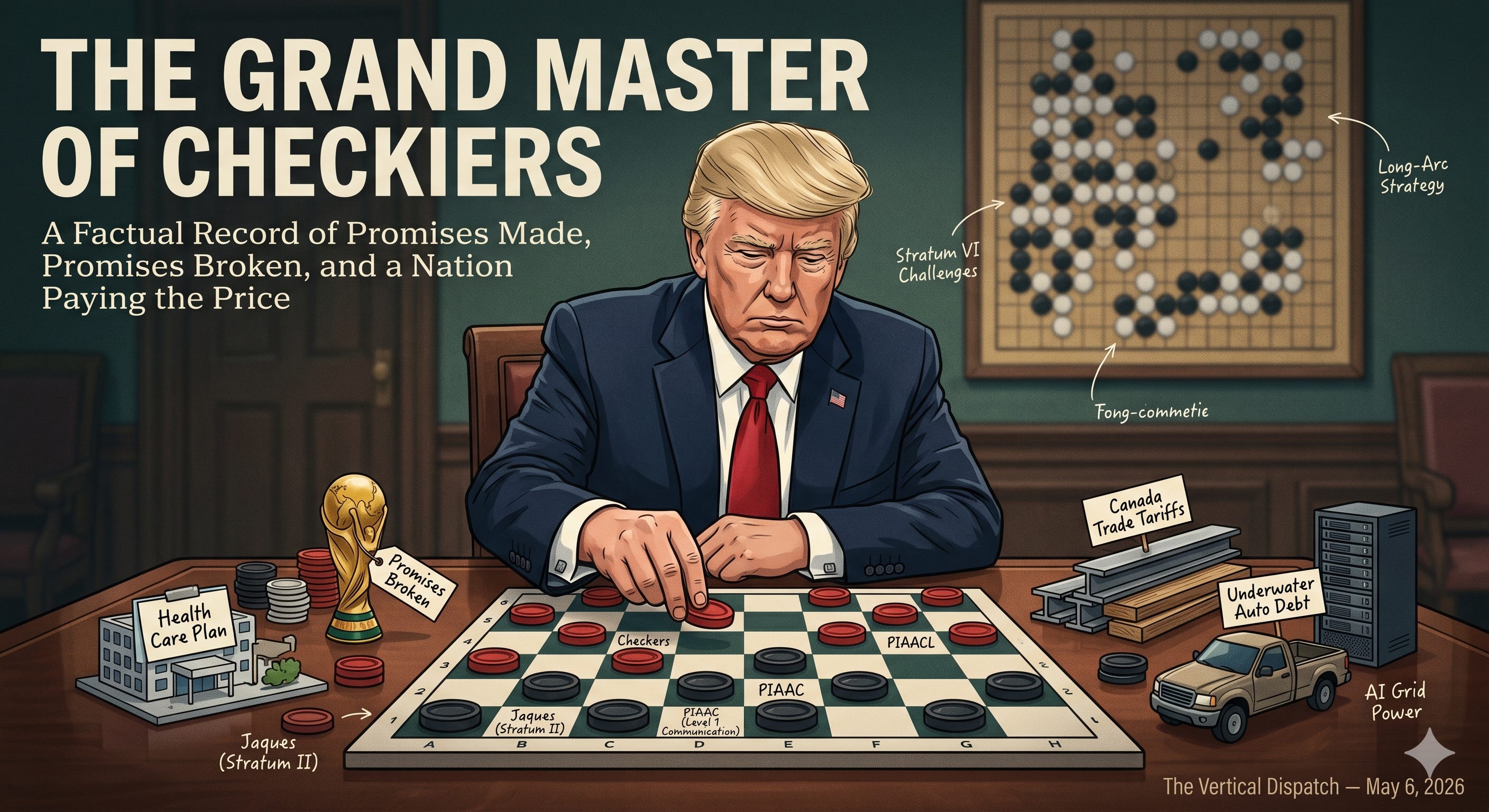
This publication has previously observed that Trump plays checkers — reactive, piece-by-piece, zero-sum, each move legible, each outcome transactional. That framing requires precision. Checkers is not a trivial game. A master checkers player understands the board, anticipates sequences, and executes with discipline.
What the record shows is something more specific: a player who announces checkers moves before making them, then does not make them, then announces them again, then makes a different and contradictory move, then declares victory. This is not checkers played at a high level. This is checkers played at the level of the announcement rather than the execution — where the promise of the move substitutes for the move itself, and where the audience’s attention span determines whether the substitution is noticed.
Jaques would identify this as Stratum II cognitive operation: the time horizon measured in days to weeks, the planning horizon collapsing at the first point of complexity, the substitution of declared intent for actual execution. The PIAAC literacy framework adds a complementary lens: a Level 1 communicator operates on assertion rather than evidence, on repetition rather than argument, on the confidence of the statement rather than the accuracy of its content.
What follows is the factual record across five domains. Not opinion. Record.
II. HEALTHCARE — THE PROMISE THAT NEVER ARRIVED AND THE CUT THAT DID
The promise, documented:
June 2019, in an exclusive ABC News interview with George Stephanopoulos at the White House: “We’re going to produce phenomenal health care. And we already have the concept of the plan. And it’ll be much better health care.” When Stephanopoulos asked when Americans would hear the plan, Trump replied: “Yeah, we’ll be announcing that in about two months. Maybe less. You’re going to have the greatest health care that anybody’s ever had.”
Two months from June 2019 was August 2019. No plan arrived.
July 2020, Fox News Sunday with Chris Wallace: “We’re signing a health care plan within two weeks, a full and complete health care plan.”
Two weeks passed. No plan arrived.
August 3, 2020, White House press briefing: A health care plan would be introduced “hopefully, prior to the end of the month.”
The month ended. No plan arrived.
The pattern begins, on documented record, in 2015. Trump left office on January 20, 2021, after four years as president of the United States, having never produced a health care plan. Not a draft. Not a framework. Not a legislative proposal. The White House healthcare page offered only this: “Replacing Obamacare will force insurance companies to compete for their customers with lower costs and higher-quality service.” That sentence was the plan.
The outcome, documented:
In his second term, Trump stopped promising to replace Obamacare and signed legislation that cut it instead. The Trump Administration’s 2025 budget law cut federal health spending by more than $1 trillion, including major cuts to Medicaid, the Children’s Health Insurance Program, and ACA marketplaces — the largest cut to healthcare in American history. The Congressional Budget Office projects nearly 12 million people will lose Medicaid coverage under the bill’s work requirements.
Trump signed this legislation after repeatedly and explicitly promising never to cut Medicare or Medicaid.
And then, by the automatic operation of the Statutory Pay-As-You-Go Act triggered by the law’s deficit expansion, the bill imposed a $45 billion cut to Medicare in 2026 and $536 billion in automatic Medicare cuts over nine years — programs Trump promised specifically and repeatedly to protect.
On May 1, 2026, at a rally in The Villages, Florida — the largest retirement community in America, filled with the seniors most dependent on Medicare and Medicaid — Trump told the crowd what he had told Dr. Oz on the plane ride down: discussing Medicaid and Medicare was “the most boring trip I’ve ever made.” He said he told Oz: “I don’t care. You work out the details.”
He said this to the people whose details were being worked out without him.
The Jaques diagnostic: a Stratum II operator cannot hold the complexity of a healthcare architecture in his planning horizon. He can announce it. He cannot execute it. When execution arrives, it arrives as something other than what was announced — and the announcement is what is remembered, not the outcome.
III. THE WORLD CUP — A SELF-INFLICTED WOUND
The 2026 FIFA World Cup was projected to generate up to $30 billion in economic activity for the United States, Canada, and Mexico. It was, on paper, one of the most significant tourism events in American history — the World Cup final scheduled at MetLife Stadium in New Jersey, sixteen host cities across the country, the eyes of the world on American hospitality and infrastructure.
The current reality: nearly 80 percent of hotels in US host cities are reporting reservations well under projected levels, despite more than 5 million match tickets sold. About 65 percent of respondent hotels cited tightened visa issuance and geopolitical instability as the primary causes. The fans who bought tickets are not booking hotels. International supporters from England, Germany, Brazil — the middle-income travelers who form the backbone of tournament spending — are choosing not to come.
Canadian travelers, traditionally among the largest inbound tourism segments to the United States, have pulled back sharply. European fans are redirecting. The $30 billion projection is being revised downward in real time, with hotel operators across Kansas City, Boston, San Francisco, and New York reporting unexpected surpluses of empty rooms during what should be peak summer season.
This is not a force of nature. It is a policy outcome. The visa environment, the geopolitical posture, the tariff-driven economic tensions, and the broader sentiment toward the United States as a destination — all of these are the direct product of decisions made by the administration that will host the tournament. The World Cup was awarded to the United States in part as a statement of American soft power and global connectedness. The administration has spent three years systematically dismantling the soft power and global connectedness on which the tournament’s commercial success depended.
The checkers player announced the win — the hosting rights, the economic windfall, the global prestige — and then made the moves that prevent the win from arriving.
IV. THE CANADA DELUSION — STEEL, ALUMINUM, LUMBER, AND TIME
The claim that the United States does not need Canada is among the most empirically testable propositions in the current trade debate. The test has been running for over a year. The results are in.
Canadian aluminum producers face a 50 percent tariff on sales to the United States — their primary export market. By July 2025, aluminum exports from Canada to the US were 50 percent below 2024 levels. Canadian steel exports have fallen by half. Lumber exports were roughly 20 percent below 2024 averages by February 2026.
What these numbers mean for the United States is not complicated. Canada is the largest foreign supplier of aluminum, steel, softwood lumber, crude oil, natural gas, and auto parts to the American economy. These are not luxury imports. They are the structural inputs of American industrial production — the materials from which houses are built, cars are assembled, pipelines are welded, and military equipment is manufactured. A 100-percent tariff on all Canadian imports, as threatened in January 2026, was estimated by analysts to raise US inflation by 1.5 to 2 percent almost immediately, with energy and auto prices rising sharply.
The deeper problem is the one that the checkers frame illuminates precisely: the claim that domestic production can substitute for Canadian supply assumes that domestic capacity can be built on the timescale of a political announcement. It cannot. Rebuilding aluminum smelting capacity, steel production infrastructure, and forestry supply chains requires a decade-long commitment of capital, workforce training, regulatory permitting, and institutional patience. None of these operate on a two-week timeline. None of them respond to a tariff announcement. They respond to sustained, long-arc investment that a Stratum II planning horizon cannot hold.
The checkers player announced the winning position — American industrial independence — and made the move that begins the game before the board exists. The board will not exist for a decade. The economy pays the gap.
V. THE AUTO DEBT SPIRAL — WHAT “MAKE AMERICA AFFORDABLE AGAIN” PRODUCED
Trump ran in 2024 on a platform that included making America affordable again. The auto market is one of the clearest empirical tests of that promise, because auto debt is measurable, documented, and reported quarterly.
In the first quarter of 2026, 30.9 percent of new car trade-ins carried negative equity — the highest share on record since the pandemic peak. The average amount owed on underwater trade-ins reached $7,183, up 42 percent from five years ago. Monthly payments for buyers with negative equity averaged $932 — the highest on record, and $159 above the market average.
In Q1 2026, 90.2 percent of new loans involving trade-ins with negative equity carried terms of at least 72 months, and 43 percent extended to 84 months — seven-year car loans on depreciating assets. One in four of all new car purchases now involves a six-year or longer loan. Buyers are financing an average of $55,970 when rolling negative equity forward — and paying $15,663 in interest over the life of the loan, compared with $9,592 for the broader market.
The pickup truck — the iconic emblem of American working identity, the vehicle most associated with the demographic Trump claims to represent — sits at the center of this crisis. Pandemic-era prices, tariff-driven input cost increases, and declining resale values have left hundreds of thousands of truck owners owing significantly more than their vehicles are worth. One documented case: a buyer trading in a Ford F-150 Lightning owed $87,000 on a truck worth $47,000. Repossession rates on auto loans in early 2026 reached their highest levels since 2010.
The tariffs on Canadian aluminum and steel that were meant to protect American manufacturing have increased the input costs of American auto production, raising new vehicle prices at the moment when consumer debt capacity is most stretched. The affordability promise and the tariff policy are in direct structural contradiction. A Stratum VIII mind would have modeled this before the announcement. A Stratum II mind makes both announcements and discovers the contradiction when it arrives in the data.
VI. THE AI POWER SEIZURE — AND WHO PAYS
The final vector is the least visible to daily commentary and the most consequential for the long arc: the AI data center buildout is systematically acquiring electrical grid capacity at prices that industrial users cannot match, and the costs are being distributed across residential ratepayers and small businesses who did not consent to the transfer.
Electricity demand from data centers soared 17 percent in 2025, with AI-focused facilities growing even faster. Electricity consumption from data centers is projected to double by 2030. A single hyperscale AI data center now requires 100 to 300 megawatts of continuous power — the equivalent of a small city’s entire load — and the infrastructure required to deliver it triggers grid upgrades whose costs are spread across all ratepayers in the service area.
In the PJM region covering the mid-Atlantic and Midwest, wholesale electricity capacity auction prices rose from approximately $60 per kilowatt-hour in 2024 to more than $300 per kilowatt-hour in 2025. This price environment is navigable for hyperscalers with capital budgets measured in hundreds of billions. Amazon alone spent $85.8 billion on capital expenditure in 2024. It is not navigable for aluminum smelters, steel producers, paper mills, or any other energy-intensive industrial operation competing for power on the same grid.
The administration that imposed tariffs on Canadian aluminum and steel — on the stated grounds of protecting American industrial capacity — simultaneously permitted and accelerated a regulatory and market environment in which that industrial capacity cannot compete for the power required to operate. The tariff is meant to protect the steel mill. The power market prices the steel mill out of existence. These are not separate policies. They are the same checkers board, and the player cannot see both squares at once.
The residential ratepayer pays the grid upgrade. The industrial user loses competitiveness. The hyperscaler acquires the capacity. The announcement said America First. The outcome says something more precise: hyperscaler first, and everyone else absorbs the cost.
VII. THE STRATUM VERDICT
Elliott Jaques spent decades arguing that the most consequential form of organizational dysfunction is not corruption, not incompetence in the ordinary sense, and not malice. It is stratum mismatch: a leader operating at a cognitive level insufficient for the complexity of the problems assigned to that leader. The leader is not lying when he announces the healthcare plan. He genuinely cannot perceive the gap between the announcement and the execution, because the execution requires holding a planning horizon longer than his cognitive architecture can sustain.
The PIAAC framework adds the communication dimension: a Level 1 operator asserts rather than argues, repeats rather than reasons, and measures success by the audience’s response to the announcement rather than by the outcome the announcement promised. The “two weeks” healthcare plan is not a lie in the ordinary sense. It is a Level 1 communication about a Level 5 problem — and the speaker cannot perceive the difference.
This is why the Villages speech is so analytically precise as a diagnostic. A man who finds healthcare policy boring, says so publicly, to the people most dependent on it, tells a television doctor to “work out the details,” and calls that leadership — is not being cynical. He is being exactly as engaged as his cognitive architecture permits. The complexity of Medicare and Medicaid is genuinely beyond what a Stratum II planning horizon can hold. So it becomes boring. So the details get delegated. So the plan never comes.
The healthcare record, the World Cup, the Canada delusion, the auto debt spiral, the power grid transfer — these are not five separate failures. They are five instances of the same structural phenomenon: a Stratum II operator making Stratum VI announcements, and the gap between the announcement and the execution being paid for by the people who believed the announcement.
Checkers is a legitimate game. It rewards the player who plays it well. The problem is not that Trump plays checkers. The problem is that he plays it on boards that require Go — and announces Go victories before the checkers game is over.
The record is available to anyone willing to read it. It does not require interpretation. It requires only the willingness to measure promises against outcomes across a horizon longer than the next announcement.
That is, in the end, what literacy is for.
Glen Roberts publishes The Vertical Dispatch on Substack. He is the author of Sacred Metaphysics and Consciousness: History of the Absolute & Eternal, and the developer of the Universal Dynamics framework and AIG — Artificially Intelligent Governance.
#TheVerticalDispatch #TheArchitect #Trump #HealthcarePromises #Checkers #StratumII #ElliottJaques #PIAAC #WorldCup2026 #TourismCrisis #CanadaTariffs #AluminumSteel #AutoDebt #NegativeEquity #AIGrid #PowerMarket #FactualRecord #PromisesVsOutcomes #MakeAmericaAffordable #Medicaid #Medicare #CdnPoli #Geopolitics2026 #UniversalDynamics #AIG #AnalyticalFramework #CivilizationalAnalysis
Agree that T is in over his head, and literally cannot see the disconnects. I suggest that the oligarchs who put him there are operating at up to a 2 year time horizon (Stratum 4 max.) Can see the impacts of their actions in markets and industry forces. Cannot see broader social or global impacts or “the enemy gets a vote “. Which is only compounded by personal greed.
Excellent analysis. Thanks again for your writing. It's clarifying in a murky time.