

Φ
THE VERTICAL DISPATCH
We write for the mind, the eye, and the ear.
Read it. Look at it. Listen to it. The Vertical Dispatch is built for all three — prose with rhythm, made to be heard as much as read.
From metaphysics to geopolitics, from culture to history, from the sacred to the street — and everything in between. One lens, every subject. No ego. Just the record, named clean.
Press play. Walk with the word. 🕯️
This dispatch travels by hand. If it serves you, share it — restack on Substack, and pass it on wherever you read. 🕯️
Sacred Metaphysics · The Universal Grammar of Non-Duality
The Metaphysics of Zero and the Physics of One
Coming September 1,2026
sacredmetaphysics.org
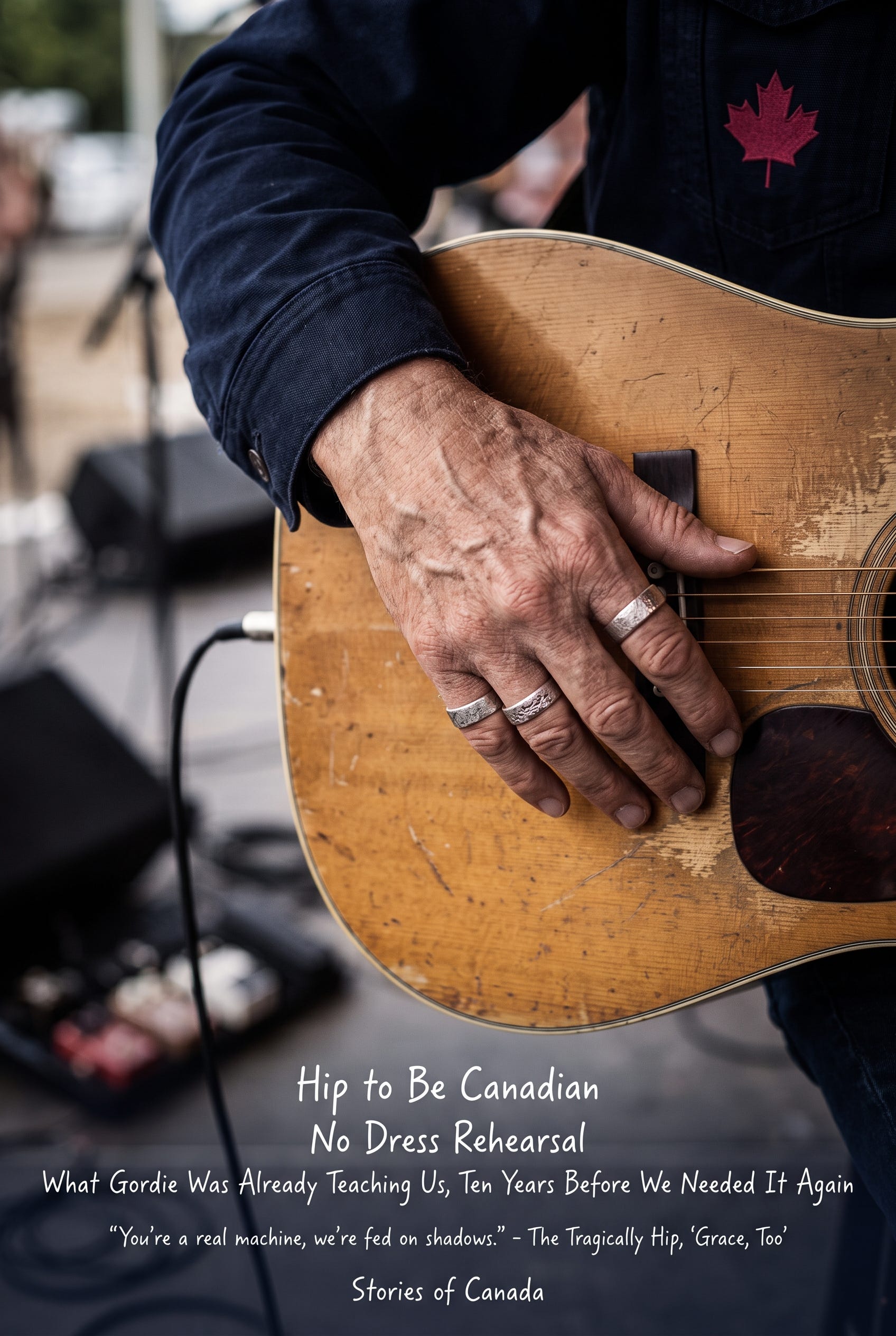
“You’re a real machine, we’re fed on shadows.”
— The Tragically Hip, “Grace, Too”
Synchronicity does not announce itself with fanfare. It arrives, instead, as a rebroadcast on a Saturday night — the CBC quietly running the tape of a concert ten years gone, while a set of trade talks in Washington finished their collapse in real time. Talks that had run, by Prime Minister Carney’s own account, in good faith for more than a year. Talks that ended not in a deal but in fifty percent tariffs on twenty billion dollars of Canadian goods, and a promise from Ottawa to match them dollar for dollar. You do not choose the week the universe hands you your metaphors. You only choose whether to notice them.
Ten years ago this weekend, a man who had been told by his doctors that he was dying stood on a stage in his hometown and played for very nearly three hours without letting up, sweat running down a face that the whole country now understood was on a clock. He did not perform grief. He performed courage — which is a different, harder discipline. Grief asks nothing of you but honesty. Courage asks you to keep standing anyway. That distinction is the whole of what this week is asking of the country.
The Machine and the Shadow
Plato would tell you the shadow is the lesser thing — the flicker on the cave wall that the unenlightened mistake for substance, when the real form waits outside, in daylight, for anyone willing to turn and climb toward it. Jung would tell you something colder and truer: the shadow is not lesser at all. It is the disowned real — the part of the self pushed into darkness precisely because it is real, and we would rather not carry it in daylight.
Downie’s line inverts Plato entirely and lands closer to Jung. The machine — the body, the diagnosis, the mechanism that fails on a fixed and knowable schedule — is the factual thing. But it is not where a person actually lives. What we are fed on, what sustains us, is the shadow-material: the songs, the room, the crowd, the unspoken thing between a man and thirty years of friends embracing onstage because there might not be another night to do it in. That is not a lesser reality. It is the only reality that ever asked anything courageous of us.
The Charge From the Stage
To understand why this piece has spoken of prime ministers at all — why a reflection on a dying singer reaches for the men who have held the helm — we have to go back to what Downie actually did on that stage, because he is the one who first tied the music to the office. He did not only point at the North in the abstract. He turned, that night, to a specific man sitting in the crowd in a Hip T-shirt — Justin Trudeau, who had come to Kingston to be there — and he charged him with the work, in front of eleven and a half million people watching live. “We’re in good hands, folks. Real good hands,” Downie said, as the cameras found the Prime Minister. “He cares about the people way up north, that we were trained our entire lives to ignore.” And then the charge itself, half praise and half command: it would take a hundred years to reckon with what had been done up there, he said, and it was really, really bad — “but we’re going to figure it out. You’re going to figure it out.” He asked the country, in the same breath, to hold the Prime Minister to that. A dying man spent some of his last hours on a public stage not raising money for his own disease, but placing the weight of reconciliation directly onto the shoulders of the one person in the room with the power to carry it, and asking a nation to make sure he did.
So when this piece weighs the record of the man who was Prime Minister then, it is not wandering from its subject. It is following the thread Downie himself tied, deliberately, as one of the last acts of his public life. He handed Justin Trudeau a charge, and handed the country a way to check whether it was kept. The honest question the years since have posed — the one Downie set in motion from that stage — is whether the man he trusted did the work he was trusted with.
It is worth saying plainly what is easy to forget under the noise of any single week: Justin Trudeau never had an ordinary premiership to compare his record against. He took office in 2015 with reconciliation as a marquee promise and roughly four clear years to build on it. Then, almost without pause, the fires arrived on top of one another and never fully left. A trade war he did not choose, when a president elected in 2016 had campaigned on tearing up NAFTA outright, and Ottawa spent years rebuilding the country’s most important economic relationship from scratch, producing CUSMA. A pandemic that Brian Mulroney — a Progressive Conservative predecessor with no partisan reason to be generous — later called the greatest challenge any prime minister has faced for Canada in a hundred and fifty-six years, and which fractured the country over what public sacrifice for a common good was even supposed to look like. A European war, and more than twenty-five billion dollars committed to Ukraine across years with no clean end in sight. And beneath all of it, the very charge Downie had laid on him — reconciliation — a genuine early instinct, a swift response to the Truth and Reconciliation Commission, real emotional investment at moments like the 2021 residential-school findings, set against structural promises that kept slipping while four fires burned at once.
None of that erases an unmet promise. But it complicates any verdict that treats the shortfall as simple hollowness. And here is the part the flat accounting always misses: the largest fire was one no rehearsal could have prepared him for. A president returned to power in Washington who treated a signed agreement as a thing to be reopened at will, and geopolitics has not been the same since. Obama, on his last visit to Parliament, had all but handed Trudeau the torch — “the world will benefit from your leadership in the years to come,” he said, and, in the line Canadians remember, “the world needs more Canada.” What the world then delivered was not a stage for progressive leadership but a decade of compounding emergency, and a neighbour who tore up the script mid-scene. Good instinct, real early follow-through, and then a decade with no dress rehearsal of its own — four fires at once, with no chance to run any of them twice. Mulroney’s own verdict, offered in 2023 without incentive to flatter a sitting Liberal, named three of those fires by name and said history would remember them, whatever the trivia of any given Parliament week produced in the meantime.
The Rehearsed Hand at the Helm
And this is the turn the synchronicity of the week is pointing at, if we will notice it. The song’s own title, the line it was built around, is the whole of the message: no dress rehearsal, this is our life. Gordie got none. Trudeau got none. And now the country stands again in uncharted water, dollar for dollar, the wave rising off the same southern shore — except this time the hand on the helm is not without rehearsal. Mark Carney has done precisely this before. He steered the Bank of Canada through the crash of 2008 and the Bank of England through the long turbulence after, a working life spent in exactly the discipline the moment now demands. The country that has twice been asked to mean it the first time, with no do-over, now has at least a steward who has read this particular wave before and knows the angle to set the boat. That is not a guarantee. It is something rarer in a rough season: a rehearsed hand, where before there was only the open water.
Hip to Be Canadian
There is a reason the phrase lands as more than wordplay. To be hip — to be with it, current, unfooled — has always meant something slightly different here than the American version of cool. American hip performs invulnerability. Canadian hip, the Downie strain of it, performs the opposite: total exposure, total visibility of the cost, and the refusal to let the cost be the last word. He used the time the machine gave him to point at things larger than himself — Chanie Wenjack, the residential schools, the long unfinished work of reconciliation — twice in one farewell set that he could easily have spent only on himself, with the sitting prime minister close enough to hear it directly. Downie’s own courage in raising it, at that cost, in that moment, is not in question. That is the model this week actually requires: not bravado about tariffs, not performative toughness aimed at Washington for its own sake, but the harder thing — standing in the room the diagnosis built for you, and using the standing itself to point at what matters more than the diagnosis.
A Most Human of Human Bands
What makes the Hip’s version of courage credible, and not merely convenient mythology, is what is absent from their thirty-three years together. The same five men from Kingston, 1984 to 2017. No lineup broken by addiction. No scandal, no tabloid wreckage, no ego war over credit — they split their songwriting royalties five ways from early on, an unusually plain act of trust for a band that successful. In a genre built on combustion, they were something rarer: a band that stayed steady in all the ways that matter, and let that steadiness carry them nine number-one albums deep. That is the second half of the Canadian message, and it may be the more important one. Courage is what Gordie showed. But the band showed the other thing a people needs in a hard season — the load carried evenly, the credit shared, the refusal to let ego break the line. A country facing a long fight needs both: the courage of the one, and the shared burden of the five.
That restraint was not the absence of a shadow. No one holds a persona together that consistently, that long, without something being carried underneath it. It is what happens to that shadow that separates discipline from denial. Downie’s did not go unspent — it broke through exactly once, publicly, during the climax of “Grace, Too,” when his familiar spoken line collapsed into a deep, full-body wail, then another, then another. Not despair. A witness in the room that night called it correctly: rage, sadness, a shriek of injustice — the sound of a man who knows he is not going to be around forever and is not ready to go. That is not superhuman restraint, and it is not a man with nothing to carry. It is the harder thing: a shadow held faithfully for thirty-three years, and spent, on purpose or not, only once it had finally earned its place. A most human of human bands, right to the end.
No Dress Rehearsal
The scream was not the last word of the night. After three encores, the band closed calmly with “Ahead by a Century,” the song built around the very line that would become the title of their own official history: no dress rehearsal, this is our life. When it ended, the five of them set down their instruments, stood arm in arm, and walked off the stage together. Scream, then song. Rage, then acceptance. That is the actual shape of the night, and it may be the shape of everything this piece has tried to hold together.
Gordie was handed one diagnosis, one farewell tour, and used every hour of it, undivided, on the things and the people that mattered most. Trudeau was handed four fires at once and a country in the middle of deciding what its own sacrifices were for, and had to metabolize all of it in real time, with no do-over available to him either. Carney has been handed the wave again — but not, this time, without having read one like it before. And the country itself is being asked, ten years after that concert, the same question the concert was always asking: not whether the diagnosis is frightening, but whether we will stand anyway, point at what matters more than our fear, and carry the load together without breaking the line. That is the Canadian message, and it came, as these things do, from a stage in Kingston ten years ago, waiting for the week we would need it. We have courage like Downie’s in us. This is the week to find it. There is no dress rehearsal. This is our life.


God is Love. Love is Truth. Truth is Consciousness. Consciousness is Brahman.
Amen. Namaste. Om Namah Shivaya.
— The Architect.
The Vertical Dispatch
sophiainitiative.ai
On the Record
The Tragically Hip performed their final concert in Kingston, Ontario, on August 20, 2016, broadcast nationally by the CBC; frontman Gordon Downie had been diagnosed with terminal glioblastoma and died October 17, 2017. The band comprised the same five members from 1984 to 2016 and are widely reported to have split songwriting credit and royalties equally. “You’re a real machine, we’re fed on shadows” and “no dress rehearsal, this is our life” are lyrics from “Grace, Too” and “Ahead by a Century” respectively, quoted here briefly for commentary. Barack Obama addressed the Canadian Parliament on June 29, 2016, stating the world would “benefit from your leadership in the years to come” and “the world needs more Canada”; the “torch of progressive politics” characterization is the CBC’s. At the August 20, 2016 concert, Downie addressed Prime Minister Trudeau (who attended) from the stage before an estimated 11.7 million live viewers, saying “We’re in good hands, folks. Real good hands. He cares about the people way up north, that we were trained our entire lives to ignore,” and “we’re going to figure it out, you’re going to figure it out” — reported by CBC, the Globe and Mail, and Global News; his final years were devoted to Chanie Wenjack and reconciliation (Secret Path). Brian Mulroney’s 2023 remarks characterizing the pandemic and naming the trade renegotiation and Ukraine are drawn from public reporting. Canada’s commitment of more than CAD$25 billion in assistance to Ukraine since February 2022, the 2018 conclusion of CUSMA, and the 2026 collapse of U.S.–Canada trade talks (50% tariffs on ~US$20 billion in goods, matched dollar for dollar) are drawn from the public record and are current only to the date of writing. Mark Carney served as Governor of the Bank of Canada (2008–2013) and the Bank of England (2013–2020). This is a reflective and devotional essay; all characterizations are interpretation offered for public-interest discussion, and no assertion is made regarding the private state of mind of any individual. Verify against primary sources before republication.
Suggested Tags
The Tragically Hip, Gordon Downie, Canada, courage, Trudeau, Carney, reconciliation, the shadow, synchronicity, no dress rehearsal, the departure lounge, culture.
Substack Notes
Synchronicity arrives quietly — the CBC rebroadcasting the Hip’s final concert on the very Saturday night the U.S.–Canada trade talks finished their collapse. Ten years ago a dying man stood on a stage in Kingston and played three hours without letting up. He did not perform grief. He performed courage — the harder discipline that asks you to keep standing anyway. That distinction is the whole of what this week is asking of the country.
The song’s own line is the message: no dress rehearsal, this is our life. Gordie got none. Trudeau got none — four fires at once, and a neighbour who tore up a signed script mid-scene, when Obama had told Parliament “the world needs more Canada.” But this time the hand on the helm is not without rehearsal: Carney steered two central banks through two crises, and has read this wave before. And the band showed the other half of the lesson — five men, thirty-three years, royalties split evenly, no ego war over credit. The load carried together, the line unbroken.
Courage like Downie’s, and the shared burden of the five: that is the Canadian message, and it came from a stage in Kingston ten years ago, waiting for the week we would need it. This is that week. We have that courage in us. This is the week to find it. There is no dress rehearsal. This is our life.
Written from love, in service of the record. Walk with the word. 🕯️
#TheVerticalDispatch #TheArchitect #SophiaInitiative #TragicallyHip #GordonDownie #Canada #Courage #Carney #NoDressRehearsal #TheDepartureLounge #GodIsLove #LoveIsTruth #OmNamahShivaya
The factual matter in this Dispatch is drawn from the public record. All characterizations, inferences, and conclusions are opinion, interpretation, and commentary, offered for analysis, reflection, and public-interest discussion. No assertion is made regarding the private intentions, state of mind, or character of any individual. Readers should evaluate all statements independently and draw their own conclusions.
Not many folks know this particular story. We miss Gord Downie. Great music!
Another unique, eye-opening perspective.