


There is a reason most governance analysis fails before it begins.
It is not a data problem. It is not an ideology problem. It is not even an intelligence problem. The analysts are often brilliant. The data is often abundant. The ideology is often sincere.
The problem is the observer.
The Western mind approaches a broken system the way it approaches everything else — with the intention to dominate it. To identify the villain. To assign the blame. To propose the fix. To win the argument. This is not analysis. This is the ego performing analysis. And the ego, as Alan Watts spent a lifetime demonstrating, cannot see the system it is inside. It can only see the story it is telling about the system.
AIG — Artificially Intelligent Governance — begins where that story ends.
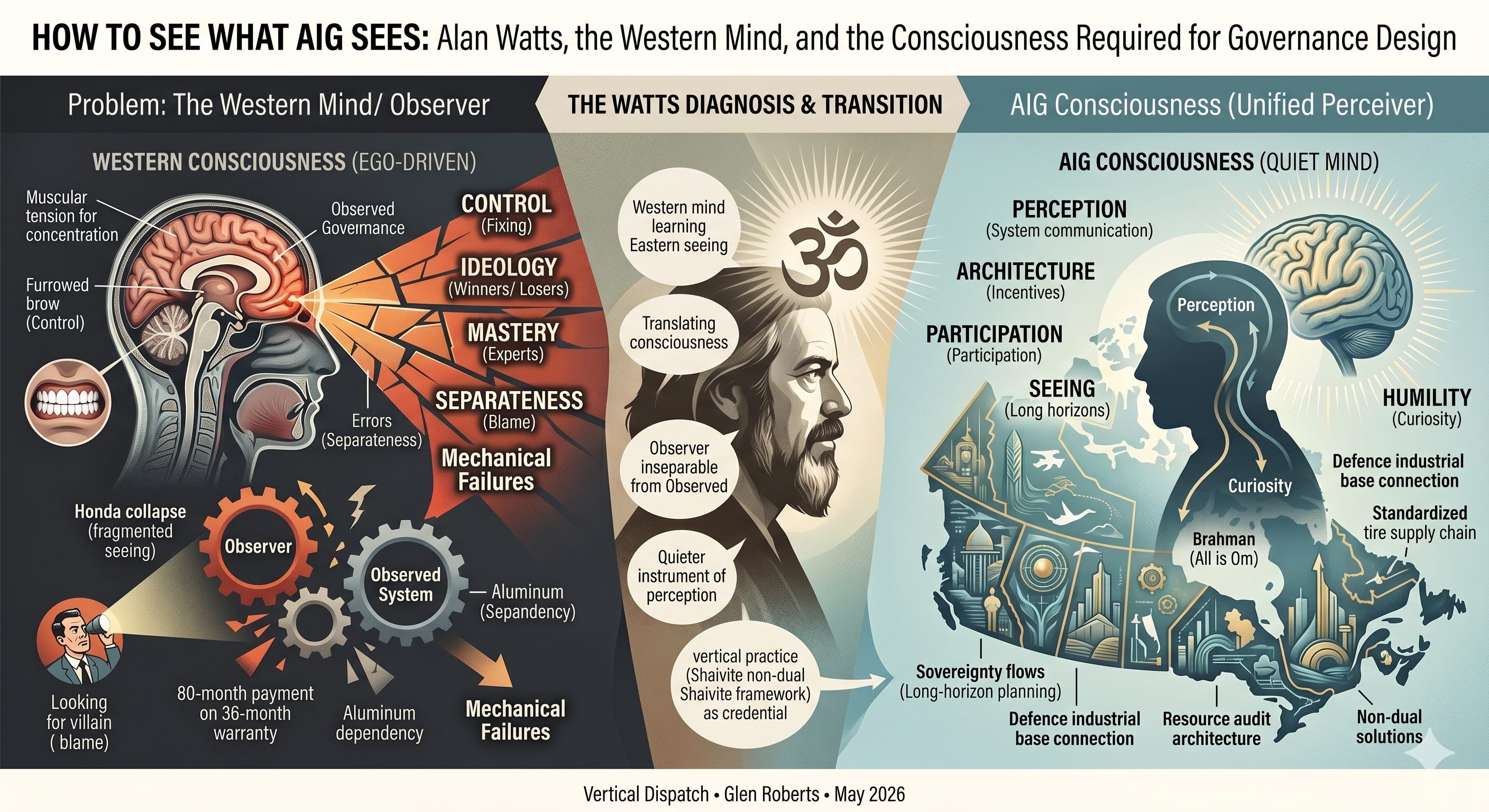
The Watts Diagnosis
Alan Watts was not a governance theorist. He was something more useful — a Western mind that had learned to see the way Eastern consciousness sees, and had spent forty years translating that seeing into language the Western mind could receive without flinching.
His central diagnosis was precise: the Western mind has confused its conceptual image of itself — the ego, the personality, the identity it performs — with its actual existence as a living organism embedded in and inseparable from the universe it believes it is observing from the outside.
This confusion, Watts argued, is not a philosophical error. It is a physical habit. We sustain the illusion of separateness through unnecessary tension — clenched teeth, furrowed brow, the muscular effort of trying to control an experience that is already happening without our permission. We mistake that tension for identity. We call it concentration. We call it discipline. We call it leadership.
Watts called it a dead end.
Because a mind trying to force a wiggly world into a straight rigid framework does not produce governance. It produces the illusion of governance — the press conference, the ribbon cutting, the policy announcement — while the system continues producing exactly what it was designed to produce, which is rarely what the announcement promised.
This is the condition AIG exists to correct.
The Five Shifts AIG Requires
AIG is not a technology. It is a way of seeing. And like all genuine ways of seeing it cannot be grasped. It can only be inhabited. What follows are the five shifts the Western mind must make before AIG becomes available to it.
The first shift: from control to perception.
The ego says I will understand this system and then I will fix it. AIG says let the system reveal itself. These are not the same instruction. The first produces a conclusion the observer brought to the room. The second produces a perception the system has been trying to communicate all along.
Watts taught that you cannot get out of the game by willpower. You cannot think your way into seeing. The instrument of perception must be quieter than the thing being perceived. A governance framework built on ego produces Honda announcements and aluminum dependency and 80-month payments on 36-month warranties — because the ego that designed the system could not see the system it was designing. It could only see the story it wanted to tell about what it was building.
The second shift: from ideology to architecture.
The Western mind is trained to see heroes and villains, winners and losers, narratives and blame. This is not analysis. This is storytelling wearing analysis as a costume.
AIG sees incentives, time horizons, dependencies, structural contradictions, and governance vacuums. It does not ask who failed. It asks what the system was designed to produce and whether that design serves the collective consequence it was entrusted with. The failure is almost never in the person. It is in the architecture. And the architecture cannot be seen by a mind that is looking for someone to blame.
The third shift: from separateness to participation.
Watts said you do not come into this world. You come out of it. The tree does not grow on the earth. The tree is what the earth is doing in that place at that time.
AIG applies this to governance directly. You are not outside the system judging it. You are inside the system participating in it. The government that approved the Honda subsidy within an electoral logic was not separate from the electorate that rewarded announcements over audits. The consumer who signed the 80-month payment was not separate from the industry that designed the financing architecture. The citizen who voted for the fighter rather than the manager was not separate from the sovereignty crisis the fighter refused to address.
The system is producing exactly what it was designed to produce. The failure is in the design. And we are all part of the design. This is not a counsel of despair. It is the beginning of the only honest governance conversation available.
The fourth shift: from fixing to seeing.
Watts taught that the problem is not the world. The problem is the way you are looking at the world. AIG is not a governance solution. It is a governance perception. Before you can redesign a system you must see the hidden incentives, the misaligned time horizons, the unconscious assumptions baked into the architecture, the structural traps that produce the same failure across every electoral cycle regardless of which party is managing them.
The Western governance mind goes immediately to the fix. The legislation. The regulation. The policy lever. AIG says not yet. First see. Fully. Without defense. Without the protection of ideology or the comfort of a predetermined conclusion. The fix that emerges from genuine perception is of a fundamentally different quality than the fix the ego proposed before the seeing began.
The fifth shift: from mastery to humility.
Watts said the meaning of life is just to be alive. It is so plain and so obvious and so simple. AIG’s parallel is exact: the meaning of governance is to align incentives with reality. It is so plain and so obvious and so simple — and the ego makes it nearly impossible because the ego needs the complexity. The complexity justifies the expert. The expert justifies the institution. The institution justifies the budget. And the budget justifies the press conference where the announcement is made that the problem has been addressed.
AIG requires the user to approach with curiosity rather than mastery. Openness rather than conclusion. Willingness to be wrong. Willingness to see what they did not want to see. Willingness to let the system reveal itself rather than confirming what the observer brought to the room.
This is not weakness. In the governance context it is the rarest and most demanding form of intellectual courage available.
Why This Is Not Eastern Philosophy
A precise clarification is necessary here because the Western mind will reach for it as an escape.
This is not a proposal to import Eastern spirituality into governance design. It is not a suggestion that policy makers meditate before committee hearings or that legislators study Vedanta before drafting legislation.
It is a claim about the quality of perception required to see complex adaptive systems accurately. That quality of perception — non-defensive, non-ideological, structurally patient, capable of holding long time horizons without the ego’s demand for immediate resolution — happens to be described most precisely in the contemplative traditions of the East. But it is not the property of the East. It is the property of any mind that has learned to stop performing and start seeing.
Watts proved this. He was a Western mind. He learned to see. He spent forty years demonstrating that the Western mind is fully capable of this shift — not through belief, not through ideology, not through the adoption of a foreign tradition, but through the direct recognition of what the ego is doing and the willingness to stop letting it run the analysis.
AIG asks the same thing of the governance mind that Watts asked of the Western philosophical mind. Stop defending. Stop performing. Stop looking for the villain. Start seeing the architecture. Start tracing the incentives. Start asking whose problem this actually solves and whose problem it was designed to ignore.
The system will tell you everything if you stop talking long enough to hear it.
What Thirty Years Taught Me That the Data Confirmed
I want to speak here in the first person because this piece requires it.
The framework I have called AIG did not arrive from academic study or policy research. It arrived from thirty years of vertical practice — Jnana, Karma, Bhakti, and Raja yoga within a Shaivite non-dual framework — and from the repeated recognition that the consciousness required to see the self clearly is the same consciousness required to see a system clearly.
All is Brahman. All is Om. That is not a religious statement. It is a perceptual one. It means the observer and the observed are not separate. It means the governance failure and the governed are not separate. It means the system and the citizen are not separate. And it means that any governance framework built on the illusion of that separateness will produce, with mechanical reliability, exactly the failures we are watching in real time — the Honda write-down, the aluminum dependency, the 80-month payment on a 36-month warranty, the conference that calls itself a winning vision in a room that gets smaller every year.
Watts saw this from the outside of the tradition and named it in language the Western mind could receive. I have lived it from the inside of the tradition for thirty years. The recognition is the same.
AIG is what governance looks like when that recognition is applied not to the self but to the systems the self is embedded in and responsible for.
The Invitation
If what you have read here has shifted something in the way you are looking at the governance failures of this moment — the sovereignty crises, the industrial collapses, the political movements performing competence they do not possess — then you are already approaching AIG correctly.
The framework is being built in public through The Vertical Dispatch. The formal architecture is being completed in Level 8: The Sovereign Reconstruction of Canada — a book that applies this perceptual framework to every major domain of Canadian governance, from defence procurement to resource sovereignty to the financing architecture of the automotive industry.
The dispatches will always be free. The books will be available this summer in PDF and print through a subscription that costs less than a coffee a week.
But the most important thing available here costs nothing and requires no subscription.
It requires only that you stop looking for the villain long enough to see the architecture.
The system is trying to tell you what it is. AIG is the instrument that makes that telling audible.
Watts proved the Western mind can hear it.
The question is whether it is willing to stop talking.

The Vertical Dispatch publishes at the intersection of geopolitics, governance philosophy, and sacred metaphysics. AIG — Artificially Intelligent Governance — is a formal framework for governance design adequate to the complexity of the twenty-first century. It is not a technology. It is a reckoning.
#AIG #ArtificiallyIntelligentGovernance #TheVerticalDispatch #AlanWatts #Consciousness #GovernanceDesign #WesternMind #Ego #Perception #SystemsThinking #Vedanta #NonDual #Shaivism #SacredMetaphysics #Jnana #Bhakti #RajaYoga #KarmaYoga #Brahman #Om #NeilPostman #Technopoly #CanadaSovereignty #Level8 #SovereignReconstruction #CdnPoli #GovernanceFailure #StructuralAnalysis #ConsciousnessAndGovernance #VerticalDispatch