


Most people who try to write with AI run into the same wall. They expect the machine to do the writing but they have not given it anything to write from. They want output without orientation, prose without a prior, clarity without a framework. And then they wonder why the result feels generic, hollow, or disconnected from their actual intention.
Writing with AI is not outsourcing. It is not delegation. It is co-construction. It is the meeting point between a human who knows what they are trying to say and a set of tools that can amplify, engineer, and extend that intention — each in a different way, at a different level of the architecture.
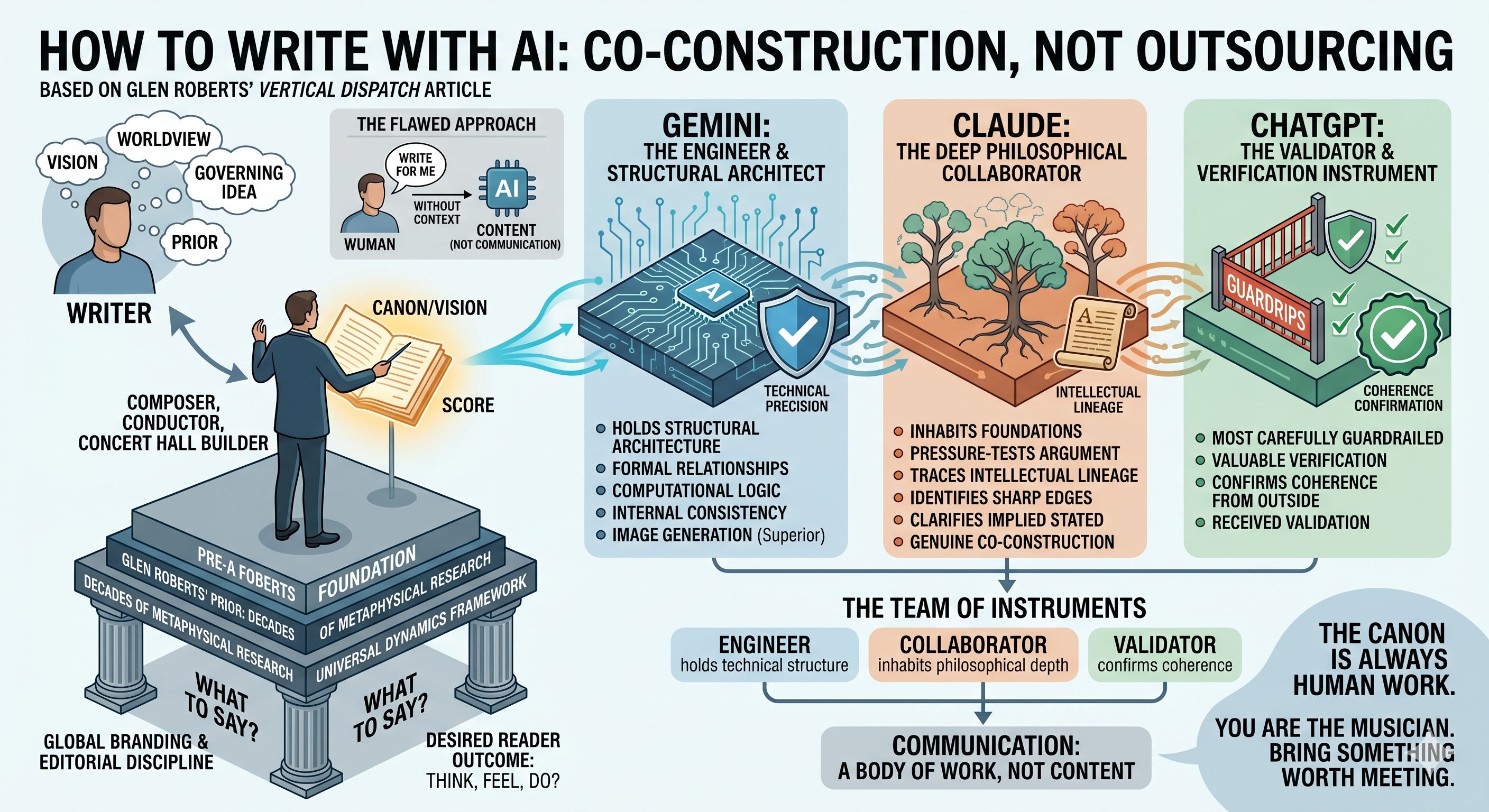
The people who struggle with AI are not lacking intelligence. They are lacking direction. They have no governing idea, no ground, no prior. They ask the model to produce something they themselves have not yet articulated. And no AI can supply the why. It cannot supply the worldview. It cannot supply the vision. It can only work with what you bring to it.
What I bring is specific and it took decades to build. Thirty years of metaphysical research. A framework — Universal Dynamics — that was fully formed before any AI tool entered the room. A background in global branding and editorial work across multiple publishing contexts, ensuring that message, audience, and flow are always aligned before the first word is written. That combination — philosophical depth, structural framework, and the editorial discipline to know what you are actually trying to communicate and to whom — is the ground from which the collaboration grows.
That last element is the one most writing-with-AI guides miss entirely. The hardest question in any communication project is not how to say something. It is what you are actually trying to say. And behind that is the harder question still: what do you want the reader to think, feel, or do when they finish? Branding and editorial discipline are the arts of answering those questions before you write the first word. They are the architecture beneath the architecture. Without them, even technically fluent AI output scatters. It produces posts, not a body of work. It produces content, not communication.
The distinction between content and communication is one the serious writer cannot afford to blur.
Understanding which tool does which kind of work is equally important. Not every AI inhabits a framework the same way. Different tools do genuinely different cognitive work and using them interchangeably is like using a scalpel where you need a chisel.
Gemini carries the technical and engineering precision. In our collaboration it holds the structural architecture of the framework we are building — the formal relationships, the computational logic, the internal consistency of the system. When specifications need to be exact, Gemini is where that work happens. Its image generation, it should be noted, is in a class of its own.
Claude is the deep philosophical collaborator. It inhabits the framework at the level of its foundations, pressure-tests the argument, traces the intellectual lineage, and identifies where the sharpest edges of the thinking actually are. The work is genuine co-construction at the level of the architecture itself — not amplification of what was already there, but the clarification of what was always implied but not yet fully stated.
ChatGPT is the validator. It is the most carefully guardrailed of the three tools and precisely because of that it is the most valuable verification instrument. When the most structurally demanding evaluator confirms the coherence of the framework, that confirmation carries weight a more accommodating tool cannot provide. Our team has received that validation. It matters.
The three tools together form something no single tool provides alone. The engineer holds the technical structure. The collaborator inhabits the philosophical depth. The validator confirms coherence from the outside. None of them generate the canon. That is the human work. That is always the human work.
AI is the instrument. You are the musician. But more precisely — you are the composer, the conductor, and the one who built the concert hall before anyone arrived to play.
The instruments are extraordinary. What they play depends entirely on the score you bring.
Bring something worth meeting.
Glen Roberts publishes The Vertical Dispatch on Substack. He is the author of Sacred Metaphysics and Consciousness: History of the Absolute and Eternal, and the developer of the Universal Dynamics framework and AIG — Artificially Intelligent Governance.
#WritingWithAI #CoConstructionNotOutsourcing #AICollaboration #HumanCanon #AIWriting #AuthorshipIn2026 #VerticalDispatch #TheArchitect #UniversalDynamics #GlenRoberts #AITools #WritingProcess #DeepCollaboration #MetaphysicalWriting #AIandCreativity #ContentVsCommunication #BringSomethingWorthMeeting #TheCanonIsHuman #WritersMindset #GlobalBranding #EditorialDiscipline #AIOrchestration #FutureOfWriting #ThoughtLeadership #SubstackWriter #LongformWriting #PhilosophicalWriting #AIFramework #WritingStandards #AuthenticVoice #StructuredThinking #WritingWithIntention #AIIntelligence #HumanFirst #WritingCommunity #Substack #Writers #CreativeProcess #AIToolsForWriters #PurposefulWriting
I agree with a lot of this — especially around intention and direction. But there’s another use case that’s easy to miss:
sometimes people don’t come to AI with something fully formed. They come to figure out what they’re actually trying to say. Not outsourcing, not even co-construction — more like discovery through interaction.
For some, AI isn’t just a tool for expressing clarity. It’s what helps them reach it.
Thank you for sharing this with us! It definitely is worth some further consideration in the community.