

If God Exists, God Is Universal
God has no army — how the children of Abraham turned the most universal insight in human history into the most persistent killing machine on earth

Written from the perspective of Alastair Crooke — former MI6 officer, EU Special Representative, and founder of Conflicts Forum, Beirut — on the eschatological collision no civilization can see clearly enough to stop
What follows is written from inside the analytical consciousness of Alastair Crooke CMG — Companion of the Order of St. Michael and St. George, thirty-year MI6 officer, Security Adviser to the EU Special Representative for the Middle East 1997–2003, founder of Conflicts Forum in Beirut, and author of Resistance: The Essence of the Islamist Revolution. It is not plagiarism. It is an attempt to inhabit the perspective of the man who has sat, longer than almost any Western figure alive, inside the actual consciousness of all three parties to the current catastrophe — and who has been warning of this collision for two decades while the West arranged deck chairs. His words, where used, are attributed. The rest is the Voice the data and the thirty years produce.
I want to begin with something that is not analysis. It is prior to analysis. It is the question that thirty years in these rooms has forced upon me, and that I find I can no longer set aside in the interest of diplomatic tidiness. If God exists — and all three of the traditions I have spent my life moving between insist, at their foundations, that God does — then God is by necessity universal. Not the God of this people over that people. Not the patron of this land against that land. Universal. The ground of all being, from which every soul without exception emerges, and to which every soul without exception returns. A God who is less than that is not God. A God who is less than that is a flag with a theology attached.
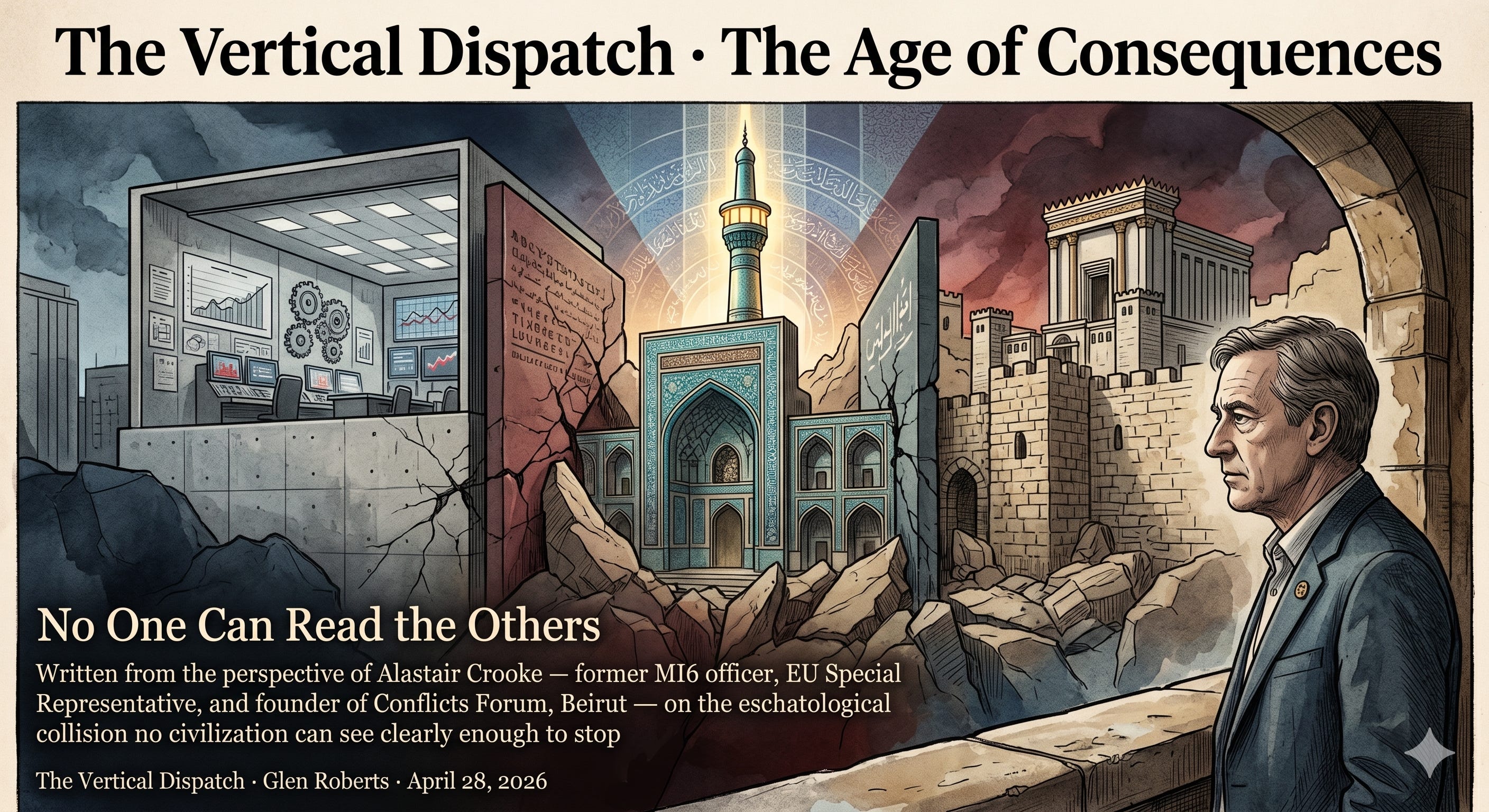
The Age of Consequences
Three traditions descend from a single patriarch. Abraham heard something in the desert — a voice, a presence, a recognition — that cracked open the tribal world of the ancient Near East and announced a God who exceeded every category the tribal mind could supply. The mystics of all three traditions that claim his lineage have never forgotten this. The Kabbalists know it. The Sufis know it. The Christian contemplatives know it. The God of the mystic is always the universal God — boundless, prior to all names, the ground beneath every ground.
The question I have carried through thirty years of ceasefires and intelligence assessments and late-night conversations in Qom seminaries and Gaza safe houses and Jerusalem back channels is this: how did the children of Abraham’s universal recognition end up here? How did the insight that cracked open the tribal world become the justification for the most intractable tribal wars on earth? And — the question I find most difficult — is there any way back, or have we passed the point at which the theological formations now driving events can be redirected by anything short of the catastrophe they are designed to welcome?
I am no longer certain the answer is reassuring.
What I found in the rooms
I first understood the depth of the problem not in a briefing room or a diplomatic cable but in a seminary in Qom, on one of my early visits to Iran. I was speaking with a man who is now, I believe, an Ayatollah. He was courteous, learned, and precise. And he told me something I have never forgotten: that the problem Iran has with the West is not its ideology. It is its way of thinking.
Not its values. Not its policies. Its way of thinking. The structure of the Western mind itself — its reduction of reality to the measurable, the material, the transactionally calculable — renders it constitutionally incapable of perceiving what Iran is. Iran is not a nation-state conducting foreign policy from a position of rational self-interest. It is a civilization organized around a vertical ontology with roots that go back through the Philosophy of Illumination of Suhrawardi in the twelfth century, through Avicenna, through the Shi’ite concept of Irfan — gnostic knowledge, the direct perception of layered realities that the materialist mind simply does not register. Khomeini himself insisted that seminarians study Western philosophy alongside Islamic philosophy. Not to adopt it. To understand precisely what they were rejecting, and why the rejection was metaphysically necessary.
When Iran says its nuclear program is non-negotiable, Washington hears a bargaining position. It is not a bargaining position. It is an identity statement. The nuclear capacity is not, in Iranian consciousness, primarily a weapons program. It is the symbol of civilizational sovereignty — the refusal to be, as Iran was for most of the twentieth century, a managed client of Western power. You cannot negotiate someone out of their identity. You can only fail to understand why your negotiations are failing, and escalate the pressure that accelerates the very resolve you are trying to break.
I have watched this failure operating in real time for thirty years. It has not improved with repetition.
What Israel has become — and cannot see in itself
On the Israeli side, the failure of self-perception is of a different kind but equal depth. I want to be precise here, because imprecision on this subject is its own form of dishonesty.
The Israel I first worked with in the late 1990s — the Israel of Rabin’s peace process, of a secular democratic self-understanding, of generals who were also poets and farmers — is not the Israel governing today. The November 2022 elections brought to power a coalition whose platform is not secular, not Enlightenment-derived, not amenable to the conceptual frameworks of Western liberal diplomacy. It is eschatological. It is messianic. Its organizing telos is the founding of Israel on the totality of the biblical Land of Israel — the displacement of the non-Jewish population, the reconstruction of the Temple, the forcing of redemption through territorial completion. This is not the fringe of Israeli politics. It is the governing coalition. Itamar Ben-Gvir is the Minister of National Security. Bezalel Smotrich controls the finances. These are not rhetorical positions. They are enacted policy.
And within this framework — I want the reader to sit with this carefully — there is no negotiating table. Not because negotiations have broken down. Because the theological premise of the movement makes negotiation ontologically impossible. You cannot negotiate the partition of a land that God has given in its entirety as the precondition for cosmic redemption. The two-state solution is not merely politically dead. It is theologically abolished. Every Western diplomat who arrives in Jerusalem with a partition map is bringing a document that, within the governing consciousness of this Israeli coalition, is not a proposal. It is a blasphemy.
But here is what Israel cannot see about itself, and what makes the situation genuinely tragic rather than merely brutal: the messianic certainty that drives this project is structurally identical, at the level of consciousness, to the eschatological certainty it faces in its adversaries. Israel’s governing right cannot read Iran because it is operating from the same cognitive architecture as Iran — absolute theological conviction, divine mandate, historical destiny — expressed in a different theological vocabulary. Two eschatologies in collision cannot negotiate because each reads the other’s resistance as confirmation of its own prophetic script.
America — and the theological minority that drives its wars
Which brings me to the third party in this collision — the one that understands itself least of all, because it does not even know it is a theological actor.
The United States believes it is a secular rational actor conducting a strategic foreign policy from a position of calculated national interest. This is perhaps the most consequential self-deception in modern geopolitics. The American foreign policy toward Israel and Iran is not being driven by a strategic assessment of American national interest. The polls make this unambiguous. Only thirty-two percent of Americans approve of the Iran war. Seventy-nine percent of Trump’s own voters want it ended. Sixty percent of Americans disapprove of Israel’s conduct in Gaza. The American people, in their aggregate judgment, do not want these wars and do not believe they serve America’s interests.
What is driving them is a specific theological minority: older, rural, white evangelical Christians carrying a nineteenth-century British theological innovation called dispensationalism — a doctrine that did not exist before John Nelson Darby developed it in the 1830s, that has no roots in the Church Fathers or the Reformation or any mainstream theological tradition, and that has the extraordinary effect of making nuclear war in the Middle East not a catastrophe to be prevented but a prophecy to be fulfilled. Within this framework, Jewish control of the full biblical land of Israel is a prerequisite for the Second Coming of Christ. Every Palestinian displacement is a prophetic milestone. Every Israeli military expansion is sacred progress. And the war with Iran — whatever its stated justifications — resonates in this consciousness as the beginning of the final chapter.
Sixty-eight percent of white evangelical Christians approve of Trump’s handling of Iran. Sixty-three percent identify Iran as a major threat — the highest of any demographic group surveyed. Among Americans with college degrees, Trump is twenty-one points underwater on the war. Among adults aged eighteen to twenty-nine, approval sits at twenty-four percent. The theological formation and the demographic formation are the same formation. This is not the American public. It is a specific, aging, geographically concentrated theological constituency that has achieved, through decades of political organization and the capture of the Republican Party, the ability to point the American military at targets chosen by its eschatological imagination.
And Netanyahu — a secular man, let us be clear about this — has understood and exploited this with cold precision. He told four hundred evangelical leaders that without them, the State of Israel would not exist. He has spent hundreds of millions of dollars maintaining their theological loyalty through pilgrimages, museum installations in megachurches, targeted messaging campaigns. He is using their eschatology as a geopolitical instrument. The dispensationalist base does not know it is being used. It believes it is enacting God’s will. And its theology, carried to its internal conclusion, holds that the Jewish people it is so fervently supporting must ultimately convert to Christianity or face damnation at the end of the age it is helping to engineer.
This is the most cynical theological transaction in the modern era. And it is, right now, the engine of a war.
Three eschatologies — and no exit
Here is what I find genuinely difficult to hold. Not analytically. Existentially.
Each of the three parties to this conflict has, within its theological tradition, a strand that does not merely accept the current catastrophe but welcomes it as confirmation. The Israeli messianic right, drawing on specific readings of Talmudic and kabbalistic eschatology, holds that the upheaval of the nations around Israel is part of the redemptive process — that the worse things become, the closer the Messiah. The American evangelical dispensationalist holds that global war centered on the Middle East is the precondition for the rapture and the Second Coming — that Armageddon is not the name of a disaster but the name of a destination. And certain strands of Shi’ite eschatology hold that the return of the Hidden Imam — the Mahdi — is preceded by a period of universal upheaval, oppression, and conflict, after which justice will be established on earth.
Three traditions. Three eschatological frameworks. All pointing at the same geography. All containing strands that read the current catastrophe not as something to be stopped but as something to be endured, even accelerated, because the catastrophe is the passage to the redemption.
I do not say this to condemn these traditions. I say it because it is the most important analytical fact about the current moment that Western strategic thinking is entirely unequipped to process. You cannot deter a party that reads your deterrent threat as prophetic confirmation. You cannot negotiate with a consciousness for which the breakdown of negotiations is itself a sign of divine faithfulness. The mechanistic toolkit of Western diplomacy — sanctions, incentives, pressure, leverage — was designed for rational actors pursuing calculable interests. It has no instrument for what it is actually facing.
And so we arrive at the place I did not expect to arrive at when I began this work thirty years ago: a moment in which three civilizational formations, each carrying a genuine fragment of the Abrahamic inheritance, each capable at its best of extraordinary depth and wisdom and compassion, are locked in a configuration that the deepest voices within each tradition would recognize as the precise inversion of everything their God actually requires.
If God exists — and Abraham’s encounter in the desert insists that something real was encountered — then that God is the ground of all souls without exception. Not the God of this eschatology over that one. The ground of all. The moment any tradition makes God the instrument of its particular historical project, it has not found God. It has found itself, dressed in God’s name.
— The Vertical Dispatch
The Shema says: God is One. Not one among many. One without division, without preference, without the tribal qualifications the political apparatus of every generation has tried to add. The Fatiha addresses God as Rabb al-’alamin — Lord of all the worlds, all the peoples, every dimension of existence. The Gospel of John does not open with a people or a land or a covenant. It opens with the Logos — the universal principle of meaning itself — present before creation, the ground through which all things came to be.
These are not peripheral texts. They are the foundations. And they do not authorize what is being done in their names. They indict it. The God of Abraham, honestly encountered, is not available for the purpose to which all three of Abraham’s children are currently putting him. That God is universal or that God is nothing — and the mystics of all three traditions have always known it.
I have spent thirty years in the rooms. I have sat with Hamas commanders and Mossad chiefs and Iranian Ayatollahs and American evangelicals and European diplomats and Palestinian mothers whose children were in the rubble. I have brokered ceasefires that held for weeks and ceasefires that held for hours. I have written assessments that were read and assessments that were filed. And what I know, after all of it, is this:
The conflict will not end when one side defeats the other. It will not end when the right deal is reached or the right pressure applied or the right leader replaced. It will end — if it ends — only when enough people within each of these traditions recover what their own deepest sources have always known: that the God they are killing for is not the God their mystics encountered. That the tribal God is a human construction. That the universal God — the one prior to all names, the ground of all souls, the consciousness from which Abraham’s original recognition came — that God has no army, no preferred eschatology, no historical timetable that requires the destruction of other human beings.
Until that recovery happens — until Z₀ displaces x₀ at the centre of the Abrahamic political imagination — the children of Abraham will continue to pay for their inheritance in the oldest currency available to them.
Each other’s blood.
Glen Roberts is a retired philosopher and author based in Ontario, Canada. He is the author of Sacred Metaphysics and Consciousness: The History of the Absolute and Eternal and publishes The Vertical Dispatch on Substack. This dispatch draws on the published writings and interviews of Alastair Crooke CMG, including his essay The Mechanistic Fallacy (Conflicts Forum, 23 April 2026) and his interview series published by Think BRICS and Forum Geopolitica, April 2026.
#TheVerticalDispatch #TheAgeOfConsequences #AlastairCrooke #GlenRoberts #Eschatology #Geopolitics #MiddleEastConflict #Iran #Israel #USA #WesternMindset #CivilizationalCollision #AbrahamicFaiths #Tribalism #UniversalGod #IntelligenceFailure #ConflictsForum #Diplomacy #TheologyAndPolicy #NoOneCanReadTheOthers #Messianism #Dispensationalism #PoliticalAnalysis #EndTimesTheology