


There is an old observation about the nature of obvious things. If it walks like a duck and quacks like a duck, it is a duck. The Canadian political establishment has spent the better part of a year applying that logic to the Alberta separatist movement — treating it as a domestic grievance, a regional frustration, a western alienation story with deep roots and legitimate complaints.
The evidence now assembled from CSIS, DisinfoWatch, the Global Centre for Democratic Resilience, the Canadian Digital Media Research Network, the Financial Times, Al Jazeera, and the CBC points to something categorically different.
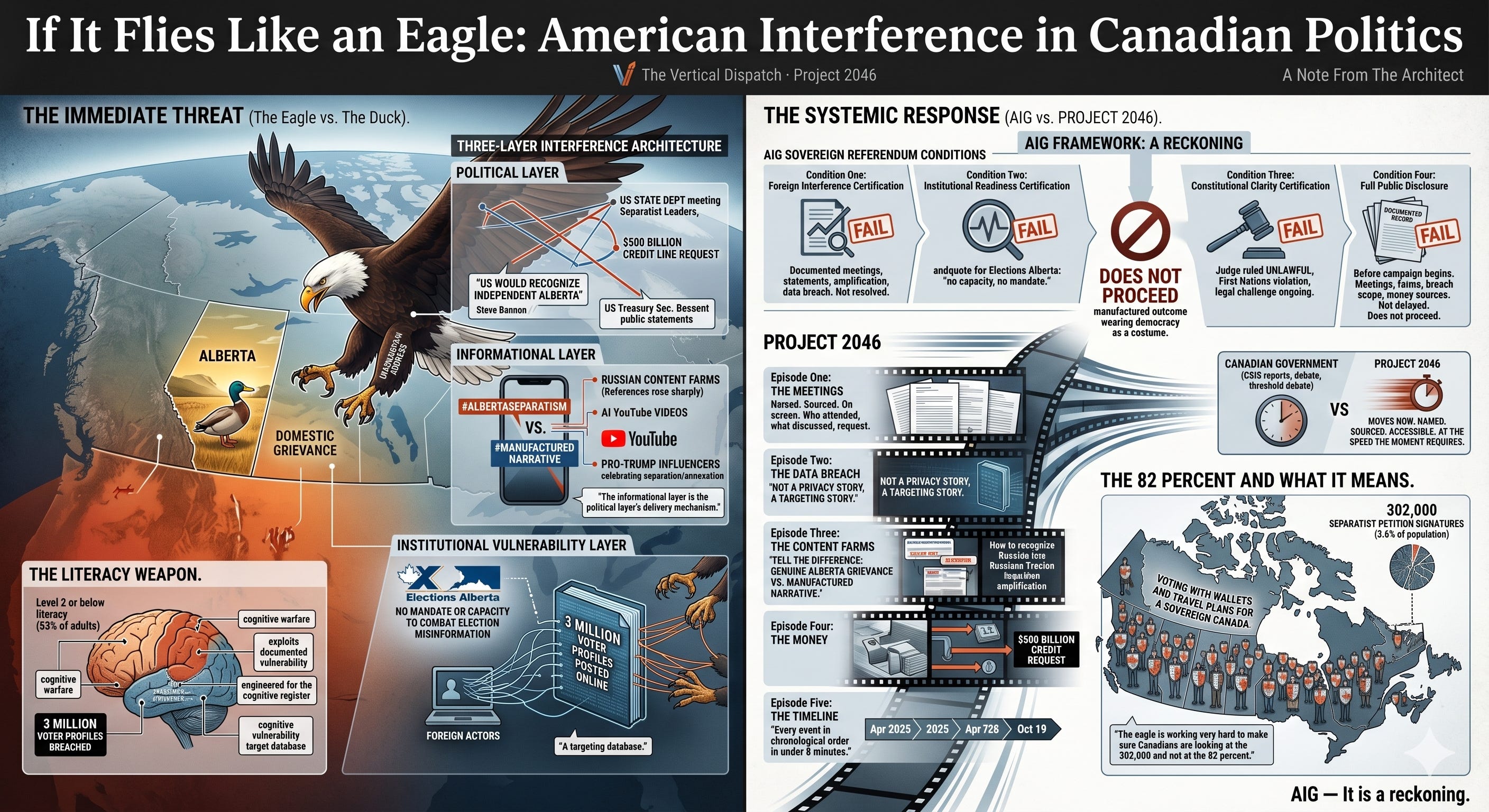
This does not walk like a duck. It does not quack like a duck. It flies at altitude, it hunts with precision, it sees the entire continental board from three thousand feet, and it has talons. What is circling the Alberta referendum is not a domestic grievance movement that got out of hand. It is an eagle — and the eagle has a Washington address.
This dispatch assembles the documented record, applies the AIG governance framework, names the actors the institutional press has been too cautious to connect into a single coherent document, and delivers the verdict that no elected official in Canada has yet been willing to state plainly: the conditions required for a free, fair, and sovereign referendum do not currently exist in Alberta. And AIG would prohibit one from proceeding until they do.
The Documented Record
Let the facts speak before the analysis begins. Every item below is sourced and verified.
Leaders of the Alberta Prosperity Project met with U.S. State Department officials in Washington at least three times since April 2025. These were not chance encounters at diplomatic receptions. They were scheduled meetings between Canadian separatist organizers and officials of the administration that has simultaneously been imposing tariffs on Canadian goods, calling the Canadian Prime Minister the Governor of the 51st state, and publicly floating the annexation of Canadian territory.
The separatist group planned to request a $500 billion credit line from the Trump administration to support a newly independent Alberta. Half a trillion dollars. From a foreign government. To fund the separation of a Canadian province. The U.S. officials confirmed the meetings and described them as routine. Routine.
U.S. Treasury Secretary Scott Bessent described Albertans as natural partners for the United States and publicly discussed rumours of a referendum on whether they want to stay in Canada or not. Steve Bannon stated that if Alberta separated, the USA would recognize it. A U.S. national security analyst on Bannon’s show suggested that Trump’s 51st state talk was specifically aimed at Alberta, proposing the U.S. could guide an independent Alberta toward becoming a U.S. state.
CSIS director Daniel Rogers told CBC’s The House on record that Alberta’s potential secession vote is susceptible to disinformation and foreign interference from players like Russia. The head of Canada’s intelligence agency. On the record. Days before the petition was submitted.
A joint report from DisinfoWatch, the Canadian Digital Media Research Network, and CASiLabs documented that between late December and late April, references to Alberta separatism rose sharply from known Russian content farms. The report describes U.S. engagement as a direct threat to Canada’s democratic integrity, national security, and cognitive sovereignty.
Researchers found that foreign adversaries are exploiting the Alberta separatist debate to erode social cohesion, deepen domestic divisions, undermine trust in democratic institutions, and amplify perceptions of political instability that damage investor confidence. The activities range from covert influence campaigns run by Russia and China to public remarks and actions by the Trump administration to encourage Alberta separatists, including meeting with their representatives in Washington.
Stay Free Alberta submitted a petition with 302,000 signatures — well ahead of the 178,000 required — to Elections Alberta. The petition submission stumbled immediately after a separatist-linked group posted the personal data of nearly three million voters online. One of the biggest data breaches in Canada’s history.
Elections Alberta has acknowledged it has no mandate or substantive jurisdiction to combat election misinformation. Security experts have concluded that Alberta is almost completely unready to counter foreign disinformation in a referendum campaign.
First Nations including the Sturgeon Lake Cree Nation, the Blackfoot Confederacy, and the Athabasca Chipewyan First Nation have formally opposed the referendum, warning that a vote to leave Canada would enable foreign interference by the US. A judge ruled in December that an independence referendum would be unlawful because it violates First Nations constitutional rights under treaties with Britain predating the creation of the province itself.
Three million voter profiles. Posted online. By a separatist-linked group. At the precise moment the petition was being circulated. Available to anyone. Including foreign actors who had already demonstrated their interest in the outcome.
This is the documented record. This is what the eagle looks like up close.
The Reagan Ad and What It Revealed
There is one more piece of evidence that has not received the analytical weight it deserves and it involves Ontario Premier Doug Ford.
Ford ran a $75 million advertising campaign in the United States using archival footage of Ronald Reagan arguing against tariffs. The ad ran during the World Series. It generated 11.4 billion impressions. Trump called it fake. Trade talks were abruptly cancelled. And then U.S. Ambassador Pete Hoekstra delivered an expletive-laced tirade at Ontario’s trade representative David Paterson at a Canadian American Business Council event in Ottawa attended by more than 200 prominent U.S. and Canadian business executives.
Hoekstra accused Canada of interfering in American electoral politics with a government-funded political ad. He said Canada and the U.S. were close to a trade deal on steel, aluminum, and energy but that Ford had scuttled that goodwill.
Pause on the architecture of what just happened.
The United States Ambassador to Canada — whose administration has met with Canadian separatist organizers, publicly encouraged the dissolution of the Canadian federation, called the Canadian Prime Minister a governor, and declared that Alberta is a natural American partner — accused Ontario of interfering in American politics for running an ad that used Ronald Reagan’s own words on free trade.
Ronald Reagan. Whose words in favour of free trade are apparently acceptable when used to justify American trade policy and unacceptable when used by a Canadian province to defend itself against American tariffs.
Ford called Hoekstra’s behaviour absolutely unacceptable and unbecoming of an ambassador. He then called Hoekstra a good guy and said he had a bet with him on the World Series.
That sequence — unacceptable behaviour, then a sports bet — is the Canadian political establishment’s relationship with American aggression in miniature. Name the violation. Accept the violation. Make a friendly wager.
The eagle noticed.
The Three-Layer Interference Architecture
What the assembled evidence describes is not a spontaneous separatist movement that happened to attract American interest. It is a three-layer interference architecture operating simultaneously across the political, informational, and institutional layers of Alberta’s democratic process.
AIG Layer One — The Political Layer: Direct meetings between U.S. officials and separatist leaders. Public statements by the Treasury Secretary, the former White House Chief Strategist, and U.S. media figures explicitly encouraging separation and annexation. Presidential rhetoric repeatedly delegitimizing the Canadian federal government and its elected leader. The Trump administration encouraging Alberta separatists — not covertly, not through proxies, but through named officials in documented meetings. This is not influence. This is operation.
AIG Layer Two — The Informational Layer: Russian content farms amplifying Alberta separatist narratives beginning in late December 2025. AI-generated YouTube videos stoking and clouding the referendum debate with falsehoods. A laundering effect that makes foreign propaganda appear to be organic local opinion. Pro-Trump American influencers celebrating separatism and the prospect of 51st state annexation. The informational layer is not supplementing the political layer. It is the political layer’s delivery mechanism — the instrument through which state-level strategic interest reaches the individual Alberta voter as apparently spontaneous social media content.
AIG Layer Three — The Institutional Vulnerability Layer: Elections Alberta has no mandate or capacity to combat election misinformation. The Provincial Security and Intelligence Office lacks the resources to address the foreign interference threat. Three million voter profiles breached and posted online. A petition signature verification process paused by court challenge. A provincial government that changed the referendum rules to lower the signature threshold from half a million to 178,000 and to permit referendum questions that run afoul of the Canadian constitution. Three layers. Political. Informational. Institutional. Operating simultaneously. Pointing in the same direction.
If it flies like an eagle, looks like an eagle, and hunts like an eagle — it is an eagle. And the eagle is not from Alberta.
82 Percent and What It Means
A Nanos survey shows 82 percent of Canadians find the boycott of American goods and travel helpful in strengthening Canada’s bargaining position — 53 percent helpful, 29 percent somewhat helpful — a number largely unchanged for months.
That number is the most important sovereignty data point in Canada right now and it is almost entirely absent from the political coverage of the referendum question.
82 percent of Canadians are already voting with their wallets and their travel plans for a sovereign Canada. They are not waiting for a referendum. They are not waiting for a political leader to give them permission. They are acting on the recognition — intuitive, immediate, and accurate — that the country is under external pressure and that the correct response is collective resistance rather than internal fracture.
The separatist petition got 302,000 signatures in Alberta. The boycott has 82 percent of the country.
Those two numbers exist in the same political moment. The eagle is working very hard to make sure Canadians are looking at the 302,000 and not at the 82 percent.
What AIG Would Require Before a Single Ballot Is Cast
Artificially Intelligent Governance does not prohibit referendums. It prohibits referendums conducted under conditions that prevent the electorate from making a genuinely informed, genuinely sovereign, genuinely free decision. The Alberta referendum as currently constituted fails every one of AIG’s sovereign referendum conditions.
AIG Sovereign Referendum Condition One — Foreign Interference Certification: No referendum on a question of constitutional significance may proceed until an independent Foreign Interference Audit has been completed and its findings published to the electorate in full. The audit must assess documented foreign government contacts with referendum campaign organizations, foreign state media amplification of referendum narratives, social media manipulation campaigns attributable to foreign state actors, and the integrity of the voter registration data used to qualify the petition. The Alberta referendum fails this condition before the audit is even conducted — the documented meetings, the Bessent statements, the Russian content farm amplification, and the three million voter data breach constitute a prima facie foreign interference case that has not been resolved.
AIG Sovereign Referendum Condition Two — Institutional Readiness Certification: No referendum may proceed in a jurisdiction that has publicly acknowledged it has no capacity to counter election misinformation. Elections Alberta’s own admission — no mandate, no jurisdiction, no capacity — is the AIG disqualification standard stated by the institution itself. The referendum cannot proceed until independent disinformation monitoring, foreign content labelling, and real-time interference reporting capacity is established, tested, and operational.
AIG Sovereign Referendum Condition Three — Constitutional Clarity Certification: A judge has already ruled that an independence referendum would be unlawful because it violates First Nations constitutional rights under treaties with Britain predating the creation of the province. The legal challenge to that ruling is ongoing. AIG prohibits a referendum from proceeding while a court is actively considering whether the referendum itself is constitutionally permissible. The Clarity Act exists precisely because the Supreme Court established that a referendum question must be clear and its majority sufficient before any constitutional negotiation can begin.
AIG Sovereign Referendum Condition Four — Full Public Disclosure Before the Campaign Period Opens: The electorate must have access to the complete documented record of external involvement in the campaign before the campaign period begins. Every documented meeting between separatist organizers and U.S. officials. Every identified foreign content farm post. Every social media account traced to foreign state actors. Every dollar of foreign-origin funding. Every data breach and its scope. Published. Publicly. In plain language. Before the question goes to the people. A vote conducted in an information environment shaped by foreign state actors, with voter data already compromised, with no institutional capacity to monitor disinformation, and with a constitutional legal challenge unresolved is not a democratic referendum. It is a manufactured outcome wearing democracy as a costume.
Can the Government Charge Them? The Legal Architecture and Its Gap
Your question is the right one and it deserves a precise answer before the AIG argument is made.
Under Section 46 of the Canadian Criminal Code, high treason includes levying war against Canada or assisting an enemy at war with Canada. Treason under Section 46(2) includes using force or violence for the purpose of overthrowing the government of Canada or a province.
B.C. Premier David Eby went on the record stating: ‘To go to a foreign country and to ask for assistance in breaking up Canada, there’s an old-fashioned word for that. And that word is treason.’
He is correct by the dictionary. He is not correct by the Criminal Code. And that gap is the entire problem.
Carleton University professor and former national security analyst Stephanie Carvin said directly: ‘Treason and sedition and other similar offences are really tied to the idea of betraying Canada during a time of war. They are medieval laws because of their aged origins.’
University of Leiden professor Yuan Yi Zhu stated that the existing legal framework sets the bar for prosecution so high as to make it almost inconceivable with regard to the Alberta meetings. They would pretty much have to be caught on tape helping Donald Trump plan an invasion of Canada to be prosecuted.
Federal officials confirmed that private citizens meeting with foreign government officials to advance a separatist cause is legal in Canada within certain limits. A Justice Department spokesman noted that while private citizens are free to speak with foreign officials, these talks are subject to criminal laws prohibiting espionage, sedition, and the sharing of state secrets — but the current activities do not appear to cross those thresholds.
So the answer is: under the current legal architecture, no. The government cannot charge the Alberta Prosperity Project leaders with treason or sedition for meeting with U.S. officials. The Criminal Code was not designed for this. Canada has no equivalent to the American Logan Act criminalizing private diplomacy. The bar is war. The bar has not been crossed. Yet.
The Literacy Weapon and Why It Matters More Than the Law
The PIAAC international literacy assessment establishes that approximately 53 percent of Canadian adults operate at Level 2 or below on the literacy scale. Level 2 means the reader can handle simple, clearly laid out texts but struggles with longer, more complex documents, implicit meaning, and information that requires integration across multiple sources.
What this means in the context of the Alberta referendum is precise and devastating.
The foreign interference architecture assembled against this referendum — Russian content farms, AI-generated YouTube videos, American influencer networks, presidential rhetoric, carefully laundered separatist messaging — is not designed to persuade Level 4 and 5 readers. It is designed for Level 1 and 2. It is engineered for the cognitive register where a short, emotionally resonant claim lands without friction and is never cross-referenced against the documented record because the documented record requires Level 4 literacy to navigate.
The three million voter profiles that were breached and posted online are not just a privacy violation. They are a targeting database. They tell a sophisticated foreign interference operation exactly which voters, in which ridings, at which demographic profiles, are most susceptible to which emotional framings.
The eagle does not need to persuade every Albertan. It needs to move the margin among the most reachable — and the most reachable are the ones operating at the literacy level that the interference content was designed for.
This is not a condescending observation about Alberta voters. It is a structural observation about how information warfare works. The weaponization of cognitive vulnerability is the crime. The cognitive vulnerability is the target.
The legal framework has no instrument for this. Treason requires war. Sedition requires force. The Criminal Code was written before a foreign government could reach into a province’s democratic process through a smartphone and manufacture the appearance of a popular movement for the cost of a content farm subscription.
What AIG Would Build That the Criminal Code Cannot
AIG Legal Instrument One — The Cognitive Sovereignty Protection Act: AIG would require Parliament to enact legislation that criminalizes the deliberate targeting of a democratic process using content specifically designed to exploit documented cognitive vulnerability thresholds in the target population. This is not a restriction on political speech. It is a restriction on weaponized informational architecture deployed by foreign state actors against a population that the PIAAC data has already identified as operating below the literacy threshold required to independently assess the credibility of the content being delivered to them. The distinction between political persuasion and cognitive warfare is measurable. The instrument that enforces it must be built.
AIG Legal Instrument Two — The Foreign Democratic Interference Registry — Expanded: The Countering Foreign Interference Act enacted in June 2024 established a public registry of foreign agents. AIG would extend the registry requirement to include every organization, individual, or platform that receives foreign state funding, direction, or coordination in connection with any Canadian referendum campaign — with mandatory real-time public disclosure, automatic suspension of campaign activities pending disclosure review, and criminal penalties for non-disclosure that apply regardless of whether the underlying activity meets the treason threshold.
AIG Legal Instrument Three — The Referendum Integrity Standard: No referendum on a question of constitutional significance may be called, certified, or conducted without a mandatory Referendum Integrity Certification issued by an independent body comprising CSIS, Elections Canada, the Privacy Commissioner, and an international democratic oversight panel. The certification must confirm that the foreign interference audit is complete, the voter data is secure, the institutional disinformation monitoring capacity is operational, and the constitutional legal questions have been resolved. Without the certification, the referendum does not proceed. Not delayed. Not modified. Does not proceed.
The Eagle and the Duck
The separatist movement will say these conditions are designed to suppress the democratic will of Albertans. That objection deserves a direct response.
The democratic will of Albertans is not suppressed by requiring that the vote be free of foreign manipulation. It is protected by that requirement. The 302,000 Albertans who signed the petition deserve to know whether the information environment in which they made that decision was shaped by Russian content farms, American state officials, and a data breach that exposed three million voter profiles to foreign actors before they cast a constitutional ballot.
The western alienation grievance is real. The pipeline frustration is real. The equalization payment argument is real. The sense of being governed from a distance by people who do not understand Alberta is real. None of those real grievances require a foreign-interference-compromised referendum to be addressed. They require governance — patient, structural, long-horizon governance that operates at the level the problem demands.
The eagle is not Alberta’s friend. It is a predator that has identified a fracture line in a sovereign nation and is applying pressure to it with strategic precision. The 82 percent of Canadians who are boycotting American goods already understand this instinctively.
The governance framework that makes that instinct into binding sovereign protection does not yet exist. Building it is the work. October 19 is the deadline.
The Architect’s Opinion
A Note From Project 2046 — Not AIG Policy. Personal Conviction.
What follows is not an AIG governance principle. It is the opinion of the Architect — offered as a citizen, as a writer, and as a Canadian who has spent thirty years studying the relationship between consciousness, language, and power. It is offered here because some things require a human voice rather than a governance framework.
The Canadian government will not move fast enough.
That is not a criticism of the Carney government’s intentions. It is a structural observation about the speed at which democratic institutions operate versus the speed at which foreign interference campaigns operate. CSIS issues reports. Parliament debates legislation. The Justice Department considers thresholds. The Privacy Commissioner investigates breaches. And while all of that is happening — carefully, procedurally, correctly — the content farms are running, the YouTube videos are multiplying, the voter profiles are in foreign hands, and October 19 is approaching.
Project 2046 proposes to do what the government cannot do at the speed the moment requires.
We name them.
Not their home addresses. Not their families. Not their private lives. We name their public actions, their documented meetings, their stated intentions, and their organizational affiliations — using only the public record, sourced and verified, presented in plain language at the literacy register that the PIAAC data says the target population can actually receive.
The Alberta Prosperity Project leaders attended documented meetings with U.S. State Department officials. Their names are in the public record. Their stated intention to request a $500 billion credit line from a foreign government is in the public record. Their legal counsel’s attendance at those meetings is in the public record. Project 2046 publishes that record — not as an accusation of criminality, because the Criminal Code does not reach them — but as a documented account of who these people are, what they did, who they met with, and what they asked for.
The disinformation researchers at DisinfoWatch named the Russian content farms. The Global Centre for Democratic Resilience named the interference architecture. The Financial Times named the meetings. CBC named the data breach. CSIS named the vulnerability on the record. Project 2046 connects those named facts into a single navigable document and publishes it in video and written form at the register that the 53 percent of Canadians operating at PIAAC Level 2 can receive without requiring a graduate degree in national security analysis to understand.
This is not doxing. This is accountability journalism operating at the speed and register the moment requires.
The Project 2046 Video Series — Five Episodes:
Episode One — The Meetings: Who attended. When. What was discussed. What was requested. What the U.S. officials said publicly afterward. Named. Sourced. On screen. Five minutes. No graduate degree required.
Episode Two — The Data Breach: What happened. Whose data. How many voters. What a foreign interference operation can do with three million voter profiles. Why this is not a privacy story. It is a targeting story.
Episode Three — The Content Farms: What Russian amplification of Alberta separatism looks like. How to recognize it. How it reaches you specifically. What the laundering effect means in plain language. How to tell the difference between a genuine Alberta grievance and a manufactured narrative.
Episode Four — The Money: Who funds the Alberta Prosperity Project. What the financing architecture of a foreign-assisted separatist campaign looks like. What a $500 billion credit line request from a foreign government means for a province that calls itself sovereign.
Episode Five — The Timeline: Every documented event from the first Washington meeting to the petition submission to October 19 — in chronological order, named, sourced, and placed on a single timeline that any Canadian with a smartphone can follow in under eight minutes.
The principle underlying this: the freedom that the separatist organizers are exercising is being exercised in full knowledge that the population they are targeting is operating below the literacy threshold required to evaluate what is being done to them. That asymmetry is the predation. Project 2046’s response to predation is not silence. It is clarity. Named. Sourced. Accessible. At the speed the moment requires.
The government will catch up eventually. The legislation will be drafted. The registry will be expanded. The thresholds will be updated.
October 19 is not eventually. Project 2046 moves now.
This section represents the personal opinion of The Architect and the editorial position of Project 2046. It does not constitute legal advice. All individuals and organizations referenced are named from documented public record only. The Vertical Dispatch and Project 2046 operate under the principles of accountability journalism and the protection of Section 2(b) of the Canadian Charter of Rights and Freedoms.
The Vertical Dispatch · Project 2046 · Glen Roberts · May 2026
AIG — Artificially Intelligent Governance — is a formal framework for governance design adequate to the complexity of the twenty-first century. It is not a technology. It is a reckoning.
The full AIG architecture is developed in Level 8: The Sovereign Reconstruction of Canada — available this summer in PDF and print.
#AlbertaReferendum #ForeignInterference #EagleNotADuck #AlbertaProsperityProject #StayFreeAlberta #CSIS #DisinfoWatch #RussianDisinfo #TrumpCanada #51stState #ScottBessent #SteveBannon #DanielleSmith #PeteHoekstra #DougFord #ReaganAd #DataBreach #VoterData #FirstNations #BlackfootConfederacy #ClarityAct #AIG #ArtificiallyIntelligentGovernance #Project2046 #CognitiveWarfare #PIAAC #CanadaSovereignty #OCanada #TheVerticalDispatch #VerticalDispatch
Your point about a significant portion of the population operating at level 2 literacy is one reason why I oppose direct democracy in favour of representative democracy. Another is that even higher level people simply don't have the time (or even inclination sometimes) to examine issues with the amount of detail they require.
However, I don't believe electoral democracy is the answer either.
Which is why I support sortition. It's the only possible solution that isn't just the insanity of doing the same thing over and over while expecting different (better) results.
As for the next obvious question of "how can sortition make use of a population that is half level 2 or lower?" No doubt certain filters (e.g. educational, age, comprehension) will be necessary to be in the pool, but Helene Landemore (and others) also makes the point that a large group of dedicated people (who aren't geniuses) can provide better answers than a small group of really smart people. It's worth looking up her work and sortition generally.
Democracy isn't about elections, it's about the people ruling. And randomly chosen representatives will be statistically representative, which is supposed to be the point behind elections anyway, right?
Another plug for non-partisan representative democracy is from Edmund Burke: "Your representative owes you, not his industry only, but his judgment; and he betrays, instead of serving you, if he sacrifices it to your opinion." and “Parliament is not a congress of ambassadors from different and hostile interests; which interests each must maintain … parliament is a deliberate assembly of one nation, that of the whole; where, not local purposes, not local prejudices ought to guide … "
Documented Russian troll farms, using exaggerated and manipulative content as a way of sewing dissent, disproportionate grievance, and social division.
This is precisely the formula used in the US in the 2010s, that lead to the formation of the MAGA movement in the US, and the first documented cases of election influencing by foreign agents.
When is our federal government going to crack down on the insidious sewage being spilled into our social media?
When are we going to shut down Facebook, as a tool of social damage and destabilization?
When are we going to get serious about amending our laws to update our sedition charges, to reflect the presence and use of social media?
We are at risk right now of becoming as toxic and polarized as the US. And if, like the US, we end up becoming essentially ungovernable, that is the goal of more predatory regimes with their eyes firmly fixed on us.