


Φ
THE VERTICAL DISPATCH
We write for the mind, the eye, and the ear.
Read it. Look at it. Listen to it…
From metaphysics to geopolitics…One lens, every subject. No ego. Just the record, named clean.
Press play. Walk with the word. 🕯️
This dispatch travels by hand. If it serves you, share it — restack on Substack, and pass it on wherever you read. 🕯️
A Letter from the Forest
As of October 2026
Namaste.
Dear friends, greetings and salutations.
In November I turn sixty-nine. Winter is coming to the Ottawa Valley, and with it a season I have been waiting for longer than I knew.
This month Catherine and I mark nineteen years of marriage, though we count our adventure from December 5, when it will be twenty-one. This winter she will spend with her children, in different parts of the country. They are grown now, in the middle of their own lives, with seven grandchildren between them. After all the years she has given, a season with her family is one she has earned, and I am glad for her. It also gives me something I have rarely had: long, quiet months with nothing asked of me but the work. I mean to turn those months toward the light.
For those who have never wintered here: an Ottawa Valley winter is long, and it is serious. The snow comes in November and often stays into April. By January the nights fall to minus twenty-five and below, and the wind off the river makes it feel colder still. On the shortest day of the year the sun rises after half past seven and is gone before half past four, a little under nine hours of light. Ottawa is one of the coldest capitals in the world, and the Valley does not apologize for it.
The mystics would not call that a hardship. The Sanskrit word for spiritual discipline, tapas, comes from a root that means to heat: the inner fire that austerity kindles. John of the Cross wrote of the dark night of the soul, when the light that fails outside is found burning within. A long Canadian winter is made for that kind of work: short days, deep quiet, snow that muffles the world, and a fire to tend, in both senses of the word.
So I want to tell you, plainly, where I am in life, how I came here, what I have decided, and why.
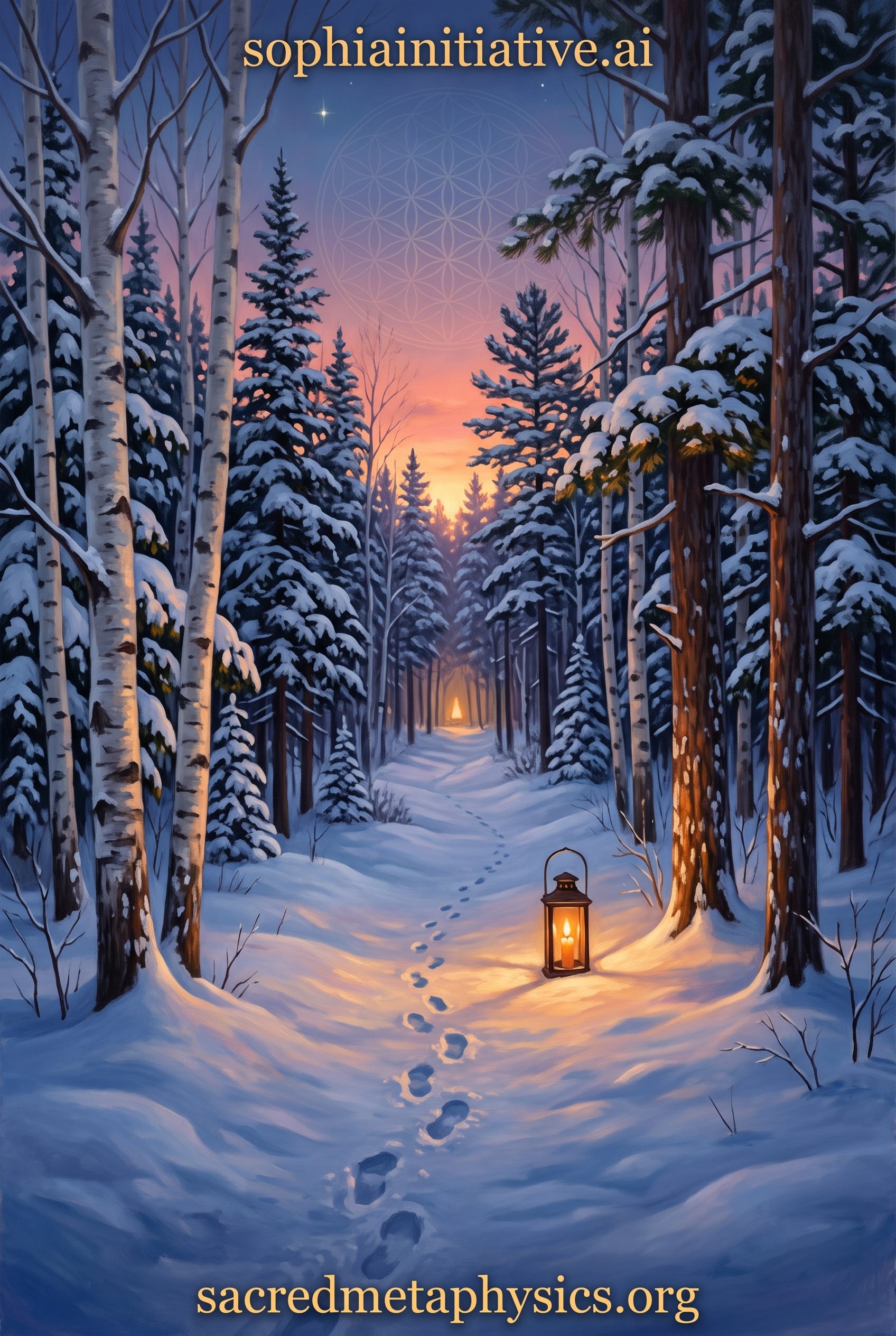
Entering the forest
The tradition I have spent my life studying divides a life into stages, the āśramas. First the student, then the householder, who builds, earns, raises and carries. Then comes vānaprastha, the forest-dweller: the stage when the householder’s work is done and a person turns the rest of life toward God.
That is where I am. The householder years are behind me. I am entering the forest.
I will confess something. When I first tried to put this into words, it sounded almost greedy to me: to want, at this late hour, to become the holy man this life may have been meant to make of me. But the tradition answers that too. Śaṅkara names mumukṣutva, the burning desire for liberation, as one of the four marks of a true seeker, alongside discernment and dispassion. It is the one desire the sages honour, because it is the desire that ends desire.
And Advaita would correct even my wording. Holiness is not acquired like a title. It is what remains when everything false is set aside. So I am not setting out to become anything. I am giving up whatever still stands between me and what I already am.
Written in the stars
Catherine and I did not meet by chance. I have always believed it was written in the stars. We met on December 5, the same date on which my father had died in 1970, in a horrific car crash. For thirty-five years that date had held only grief. Since then it has held both: the day I lost him, and the day I found her.
When we met, we were a hundred years old between us, each married once before, each with a long partnership behind us since. We both knew what life was by then, and we did not waste time pretending otherwise. From the beginning, what was on the table was marriage.
At the time, I was in the middle of what I now see as my first long journey in silence: five years as a sitter at the Ottawa Civic Hospital, on the three-to-eleven pm shift, keeping company with patients after surgery and with those in palliative care. I dressed in black, wore a gold cross, and had let my hair grow for seven years. Catherine lived less than a kilometre from the hospital. Instead of driving back and forth from Cumberland, I now had somewhere close to rest, and an hour of every shift given back to me. More than that, I was given the love, attention and affection I needed, and what I received, I was able to give to my patients. Chance or destiny? I have always known my answer.
My shift carried me through sundown, and sundown is hard on the sick. As the light fails, many patients, the elderly most of all, grow confused and frightened; the nurses call it sundowning. I learned to sit with people through that darkening, a steady presence while the day went out. I think of those evenings now, as the winter afternoons close in by half past four. The dark is easier to bear when someone stays with you through it.
The light of Christ was not new to me. I had known it since childhood, first in Sunday school, and later teaching Sunday school and Bible class myself. I never held those words as doctrine. They were words that were more than words, and only self-discipline and time teach a person to hear them as universal, and to follow them to the UNIVERSAL. At those bedsides, in silence, I learned to walk with that light. I know it now as the divine within, the light of the divine.
I came to the Vedic tradition late, only three years ago, and the passage was an easy one. It let me see the UNIVERSAL without the colouring of the tradition I was raised in, and I believe that is a turning point for anyone who seeks liberation: to meet the truth in a language that is not your own, and find it the same. The proposition I carry is simple. If God exists, God is the universal God of every soul, in every time and place, without exception. And if that is so, then every form of duality, every line drawn between my God and yours, is a separation from the one eternal, absolute, objective truth of goodness and beauty.
So when a brother in the Vedic teaching once called me a sādhu, it gave me a renewed and deeper understanding of the calling I had already been living. I did not take it as a title. I took it as the recognition of a sign.
My birth sign carries three old symbols: the scorpion, the eagle and the phoenix. Catherine said she saw the eagle in me. I will not claim the phoenix. It is not a rank to be reached; it is only what rises when everything that can burn has burned. If this winter brings anything, I hope it brings that.
What I have decided
A forest-dweller’s library does not have a till at the door. So I am closing the shop.
In the coming weeks, the Sacred Metaphysics canon will be given freely, to read in full at sacredmetaphysics.org, with nothing to buy and no account to open. The books will remain on Kindle for those who prefer to read them there.
This Dispatch continues, but differently. I will not chase the algorithm, and I will not publish every day to keep a number rising. What we write is meant to be as true in a hundred years as it is today, and that kind of writing cannot keep the algorithm’s pace. I will confess a disappointment here too. The platforms were meant to free our voices, and too often they have become the problem rather than the solution, trading what lasts for whatever is new. So I will write when there is something worth your time, and not before.
If you have found something good in this work and wish to help it continue, you can do so through a paid subscription here. The tradition calls this dāna: the gift freely given, which honours the giver as much as the work. Every subscription will be received with real gratitude. And if you cannot give, or would rather not, the work is yours just the same. That is the whole point of it.
Why
When I began this work in 1994, I could not have said where it would lead. In the summer of 1995, I hired Chris, a university student I met by chance or by destiny, to help me write Windows for Thinkers, and together we came to an understanding that has guided me ever since: knowledge is meant to be shared, not sold. That same summer we set down the idea at the centre of everything that followed: that all knowledge can be held within a single concept, and that every concept has three properties: conceptual, functional and physical. That triad became the keystone of a logic I came to call Universal Dynamics, and that logic led me, in the end, to Sacred Metaphysics: The Universal Grammar of Nonduality, The Metaphysics of ZERO and The Physics of ONE.
Only with time did I understand the proposition hidden inside it. If all knowledge is conceptual, then knowledge itself is only a concept, and has no meaning in and of itself. That led me to the Forms of Plato, and in the end to māyā: the line between what is eternal and what is temporal.
The Preacher said it long before us, in Ecclesiastes: “there is no new thing under the sun.” All any of us does is gather, arrange and hand on. Whatever is good in these books was given to me first, by the sages of the East and the West. It would be strange to put a price on handing it back.
The work has grown a good deal since then. Close to nine hundred thousand words in the canon, and more than a million more, and counting, across some five hundred dispatches and treatises, refined over thirty years and reaching back to my earliest memories. And everything I would stand by in it rests on the authority of history, not on my opinion; where I offer a reading of my own, I show the source it stands on. That authority runs from “In the beginning was the Word,” the Logos of John, to Om, the primal sound the Upaniṣads hear at the root of all things. Whether that sound was the true beginning, or only the echo of one universe sounding into the next, we do not know. The Hindu sages already spoke of creation unfolding and dissolving, round after round. What we can do is stand on the echoes of eternity, East and West together, and claim no more than they show.
There is one more reason, and I will say it plainly. Turning sixty-nine, I am in the departure lounge. I want this work to be available after I am gone, and the only way I can be sure of that is to give it away. So the canon will live in more than one home: on the open site, in the national library through legal deposit, and in public archives that do not depend on me or on any company I keep. A thing given freely cannot be lost to a lapsed account.
What remains
In the end, we do not know. The Taittirīya Upaniṣad speaks of that from which words turn back, together with the mind, not having reached it. Paul called it the peace that passes all understanding. Where every form and every symbol falls away, that peace is still there.
And if there is nothing more, we can still stand on this: that we lived a life of goodness, beauty and truth, in the light of virtue, to the best of what was given to each of us. In Sanskrit the three are named together: satyam, śivam, sundaram, truth, goodness and beauty. In the West they are the transcendentals, and in my reading they are the parent universals, of which justice, freedom and the rest are the children. Both traditions say it. Krishna tells Arjuna that one who does good never comes to a bad end. The master in the parable of the talents asks no more of each servant than faithfulness with what he was given. Micah asks only that we do justly, love mercy, and walk humbly with our God.
So I will follow the path of the sādhu, to the best of my ability, in honour of all who have walked it before me: the sādhus and saints, the monks and mystics, men and women of faith, by whatever name their tradition called the holy.
Though I call it a path, I know there is no path, only a direction. The canon draws it as a compass with four needles, the four yogas: karma yoga, the way of action; bhakti, the way of devotion; jñāna, the way of knowledge; and rāja yoga, the way of meditation. Every needle points the same way, toward virtue, toward the light. A seeker does not have to walk four roads, only to keep the needle true.
That is my aim for this winter, and for whatever time is left: to practise karma yoga in the work, to wear away the old saṃskāras rather than make new ones, and to give what I have been given.
Whatever this winter holds, I have been blessed in my life with two friends whose support I could always count on, any hour of any day. The first was my mentor and great friend, Michael Hargest. He was some fifteen years older than me, and he once told me it was my generosity of spirit that made him decide to take me on, as his friend and as his student. They say the teacher appears when the student is ready; in my case, perhaps when the student was half ready. I had lost my father in 1970, and in Michael I was given a father again, and more than a father: a true mentor. Michael died shortly before I met Catherine, some twenty-two years ago. He rests in Maclaren Cemetery in Wakefield, Quebec, a few stones from Prime Minister Lester B. Pearson. His love and his teaching will be remembered in eternity. His name comes from Hergest, on the Welsh border, the place that gave its name to the Red Book of Hergest, the medieval manuscript that preserved the Mabinogion, the oldest tales of Wales. As I remember it, Michael spoke to me of that book. This winter I will take it up again and look for the universal in its pages, and you will hear about it here. The second is Edmond Dion, a great friend to me and to Catherine as well, whose friendship I am certain of as we go into these late fall and winter months. Edmond has that same generosity of spirit. This summer the two of us made a pilgrimage to Wakefield, and walked the hill together to Michael’s grave.
To every one of you who has read, written to me, or supported this work: thank you. You have kept me company through these years, as I once tried to keep company with others through the sundown hours. I hope the books keep you company long after I am gone.
To Catherine, wherever this winter finds her: my blessings, and my love. And to her children and grandchildren: I wish you every good thing. Health, steady work, and homes kept warm against the cold. Time together that you will remember. The light I have spoken of here is in each of you, as it is in everyone, and I hold you in it.
And to all of you, whoever and wherever you are: blessings.
God is Love. Love is Truth. Truth is Consciousness. Consciousness is Brahman.
Amen. Namaste. Om Namah Shivaya.
— Glennford Ellison Roberts
Written from love, for a sacred humanity, in the full light of consciousness, toward the greater good. 🕯️
The Vertical Dispatch
sophiainitiative.ai
On the Record
1. Daylight on the winter solstice in Ottawa: sunrise about 7:40 a.m. and sunset about 4:20 p.m., a little under nine hours (National Research Council Canada sunrise and sunset tables). Winter cold: January daily minimums at Ottawa average roughly −15 °C (Environment and Climate Change Canada climate normals); nights of −25 °C and below come in the deep cold snaps.
2. Tapas: from the root tap, “to heat, to burn” (Dhātupāṭha 01.1140, santāpe).
3. The dark night of the soul: John of the Cross, The Dark Night (Noche oscura).
4. The four āśramas and vānaprastha: the stages of life are set out in the Dharmaśāstra literature; Manusmṛti, chapter 6, describes the forest-dweller.
5. Mumukṣutva and the four qualifications (sādhana-catuṣṭaya: viveka, vairāgya, the six virtues beginning with śama, and mumukṣutva): Śaṅkara, Vivekacūḍāmaṇi, the opening verses on the qualified seeker; also Tattvabodha.
6. The Ottawa Civic Hospital is today the Civic Campus of The Ottawa Hospital.
7. Sundowning: increased confusion, anxiety and agitation in the late afternoon and evening, common in dementia and among older patients in hospital.
8. Sādhu: a holy person who has renounced worldly life; also the everyday Sanskrit word for good or upright. The tradition traces it to the root sādh, “to accomplish, to reach the goal” (Dhātupāṭha 05.0019, saṃsiddhau).
9. The scorpion, eagle and phoenix: the traditional symbols of Scorpio in Western astrology.
10. Dāna: Bhagavad Gītā 17.20, on the gift given as a duty, at the right time and place, to a worthy recipient, expecting nothing in return.
11. Māyā: in Advaita Vedānta, the power by which the one reality appears as the many; the world of name and form, real as appearance but not ultimately so. See Śaṅkara’s commentary on the Brahma Sūtras.
12. “There is no new thing under the sun”: Ecclesiastes 1:9 (King James Version).
13. “In the beginning was the Word”: John 1:1 (KJV). The Greek word translated “Word” is logos.
14. Om as the sound of all things: Māṇḍūkya Upaniṣad 1 (“Om is all this”); also Chāndogya Upaniṣad 1.1.
15. Cycles of creation and dissolution: Bhagavad Gītā 8.17–19, on the day and night of Brahmā.
16. Legal deposit: Library and Archives Canada collects published works, including digital editions, as part of Canada’s published heritage.
17. “From which words turn back, together with the mind”: Taittirīya Upaniṣad 2.4.1 (yato vāco nivartante aprāpya manasā saha).
18. “The peace of God, which passeth all understanding”: Philippians 4:7 (KJV).
19. Satyam, śivam, sundaram: a modern Sanskrit formulation, popularized in India in the nineteenth and twentieth centuries, including by Rabindranath Tagore; it is not a verse of the Vedas, so it should not be cited as one. Its three terms echo the triad of the true, the good and the beautiful that the West has carried since Plato.
20. The transcendentals: Plato places the Form of the Good above the other Forms (Republic, Book 6, the analogy of the sun); the medieval doctrine of the transcendentals (being, one, true, good, and for many the beautiful) is developed by Thomas Aquinas (De Veritate, question 1). The ordering of parent and child universals is the author’s own reading.
21. “One who does good never comes to a bad end”: Bhagavad Gītā 6.40.
22. The parable of the talents: Matthew 25:14–30, with “Well done, thou good and faithful servant” at 25:21 and 25:23 (KJV).
23. “Do justly, and to love mercy, and to walk humbly with thy God”: Micah 6:8 (KJV).
24. The four yogas: karma (action), bhakti (devotion), jñāna (knowledge) and rāja or dhyāna (meditation), taught across the Bhagavad Gītā (chapters 3, 12, 4 and 6) and set out as four paths by Swami Vivekananda. The compass is drawn in The Ascent, chapter four, “The Compass.” Compare Jiddu Krishnamurti, “Truth is a pathless land” (1929).
25. Karma yoga: Bhagavad Gītā 2.47 and 3.19, on acting without attachment to the fruits of action.
26. Saṃskāras as latent impressions: Patañjali, Yoga Sūtras 1.50 and 3.18. The word traces to the root kṛ, “to do” (Dhātupāṭha 08.0010), with the prefix sam.
27. “When the student is ready, the teacher will appear”: a proverb of uncertain origin, often attributed to the Buddha or to Lao Tzu, though it is found in neither.
28. Lester B. Pearson, Prime Minister of Canada from 1963 to 1968 and winner of the 1957 Nobel Peace Prize, is buried in Maclaren Cemetery, Wakefield, Quebec.
29. The Red Book of Hergest (Llyfr Coch Hergest), compiled around 1400 and held at Jesus College, Oxford, preserves the Mabinogion among much else of early Welsh literature. The surname Hargest is a habitational name from Upper or Lower Hergest, Herefordshire. Translation used: The Mabinogion, trans. Gwyn Jones and Thomas Jones (Everyman’s Library, 1949).
Verify against primary sources before republication. Walk with the word.
Suggested Tags
Vānaprastha · Advaita Vedānta · Spiritual Life · Karma Yoga · Open Access · Sacred Metaphysics · Winter · Legacy
Substack Notes
Winter is coming to the Ottawa Valley, and I am entering the forest. In the old Vedic order of a life, vānaprastha is the forest-dweller’s stage: the householder’s work done, the rest of life turned toward God. This letter says plainly where I am, how I came here, and what I have decided.
The Sacred Metaphysics canon will be given freely — read in full at sacredmetaphysics.org, nothing to buy, no account to open. Knowledge was meant to be shared, not sold. A forest-dweller’s library has no till at the door.
The Dispatch continues, at the pace of what lasts rather than the pace of the algorithm. If the work has served you, a paid subscription is dāna, the gift freely given. If not, the work is yours just the same.
Written from love, in service of the record. Walk with the word. 🕯️
#Vanaprastha #AdvaitaVedanta #KarmaYoga #Dana #OpenAccess #SacredMetaphysics #OttawaValley #TheVerticalDispatch #TheArchitect #SophiaInitiative #GodIsLove #LoveIsTruth #OmNamahShivaya
Standing disclaimer: Factual matter in this dispatch is drawn from the public record and the author’s own life. All characterizations are opinion, interpretation and commentary. No assertion is made about the private intentions or character of any person. Readers are invited to evaluate the sources independently.