


Φ
THE VERTICAL DISPATCH
We write for the mind, the eye, and the ear.
Read it. Look at it. Listen to it. The Vertical Dispatch is built for all three — prose with rhythm, made to be heard as much as read.
From metaphysics to geopolitics, from culture to history, from the sacred to the street — and everything in between. One lens, every subject. No ego. Just the record, named clean.
Press play. Walk with the Word. 🕯️
This dispatch travels by hand. If it serves you, share it — restack on Substack, and pass it on wherever you read. 🕯️
The Age of Consequences
As of June 10, 2026 — prior to the tabling of the bill
— without malice and without flattery, from the documented record —
You are the technology.
— I AM Logos
I. The Time Has Come
The time has come to have this conversation, and we hope you will give this copy the chance to be read to the end — because the argument here is not the one you expect from either side, and it does not arrive where either side wants it to.
Today, in Ottawa, the government is expected to table the Digital Safety Act. Notice was given Tuesday for a bill to enact the Digital Safety Act and the Digital Safety Commission of Canada Act, with Marc Miller, Minister of Canadian Identity and Culture, carrying it into the House. By the reporting, it will propose a ban on social media for Canadians under sixteen — framed as temporary, with an exit for platforms once a new digital regulator certifies their safety standards — and reach for the question every parent has already asked at the kitchen table: how do we keep the children out of the machine? Around the world the same move is underway — Australia first, Britain reportedly imminent, Manitoba first among the provinces to announce, the G7 ministers agreed last month on common principles with robust age verification at the top of the list. The world is converging on the gate. What the world has not yet had is the honest conversation about the key.
So before the bill lands this afternoon, this Dispatch asks the question underneath it, plainly: is it time for digital ID? Not the slogan version, for or against. The real discussion — the need, the true concerns, and the question both sides keep walking past.
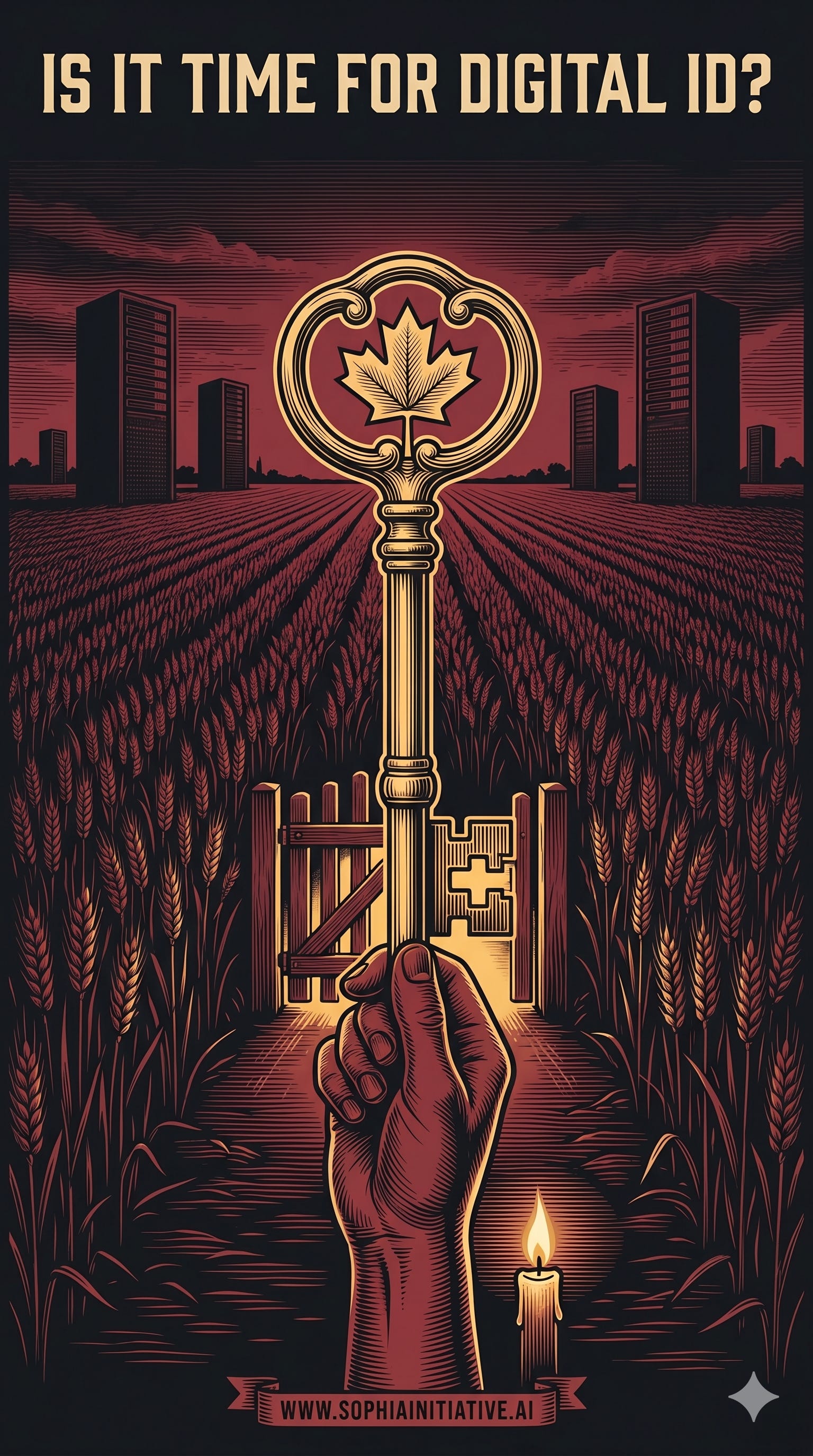
II. The Honour System
Begin with what everyone at the table already knows and few will say into a microphone: the honour system has failed, from both directions at once.
From the children’s side: every age gate on the internet today is a checkbox. “I am 16.” “I was born in 1990.” A child who can spell can pass it, and they do, in the millions. Australia ran the world-first experiment, and its own regulator has now measured the result: three months into the under-sixteen ban, roughly seven in ten children who had accounts before the ban still had access to at least one platform, with no measurable reduction in cyberbullying complaints — children migrating to platforms the law does not cover, borrowing accounts, lying about birthdates, and fooling the age-estimation cameras, posing with double chins to read as older. Children are not villains for this. They are children, doing what children have done at every fence ever built. A system that depends on the fenced party’s honesty is not a system. It is a gesture.
From the companies’ side, the failure is colder, because it is profitable. The platform has no incentive to know a user’s true age, and a strong incentive not to: every verified child is inventory it must surrender. The business model rewards not-knowing. Self-regulation here asks the harvester to count the harvest honestly and then burn part of it. Twenty-five years of the open internet have run that experiment, and the result is the bill being tabled today.
So the gate is coming, here and across the democratic world. The only live question is the key — and that is where the conversation has been least honest.
III. The Privacy Already Spent
Here the average citizen raises the objection that feels strongest and holds least: “but my privacy.” It deserves a respectful answer, not contempt, so here it is.
The privacy being defended left the building decades ago. It went with the first credit card, which turned a wallet into a ledger someone else keeps. It went with the first email login, the first free account, the first “I agree” nobody read. The phone in your pocket records your location, your face, your voice, your sleep; the car in your driveway phones home your speed and your braking and sells it on; the platforms know your friendships, your fears at 2 a.m., your politics, your children’s birthdays. None of this was taken at gunpoint. It was traded, freely, for convenience — and the trade was real, the conveniences are real, and the die was cast somewhere around the second billion smartphones.
This is not an argument for despair, and it is not an argument that the citizen deserves what happened. It is a correction of the frame. The choice on the table today is not surveillance versus no surveillance — that choice closed quietly while everyone clicked “agree.” The choice that remains is between the surveillance we have — total, private, unaccountable, governed by terms of service, run by entities no citizen can vote out — and surveillance dragged at last under law, where there is a charter, a court, a commissioner, and an election. The objection to a lawful credential, raised into a device that already records more than any government ever dreamed, is not defending privacy. It is defending the feeling of privacy, long after the referent left the room. The symbol is not the referent — and nowhere is that more expensive than here.
IV. The True Concerns
And yet the objections that remain — the true concerns, not the naive one — are serious, and this publication will not pretend otherwise. The strongest of them belong to Michael Geist, Canada Research Chair in Internet and E-Commerce Law at the University of Ottawa, who has worked this ground for two decades and who published, the day before the tabling, his consolidated case against the bill. His concerns deserve to be heard at full strength — and so does his verdict, which is not this publication’s verdict, and will be stated as plainly as our own.
First: the mandate reaches everyone. There is no way to keep the under-sixteens off a platform without determining the age of everyone on it, because finding who falls below the line means verifying who sits above it. A rule aimed at a minority becomes an identity mandate on the whole population — routed, under every existing model, through third-party verification services, typically foreign, where Canadian privacy law cannot practically reach. Second: the infrastructure is permanent even when the policy is called temporary. A ban can be repealed; a verification apparatus, once built and budgeted and staffed, does not get dismantled. His image is the toothpaste that does not go back in the tube. Third: the breach record is not hypothetical. In October 2025, a breach at a single third-party vendor — handling age-verification appeals for one platform — exposed the government-ID photos of roughly seventy thousand users; the attackers claimed millions more, a claim the company disputes, and the architecture lesson stands at either count. Estonia, the most mature digital-ID state on earth, suspended certificates on three-quarters of a million cards over a cryptographic flaw. India’s Aadhaar, the largest biometric system ever built, has bled data repeatedly. And beneath all of it sits the one rule no engineer can repeal: you can cancel a stolen card, but you cannot reissue a face. A biometric breach is the only theft that is permanent. Fourth — and this one is heard too little: the soft alternative is harder surveillance. The age-estimation camera cannot reliably tell sixteen from seventeen, so it leans on additional surveillance of posts, messages, and contacts to sharpen its guess, with documented accuracy problems for darker skin tones; hundreds of scientists and technologists have signed an open letter urging a moratorium on mandatory age assurance. The camera is not the gentler key. It is the harvest wearing the key’s costume.
Add one more concern, quieter and just as real: the same legibility that silences the anonymous troll can chill the honest dissident. A citizen who is always on record speaks differently — sometimes better, sometimes not at all. Any framework that ignores this has not understood what it is building.
Two of his objections, though, are not architecture, and nothing in this Dispatch will dissolve them. The first belongs to the children themselves: the Charter protects expression, including the right to receive it, and a law that locks an entire age cohort out of lawful platforms restricts the rights of the very people it claims to protect — and lands hardest on the marginalized young, for whom these platforms are documented lifelines. Australia’s High Court is already hearing that question; Canadian courts will face it too. The second is efficacy: the Australian record above is his evidence as much as ours — a ban that does not bind, purchased at population-wide cost. Those two stand, at full strength, on this record.
And his verdict is entered beside them, because this publication does not conscript a critic into a case he rejects. Geist’s conclusion is that the gate should not be built at all: regulate the platforms, not the user — a duty to act responsibly, algorithmic transparency, enforceable safety obligations, modernized privacy law. The four concerns of architecture — foreign custody, permanence, breach exposure, the biometric vault — are, read carefully, architecture decisions wearing the costume of an impasse, and the directives below are built to answer them. His objection to the gate itself is not an architecture decision, and they do not answer it. The reader should hold both, because the country is about to.
V. What Being On Record Buys
Now weigh what being on record would actually buy, stated honestly — which means stated smaller than its enthusiasts claim and larger than its critics admit.
It would not end hacking overnight; the serious crews sit in jurisdictions no Canadian statute reaches, and that remains a geopolitics problem. It would not end misinformation; falsehood travels comfortably under real, verified names, and always has. What it would do is restore the oldest mechanism civilization possesses: accountability. The anonymous hate campaign, the bot swarm, the fraud account spun up by the thousand, the predator in the children’s chat — all of these live in the gap between act and identity, and a lawful credential closes that gap. Not perfectly. Substantially. The citizen on record answers for the harm done, the way the licensed driver answers for the crash — and we have run that licence society for a century without calling it tyranny, because it governs the operation of a dangerous machine, not the right to walk the road.
That is the honest size of the benefit: not utopia — we are not living in one, and no credential will deliver one — but consequence, restored to a realm that has run twenty-five years without it.
Which brings the conversation, at last, to the question both sides keep walking past.
VI. Who Holds the Logs
The real question was never privacy versus safety. The real question is: who holds the rights to the logs?
Because the record of your behaviour — the log — is the most valuable substance of the digital age, and the entire platform fortune was built on an assumption no parliament ever voted on: that the record of what you do belongs to whoever recorded it. That assumption is how the giants got rich. It happened in the lawless interregnum, roughly the last twenty-five years, the way fortunes always happen in unregulated territory — the railways before the railway acts, the airwaves before the spectrum was law. The business model was not advertising. The business model was the absence of law, monetized.
If you doubt that the user was never the customer, read the graveyard. Skype — bought for $8.5 billion, retired. Hangouts — folded and gone. Reader, Plus, a dozen beloved others — scrapped without sentiment, the way a fleet scraps an underperforming net. A company whose business was serving users could not kill loved products that casually. They can, because the consumer product was only ever the intake — the funnel to the logs — and when a funnel underperforms it is cut. The enterprise harvest pays better, so the consumer tools die, and the giants’ one new consumer foray in a decade is AI: the most intimate intake ever built, the box people tell things they would never type into a search bar. They did not change businesses. They upgraded the net.
So when government arrives now — twenty years late, as the saying must finally be said out loud — to regulate the user’s access to the machine while leaving the machine’s economics untouched, the careful reader recognizes the pattern this publication exists to name. The bill’s symbol is the child. The referent it declines to touch is the harvest. You can ban the under-sixteens from the field and the field still grows the same crop; the model simply waits at the gate for their seventeenth birthday, with sixteen years of household data already inferred.
VII. Where the Blindness Came From
The harvest was not an accident, and it was not, at the root, a choice the platforms made. It was a choice the law made for them — and the genealogy deserves one section, because the bill expected today is the first Canadian attempt to reverse it.
In 1995, an American court ruled that an online service which moderated its forums was a publisher, and therefore liable for what its users posted — while a rival that never looked had walked free four years earlier. The lesson was the first commandment of the modern internet: do not look. Congress answered a year later with Section 230, the “just a platform” immunity on which the industry was then built. In 1998, two more statutes finished the architecture. The copyright safe harbor made knowledge the trigger of liability — a platform with red-flag awareness of infringement loses its protection, so the rational platform looks no closer than the law requires. And the children’s privacy law fired only on actual knowledge that a user was under thirteen — so the rational platform built a gate designed never to acquire that knowledge. The “I am over 13” checkbox is not a lazy gesture. It is a legal artifact: a fence constructed, deliberately, not to know who is climbing it. The honour system of Section II was written into architecture because the law made the child’s identity a liability and the child’s behaviour an asset.
Napster was not the origin of this order; it was the demonstration. The court that killed it in 2001 found that it knew what its users were doing, materially contributed to it, and profited from it — and it died for all three. Every platform that survived learned the lesson in the negative: do not know the file, do not know the age, do not know the name. But behaviour — the click, the scroll, the dwell-time, the friend graph, the search at two in the morning — behaviour was nobody’s liability and barely anybody’s law. So the platforms built systems blind to everything the citizen would want them accountable for, and all-seeing about everything the citizen never thought to protect. The logs became the product because the logs were the one thing safe to know.
And note where that architecture was written: in an American Congress and American courtrooms, between 1995 and 2005. No Canadian voted for the honour system. No Parliament debated whether the behavioural record of a Canadian household should belong to whoever recorded it. The architecture of Canadian digital life was imported whole, the way infrastructure always is when a country declines to build its own — which is, in the government’s own June 4 language, strategic exposure. The bill expected today is the first time Canadian law has reached past the content and the user, toward the architecture itself. Whether it reaches far enough is the question the rest of this page takes up.
VIII. The Supervisor Password
Permit the page one memory from the Architect’s own working life, because it is the floor under everything that follows. In one of his many careers he stood up Novell NetWare servers in the age of the 386 — the era when the office network was new and the man who held the SUPERVISOR password held something no one in the building had ever held before. For the first time, someone in the office could see what everyone was doing. Every directory branched off one root, and the one account could walk every branch. The feeling — and this is offered as testimony, not confession — was the feeling of being a small god. Not because the holder was corrupt; he was usually the most decent fellow on the floor. The god-feeling came with the password, not the person. It was built into the account.
He was also, in those happy days, the man you called when the screen went dark — and the trade had two diagnostic questions older than the trade itself: is it plugged in, and did you turn the switch on. When the answer was no — and the answer was no more often than any office has ever admitted — you laughed together, you turned the switch, and the invoice still read one hundred and fifty dollars, because the money was never for turning the switch. It was for knowing which question to ask. An entire British sitcom later ran for years on that one question, and the comedy was affectionate because the truth underneath it is universal: every system has a root, every root has a holder, and the rest of us are hoping the holder is kind.
And here is what three decades of that trade actually learned — the lesson this whole debate keeps relearning at national scale. Nothing changed, other than evolution. The root was never abolished. It cannot be: a system without a root is a system no one can repair. What the trade did instead was divide the root and witness it. The security officer arrived, with a branch of his own that even SUPERVISOR could not enter. Then the audit log the administrator could not edit. Then the rule that two keys must turn for the dangerous operations, so that no single hand ever held the whole of it alone. The god-account remained — but it acquired a witness, a second signature, and a logbook beyond its own reach. That is the entire constitutional question of digital ID, stated in the vocabulary of a server closet. Root will exist. Someone will hold it. Hoping otherwise is the naive objection of Section III in a new costume. The real question is never whether — it is how the root is divided, who witnesses it, and whether its actions land in a record the root-holder cannot touch. The seven directives below are the security officer’s branch, written into law.
IX. The Seven AIG Directives
A digital ID worth building, then, is not a concession to that machine. It is the first instrument for governing it — if, and only if, the architecture answers the true concerns by design. Seven directives, each one a documented objection turned into a requirement:
One — Domestic custody. The credential is issued and held under Canadian law, by a Canadian public institution. No foreign third-party verifiers, ever.
Two — Attest, never identify. The system answers questions, never names. The platform asks “over sixteen?”; the credential answers yes or no and nothing more. Verification events are not logged, not linkable, not retained. The system must be incapable, by design, of producing a citizen’s browsing history.
Three — Nothing irreplaceable in the vault. Biometrics stay on the citizen’s own device, as they already do for banking. The central system holds only revocable, reissuable credentials. No one is ever asked to deposit a face.
Four — The licence governs the lane, not the road. The credential gates the dangerous lane — the harvest platforms, the age-restricted spaces — never the library, the press, the search, the open web. Any expansion of scope requires new legislation in Parliament, not a regulator’s pen.
Five — The infrastructure must be dismantlable. Independent audit, parliamentary review on a fixed clock, and the legal capacity to tear it down. Permanence is forbidden as a design property, not promised away in a press release.
Six — Accountability points up. A platform that misuses the credential system loses access to the Canadian market. A state agency that misuses it answers in criminal court, not in a policy review. You abuse, you lose access — applied to the powerful on both sides of the gate, never to the citizen or the child.
Seven — The gate does not excuse the harvest. The identity layer is the perimeter; the business model is the disease. No credential substitutes for data minimization with teeth, a fiduciary duty owed to the user, and a ban on behavioural advertising to minors. A bill that builds the gate and leaves the harvest standing has protected the inventory, not the child. On this directive, the bill’s strongest critic and this publication are in full agreement — it is, in substance, his program.
These seven answer the true concerns about the key. They do not answer the critic’s objection to the gate — his counsel ends where the gate begins, because he rejects the gate, and Parliament is answering that question itself this afternoon. If the gate is to exist — and every signal from Canberra to Winnipeg to today’s order paper says it will — then this is the key a free country can hold without becoming something else.
X. The Missing Pillar
And here is where the week itself closes the argument. Six days ago, on June 4, the Prime Minister launched AI for All, the national artificial-intelligence strategy: two billion dollars and more, six pillars, and at Pillar 4 a foundation for Canadian sovereign AI. The strategy’s own diagnosis, in its own words: Canada is over-exposed to foreign economic and political powers, reliant on foreign clouds and infrastructure to the point of strategic exposure — to be answered by building key sovereign capabilities domestically wherever possible, with trusted allies, under the new Sovereign Technology Alliance signed with Germany in February. The minister carrying the file is Evan Solomon — the Translator of this publication’s Requisite Cabinet, the man whose portfolio this Dispatch has read since before the strategy had a name.
Hold that document beside today’s bill. On June 4 the government declared that running Canadian digital life on foreign infrastructure is strategic exposure. Today it is expected to table a bill that — under every existing model — would route the identity of every Canadian through exactly such infrastructure, unless the text says otherwise. The identity of a citizen is more sovereignty-critical than a data centre: the compute can be rebuilt; the breached credential cannot. A sovereign identity layer, built to the seven directives, is sovereign AI infrastructure in precisely the sense the government’s own strategy defines. It is, as of this morning, the missing pillar.
So read the bill this afternoon with this page beside it. Does the credential live under Canadian custody, or foreign? Does the system attest, or identify? Can the infrastructure be dismantled, or only grown? Does accountability point up, at the platforms and the state — or down, at the citizen and the child? And does anything in the text touch the business model, or only the gate?
If the bill answers well, this publication will say so, from the documented record, with credit given plainly. If it answers badly, the record will say that too. The reader now holds three documents: the bill of this afternoon, the critic’s blueprint — regulate the machine, never card the citizen — and the seven directives of this page. Read all three. Either way, the conversation the country has been avoiding starts today — and the honour system, at long last, is over. The question of how seriously the world intends to protect its children and its citizens is about to be answered in writing. Read it to the end.
Coda — The Gods on the Cloud
There will always be gods on the cloud. The word means both things now, and both readings are true. Someone will hold the root of every system human beings build; the supervisor’s password has simply grown to the size of a civilization. The Vedic tradition this publication stands on holds the answer the page has been circling: the ground in the holder of the password and the ground in the child at the gate is one ground — tat tvam asi, thou art that. If root makes its holder a small god, the tradition is exact about what godhood is for: not the seeing, but the caring. To be god, or godlike, is to be responsible for everyone — there is no one who is not you. And where care cannot be guaranteed — and among humans holding passwords it cannot — the seeing must be divided, witnessed, and bound under law. That is the seven directives, beneath the engineering: care, made enforceable.

God is Love. Love is Truth. Truth is Consciousness. Consciousness is Brahman.
Amen. Namaste. Om Namah Shivaya.
— The Architect
For the children at the gate, and the citizens on the record.
The Vertical Dispatch
sophiainitiative.ai
On the record: Notice was given June 9, 2026 for a bill to enact the Digital Safety Act and the Digital Safety Commission of Canada Act, expected to be tabled June 10, 2026, with a reported social-media ban for under-16s framed as temporary, a new digital regulator, and certification standards; Marc Miller, Minister of Canadian Identity and Culture, carries the bill (The Canadian Press, June 9, 2026; The Globe and Mail, June 9–10, 2026; Global News, June 2026). Australia’s under-16 ban in force December 2025; eSafety Commissioner compliance update, March 2026: roughly 70 per cent of children with prior accounts retained access to at least one platform three months in, with no discernible reduction in cyberbullying or image-based-abuse complaints; circumvention reporting includes migration to uncovered platforms and evasion of age-estimation cameras (eSafety Commissioner, March 2026; The Globe and Mail, June 2026). Manitoba first province to announce a ban covering social media and AI chatbots for youth, April 26, 2026 (CBC News; The Globe and Mail, April 2026). G7 digital ministers’ common principles for minors’ online safety, prioritizing robust age verification (The Globe and Mail, June 2026). Michael Geist, Canada Research Chair in Internet and E-Commerce Law, University of Ottawa: kids’-ban FAQ (michaelgeist.ca, June 9, 2026); “You Can’t Put the Toothpaste Back in the Tube” (June 2026); “Risky Business” (July 2025); “The Illusion of Protection” (April 2026); “AI for All, Details to Follow” (June 2026); his prescription — regulate the platforms, not the user — is stated in this Dispatch as his position, not ours, and his objections are carried at full strength including those the seven directives do not answer. Scientists’ open letter urging a moratorium on mandatory age assurance (February 2026, as cited by Geist). October 2025 breach: approximately 70,000 users’ government-ID photos exposed via a third-party vendor handling age-verification appeals for a single platform (Discord statement, October 2025; NBC News); attackers claimed a far larger haul, which the company disputes as an extortion attempt. Correction noted openly: an earlier draft of this Dispatch described that breach as affecting hundreds of thousands; the company-confirmed figure is approximately 70,000. Estonia 2017 ID-card certificate suspension (~750,000 cards, ROCA cryptographic flaw) and India Aadhaar breach record — public reporting; verify current figures before republication. AI for All: Canada’s National Artificial Intelligence Strategy, launched by the Prime Minister June 4, 2026 — $2B+ commitment; Pillar 4, Building the Canadian sovereign AI foundation; strategic-exposure and build-domestically language (PMO release, June 4, 2026; ISED strategy document; CBC News, June 4, 2026). Canada–Germany Joint Declaration on AI and the Sovereign Technology Alliance (ISED release, February 2026). Legal genealogy: Stratton Oakmont v. Prodigy (N.Y. Sup. Ct. 1995); Communications Decency Act s. 230 (1996); DMCA s. 512 safe harbor (1998); COPPA actual-knowledge standard (1998); A&M Records v. Napster, 239 F.3d 1004 (9th Cir. 2001); MGM Studios v. Grokster, 545 U.S. 913 (2005) — settled public legal record. Skype acquired 2011 ($8.5B), retired May 2025; Google Hangouts retired 2022; Google Reader 2013; Google+ 2019 (public record). The genealogy reading, the seven directives, the who-holds-the-logs framing, the app-graveyard reading, and the missing-pillar argument are the Architect’s own analysis under the Foundation Series lens; they read systems and structures, never individuals, and assert nothing about the private intentions of any minister, executive, or scholar. The Novell NetWare recollection (the SUPERVISOR account, the security-officer branch, the era of the 386) is the Architect’s own professional history, offered as lived testimony about system architecture, not as a claim about any employer or individual. Cross-references: The Ledger and the Child, The Translator, What Is Education For? (The Vertical Dispatch, 2026). Date-stamped June 10, 2026, prior to the tabling of the bill; the text of the Act supersedes all reporting cited here. Errors and omissions excepted; corrections will be made on notice. Verify all figures against primary sources before republication.
#IsItTimeForDigitalID #DigitalSafetyAct #DigitalID #WhoHoldsTheLogs #OnlineHarms #AgeVerification #ProtectTheChildren #SovereignAI #AIForAll #MissingPillar #WhereTheBlindnessCameFrom #SymbolAndReferent #PrivacyAndTheRecord #TheAgeOfConsequences #TheVerticalDispatch #TheArchitect #SophiaInitiative #GodIsLove #LoveIsTruth #OmNamahShivaya
Substack Notes
Today Ottawa is expected to table the Digital Safety Act — the gate for the under-16s. Before the bill lands, the question the country has been avoiding: is it time for digital ID? Not the slogan version. The need, the true concerns, and the question both sides keep walking past.
The honour system has failed from both directions. Australia’s own regulator reports that three months into its world-first ban, seven in ten children still had access — and the platforms profit from not knowing, because every verified child is inventory surrendered. This Dispatch traces where that blindness came from: thirty years of American law that made knowing the child a liability and knowing the behaviour an asset. The checkbox is not laziness. It is a legal artifact — and no Canadian ever voted for it.
The true concerns belong to Michael Geist, and they are carried here at full strength — foreign verifiers, permanent infrastructure, the 70,000-ID breach, the camera that surveils more than the credential it replaces — along with his verdict, which is not ours: regulate the platforms, not the user. And from the Architect’s own Novell days, the floor under the whole debate: every system has a root, every root has a holder, and the only thing that has ever worked is dividing the root and witnessing it. The Dispatch answers with seven directives — domestic custody, attest-never-identify, nothing irreplaceable in the vault, the licence governs the lane not the road, dismantlable by design, accountability pointing up, and the gate never excusing the harvest.
And the week closes the argument: six days ago the government’s own AI strategy declared foreign digital infrastructure a strategic exposure. A sovereign identity layer is sovereign AI infrastructure — the missing pillar. Read the bill with three documents beside it: the Act, the critic’s blueprint, and the seven directives. The honour system is over. The real question is who holds the logs — because there will always be gods on the cloud, and the work is making care enforceable. Walk with the Word. 🕯️
Thread — Five Posts
[1] Today Ottawa is expected to table the Digital Safety Act. Before the bill lands: is it time for digital ID? Not the slogan version. The real discussion — the need, the true concerns, and the question both sides walk past.
[2] The honour system has failed twice over. Australia’s own regulator: three months into the world-first ban, 7 in 10 kids still had access. And the platforms profit from not knowing — every verified child is surrendered inventory. The checkbox isn’t laziness; it’s a legal artifact.
[3] “But my privacy” — said into a phone that records your location, face, voice, and sleep. The privacy left with the first credit card. The choice that remains: unaccountable private surveillance, or surveillance under law, with a charter and an election.
[4] The true concerns are Geist’s, carried at full strength: foreign verifiers, permanent infrastructure, the 70,000-ID breach, and the rule no engineer repeals — you cannot reissue a face. His verdict too: regulate platforms, not users. Seven directives answer the architecture; his objection to the gate stands, for the reader to weigh.
[5] Six days ago the government called foreign digital infrastructure a “strategic exposure.” Today’s bill, under every existing model, routes Canadian identity through exactly that — unless the text says otherwise. Sovereign ID is the missing pillar. Who holds the logs?
Suggested tags: digital ID, online harms, Canada, privacy, AI, public policy, children
The factual matter in this Dispatch is drawn from the public record. All characterizations, inferences, and conclusions are opinion, interpretation, and commentary, offered for analysis, reflection, and public-interest discussion. No assertion is made regarding the private intentions, state of mind, or character of any individual. Readers should evaluate all statements independently and draw their own conclusions.
Estonia has been leaders in this space both with ID and other blockchain cybersecurity
https://e-estonia.com/solutions/estonian-e-identity/id-card/
https://e-estonia.com/solutions/cyber-security/ksi-blockchain/
PKI using the standard X.509 certificate that all mobile devices and PC's already support would seem the likely technology.
It's possible to assert age and not identity and it's possible without relying on government or private collection and storage of birth date and name.
The Canadian government could mimic the kind of bottom up authentication that "web of trust" systems like OpenPGP and Certification Authorities like CACert already employ. Regular civilians attesting to the minimum age of the subject. Penalties for fraudulent assurance.
I've been an OpenPGP user for thirty years and a CACert Assurer for more than ten years.