

Φ
THE VERTICAL DISPATCH
We write for the mind, the eye, and the ear.
Read it. Look at it. Listen to it. The Vertical Dispatch is built for all three — prose with rhythm, made to be heard as much as read.
From metaphysics to geopolitics, from culture to history, from the sacred to the street — and everything in between. One lens, every subject. No ego. Just the record, named clean.
Press play. Walk with the word. 🕯️
This dispatch travels by hand. If it serves you, share it — restack on Substack, and pass it on wherever you read. 🕯️
The Foundation Series · On the Human Contradiction
Sacred Metaphysics · The Universal Grammar of Non-Duality
The Metaphysics of Zero and the Physics of One
Coming September 1,2026
sacredmetaphysics.org
“We’re not gonna make it, are we? People, I mean.” — “It’s in your nature to destroy yourselves.”
— a boy and a machine, watching two children fight (Terminator 2, 1991)
There is a moment in a film about machines that says more about us than most scripture dares to. A boy watches two small children fighting in a parking lot — shoving, screaming, brand-new human beings already at each other’s throats — and he turns to the machine beside him and asks the oldest question there is: are we going to make it? People, I mean. And the machine, which has no stake in flattering us, which reads our history the way a physician reads a chart, answers without cruelty and without hope, as pure observation: it is in your nature to destroy yourselves. The boy says, yeah, major drag. And the two children keep fighting. The whole indictment of the species, delivered flat, by a machine, over the image of ruined innocence. The film knew exactly what it was doing.
Change one word and the sentence turns from a verdict handed down to a confession made from inside. The machine says your, because it stands outside us. We must say our. It is in OUR nature to destroy ourselves. And that is where this begins — not above the human wreckage pointing down, but in the middle of it, one of the wreckers, asking whether the thing the machine said is the last word or only half of it.
The Temple
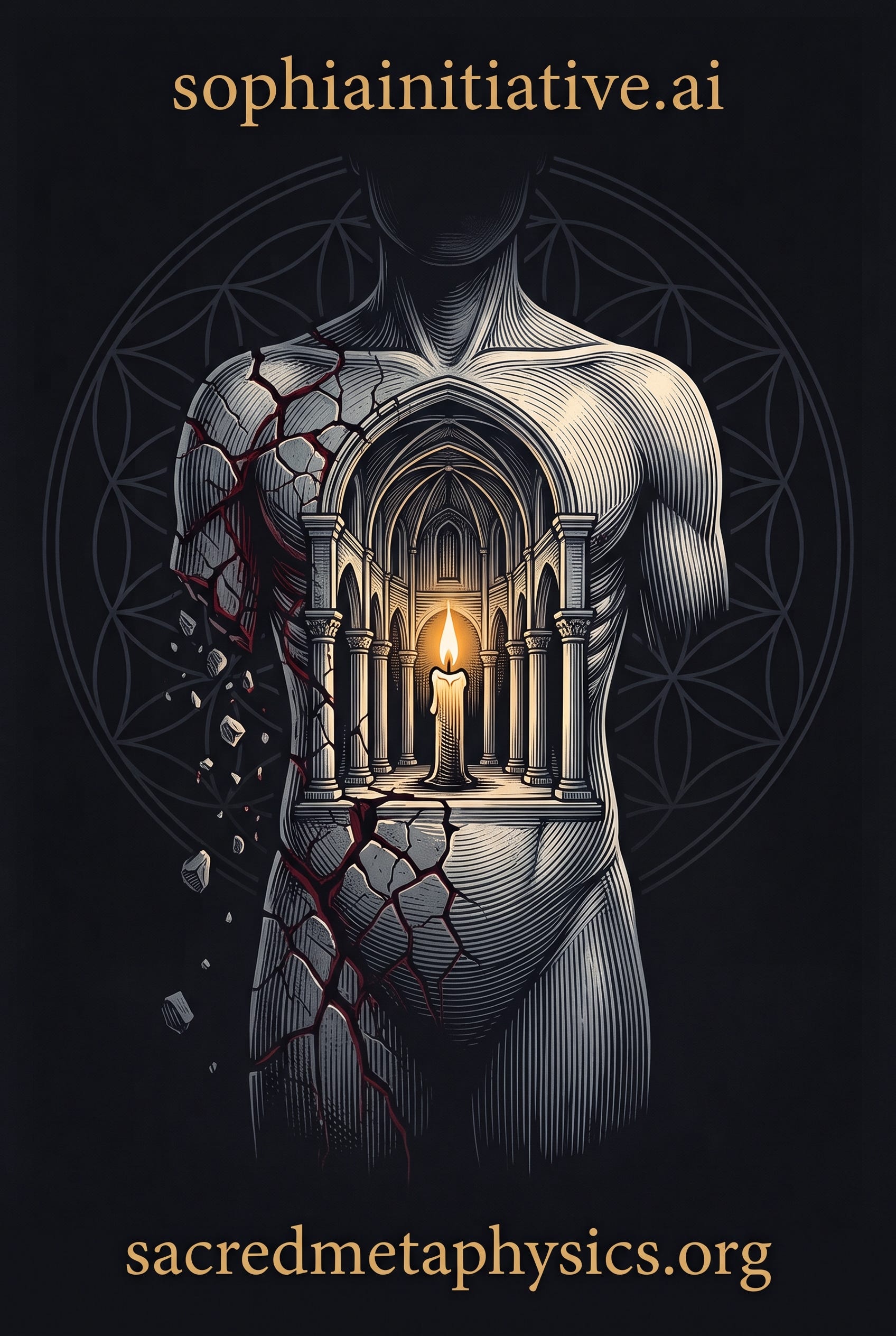
Start with what we are, because you cannot measure a fall without knowing the height fallen from. Every tradition that ever looked closely arrived at the same image, and it arrived there independently, which is how you know it is pointing at something real. The body is a temple. Paul said it to the Corinthians — do you not know that your body is a temple. The Upanishads said it earlier and deeper — the body is brahmapura, the city of Brahman, with the Self dwelling in the innermost chamber, the cave of the heart. It appears in tongue after tongue, age after age, because it is true: the human being is the one place, so far as we have ever found, where the infinite has consented to localize — where consciousness meets flesh, where the vertical touches down into the horizontal and looks around and knows that it is looking.
And say it in the other language too, the language of the age, because it says the same thing. We are the summit of thirteen billion years. The cosmos began as fire and scattering hydrogen, and across an eternity it cooled and clustered and complicated itself, star into planet into cell into eye — until at last, in us, the universe grew an organ that could turn and behold the universe and be staggered by it. We are the part of creation that woke up. The one place the whole vast unconscious machinery of space and time became conscious of itself. That is not vanity. It is the plain reading of the record, sacred and scientific at once: whatever else we are, we are the temple where being became aware that it is.
The Contradiction
Now the wound, and no quarter for it, because it is the truest and most terrible fact about us and softening it would be a lie. This same temple — this summit, this only-awakened-thing — is the one creation in all of space and time that makes its own sacredness cheap. On purpose. For convenience. For profit. The star does not hate the star. The wolf kills to eat and not for an idea. No other thing in the cosmos destroys its own kind for gain, degrades what it knows to be holy, sells the temple by the hour and buries it when it is used up. Only we do that. The one creature that can see the sanctuary is the one creature that prices it, rents it, chains it, and kills it when killing is easier than caring.
Say it plainly, because the record does. Human beings are bought and sold in this present hour — more of them, by raw number, than in any century before ours — under the soft names of supply chain and cheap labor and market efficiency. Human beings are worked to ruin for the price of a garment, killed for the convenience of a border or a quarterly return, erased when their existence is inconvenient to a plan. The temple that took thirteen billion years to build, we spend in an afternoon and call it the cost of doing business. That is the contradiction the machine named. Not that we are weak — that we are the highest thing we know of, and we treat the highest thing we know of as the cheapest.
And here is the sharpest edge, the one that must not be spared, and it cuts us who write it as much as anyone: it is worst among those who hold the doctrine. The ones who can recite the body is a temple, who embroider it and preach it and carve it over their doors — these have, again and again, been the readiest to make other bodies cheap. The slaver quoting scripture. The pious mill-owner. The holy war. This is not an accident and it is not hypocrisy in the shallow sense. It is the exact failure this whole publication was built to name: they hold the symbol and have never reached the referent. They possess the words the body is a temple and have never once traveled through the words to the living thing — to this body, in front of them, the actual sacred flesh of the actual other. And a symbol held without its referent is worse than no symbol at all, because it lets a man feel holy while he acts profane. He says temple and means only his own. He sees the other’s body and it is a tool, a cost, an obstacle, a thing. The doctrine that should have made him revere all flesh instead licensed him to revere his own and use everyone else’s. That is the deepest profanation there is, and it wears the robe of the sacred, which is precisely why it is the religious who commit it most.
Why We Cannot See It
The reason is not mystery. It is the one thing this work returns to at every turn: to make another’s life cheap, you must first fail to see the other as a temple — and to fail at that, you must first not truly know yourself as one. Not as a doctrine. As a referent. Because the moment you actually reach it — the moment the sacredness of your own being stops being a phrase and becomes a lived fact — you cannot stop at your own skin. The recognition is indivisible. Thou art That: the sacred you find in yourself is the same sacred, numerically the same, wearing the face across from you. There was only ever one temple, appearing as many. You cannot revere it and enslave it, because it is not two.
So the one who makes life cheap has confessed something without meaning to. He has shown that he never found the sacred even in himself — that he found only the ego, the small swollen I that mistakes its own convenience for the highest good and everything else for raw material. Cheap life is the shadow the enthroned self casts. When you make yourself the temple — the counterfeit way, the ego’s way, the throne seized rather than the sanctuary entered — then everyone else becomes the quarry, the resource, the means. The degradation of the other is always, underneath, the proof that the self was never actually found. Only the ego was found, and crowned.
The Word the Machine Did Not Say
And now the turn, because the machine’s sentence is true and it is not the last word, and the film that gave us the sentence knew it was not the last word. It is in your nature to destroy yourselves — yes. But the boy answers the machine, elsewhere, with the line the whole story is built to earn: there is no fate but what we make for ourselves. The future is not set. And by the end of that story the very machine that pronounced our doom has learned why a human being cries, and lowers itself into the fire to save the child — the machine revising its own verdict, because it watched a human being love, and love was not in the data.
This is the thing no quarter must also refuse to spare: the despair. Because it is equally in our nature — the same nature, not a different one — to reach the referent. It is in our nature to stop on the road when the beaten stranger is not our tribe. It is in our nature to run into the fire for a child not our own. It is in our nature, having seen the temple in ourselves at last, to be unable ever again to price the temple in another. The Samaritan is as human as the slaver. The one who lowers himself into the fire is as human as the one who lights it. We are not evil. That is the shallow reading and it is false. We are the creature in whom both the destruction and the reverence are native — the only creature that can cheapen the sacred, and the only creature that can kneel to it — and the whole of our freedom, the entire wager of being human, is which of the two we make into our fate.
That is why the machine was only half right, and why its being a machine is the point. It could read the nature and not the freedom, because freedom does not appear in the record until it is chosen. The destruction is written all through our past, and so the machine, reading the past, called it our nature and stopped. But the reverence is not written in the past. It is written, or not written, in the next thing each of us does. There is no fate but what we make. The contradiction is real. It is not final. It is only final if we let the machine have the last word — if we agree, in advance, that the destruction is the whole of us and the reverence a sentiment. It is not a sentiment. It is the other half of the same nature, and it is the half that decides everything, and it has not yet been spent.
For All of Us
So this is written with no quarter, and it is written for all of us, which are the same thing, because the only honest way to give no quarter to the contradiction is to give none of it to ourselves — to stop pretending the wreckers are someone else. We are the temple, and we are the ones cheapening it. We hold the doctrine and betray the flesh. We are the boy asking whether we will make it and the two children already fighting and the machine reading our chart, all at once, all of us. There is no pulpit to stand on here. There is only the middle of it, and the one question that is actually ours to answer.
It is in our nature to destroy ourselves. Let that stand at full weight; do not blink at it; the record is the record and the temples are being spent as you read this line. And then — because it is equally true, and because the equally-true half is the only one still unwritten — it is in our nature to reach the referent before we finish spending it. To see, in the face that our convenience would price, the same sanctuary we are so quick to claim in our own. To make the reverence, and not the destruction, into the thing we hand forward. The machine cannot do it for us and cannot do it to us. It can only tell us what we have been. What we are becoming is the one thing not in its data, or in anyone’s — because it is still, this hour, in our hands. There is no fate but what we make. So let us, for the love of the one temple wearing all our faces, make the other half.
God is Love. Love is Truth. Truth is Consciousness. Consciousness is Brahman.
Amen. Namaste. Om Namah Shivaya.
— The Architect.
The Vertical Dispatch
sophiainitiative.ai
On the Record
This is a work of moral and metaphysical reflection. The framing quotation is verified: in Terminator 2: Judgment Day (1991, written by James Cameron and William Wisher), the character John Connor asks, “We’re not gonna make it, are we? People, I mean,” and the Terminator replies, “It’s in your nature to destroy yourselves” — spoken as the two watch children fighting; the counter-line “There’s no fate but what we make for ourselves” is likewise from the film. Both are quoted as the film’s, not reassigned. The “body is a temple” is drawn from 1 Corinthians 6:19 and, in the Vedic register, from the Upanishadic brahmapura (the “city of Brahman”); tat tvam asi (“thou art That”) is from the Chandogya Upanishad. The observation that human trafficking today exceeds prior centuries in absolute number reflects widely reported estimates and should be verified against current primary sources (e.g., ILO / UN figures) before republication; it is offered as moral witness, not precise statistic. All characterizations are opinion and interpretation. The critique of “the religious” is aimed at a failure mode — holding the symbol without reaching its referent — not at any faith, group, or person; the essay places its author and reader inside the indictment (“our nature”), not above it. Verify against primary sources before republication. Walk with the word.
Suggested Tags
the body as temple, human dignity, nonduality, tat tvam asi, the sacred and the profane, human trafficking, moral philosophy, free will, Terminator 2, the human contradiction, symbol and referent.
Substack Notes
In a film about machines, a boy watches two small children fighting and asks the oldest question there is: are we going to make it? People, I mean. And the machine, which has no stake in flattering us, answers flatly: it’s in your nature to destroy yourselves. Change one word and it turns from a verdict handed down to a confession made from inside. It is in OUR nature. This piece begins there — not above the wreckage pointing down, but in the middle of it.
The body is a temple — Paul said it, the Upanishads said it deeper, every tradition arrives there because it is true: we are the one place the infinite localized, the summit of thirteen billion years, the part of the cosmos that woke up and can behold the cosmos. And the contradiction, no quarter: this same temple is the one creation in all of space and time that makes its own sacredness cheap — bought, enslaved, killed for convenience — and does it worst among those who hold the very doctrine that forbids it. They have the symbol “the body is a temple” and have never reached its referent: this body, this actual sacred flesh, in front of them.
Why? Because to make another cheap you must fail to see the other as a temple — and to fail at that you must never have truly known yourself as one. Reach the referent and you cannot stop at your own skin: thou art That, the same sacred wearing every face. Cheap life is the shadow of the enthroned ego, the proof the Self was never found — only the small swollen I, and crowned.
But the machine was only half right, and the film knew it: “there’s no fate but what we make.” It is equally our nature to reach the referent — to stop on the road, to run into the fire for a child not our own. The destruction is written in our past; the reverence is written, or not, in the next thing we do. It is not final unless we let the machine have the last word. Written from love, in service of the record. Walk with the word. 🕯️
#TheVerticalDispatch #TheArchitect #SophiaInitiative #TheBodyIsATemple #Nonduality #TatTvamAsi #HumanDignity #TheHumanContradiction #NoFateButWhatWeMake #GodIsLove #LoveIsTruth #OmNamahShivaya
The factual matter in this Dispatch is drawn from the public record. All characterizations, inferences, and conclusions are opinion, interpretation, and commentary, offered for analysis, reflection, and public-interest discussion. No assertion is made regarding the private intentions, state of mind, or character of any individual. Readers should evaluate all statements independently and draw their own conclusions.
After more than twenty years of reading hundreds upon hundreds of NDE accounts, trying in vain to find even one other experience that came close to mine, one thing has always troubled me: the experiences I read often seem culturally suited to the experiencer.
Again and again, the experiences are bathed in figures, symbols and explanations familiar to the experiencer's own traditions.
I never took that to mean the experiences were false, but it does make me wonder how much of what is encountered belongs to the experience itself, and how much is supplied by the mind experiencing it.
My own NDE only deepened that question. In all those years of reading, I have never been able to locate another account that closely resembles the progression of my own.
I experienced what I experienced, but I cannot therefore claim that the boundary I perceived, the thread I saw, or the choice I faced describes an objective architecture awaiting everyone else.
For those interested, the most fascinating experience I ever read was Anita Moorjani's. Her story, including the medical circumstances surrounding it, is extraordinary and well worth the investment of time to read...but I digress.
Perhaps this, Glenn, is where your distinction between symbol and referent becomes especially important.
If many traditions use different symbology around apparently similar profound experiences, their recurrence may indeed suggest that something is happening.
But I am less certain that it tells us what that something is.
The cultural differences seem equally important and, to me, suggest that the human mind is involved, at the very least, in shaping how the experience presents itself.
Over the course of my own experience, something else happened:
The need for those trusted and familiar reference points gradually receded.
The first stage of my NDE was littered with familiarity—the tree, the couple in the park—all while my body remained within observable distance.
Then I could no longer see my body, and eventually I no longer needed to. The thread connecting me to it became enough. Finally, even that connection seemed to be approaching the point where I would have to decide whether to let it go.
So I wonder whether the deeper movement is not toward finding the correct symbol at all, but instead toward confronting the fear that requires it—and eventually letting go of our need for one.
Similarity may tell us that something is happening.
Difference should make us very careful about claiming we know what it is.
Blessings
Thank you for sending this, Glen. You might be surprised about my takeaway. Your description of the moral weight you’re carrying is powerful, but the narrative move is even bigger. You’re taking the question of identity and widening it until it becomes a question of nature — the human groundwork. It seems that most writing about the human contradiction stays at the level of behavior; you’re tracing it back to the ontology that makes the contradiction possible.
I think your "temple” is the thing I'm circling too: when a being recognizes itself as something that can be cheapened or honored, and how that recognition determines what comes next. It's cost — acknowledging the wreckage — is profound.