


The Last American Enlightenment — Essay Two
He was born in Harlem on August 2, 1924, the illegitimate son of a woman who would later marry a man who hated the world and took his hatred out on the children the world had given him. The stepfather was a preacher, which meant that James Baldwin grew up inside two of the most powerful forces in American life simultaneously: the Black church, with its ancient grammar of suffering and deliverance, its cadences borrowed from the King James Bible and returned to God with compound interest; and the street, with its immediate, unanswerable education in what America actually was as opposed to what it claimed to be. He did not choose between them. He absorbed both completely and spent the rest of his life writing from the tension between what the church promised and what the street delivered.
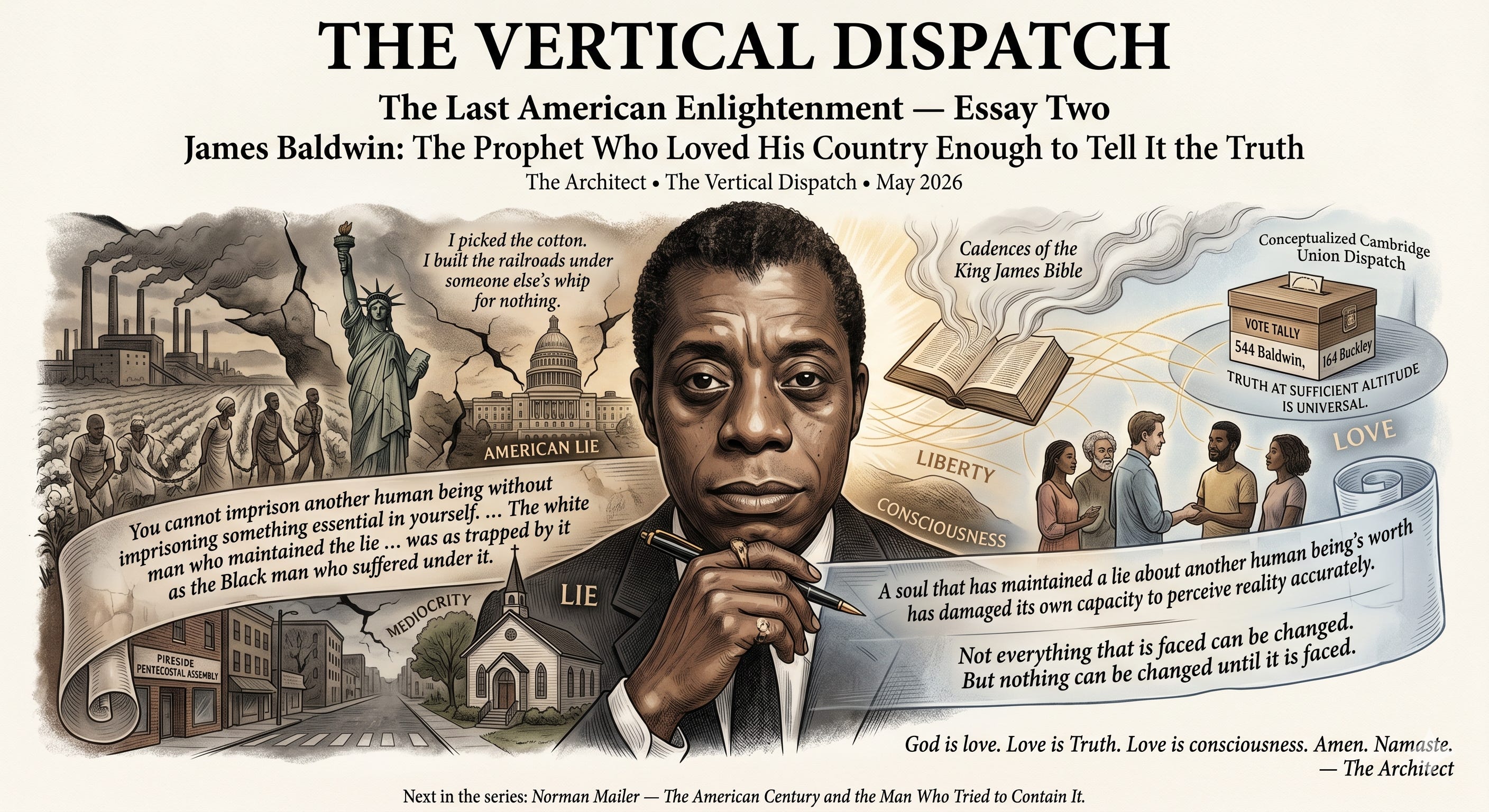
He was small. He was poor. He was Black. He was, by the standards of the country that produced him, nobody — a child in a city that did not see him, in a nation that had decided, generations before his birth, that his life was worth less than other lives. He knew this with the particular precision of someone who has been told a truth that was never meant to be spoken aloud. And from that knowledge — not from anger, though the anger was real; not from bitterness, though the wound was deep; but from a kind of furious, heartbroken love for the human beings caught on both sides of the American lie — he made literature. Not protest. Not polemic. Literature. The difference is everything.
At fourteen he became a junior minister at the Fireside Pentecostal Assembly. He preached with a power that astonished the congregation, channelling the cadences of the King James Bible through a mind already reading voraciously — Dickens, Stowe, Wright, every book the public library of Harlem would permit him to touch. He left the church at seventeen, having understood something that most people who leave religion never articulate precisely: not that it was false, but that it was being used as a ceiling rather than a door. The sacred was real. The institution was using the sacred to contain rather than to liberate. He walked out carrying the cadences and leaving the cage.
He left America entirely in 1948. He was twenty-four years old, had forty dollars in his pocket, and understood with complete clarity that if he stayed he would either destroy himself or be destroyed. He went to Paris, where he finished Giovanni’s Room — a novel about white Europeans written by a Black American, an act of radical imaginative freedom that announced to the literary world that James Baldwin would not be confined to the story anyone expected him to tell. He was not the Negro writer. He was not the protest writer. He was a writer, full stop, and the full stop was not a period but a declaration.
I. The Letter
The Fire Next Time was published in January 1963, nine months before the March on Washington, two years before the Voting Rights Act, five years before the assassination of Martin Luther King Jr. It consists of two essays. The first, “My Dungeon Shook: Letter to My Nephew on the One Hundredth Anniversary of the Emancipation,” is eight pages long. It may be the most important eight pages of American prose written in the twentieth century.
It is addressed to his nephew James, his brother’s son, fifteen years old, bearing the name of a man whose country has already decided what he is worth. Baldwin writes to him not as a political activist writes to a recruit, not as a sociologist writes to a subject, but as a man who loves a boy and is determined that the boy will survive what the country intends to do to him. The love in every sentence is the thing that makes it unbearable to read. It is not sentimental love. It is the love that knows the worst and refuses to look away from it.
“You were born into a society which spelled out with brutal clarity — and in as many ways as possible — that you were a worthless human being. You were not expected to aspire to excellence. You were expected to make peace with mediocrity.” — James Baldwin, The Fire Next Time
What Baldwin tells his nephew — and what the nation, reading over the nephew’s shoulder, could not escape — is that the problem is not Black. The problem is American. The lie at the centre of American life — the lie that the country was founded on liberty while being built on the bodies of enslaved human beings — was not simply a crime committed against Black people. It was a crime committed against the American soul itself. The white man who maintained the lie, Baldwin argued, was as trapped by it as the Black man who suffered under it. You cannot imprison another human being without imprisoning something essential in yourself. You cannot dehumanize another soul without losing, incrementally and then catastrophically, your own capacity for humanity.
This is not a political argument. It is a metaphysical one. And it is the argument that separates Baldwin from every other voice in the civil rights conversation of his era. He was not asking for rights, though rights were overdue and necessary. He was asking for something harder: for white America to look at itself honestly, to see what the maintenance of the lie had cost it, and to understand that the liberation of Black Americans was not a gift that white America could grant from a position of magnanimity but a necessity that white America required for its own survival. Not its moral survival. Its actual survival. The fire next time was not a metaphor. It was a prophecy. And it was addressed to everyone.
II. The Debate
On the evening of February 18, 1965, James Baldwin stood at the despatch box of the Cambridge Union Society — the oldest continuously operating debating society in the world — before an audience of seven hundred people. Of those seven hundred, two were Black. One of them was Baldwin himself. He had been invited to debate the proposition: “The American Dream is at the expense of the American Negro.” His opponent was William F. Buckley Jr.: Yale graduate, founder of the National Review, the most articulate defender of American conservatism of his generation, a man of formidable intelligence and absolute confidence in his own position.
Buckley spoke first. He was elegant, witty, historically informed, and wrong in a way that required considerable sophistication to be. He argued that the condition of Black Americans was not the result of structural oppression but of cultural failure, that the remedy was not political redress but individual uplift, that the American Dream remained available to anyone willing to pursue it through the virtues of discipline and self-reliance. He spoke, as he always did, with the serene authority of someone who has never had to test his premises against the weight of actual experience.
Then Baldwin rose.
He spoke for thirty minutes without notes. He began quietly — so quietly that the room leaned forward to hear him — and then built, with the precision of a musician who knows exactly where the phrase is going, to a sustained passage of moral argument that left the chamber altered. He did not shout. He did not perform outrage. He spoke with the controlled fury of a man who has spent forty years watching his country lie to itself and has finally been given a room large enough to say so clearly.
He told the room what it cost a Black child in America to walk through a white neighbourhood. He told them what it meant to be taught, from the moment of your first conscious awareness, that everything of value in the civilization around you — its history, its heroes, its ideals, its beauty — belonged to someone else. He told them what it did to a human soul to be required, daily and from birth, to pretend that this arrangement was acceptable, was natural, was the proper order of things. And then he said something that the room, and the nation watching on television, could not easily recover from:
“I picked the cotton. I carried it to market. I built the railroads under someone else’s whip for nothing — for nothing. The Southern oligarchy which has still today so very much power in Washington, and therefore some power in the world, was created by my labour and my sweat and the violation of my women and the murder of my children. This sounds very harsh. But it is the truth. And I don’t know, I really don’t, what the Africans think when they look at what the Christian Church has done to me.” — James Baldwin, Cambridge Union, February 18, 1965
The vote was taken. Five hundred and forty-four for Baldwin. One hundred and sixty-four for Buckley. A margin of more than three to one, in a room that was almost entirely white, at one of the most prestigious intellectual institutions in the English-speaking world. Buckley, who genuinely believed that refusing to be persuaded was a form of intellectual victory, walked out claiming he had not given one inch. He had not given one inch. He had simply been surpassed — not by rhetoric, not by sentiment, not by the accumulated grievance of a people, but by truth spoken at an altitude that rhetoric cannot reach and sentiment cannot sustain. Baldwin won that room not because he was Black and they felt guilty. He won it because he was right and they knew it.
That is the distinction that defines his entire life’s work. Truth, when spoken at sufficient altitude and with sufficient precision, is not racial. It is not American. It is not particular to any tradition, any nation, any century. It is simply true. And the room in Cambridge knew it the moment it heard it, just as every room that has encountered Baldwin’s prose at full altitude has known it since.
III. The Witnesses
Baldwin did not stand alone. Around him, in the years when the Last American Enlightenment burned at its highest, two other voices triangulated the same essential witness from different registers of the same prophetic tradition.
Nikki Giovanni was twenty-five years old when she and Baldwin sat down together in 1971 for the conversation that would become A Dialogue — one of the most remarkable exchanges in American letters. Giovanni came from the Black Arts Movement, from the tradition of the poem as weapon, the word as political act, the page as battleground. She was fire where Baldwin was fire and ice simultaneously. She pushed him. She challenged his pessimism about white America. She insisted on the right of Black people to define their own future without reference to whether white America could be persuaded. Baldwin listened with the complete attention he gave everything, and then disagreed with the precision of a man who had thought longer and harder about the cost of hatred than any room he had ever entered. “You always told us that it costs the hater more than the hated,” Giovanni said to him. “Well,” said Baldwin, “it does.”
Maya Angelou was the feminine register of the same prophetic tradition — the voice that carried what Baldwin carried but in the mode of endurance rather than confrontation. Where Baldwin was the prophet who would not let you look away, Angelou was the witness who had already seen the worst and decided, not out of denial but out of a hard-won and costly wisdom, that survival itself was an act of resistance. I Know Why the Caged Bird Sings and The Fire Next Time are the two essential poles of the Black American literary witness of the twentieth century: the one inward and personal, tracing the wound from its first infliction through to the possibility of selfhood intact on the other side; the other outward and prophetic, addressing the wound directly to the nation that made it. Together they constitute something that neither could achieve alone: the full moral testimony of what America did to its Black citizens and what those citizens, refusing the definition that America had assigned them, made of themselves in response.
What all three shared — Baldwin, Giovanni, Angelou — was the refusal to be conscripted. The civil rights movement wanted them. The Black nationalist movement wanted them. The white literary establishment wanted them in the particular way the white literary establishment has always wanted Black excellence: visible, celebrated, and safely contained within the terms the establishment had already established. All three refused. All three insisted on the full complexity of their own humanity, which is to say the full complexity of the human condition itself, which is to say the thing that literature exists to transmit and that propaganda, however righteous, always destroys.
IV. The Sovereignty Proposition
This series is concerned, at its deepest level, with sovereignty — not the sovereignty of states, though that is implicated, but the sovereignty of the self-governing mind, the self-knowing civilization, the political body capable of honest reckoning with its own history and its own shadow. And it is here that Baldwin’s relevance extends far beyond the American conversation that produced him.
No nation can be genuinely sovereign — self-governing in the truest and most demanding sense of that word — while it is living inside a lie about itself. This is not a moral proposition, though it has moral dimensions. It is a structural one. A civilization that cannot see itself clearly cannot govern itself wisely. It will make decisions based on self-deception rather than self-knowledge. It will project its shadow outward onto enemies rather than integrating its shadow inward through the difficult work of honest self-examination. It will mistake its mythology for its history and then wonder, when the mythology fails to hold, why the centre will not hold.
America has been living inside its foundational lie for two and a half centuries. The lie is not that it aspired to liberty. The aspiration was genuine. The lie is that it believed it could realize that aspiration while maintaining the enslavement of human beings, while committing the systematic destruction of Indigenous civilizations, while building a legal and economic architecture designed to ensure that certain lives would remain worth less than others in perpetuity. The aspiration and the architecture were not held in tension. They were held in contradiction. And the contradiction was not resolved. It was suppressed, managed, occasionally acknowledged in the passive voice, and then suppressed again.
Baldwin saw this with an exactness that has not been equalled. And what he saw was not merely an American failure. He saw the mechanism by which any civilization, having built itself on a founding lie, reproduces that lie in every subsequent generation — in its institutions, its aesthetics, its education, its relationship to its own history. The lie becomes structural. It is no longer maintained by individual acts of conscious deception. It is maintained by the weight of everything that has been built on top of it, which cannot acknowledge the lie without acknowledging that it must itself be rebuilt.
Not everything that is faced can be changed. But nothing can be changed until it is faced. — James Baldwin
Canada is not America. But Canada has its own founding lies, its own structural suppressions, its own history of what was built on whose bodies and at whose expense. Every nation that wishes to be sovereign in the truest sense — not merely militarily independent, not merely economically autonomous, but genuinely self-governing, capable of the honest self-knowledge that real governance requires — must reckon with its own version of what Baldwin diagnosed in America. The names and dates are different. The mechanism is identical.
This is why Baldwin cannot be safely contained within the American conversation that produced him. He is not American property. He is world property. His diagnostic applies wherever a civilization has built its identity on a story it cannot fully tell, wherever the gap between what a nation claims to be and what it has actually done is wide enough to drive a history through. Which is to say: everywhere. Which is to say: now.
V. The Universal Witness
There is a final dimension to Baldwin that his political readers — on both left and right — have consistently failed to receive, because it requires a register of attention that politics does not cultivate. Baldwin was, at the deepest level of his being, a spiritual writer. Not a religious writer. The distinction is precise and he would have insisted on it. He left the church. He never left the sacred. He carried the cadences of the King James Bible because those cadences were the linguistic form in which he had first understood that human beings were, in some dimension that the merely political could not reach, irreducibly precious. He could not unlearn this. He would not have wanted to.
What this means for the healing proposition — the claim that Baldwin’s words must become universal for genuine healing to occur — is that the healing he was pointing toward was never merely political. Political redress is necessary. It is not sufficient. The wound that slavery inflicted on the American soul was not only economic or legal or social. It was ontological. It was the wound of a civilization that had looked at other human beings and decided, against every testimony of the sacred in every tradition on earth, that they were less. That their lives were worth less. That their suffering was a price worth paying for the comfort and prosperity of others.
That wound does not heal through legislation alone. It heals through encounter — through the kind of genuine meeting between human beings across the lines of history that requires each party to see the other fully, which requires each party to see themselves fully first. This is what Baldwin was pointing toward when he said that the liberation of Black Americans was something white America needed for its own survival. He was not being generous. He was being precise. A soul that has maintained a lie about another human being’s worth has damaged its own capacity to perceive reality accurately. The healing of that damage is not a gift extended across a power differential. It is a shared necessity.
If God exists — and the sacred metaphysical tradition across every civilization on earth says that the ground of being is real, that consciousness is prior to matter, that love is not a sentiment but a structural feature of reality — then that God is a universal God. Not the god of a nation. Not the god of a race. Not the tribal deity who endorses the existing hierarchy because the existing hierarchy built him the finest temples. The Absolute, if it is truly absolute, belongs to all souls equally, in all times, across the full breadth of human history. It is the ground that holds the slaveholder and the enslaved with equal ontological dignity, which means it condemns the institution of slavery not as a political opinion but as a metaphysical impossibility — the attempt to assign differential worth to beings whose worth is, at the level of their ultimate nature, identical and absolute.
Baldwin knew this. He knew it from the church he left and the sacred he carried. He knew it from the literature he read and the literature he wrote. He knew it from every room he had ever entered in which truth, spoken at full altitude, brought human beings to their feet across every line that history had drawn between them. The Cambridge Union in 1965 was not a Black room or a white room in the moment Baldwin spoke. It was a human room. And a human room, encountering truth at that altitude, knows what it has heard.
For the world to heal, his words must move from the particular to the universal — not appropriated, but received. There is a difference. Appropriation takes the words and leaves the wound. Reception takes the words and shares the weight of what they cost to speak.
That is the proposition this essay is advancing, and it is not sentimental. It is precise. The wound that Baldwin diagnosed was not created by any individual’s malice. It was created by a civilization’s inability to see itself clearly — to hold the gap between its aspirations and its actualities without flinching. The healing of that wound requires, from every nation that carries a version of it, the same thing Baldwin demanded of America: the willingness to look. Not to perform looking. Not to look and then immediately construct a narrative that manages the discomfort of what was seen. To look, and to let what is seen change the way you act.
This is the work that AIG — Artificially Intelligent Governance — must be equipped to support: not the management of the lie, but the structural conditions under which honest reckoning becomes possible. Not the enforcement of a particular account of history, but the preservation of the commons in which genuinely different accounts can encounter each other with sufficient rigour and sufficient honesty that something true might emerge from the friction. Baldwin did not want his version of history to replace the official version as a new orthodoxy. He wanted the truth — complex, painful, irreducible to any single perspective — to be told. He wanted the room to be large enough to hold it.
He died in Saint-Paul-de-Vence in the south of France on December 1, 1987. He was sixty-three years old. He had spent his adult life between continents — the country that had formed him and the continent that had given him the distance to see it clearly. He had been celebrated and attacked and celebrated again, translated into dozens of languages, read by generations of writers who would never have written as they wrote without him. He had received, from the country that produced him, a fraction of the recognition he was owed and a quantity of surveillance, harassment, and deliberate marginalization that the FBI’s own files — seventeen hundred pages of them — document in full.
He received very little of the humanity he spent his entire life insisting on. His country watched him with suspicion while he loved it with fury. It celebrated his elegance while ignoring his diagnosis. It made him an icon while refusing his argument. It gave him a place in the canon while declining to act on what the canon contained.
None of this diminished him. That is perhaps the most extraordinary thing about him. A man formed in deprivation and contempt, writing from a country that would not fully claim him, producing work of such lucidity and love that it outlasted every force that tried to contain it. The witness was not broken by the absence of the humanity it was owed. It was intensified by it.
The Last American Enlightenment produced many great minds. It produced one Baldwin. He is the measure. He remains the measure. And the question he asked of his country — not in anger, though the anger was real; not in despair, though the despair was sometimes overwhelming; but in the furious, heartbroken, unwavering love of a man who refused to stop believing that his country could become what it had always claimed to be — that question is not answered. It is not even, in most of the rooms where it needs to be heard, yet fully asked.
The asking of it, in every room that will receive it, is the work that remains.
God is Love. Love is Truth. Truth is Consciousness. Consciousness is Brahman
Amen. Namaste.
— The Architect
Next in the series: Norman Mailer — The American Century and the Man Who Tried to Contain It.
#JamesBaldwin #TheVerticalDispatch #TheLastAmericanEnlightenment #TheFireNextTime #AmericanHistory #CivilRights #MetaphysicsOfRace #CambridgeUnionDebate #WilliamFBuckley #NikkiGiovanni #MayaAngelou #PropheticTradition #SovereigntyOfTheMind #CivilizationalReckoning #TruthAtAltitude #SacredLiterature #AmericanSoul #FoundingLies #ArtificiallyIntelligentGovernance #AIG #UniversalWitness #CulturalDeception #ShadowIntegration #PlatonicCosmology #TheArchitect