


Φ
THE VERTICAL DISPATCH
We write for the mind, the eye, and the ear.
From metaphysics to geopolitics, from culture to history, from the sacred to the street — one lens, every subject. No ego. Just the record, named clean. 🕯️
This dispatch travels by hand. If it serves you, share it — restack on Substack, and pass it on wherever you read. 🕯️
The Age of Consequences · The Sacred Metaphysics Floor
Without malice and without flattery, from the documented record only.
“The work of destruction is quick, easy and exhilarating;
the work of creation slow, laborious and dull.”
— Sir Roger Scruton, How to Be a Conservative
Let me begin where the word begins, because the word is not the thing, and this whole dispatch turns on the difference between them.
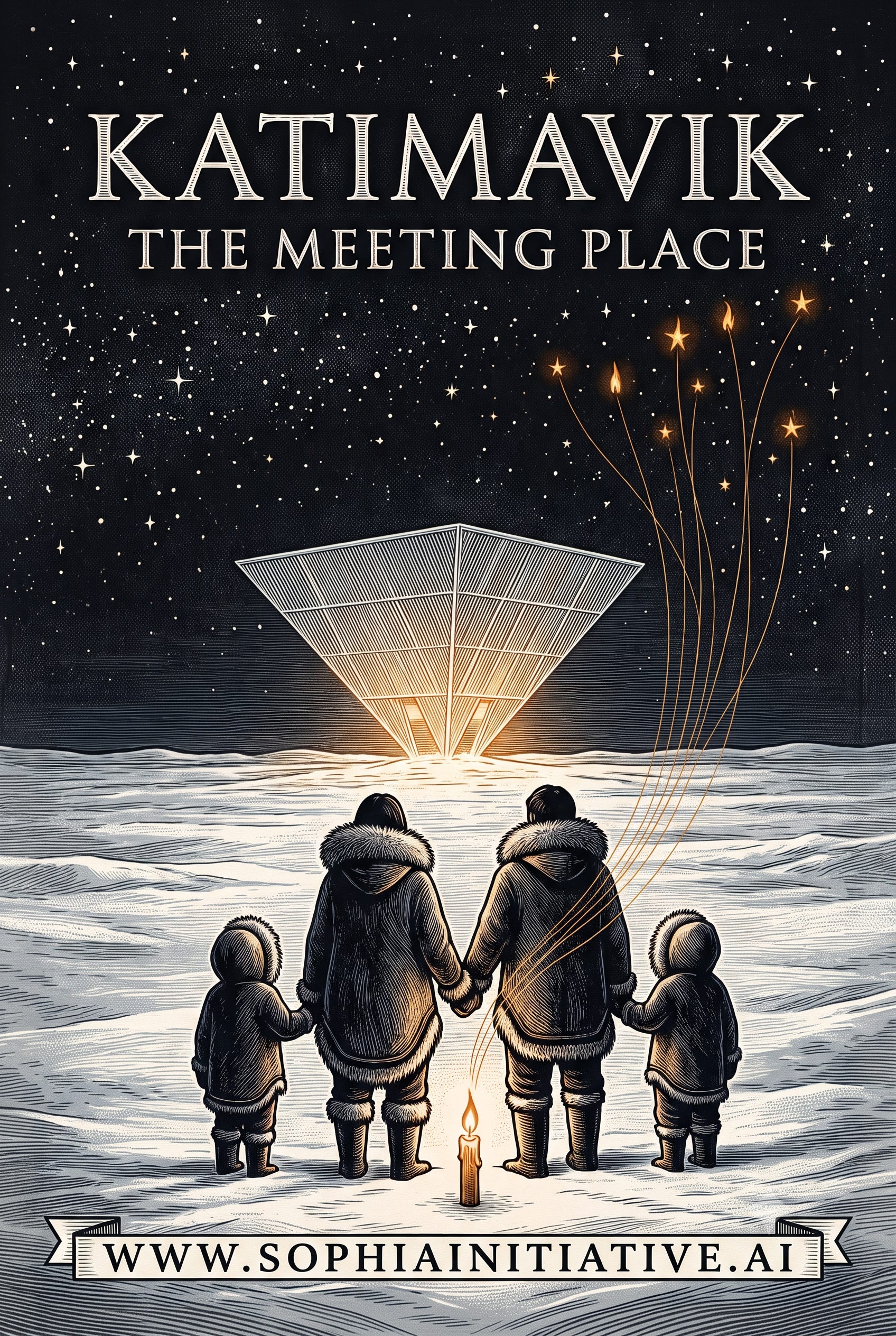
There is an Inuktitut word — Katimavik. It means the meeting place. The gathering place. The room where the scattered come together and, for a while, are one. Hold that word in your hand for a moment, because Canada has reached for it twice, a decade apart, and both times it reached for the same thing, and both times it let that thing be taken away.
I should tell you plainly that I did not know what the word meant until this year, at sixty-eight. I stood inside it as a boy of nine — I have the passport still, every page stamped — and I could not read it. It took me fifty-nine years to learn where I had been. That is the whole of this dispatch in one confession: a man can live inside a word for a lifetime and never once see the thing it points at. The word is not the thing. But if you stay awake long enough, the thing behind the word walks up and takes your hand — and then you understand what was built, and what was lost, and why it matters that it was let fall.
I. The Word, Twice Spoken
In 1967, at the summit of the country’s hundredth birthday, the Canadian Pavilion at Expo rose as a great inverted pyramid — nine storeys, suspended in the air, the largest pavilion at the fair. Its architects named it Katimavik: the meeting place. On Canada Day of that year it drew its highest crowd. A boy of nine could climb it and stand inside the country’s own image of itself. Its designer called it a symbol of permanence.
It was not permanent. The St. Lawrence eroded the fill beneath it, and the pavilion is gone.
Ten years later, in 1977, a youth program was born under Pierre Trudeau’s government — the work of Senator Jacques Hébert and Defence Minister Barney Danson, a man who had been wounded at Normandy. They took young Canadians, seventeen to twenty-five, grouped them eleven at a time from every region, and sent them to live and serve in communities far from home for months at a stretch. They learned the other official language. They did real work for organizations that could not afford to hire. And they came home having seen the actual size of their own country. The program’s name was Katimavik: the meeting place.
It was not permanent either. Two governments moved against it. The second one finished it.
Now — I want to be careful here, at the referent, because a good story wants to outrun its source. I cannot show you a document proving the founders named the program after the pavilion. What I can show you is this: twice, when this country wanted to name the room where a scattered people becomes one, it reached into the language of the Inuit and drew out the same word. Whether by design or by the deep pull of a word already made famous, the meaning is identical. The word kept surfacing because the need kept surfacing. And there is a quiet justice in it, worth naming once and then leaving to rest: a settler country, twice, named its highest hope for unity in the tongue of the people it had most failed to gather in.
Twice the country named its meeting place. Twice it meant the same thing. Twice it let the meeting place fall.
II. Two Grammars
Here is the lens this Dispatch reads by, offered as a way of seeing and not as a proven law of the world. Beneath every culture runs a grammar it does not consciously speak — a deep rule that bends the whole people one way or the other. One grammar points toward the other: I am found by being poured out into something larger than myself; the self is completed in service, in gathering, in the room full of strangers who become kin. Call it the grammar of the other. The other grammar points back at the self alone: what is mine, what is owed to me, who is to blame for what I lack. Call it the grammar of the me.
These are not the grammars of parties. They are older than parties, and either one can wear any flag. But a culture is always, quietly, being bent toward one or the other — toward the ideal or the profane, toward the finding of the self or the losing of it. And the instruments a country builds are the visible shape of which grammar it is speaking.
Katimavik — the program — was an instrument of the other. This is its whole meaning. It did not lecture a young person on what it is to be Canadian. It took the young person out of the small room of the self and set them down in a house with ten strangers and a country to serve. It made the other unavoidable. You cooked for people you did not choose. You worked beside a kid whose language you were still learning. You gave your hours to a town that was not yours. The transformation, where it came, was not taught. It was arranged. The room did the work.
III. The Symbol and the Ledger
There is a line in Christopher Nolan’s Batman Begins that reaches for exactly this. A man, Bruce Wayne tells us, is flesh and blood — he can be ignored, he can be destroyed. But as a symbol he can be incorruptible, everlasting. It is a beautiful idea, and it is a fiction, and the fiction is the point. For a nation’s real symbols are not incorruptible. They are not everlasting. They are, in Scruton’s exact words, good things easily destroyed and not easily created. They live only as long as someone chooses, year upon year, to keep them.
Katimavik was such a symbol — mortal, dependent, sustained only by will. And here is where the grammar of the me does its work, wearing the mask of prudence. In 1986, the newly elected government of Brian Mulroney moved to cancel the program. Senator Hébert — its own founder — went on a hunger strike in the Senate lobby that lasted twenty-one days. The funding was restored. The meeting place survived its first dismantling.
It did not survive the second. In the federal budget of March 2012, the government of Stephen Harper ended the funding — roughly fourteen million dollars a year — and cited the cost per participant, a figure the Heritage Minister put at more than twenty-eight thousand dollars, alongside a dropout rate of about one third. The minister called ending it one of the easiest decisions he had made.
Set the numbers in the light and let them speak. Fourteen million dollars, against a total federal budget in the range of a quarter-trillion, is a sum so small it rounds to a rounding error — a few thousandths of one percent of the whole. But smallness is not the argument, because a hostile reader answers smallness in one breath: every cut is small, and guarding small things is what discipline means. The argument is not the size. The argument is the inconsistency. Justin Trudeau — who had himself chaired Katimavik before politics — set its cost beside the Cadets program, a comparable youth program left entirely untouched: Katimavik at roughly two thousand dollars a month per participant, Cadets at roughly four thousand. The cheaper program was the easy decision to kill. The dearer one was safe. He also stated that the government’s own review had found Katimavik valuable and aligned with its priorities.
Weigh that honestly, and carry the other side at full strength, because that is what makes a verdict unkillable. The dropout rate was real — a third is a real weakness, and a program people leave is a fair thing to question. Guarding the public purse is itself a form of stewardship, and a beloved thing can be honestly judged too costly. That case deserves to stand at its full height. But even standing at full height, it does not answer the ledger’s own arithmetic: the program that cost half as much per head was the easy one to end, while the one that cost twice as much was kept. When the cheaper instrument of the other is the first to go, cost was the stated reason, not the operative one. The number was never the problem. The number was the alibi. What could not be seen was the meaning — and a grammar that can price a thing but cannot value it will always find the meeting place too expensive.
A grammar that can price a thing but cannot value it will always find the meeting place too expensive.
IV. The Betrayal of the Word
And here I must say the hard thing carefully, because the temptation is to say it carelessly. It would be easy — and false — to say that this is simply what conservatives do. That is the grammar of the me turned into a weapon, and I will not hand it to you, because it collapses a whole tradition into a tribe and reads the hearts of people I cannot see.
The truer thing, and the harder one, is this. Conservatism, in the words of its own greatest modern voice, is the stewardship of good things easily destroyed and not easily created. Scruton wrote that conservation and conservatism are two aspects of one thing. By that definition — its own definition — what was done to Katimavik was not conservative at all. It was the betrayal of conservatism by people flying its banner. The real conservative, the steward, has somewhere to stand here, and it is beside the meeting place, not over its grave.
This is why one may say, without dismissing anyone, that there are few real conservatives left in the loud places. Not because conservatives are the problem — because a tradition built on the grammar of the other has been hollowed out and reoccupied by the grammar of the me, and the same word now points at its opposite. Watch the rise of the grievance politics of our moment, on every continent: the outward blame, the search for someone else to hold responsible for what I lack. That is the me-grammar ascendant, calling itself many things, conserving nothing. Symbol and referent, torn apart at the scale of a whole movement. The banner still reads stewardship. The hands beneath it demolish.
V. What the Room Was For
So return to the word, one last time, and to the question underneath the whole account. Katimavik was Canada’s answer to the same mid-century conviction that gave America its programs of service — the belief that a country owes its young a way to serve it and be changed by the serving. But note the asymmetry, and let it sting a little, because the record earns the sting: the Americans have argued over their service programs for sixty years and kept them breathing. Canada simply switched ours off. Not once, by the party that opposed its politics. Twice — the second time by the party still flying the banner of conservation.
Was it a perfect program? No. Well-intentioned, with successes and failures, and by the honest weight of the record more success than failure: tens of thousands of young Canadians through it, more than a thousand communities, five hundred and more organizations served each year with hours they could not have paid for. The transformation of the young people themselves is deep in the testimony and thin in the formal study — I will not borrow the authority of a measurement that, as far as the open record shows, was never made. What is measured is the labour and the reach. What is attested is the change. What is fair is to say: it worked at what can be counted, and it needs, like every living instrument, to be monitored in real time and mended, not demolished.
The pragmatic case, then, is not nostalgia. It is stewardship in the true sense: the country already built the meeting place, kept it thirty-five years, and switched it off for reasons its own ledger refutes. At a moment when Canada is asked, from the outside and the inside both, to say what it is — a moment when sovereignty has become the word of the hour — it might choose to build the meeting place again. Not restored as it was, walking back into the same two critiques, but rebuilt in the light of what the first one taught: the retention answered, the cost defended, the door held open and never a hand forcing anyone through. For that is the whole of it. The Samaritan is only the Samaritan because he chooses to stop on the road. Conscript him, and he is a functionary; the meaning drains out. Katimavik was always a door, never a draft. Keep it a door, and it remains what its name says — the meeting place, the room where a scattered people walks in as many and walks out, a little, as one.
There is a second motion worth naming here, because it runs the same direction as the word. Canada’s motto is a mari usque ad mare — from sea to sea, drawn on the old east-west line, the Atlantic to the Pacific. But in 2006, on that motto’s hundredth anniversary, the premiers of the three northern territories — Nunavut among them, itself born only in 1999 — asked the country to say it differently: from sea to sea to sea, and name the Arctic that had always been the third coast. The official words were never changed. But prime ministers of both parties have reached for the fuller phrase — Chretien said it, Harper said it, it is common in our mouths now — because the country kept growing toward the plain truth that it faces three oceans, not two, and the people at the top of the map were always there. That is the same turn as the word Katimavik: a nation learning, late and across its parties, to gather in what it had left at the edge. The meeting place and the third sea are one instinct — the grammar of the other, reaching north.
That is the internal face of sovereignty, the one the trade file never touches: a country’s capacity to still be a single people who recognize one another. Everything external rests on it. And it is built, or lost, in rooms like the one this word has always named. Which brings us to the vision the meeting place was only ever the instrument of — the just society itself, named in a throne speech in 1968, inherited from the institutions Pearson built before it. But that is the next dispatch.
God is Love. Love is Truth. Truth is Consciousness. Consciousness is Brahman.
Amen. Namaste. Om Namah Shivaya.
— The Architect
For the meeting place, and the will to keep it.
The Vertical Dispatch
sophiainitiative.ai
On the record
Katimavik is an Inuktitut word meaning “meeting place” / “gathering place.” The Canadian Pavilion at Expo 67 was a nine-storey inverted pyramid named Katimavik, the largest pavilion at the fair, with its highest single-day attendance on Canada Day, July 1, 1967; its architect Roderick Robbie described it as “a symbol of permanence”; the pavilion no longer stands: Wikipedia (Canadian Pavilion; Expo 67 pavilions); worldfairs.info; Canadian Coin News. No primary source has been located establishing that the youth program was named after the pavilion; the shared Inuktitut name is documented, the causal link is not, and the piece does not assert it.
The Katimavik youth program was founded in 1977 under Pierre Trudeau’s government; co-founders Senator Jacques Hébert and Minister of National Defence Barney Danson. In 1986, facing cancellation by the Mulroney government, Hébert conducted a 21-day hunger strike in the Senate; funding was restored: The Canadian Encyclopedia; Katimavik program records. Justin Trudeau chaired Katimavik prior to entering politics.
The 2012 federal budget (tabled March 29, 2012, by Finance Minister Jim Flaherty) ended Katimavik’s funding (~$14 million/year). Heritage Minister James Moore cited a per-participant cost of “more than $28,000” and a roughly one-third dropout rate (CBC, April 2012). Justin Trudeau’s comparison of Katimavik (~$2,000/participant/month) to the Cadets program (~$4,000/participant/month), and his statement that the government’s own review found the program valuable, are attributed to him as his characterization (CBC, April 2012); the text of that review has not been independently located and is not presented here as an established finding. Total 2012–13 federal budgetary expenditure was in the range of a quarter-trillion dollars (Public Accounts of Canada; 2012 Canadian federal budget); $14M is well under one-hundredth of one percent of that total. All figures date-stamped to the 2012 budget cycle.
No formal outcome study of Katimavik participant results was located in the open record; claims of participant transformation are testimonial and are presented as such. Documented outputs — participants served, communities reached (1,000+), non-profit organizations assisted (500+/year) — are drawn from program records. Canada’s motto a mari usque ad mare (“from sea to sea,” Psalm 72:8) has been official since 1921 and has not been formally changed; in 2006, on its centenary, the premiers of Nunavut, the Northwest Territories and the Yukon proposed “from sea to sea to sea” to include the Arctic Ocean; the informal three-sea phrase has been used by prime ministers of both major parties (e.g., Chrétien 2002, Harper 2014): Wikipedia; The Canadian Encyclopedia; CBC. Nunavut became a territory April 1, 1999. Scruton quotation from How to Be a Conservative (2014), one line, cited. Batman Begins (2005, dir. Christopher Nolan) referenced as fiction and foil, not as evidence. Verify against primary sources before republication.
Suggested tags
Katimavik · national service · Canada · sovereignty · Roger Scruton · conservatism · stewardship · Expo 67 · the meeting place · Jacques Hébert · the grammar of the other · The Vertical Dispatch
Substack Notes
There is an Inuktitut word — Katimavik, the meeting place — and Canada has reached for it twice. In 1967 it named the great inverted pyramid at the heart of the Expo pavilion. In 1977 it named a youth program that took young Canadians from every region, put them in a house together far from home, and sent them out to serve. Both were called symbols of permanence. Neither was permanent. Both were let fall.
This dispatch reads the loss through a single lens: beneath every culture runs a grammar it does not consciously speak — one pointing toward the other, the self found by being poured out into something larger; one pointing back at the me, the self alone with its grievances. Katimavik was an instrument of the other. It didn’t teach a kid to be Canadian; it put him in the room where it happens and let the room do the work.
It was dismantled twice — by Mulroney in 1986, when its founder answered with a 21-day hunger strike and won, and by Harper in 2012, when the cost was called too high while a program costing twice as much per head was left standing. The number was never the problem. The number was the alibi. By conservatism’s own greatest voice — Scruton, for whom conservation and conservatism are one — what was done was not conservative at all, but the betrayal of the word by the hands still flying its banner.
Written from love, in service of the record. Walk with the word. 🕯️
#Katimavik #NationalService #Canada #Sovereignty #RogerScruton #Conservatism #Expo67 #TheMeetingPlace #TheVerticalDispatch #TheArchitect #SophiaInitiative #GodIsLove #LoveIsTruth #OmNamahShivaya
The factual matter in this Dispatch is drawn from the public record. All characterizations, inferences, and conclusions are opinion, interpretation, and commentary, offered for analysis, reflection, and public-interest discussion. No assertion is made regarding the private intentions, state of mind, or character of any individual. Readers should evaluate all statements independently and draw their own conclusions.
I had a friend who did Katimavik. I joined the military after high school, and my friend did 3 months military as part of Katimavik and loved it so she also enlisted after she finished the Katimavik program. Katimavik was a wonderful program for young people and conservatives hated it, spending money on our youth to show the Canada, and our people. Seems the Conservatives party hasn't changed, they still promise what they believe we will think are great things all while trying to undermine the average Canadian. This party is truly unworthy of power!