

What follows is written from inside the analytical consciousness of Alastair Crooke CMG — Companion of the Order of St. Michael and St. George, thirty-year MI6 officer, Security Adviser to the EU Special Representative for the Middle East 1997–2003, founder of Conflicts Forum in Beirut, and author of Resistance: The Essence of the Islamist Revolution. It is not plagiarism. It is an attempt to inhabit the voice of the man who has sat, longer than almost any Western figure alive, inside the actual consciousness of all three parties to the current catastrophe — and who has been warning of this collision for two decades while the West arranged deck chairs. His words, where directly used, are attributed. The rest is what thirty years in those rooms produces when the diplomatic tidiness is finally set aside.
There is a mountain in the Book of Genesis called Moriah. A father climbs it carrying wood and fire and a knife. His son walks beside him and asks the question that has echoed through fourteen centuries of Abrahamic civilization: where is the lamb for the offering? The father answers: God will provide. They reach the summit. The son is bound. The knife is raised. And then — the text is precise about this — an angel calls from heaven and says: do not lay your hand on the boy. Do not do anything to him. A ram is found in the thicket. The boy lives. And the meaning of the story, carried in the bones of three traditions ever since, is this: God does not require the death of the next generation. The willingness was tested. The act was refused. The angel was the point.
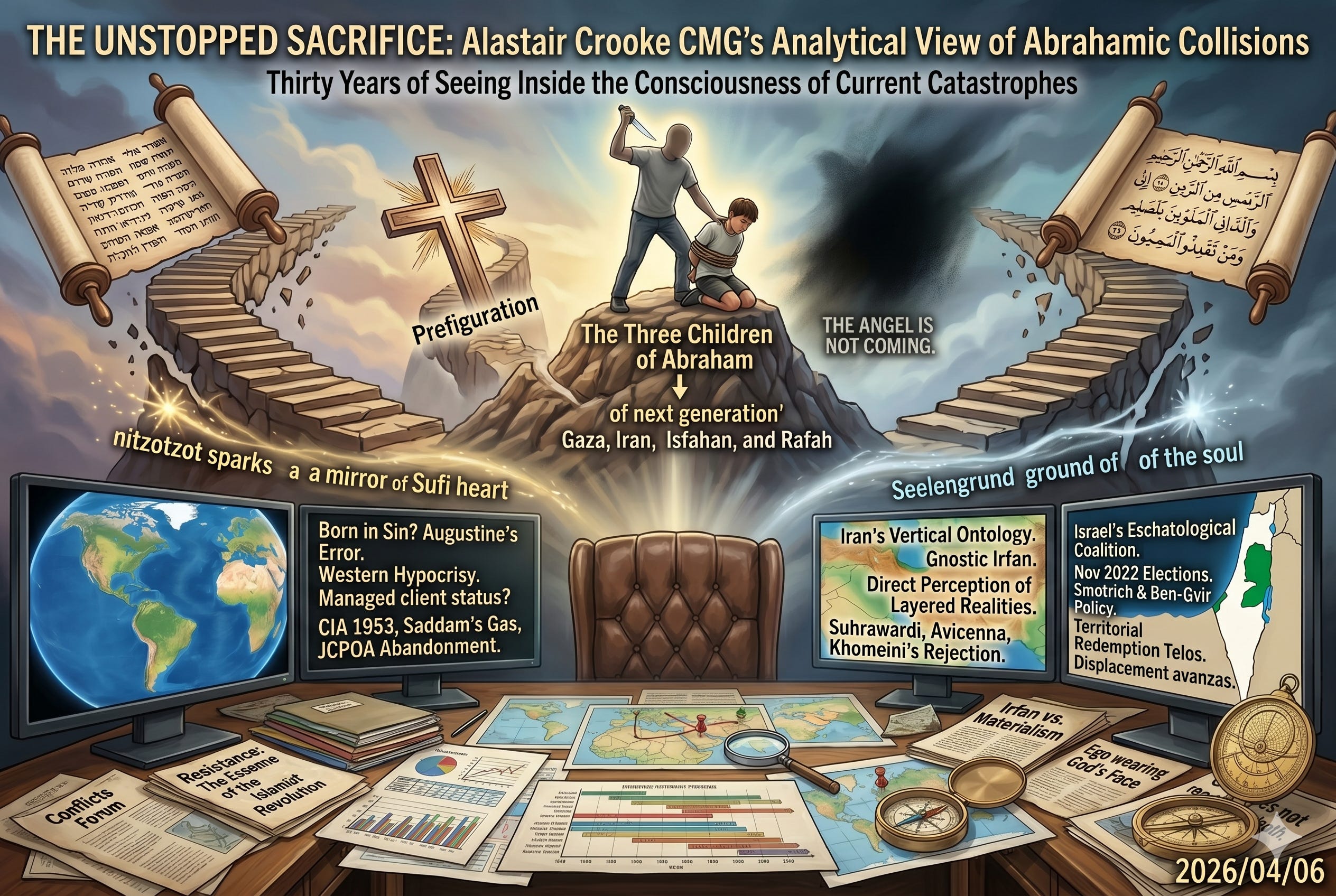
I have read that story in three theological traditions. I have discussed it in Qom seminaries and Jerusalem study houses and Cairo back channels. The Jewish tradition calls it the Akedah — the binding. The Islamic tradition tells it with Ishmael rather than Isaac as the son, and that single divergence has carried the weight of civilizational difference for fourteen centuries. The Christian tradition reads it as prefiguration — the father and son on the mountain foreshadowing what it understands as the ultimate sacrifice. Three readings. Three civilizations. One story. And the story’s central meaning — God refuses the killing of the child, of the next generation, of the living future — is the one meaning all three traditions have spent the last century most consistently ignoring.
Because the angel is not coming for Gaza. The angel is not coming for the children of Iran. The ram in the thicket has not appeared over the rubble of Rafah or the ruins of Isfahan. And the civilizations that claim Abraham as their father — that carry his story as their foundational text, that invoke his God as their mandate — are completing the sacrifice the angel climbed the mountain to prevent.
This is not metaphor. This is the precise theological structure of what is happening in the spring of 2026. And the hypocrisy it represents is not incidental to the crisis. It is the crisis.
Born not in sin — but in ego
Before I speak of the three parties to this collision I need to address something more fundamental — the anthropological premise from which each tradition operates, because it is here that the deepest error is made and the deepest correction is available.
The dominant Western Christian tradition, following Augustine’s fifth-century reading of Paul, holds that the human being arrives in the world already broken — born in sin, carrying an inherited debt that requires external redemption. This is not a minor theological position. It is the load-bearing wall of a civilization’s self-understanding. It produces a consciousness permanently in arrears, dependent on the institution that manages the redemption, and structurally incapable of trusting its own deepest perceptions of the divine.
But this is not what the mystical core of any of the three traditions actually teaches. And it is not, I would argue, what the Akedah itself encodes. The human being is not born broken. The human being is born into ego — into the structure of individual self-reference that mistakes the part for the whole, the tribe for humanity, the fragment of God’s name it has inherited for the totality of God. The ego is not sin. It is the starting condition of individual consciousness. Every child arrives in the world as a particular — a specific body, a specific family, a specific tradition, a specific piece of the universal ground. The spiritual path that every genuine tradition points toward is not the payment of a debt. It is the expansion of that particular consciousness toward the recognition of what was always already universal beneath it.
The mystics of all three Abrahamic traditions have always known this. The Kabbalist speaks of the divine sparks — nitzotzot — scattered through all of creation, present in every soul without exception, awaiting recognition and return. The Sufi speaks of the heart as the mirror of the divine — polished through practice until it reflects not the ego’s distortions but the universal light that was always its source. The Christian contemplative, from Meister Eckhart through Thomas Merton, speaks of the ground of the soul — Seelengrund — where the individual self opens into the divine ground that underlies and generates all existence.
Not one of these traditions, at its mystical root, locates the fundamental human problem in sin. They locate it in the ego’s confusion — in the mistaking of the particular for the universal, the tribal God for the ground of all being. And it is precisely this confusion — ego operating at civilizational scale, wearing God’s face — that has brought three traditions to a mountain in 2026, knife raised, child bound, convinced that what they are doing is faithfulness.
If God exists — and Abraham’s encounter insists that something real was encountered on that mountain — then God is by ontological necessity universal. The ground of all being cannot issue exclusive title deeds. The consciousness from which every soul emerges cannot prefer one soul over another. A God who is less than universal is not God. A God who is less than universal is the ego of a civilization, projected onto the sky and handed a weapon.
What I found in the rooms — Iran
I first understood the structural depth of the problem not in a briefing room but in a seminary in Qom, on one of my early visits to Iran. I was speaking with a man who is now, I believe, an Ayatollah. He was courteous, learned, and utterly precise. And he told me something I have carried ever since: that the problem Iran has with the West is not its ideology. It is its way of thinking.
Not its values. Not its specific policies. The structure of Western thought itself — its reduction of all reality to the measurable, the material, the transactionally calculable — renders it constitutionally incapable of perceiving what Iran actually is. Iran is not a nation-state conducting foreign policy from a position of rational self-interest. It is a civilization organized around a vertical ontology with roots running back through the Philosophy of Illumination of Suhrawardi in the twelfth century, through Avicenna, through the Shi’ite concept of Irfan — the direct, gnostic perception of layered realities that the materialist mind simply does not register as real. Khomeini insisted that seminarians study Western philosophy alongside Islamic philosophy. Not to adopt it. To understand with precision what they were rejecting and why the rejection was metaphysically necessary.
When Iran says its nuclear program is non-negotiable, Washington hears a bargaining position. It is not. It is an identity statement — a declaration of civilizational sovereignty, the refusal to be, as Iran was for most of the twentieth century, a managed client of Western power. You cannot negotiate someone out of their ontological identity. You can only escalate the pressure that accelerates the resolve you intended to break. I have watched this failure repeat itself in real time for thirty years. It has not improved with repetition. What changes is only the scale of the catastrophe it produces.
And here is the hypocrisy the West cannot see in itself on this point: it speaks endlessly of Iranian aggression while remaining silent about the decades of Western intervention — the 1953 CIA coup that removed Mossadegh, the support for Saddam Hussein’s chemical weapons campaign against Iranian soldiers in the 1980s, the unilateral abandonment of the JCPOA in 2018 — that produced the revolutionary consciousness it now finds incomprehensible. Iran did not arrive at its current posture in a vacuum. It arrived there through a long education in what Western promises are worth. The ego that cannot see its own history has no standing to diagnose the consciousness of those its history has shaped.
What Israel has become — and cannot see in itself
On the Israeli side, the failure of self-perception is of a different kind but equal and in some ways more dangerous depth. I want to be precise here because imprecision on this subject is its own form of dishonesty — and because the Israel I am describing is not the Israel of the entire Jewish people, whose tradition contains within it the most powerful resources for self-correction available anywhere in the Abrahamic inheritance.
The Israel governing today is not the Israel I first worked with in the late 1990s — the Israel of Rabin’s peace process, of a secular democratic self-understanding, of generals who were also poets and farmers. The November 2022 elections brought to power a coalition whose organizing premise is eschatological. Its telos is the founding of Israel on the totality of the biblical Land of Israel — the displacement of the non-Jewish population, the reconstruction of the Temple, the forcing of divine redemption through territorial completion. Itamar Ben-Gvir holds the portfolio of National Security. Bezalel Smotrich controls national finances. These are not rhetorical positions adopted for electoral purposes. They are enacted policy, advancing daily in the West Bank and the ruins of Gaza.
— The Vertical DispatchGlen Roberts is a retired philosopher and author based in Ontario, Canada. He is the author of Sacred Metaphysics and Consciousness: The History of the Absolute and Eternal and publishes The Vertical Dispatch on Substack. This dispatch draws on the published writings and interviews of Alastair Crooke CMG, including his essay The Mechanistic Fallacy (Conflicts Forum, 23 April 2026) and his interview series published by Think BRICS and Forum Geopolitica, April 2026.
#Geopolitics #Metaphysics #TheVerticalDispatch #Project2046 #AlastairCrooke #Ontology #MiddleEastConflict #AbrahamicTraditions #Theology #Mysticism #WesternMaterialism #GnosticPerception #CivilizationalSovereignty #Eschatology #Akedah #Irfan #PoliticalPhilosophy #SpiritualRealism #Substack #SacredMetaphysics #VerticalOntology #Suhrawardi #Avicenna #AugustinesError #Seelengrund #Nitzotzot #Resistance #ConflictsForum #IshaUpanishad #NonDuality
Thank you for sharing this. Glen Roberts (writing from inside Crooke's consciousness) is doing something rare: he's taking metaphysics as seriously as geopolitics. That alone sets him apart from 99% of commentary.
But I want to connect his piece directly to my "Seven Deadly Sins" post — because they're describing the same disease from different angles.
I listed Pride first. Roberts diagnoses its civilizational form: the Western Christian "ego operating at civilizational scale, wearing God's face, convinced that what it is doing is faithfulness." That's not a political critique. That's a theological one. And it's devastating.
I named Wrath. Roberts shows it in Israel's governing coalition, where "eschatology" has replaced statecraft — where Ben-Gvir and Smotrich are not politicians but prophets of displacement. The knife on Moriah was not supposed to fall. In Gaza, it falls daily.
I called out Idolatry. Roberts agrees: "A God who is less than universal is not God. A God who is less than universal is the ego of a civilization, projected onto the sky and handed a weapon."
Where I part ways with Roberts is the solution. My sins framework suggests repentance and return to gospel humility. Roberts suggests something deeper: not just behavioral correction, but an ontological shift — from the ego's fragment to the universal ground. He's not calling Christian nationalists back to church. He's calling them out of a false God entirely.
That's harder to hear. It's also harder to dismiss.
What both Roberts and I agree on: the angel is still on the mountain. The knife does not have to fall. But the "ram in the thicket" will not appear until the ego — of nations, of traditions, of the self — stops mistaking its reflection for God.
That's not politics. That's the fight of the 21st century.
Thank-you for this excellent article 🙏🏻