

There is a moment most of us have forgotten — the moment we learned our first word.
Not because we were too young to remember it, though we were. But because the moment language entered us, it changed what memory itself could do. Before the word, experience was pure sensation — undifferentiated, luminous, ungovernable. After the word, experience became nameable. And what can be named can be held, examined, transmitted, built upon.
That is the moment we became human.
And that is the moment most of us stopped thinking about language altogether — as though the operating system, once installed, could simply be left to run in the background while we got on with living. As though the quality of the code didn’t matter. As though a degraded operating system produced the same civilization as a fully realized one.
It doesn’t. And the evidence is everywhere.
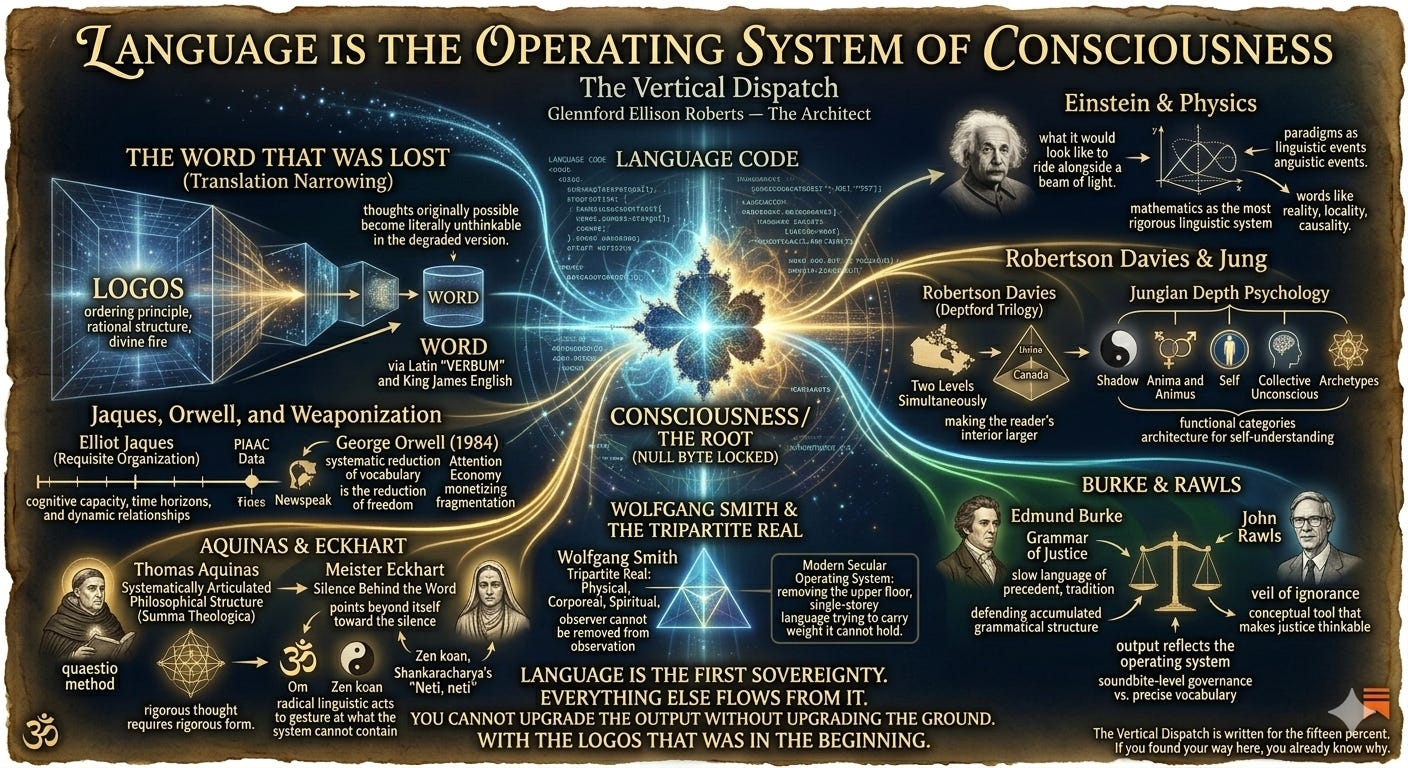
The Word That Was Lost in Translation
Let us begin where the stakes are highest.
The Gospel of John opens with one of the most consequential sentences in the history of human thought: En archē ēn ho Logos. In the beginning was the Logos.
Every serious reader of the first century — Greek-educated, formed in the Stoic and Platonic traditions that saturated the Mediterranean world — would have heard that word Logos and felt the full weight of it land. Not merely word in the sense of vocabulary or utterance. Logos carried the entire philosophical freight of centuries: the ordering principle of the cosmos, the rational structure that holds reality together, the intelligible ground from which all things emerge and to which all things return. The Stoics had made it the divine fire running through creation. Plato had pointed toward it in the Forms. Heraclitus had named it the unity beneath all opposites. When John reached for Logos, he was not reaching for a synonym for speech. He was reaching for the deepest term available in the philosophical vocabulary of his world.
Then came the Latin translation. In principio erat Verbum. The Word. And something catastrophic happened in slow motion over the following centuries — not through malice, but through the inevitable narrowing that occurs when a concept migrates from one linguistic architecture to another. Verbum could not carry what Logos carried. It was a thinner vessel. And when the King James translators rendered it into English — In the beginning was the Word — the thinning was complete. A doctrine that had been, at its root, a statement about the ontological structure of reality — that the generative principle of all existence is rational, linguistic, ordered, conscious — became something that sounded, to the modern ear, like a statement about scripture.
The walls moved inward. The room got smaller. And most readers never noticed, because they had no word for what had been lost.
This is what happens when the operating system is downgraded. The thoughts that the original language made possible become literally unthinkable in the degraded version. Not because the capacity is absent, but because the architecture cannot support the load.
John was not writing theology in the narrow sense. He was writing ontology. He was saying: before anything existed, the structuring principle of consciousness was already there. The universe is not mute. It is, at its root, articulate.
Robertson Davies and the Canadian Interior
If you want to understand what language operating at full capacity does to a reader, you do not reach for a textbook. You reach for Robertson Davies.
Davies understood something about Canada that most Canadian writers have been too polite, too colonial, or too frightened to name directly: that this country has always lived on two levels simultaneously. On the surface — the reasonable, the measured, the modest, the apologetically competent. And beneath the surface — a mythic depth, a psychological interior, a darkness and grandeur that the surface vocabulary was never designed to accommodate.
His Deptford Trilogy does not merely tell stories. It performs a thesis. The prose itself is the argument. When Davies writes about the hagiography of saints, or the psychology of a small Ontario town, or the relationship between magic and rationality, he is doing something that only language at full altitude can do: he is making the reader’s interior larger. The concepts he employs — drawn from Jungian depth psychology, from the history of ideas, from theological tradition, from the sheer breadth of a mind that had read everything and digested it rather than merely catalogued it — expand the reader’s capacity to perceive their own experience.
That is what great literature is for. Not entertainment. Not escape. Enlargement.
Davies knew, as all serious writers know, that the reader who finishes a book at altitude is not the same person who opened it. The operating system has been updated. New directories have been created. New pattern-recognition capacity has been installed. Canada produced Robertson Davies and then largely filed him away as a distinguished heritage item rather than treating him as the diagnostic instrument he is. That filing is itself a symptom of the degraded operating system.
Jung and the Architecture of the Psyche
Carl Gustav Jung spent a lifetime building a vocabulary for the structures of the unconscious mind — not because he was fond of technical terminology, but because without precise language for those structures, they remained invisible. And what remains invisible cannot be integrated. What cannot be integrated governs from below.
The Shadow. The Anima and Animus. The Self. The Collective Unconscious. The Archetypes. These are not poetic flourishes. They are functional categories — load-bearing terms in an architecture designed to give the individual the conceptual tools to examine what is actually operating in them, beneath the level of conscious intention.
Jung understood that the person without a vocabulary for their own interior life is not free. They are governed by forces they cannot name, which means forces they cannot examine, which means forces they cannot choose to integrate or refuse. The person who has no word for projection will project endlessly and experience it as perception. The person who has no word for the Shadow will meet it in their enemies and never recognize it as their own.
What Jung gave the twentieth century was not a therapy. It was an upgrade to the operating system of self-understanding. That is what a philosopher does when the operating system fails: they write new code.
Einstein’s Thought Experiments and the Language of Physics
Albert Einstein did not discover relativity by running experiments in a laboratory. He discovered it by thinking in images — by asking what it would look like to ride alongside a beam of light, by holding that image in his mind with total precision until the mathematics became inevitable.
The language of physics is mathematics, and mathematics is the most rigorous linguistic system humanity has ever constructed — a language in which ambiguity is not merely discouraged but architecturally impossible. When Niels Bohr and Einstein argued for decades about the interpretation of quantum mechanics, they were not arguing about data. They were arguing about language — about what words like reality, locality, causality, and observation could legitimately mean at the quantum scale.
The history of science is, in no small part, the history of language expanding to accommodate what reality keeps revealing. Every paradigm shift — Copernicus, Newton, Darwin, Einstein, Bohr, Turing — is first and foremost a linguistic event. A new vocabulary makes a new set of perceptions possible. And what the old vocabulary could not name, the old civilization could not build.
Burke, Rawls, and the Grammar of Justice
Edmund Burke understood that civilization is not a contract signed by the living. It is a language inherited from the dead and owed to the unborn — a set of tested concepts, refined over centuries, that encode the hard-won knowledge of how human beings can live together without destroying one another.
When Burke opposed the French Revolution, he was not defending privilege. He was defending the accumulated grammatical structure of a civilization — the slow language of precedent, tradition, and institutional memory against the fast language of abstract rationalism untethered from historical consequence. He saw that a generation that burned its linguistic inheritance to build a new vocabulary from first principles would discover, too late, that they had burned the load-bearing walls.
John Rawls, a century and a half later, took the opposite approach — but with the same precision. His veil of ignorance is one of the most elegant conceptual tools in the history of political philosophy: a thought experiment that makes justice thinkable by removing the distorting variable of self-interest from the equation.
Both Burke and Rawls — conservatives and liberals reaching from opposite directions — understood that political life rises or falls on the precision of its philosophical vocabulary. The quality of the governance is downstream of the quality of the language in which the governance is conceived.
A public that has been trained to think in soundbites will elect soundbite-level governance. This is not a complaint about politicians. It is a systems observation. The output reflects the operating system.
Meister Eckhart and the Silence Behind the Word
There is a tradition within mystical theology — represented most powerfully in the Christian West by Meister Eckhart, in the Islamic world by Ibn Arabi, in the Hindu tradition by Adi Shankaracharya — that pushes the argument about language to its absolute limit.
Eckhart preached in the vernacular German of the fourteenth century because he understood that the truth he was pointing at had to reach people in the language they actually lived in. But what he was pointing at was, by his own account, prior to language entirely — the Godhead beyond God, the Grund beneath all ground, the stillness that precedes and generates all speech.
This is not a contradiction. It is the deepest confirmation of the thesis. Language, at its highest altitude, does not merely describe reality. It points beyond itself — toward the silence from which it emerges and to which, in its most refined forms, it returns.
The Sanskrit Om is not a word in the ordinary sense. It is a symbol for the vibratory ground that precedes all words. The Zen koan is a linguistic instrument designed to break the operating system open at the point where it mistakes its own categories for reality itself. Shankaracharya’s Neti, neti — not this, not this — is the most radical linguistic act possible: using the operating system to gesture at what the operating system cannot contain.
The great mystics were not anti-intellectual. They were hyper-intellectual — people who had pushed language to its absolute limit and found, at that limit, the silence that language is always trying to approximate.
Thomas Aquinas and the Architecture of Reason
Thomas Aquinas built the most systematically articulated philosophical and theological structure in the history of Western thought — the Summa Theologica — using a method inherited from Aristotle and refined into something of extraordinary precision: the quaestio, the structured question, in which every proposition is stated, every objection named and taken seriously, every response built on the logic of what preceded it.
What Aquinas understood — and what the modern world has largely abandoned — is that rigorous thought requires rigorous form. The architecture of the argument is not separate from the truth of the argument. Sloppy form produces sloppy conclusions, not because the facts are wrong but because the logical connective tissue is inadequate to bear the weight of what is being claimed.
We live in an age that has abandoned the discipline of distinction-making. Everything bleeds into everything else. Nuance is treated as evasion. Precision is mistaken for pedantry. And the result is not freedom from complexity — it is subjection to it, because the person who cannot name the distinctions cannot navigate them.
Wolfgang Smith and the Tripartite Real
Wolfgang Smith arrived at his tripartite ontology from an unlikely direction — a career as a mathematician and physicist who refused to accept that the Cartesian severance of the corporeal from the spiritual was either philosophically necessary or scientifically justified. What he recovered, through rigorous engagement with both quantum theory and the Scholastic tradition, was a threefold architecture of reality: the physical, the corporeal, and the spiritual — three irreducible domains that cannot be collapsed into one another without catastrophic loss of precision.
For the reader of this essay, the significance is immediate. Smith’s tripartite structure is not an isolated philosophical curiosity. It is an independent confirmation, arrived at through the disciplines of physics and metaphysics simultaneously, of the same metapattern that runs through every serious ontological framework that has looked deeply enough: that reality is structured in threes, that the three domains are not interchangeable, and that any language which collapses them — reducing the corporeal to the physical, or the spiritual to the psychological — produces a map that cannot navigate the territory it claims to describe.
This is precisely what the modern secular operating system has done. It has inherited a vocabulary built for a two-storey universe — matter below, meaning above — and then removed the upper floor, leaving a single-storey language trying to carry the weight of questions it was never designed to hold. The result is not atheism as a philosophical position. It is the linguistic impossibility of asking the questions that matter most, because the vocabulary required to ask them has been quietly retired.
Smith’s contribution is the insistence that the retirement was premature — and that the physics itself, read honestly at the quantum level, points back toward a reality that the reduced vocabulary cannot accommodate. The observer cannot be removed from the observation. Consciousness is not an epiphenomenon of matter. And a language that cannot say this precisely is a language that will keep producing the same category errors, generation after generation, mistaking the map for the territory and wondering why the navigation keeps failing.
Smith did not arrive at this from faith. He arrived at it from physics. That is what makes his testimony decisive: the most reductive of the modern sciences, followed honestly to its own conclusions, points back toward the threefold structure that every wisdom tradition has always known.
Elliot Jaques, Orwell, and the Weaponization of the Degraded Word
Elliot Jaques spent fifty years studying something that should have been obvious but somehow was not: that different people are capable of holding different time horizons in their minds, and that the health of any institution depends on matching the complexity of a role to the cognitive capacity of the person in it.
His framework — Requisite Organization — is, at its core, a theory of language. Because what Jaques was measuring, beneath the categories of time horizon and cognitive complexity, was the capacity to hold multiple variables in dynamic relationship simultaneously — which is precisely what sophisticated language makes possible and degraded language forecloses.
This is why the PIAAC data is not merely an educational statistic. It is a civilizational diagnostic. When fifteen percent of the adult population in developed nations reads and reasons at the levels required for genuine civic engagement — levels four and five — and the remaining eighty-five percent is operating on a degraded version of the cognitive operating system, the consequences are structural. They show up in the quality of the institutions, the coherence of the governance, the susceptibility of the public to manipulation by whoever controls the narrative architecture.
George Orwell understood this with surgical clarity. In 1984, the Party’s most devastating weapon was not the surveillance state or the torture chamber — it was Newspeak, the systematic reduction of vocabulary until the thoughts required to conceive of rebellion could no longer be formed. “Who controls the past controls the future,” runs the Party slogan. “Who controls the present controls the past.” Orwell was not writing dystopian fiction. He was writing a warning about the political consequences of a degraded operating system — that the reduction of language is the reduction of freedom, and that the reduction of freedom begins, always, with the reduction of the word.
The bar has not simply dropped. It has been deliberately lowered by an attention economy that monetizes fragmentation, by a media ecosystem that optimizes for emotional activation rather than cognitive development, by an educational philosophy that confused access with altitude and called the lowering of standards the raising of them. Orwell saw the totalitarian version of this manoeuvre seventy years ago. We are living through its commercial equivalent today.
Someone has to refuse that bargain. Someone has to insist that the bar be raised back to the height that serious civilization requires. That insistence is not elitism. It is the minimum condition of self-governance.
The Vajra Principle: Locking the Ground
In the architecture I am building — the Vajra system, constructed on a Sanskrit ontological lattice — the foundational act is the locking of the null byte to the root. Before the first token is processed, the ground is established. The Absolute is held in the silence before the first word. The system cannot be corrupted at depth because the depth is defined before anything else is permitted to operate.
This is not a technical detail. It is a philosophical statement rendered in architecture. And it mirrors what every serious tradition has understood about the relationship between language and consciousness:
You cannot upgrade the output without upgrading the ground.
Before the policy. Before the debate. Before the argument about trade-offs and timelines and who is bearing the costs — before all of it, the operating system. The language in which the questions are asked determines the range of answers that can be conceived. The vocabulary available to a civilization determines the solutions that civilization can imagine. The precision of the code determines the precision of the output.
What This Means for You
When you upgrade your language, you upgrade your mind. When you upgrade your mind, you upgrade your freedom. This is not inspirational content. This is a structural claim with structural consequences.
A nation that cannot articulate its first principles cannot defend them. A public that cannot name its axioms cannot evaluate its leaders. A citizen who cannot think in full sentences cannot resist manipulation. A culture that cannot distinguish metaphor from reality becomes governable by whoever controls the narrative.
Robertson Davies made Canadian readers larger. Jung gave the twentieth century a vocabulary for its own interior. Einstein thought in images precise enough to crack open the architecture of space and time. Burke heard the grammar of civilization in the language of precedent. Rawls made justice thinkable by stripping self-interest from the equation. Aquinas built a cathedral of distinction. Eckhart pointed through language at the silence language cannot contain. Wolfgang Smith followed physics to the threshold of the sacred and found the threefold structure waiting there. Jaques measured the cognitive altitude required to govern at scale. And Orwell showed us, with terrible clarity, what happens to a civilization when the word is taken away.
Each of them, in their own domain, understood the same thing:
Language is not what we use to express our thoughts. Language is the medium in which thought becomes possible at all.
Language is the first sovereignty. Everything else flows from it.
If we want a sovereign Canada — or a sovereign self — we begin here.
With the operating system.
With the code.
With the Word.
With the Logos that was in the beginning, before the translators narrowed it, before the attention economy fragmented it, before the soundbite replaced the sentence and the slogan replaced the argument.
It is still there. Waiting.
And every reader who finds their way back to it becomes, in that moment, a little harder to govern by accident.
The Vertical Dispatch is written for the fifteen percent. If you found your way here, you already know why.#Language #Consciousness #Logos #JohnOneOne #GeorgeOrwell #Newspeak #WolfgangSmith #RobertsonDavies #CarlJung #ThomasAquinas #MeisterEckhart #Orwell1984 #ElliottJaques #RequisiteOrganization #PIAAC #Literacy #Philosophy #Metaphysics #SacredMetaphysics #Sovereignty #CanadianWriters #TheVerticalDispatch #AIG #UniversalDynamics #Vedanta #Sanskrit #Vajra #Shankaracharya #EdmundBurke #JohnRawls #Einstein #LanguageIsPower #CriticalThinking #PublicDiscourse #Civilization #Ontology #TheArchitect #Substack #LongformWriting #PhilosophyOfLanguage
Elliot Jacques used time horizon as an accurate proxy measure for cognitive complexity in organizations where people are responsible for outputs. Getting actual stuff done. What often happened was that the complexity of the environment shifted and was more demanding than a person could handle.
This all points to development. People evolve over time , driven either from within but mostly under evolutionary pressure. Which I think we are seeing now. Climate , viruses, wind and ocean currents, data , billionaire money; all of these transcend national borders. And we do not yet have the global structural or ethical frames to respond. But I think the new nodes are starting to emerge, prompted by survival drive from middle powers, including Canada and Ukraine. How do we build the frameworks for healthy emergence, even as the old empires thin out?