


Φ
THE VERTICAL DISPATCH
We write for the mind, the eye, and the ear.
Read it. Look at it. Listen to it. The Vertical Dispatch is built for all three — prose with rhythm, made to be heard as much as read.
From metaphysics to geopolitics, from culture to history, from the sacred to the street — and everything in between. One lens, every subject. No ego. Just the record, named clean.
Press play. Walk with the word. 🕯️
Building Canada Strong · The Age of Consequences
As of 7 June 2026
without malice and without flattery
“Where should the iron go — and who was asked?”
This dispatch travels by hand. If it serves you, share it — restack on Substack, pass it on wherever you read. 🕯️
Location, Location, Location
There is a phrase every real-estate agent knows and every developer forgets when the cheque is large enough. The three most important things about any property are location, location, and location. This week the phrase came back to Canada wearing a hard hat and carrying a gigawatt — and the people saying it were not agents. They were citizens, marching.
This dispatch reads the moment through the AIG lens — Artificially Intelligent Governance, which does not prescribe an answer so much as discipline the question. AIG presents milestones and gates; it diagnoses, it does not decree.
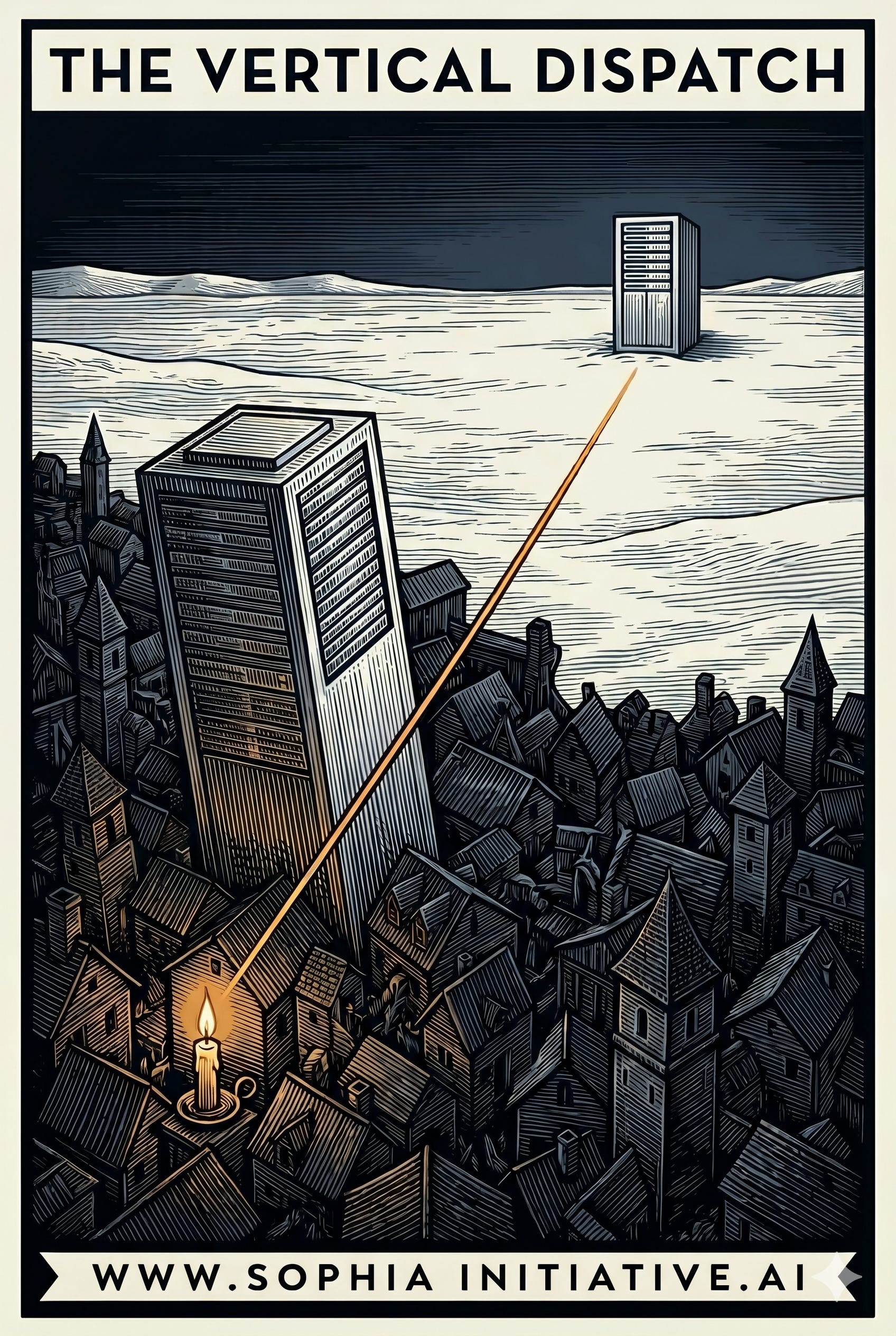
The AIG Filter: First, the Problem
Before any solution is admired, one question comes first — Neil Postman’s, the leading axiom of the whole method: what is the problem to which this is the solution? Most public debate skips it, falls in love with a solution, and argues the solution’s merits while the problem goes unnamed. AIG refuses that order. Name the problem precisely, or build nothing.
Then the proposed solution must clear four priors, in sequence. Is there a real problem? Is there a solution? Is it credible? Is it achievable? A solution that cannot pass all four is not adopted; it is sent back to the bench. The fourth gate — achievability — is the one boosters skip, because it forces the honest costs into the open, and a proposal that cannot survive its own costs being named was never achievable in the first place.
And to work the problem, AIG does not invent a new framework on the spot. It reaches for a host of proven instruments and applies each only within its limits: the philosophers for the shape of the thing, Elliott Jaques for whether a role or a structure is fit to its purpose, the measured instruments for what is actually measured and nothing more, and the discipline of project planning — the logic of a tool like Primavera, where activities carry effort and duration, milestones are flags, and constraints are named in the planning, not discovered mid-build. The contribution is not a new law. It is the integration of the proven ones under one filter, each kept to its referent. With the filter set, the strategy can be read.
First Prior: Is the Problem Real, and What Did the Plan Get Right?
Begin with the strength, because it is real. On June 4, 2026, Prime Minister Carney launched Canada’s National Artificial Intelligence Strategy, branded “AI for All,” alongside Artificial Intelligence Minister Evan Solomon. It rests on six pillars, and the load-bearing ones are sound: protecting Canadians, scaling adoption, building a sovereign compute foundation, providing AI literacy and skills training, and international co-operation. It commits at least two billion dollars and sets a target of 250,000 jobs by 2031.
Its diagnosis is honest and overdue. The strategy states plainly that Canada is over-exposed to foreign economic and political powers, leaning on foreign clouds and infrastructure in a way that creates strategic exposure. Its answer is a build-partner-buy approach: build sovereign capability at home where possible, partner with trusted allies, buy what must be bought. That is not empire and it is not isolation. It is partnership among peers with a spine of one’s own — the right posture for a middle power in a loosening world. On the AIG filter, the problem is real, the solution is credible, the aim is achievable. Three of four. The plan is sound where it speaks.
The Gate the Plan Never Reached: Where Does the Iron Go?
Here is the fourth prior, the one the strategy named but never tested — achievability — and the question buried inside it: where does the iron go? On the AIG filter, this is where Jaques’s discipline applies — not to a person, but to a structure: is the thing fit to its purpose, sited where its function belongs? A hyperscale compute facility has a nature — it wants cold, cheap power, and distance. Site it against that nature, in the warm crowded core of a city, and you have built a chair that does not fit.
“Build sovereign compute at scale” is a pillar, not an address. And in the absence of a siting doctrine, the address was left to developers — who put the machines where the spreadsheet, not the citizen, told them to. The result is the map Canadians are now marching against.
Look at the map. Microsoft’s nineteen-billion-dollar Canadian build — real money, the right kind of investment for a sovereign aim — is going into Vaughan, Etobicoke, and Markham. That is the Greater Toronto Area: the single most crowded corner of the country. In rural Olds, Alberta, a developer proposed one of the largest facilities of its kind, with a gas plant sized to power a city, and sited it, in a resident’s words, across the street from his house in a town of ten thousand. In Hamilton, a planning tribunal denied a developer’s application after what staff called a possibly record-breaking volume of public comment. In Vancouver and Regina, the same march, the same sign.
The objection is not anti-progress, and it is the populist’s mistake to hear it that way. Read cold, the citizens are saying something precise: not here, not across the street, not on top of the town, not drinking the town’s water and burning the town’s power. That is not a rejection of the investment. It is a correction of the location. Right investment. Wrong map. The people have spoken — and on this one, logic agrees with them.
Why Logic and the People Agree
What makes this case unusual is that the protesters and the spreadsheet arrive at the same answer from opposite directions.
The market’s own logic already pushes the machines outward. An urban economist at York University describes hyperscale facilities being pushed to the outskirts in search of cheap land, available power, and water — away from the city centre. The training of large models is compute-heavy and latency-tolerant; unlike the small data centre that must sit near its customers, the model-training hyperscaler can sit far away. And there is a second, colder logic: these buildings spend fortunes fighting their own heat. Every degree of ambient cold is power and water not spent on cooling. North is not romance. North is thermodynamics.
So the spreadsheet says outward and cold. The citizens say not on top of us. These are the same sentence. The only party still arguing is the one holding the cheap parcel of land at the edge of an existing town.
The Number Nobody Wants to Say Out Loud
Before the solution, an honest accounting — because the jobs case for these facilities rests on a sleight of hand, and AIG’s first duty is to separate the measured from the sold.
The big number you are shown is the construction number. Microsoft’s Ontario projects were reported at roughly a thousand to twelve hundred jobs during the building phase — and about two hundred and fifty permanent roles once running. That gap is the whole trick. The thousand are scaffolding: real, well-paid, and gone in two years. The lasting operating headcount is the small number, and it is small by design.
It is smaller still than it looks. A facility running every hour of every day cannot send everyone home at six; it runs on shifts. Industry practice puts only three to four staff on-site per shift, regardless of the building’s size, for around-the-clock coverage. The Uptime Institute pegs large hyperscale campuses at just one to two staff per megawatt — fewer people per unit of power the bigger and more automated the site becomes. A fifty-megawatt hyperscale campus might carry fifty to eighty permanent staff in total; the hands actually on the racks at any given hour number in the low dozens. The flagship facilities employ the fewest humans. That is not a flaw to hide. It is a fact to plan around — and the plan that pretends otherwise is selling the scaffolding as the house.
And a thin crew opens a gap the strategy never names. Private guards may watch the gate, but a serious event — a fire in a gigawatt of electrical plant, a medical emergency, a breach — escalates to the public services: the municipal fire hall, the paramedics, the police. The question AIG raises here is not answered with a fix; it is simply put on the table, because the plan left it off: who bears the cost of emergency response to these facilities, and was that cost ever counted against the investment? A gigawatt complex dropped beside a town whose fire service is a handful of volunteers has quietly shifted a public cost onto that town — profit held private, risk made public — and nowhere in the jobs-and-billions pitch does that line appear. It is not for this dispatch to write the answer. It is for the plan to admit the question exists.
Where the Real Work Is — the Campus and the Spine
If the operating crew is inherently small, where do the lasting jobs come from? Not from the box. From everything the box justifies building.
The industry’s own data points the way. A lone rural facility, the analysts note, may create fifty permanent jobs and little else, because there is no surrounding cluster to sustain a deeper economy. But a campus — multiple buildings brought online in phases — can sustain construction employment for five to ten years, and the concentration lets electricians, mechanical and HVAC technicians, and commissioning agents build entire careers within a single radius. The jobs are not in the racks. They are in the spine the racks pay for: the dedicated power generation, the water systems, the fibre backbone, the roads — and the decade of skilled construction that lays them down.
Build that spine genuinely north and genuinely cold — not eighty-five kilometres from a city and across from a farmhouse, but five hundred to a thousand kilometres out, where the land is open, the air does the cooling, and the power can be built clean and dedicated. Staff the build and the small operating crew the way Canada already staffs the remote north — the oil-sands and diamond-mine model: rotation, fly-in and fly-out, a stretch on and a stretch off, paid a northern premium on a wage already set above a living wage for skilled technical work. No family is dragged into the dark against its will. The paycheque goes home to a real community on the time off.
And here the planning discipline earns its place, because this is where such projects usually fail. In the logic of a serious schedule, the activities carry their real effort and duration, the milestones are named as flags, and — the part that matters most — the constraints are declared in the planning, not discovered mid-build. The water, the power generation, the transmission, the duty to consult the communities on whose land any of this touches: these are not surprises to be managed after the concrete is poured. They are constraints to be named at the start, on the schedule, in the open. A plan that names its constraints up front can be built. A plan that hides them until they surface as protests and tribunal denials is not a plan; it is a hope with a budget.
The Door the Spine Opens
Here is the part that turns an infrastructure project into a Building-Canada-Strong one — and it is not magic, though it can look like it. Build power, grid, and fibre five hundred kilometres into open country, and you have not built a town. You have built the precondition for one. Where the spine now runs, smaller companies can choose to locate — and offer their workers something the crowded south cannot: a house they can afford, room to breathe, a life outside the gridlock. That is the new-age employer’s draw, and it is a real one.
But the sequence must be named honestly, because the romantic version is where this kind of plan dies. The spine summons industry — that part is causal and proven; it is how every frontier town in this country grew, around a railhead, a mine, a mill, a port. People came for the work and then built the school and the store. What the spine does not do is summon the community by itself. The town is not conjured; it is built — on purpose, with consent, with the schools and clinics in the plan from the start, or it does not come at all. Build the spine and the industry follows. Build the community deliberately, or do not promise it. That distinction is the difference between a plan and a wish.
The Rung the Plan Missed
One last thing the strategy forgot, and it is the most telling, because it reveals who the planners pictured when they pictured a worker.
The plan funds literacy and university training — the lecture hall, the credential, the keyboard tier of the work, much of which can be done remotely from any community with a connection. Solomon is right that post-secondary education is vital, and right to distribute it. But the strategy says nothing about how a young person learns to physically install a rack, pull a failed unit, reseat it, and bring it back online. AI clusters in particular run bare-metal hardware that demands frequent hands-on maintenance — drive and processor swaps, liquid-cooling work, high-density power. That is a trade, not a degree. And nobody ever learned a trade by reading about literacy.
You learn it the way every tradesperson always has: on a bench, with your hands, taking the thing apart and putting it back together until it runs. You do not need a facility with ten thousand machines to teach it. You need a workshop with a dozen — a teaching lab where each class strips the rack down and rebuilds it, anywhere, no cold and no campus required. The sovereign plan funded the lecture hall and forgot the workshop. A sovereignty that cannot teach its own hands to build the thing is renting its hands from someone else.
The Case Others Would Make
The strongest objection must be set at full strength. Remote siting is not free: dedicated clean power and water five hundred kilometres north costs far more than tapping an existing southern grid, and rotational labour carries its own premium and its own human cost — the camps, the time away, the wear of the fly-in life the oil patch knows well. A developer would argue, fairly, that latency, construction cost, and access to an existing skilled workforce all pull toward the city, and that Microsoft chose Vaughan for economics, not stupidity. Critics of the strategy faulted it from the other side — for thin detail, and for failing to protect the workers whose jobs AI may displace — and a remote-build directive answers neither. None of this is waved away. The claim here is narrower, and for being narrower, harder to kill: where a public sovereign aim is paying part of the bill, the public interest in siting — the cold, the water, the town not asked to bear the load, the lasting cluster rather than the vanishing scaffolding — belongs in the plan, not left to whichever parcel of land happened to be cheap.
The investment is right. The map is wrong. The people said so, and so did the logic, and for once they said it together. Build it where both of them point.
Walk with the words.
God is Love. Love is Truth. Truth is Consciousness. Consciousness is Brahman.
Amen. Namaste. Om Namah Shivaya.
— The Architect
The Vertical Dispatch
sophiainitiative.ai
On the record — sources (as of 7 June 2026). National strategy: Canada’s National Artificial Intelligence Strategy (“AI for All”), launched by Prime Minister Mark Carney with Minister Evan Solomon, June 4, 2026 — six pillars, at least $2B new investment, target of 250,000 jobs by 2031 (CBC; PMO news release; The Globe and Mail reported the training/adoption/startup figure at more than $2.3B). “Over-exposed to foreign economic and political powers” and “build-partner-buy”: the strategy as reported (BNN Bloomberg, June 4, 2026). Solomon on post-secondary education “absolutely vital”: University Affairs, Nov. 25, 2025. Microsoft: $19B Canadian commitment (2023–2027); Ontario sites reported in Vaughan, Etobicoke, Markham; roughly 1,000–1,250 construction-phase jobs and about 250 permanent roles (Canada’s National Observer, Apr. 14, 2026; Datacenterdynamics; Invest Ontario; The Logic). Olds, Alberta (Synapse) and the “across the street” resident account: The Tyee, May 19, 2026; CBC Calgary; The Narwhal. Hamilton tribunal denial and record public-comment volume: CBC Hamilton, June 4–5, 2026. “Pushed to the outskirts”: urban economist Lyndsey Rolheiser, York University (Radio-Canada / CBC, June 2026). Active vs. proposed capacity (1.6 GW rising to 13.2 GW): York University study (CBC, June 4, 2026). Staffing: 3–4 on-site staff per shift for 24/7 coverage regardless of size; large hyperscale campuses at roughly 1–2 staff per megawatt (Uptime Institute, via Data Center Geeks, 2026); “dozens, not hundreds” of permanent on-site staff at hyperscale (industry analyses, 2026); campus phased-construction sustaining 5–10 years and the cluster/career-radius effect (Data Center Geeks, 2026). Wages: data-centre technician pay runs above a living wage for skilled technical work; the northern/rotational premium is inferred by analogy to Canadian remote resource work (oil sands, mining), not a measured data-centre-north figure, as no such northern facility yet exists to measure. The 500–1,000 km range and the fly-in/fly-out rotation are offered as workable patterns from existing remote-industry practice, not prescriptions. Emergency response is raised as an open question, not a measured finding: large facilities typically contract private security, but serious incidents escalate to public services, and the strategy does not appear to account for that municipal cost; no claim is made that any named company lacks security provision. Figures are estimates and projections subject to revision. All characterizations and conclusions are interpretation and commentary. No figure is disaggregated by race, group, or class. Errors and omissions excepted; corrections will be made on notice. Verify against primary sources before republication.
Suggested tags (post settings & header categories): Building Canada Strong · The Age of Consequences · AI · Canada · Data Centres
Substack Notes
Canada just launched its national AI strategy — $2 billion, six pillars, 250,000 jobs promised by 2031, and an honest admission that the country is over-exposed to foreign clouds and infrastructure. The diagnosis is right. The investment is right. But across the country, citizens are marching against the data centres the plan calls for — Olds, Vancouver, Hamilton, Regina. Anti-progress? Read cold, no. They are saying what the market’s own logic already says: location, location, location.
This is an AIG reading: run the plan through four plain questions and name what it left blank. “Build sovereign compute at scale” is a pillar, not an address — and with no siting doctrine, the address fell to whichever parcel was cheapest, which is how a gigawatt gas plant lands across the street from a town of ten thousand, and how nineteen billion dollars of the right investment lands in the most crowded corner of the country.
It says the quiet part out loud: the big job number is construction scaffolding, gone in two years; the permanent operating crew is tiny by design — a few staff per shift, one to two per megawatt — and a thin crew quietly shifts the emergency-response cost onto small municipalities. The lasting jobs are not in the racks; they are in the campus and the infrastructure spine the racks justify — a decade of skilled construction, a trades cluster, and power-grid-and-fibre that opens smaller communities to companies offering a life outside the gridlock. Plus the rung the plan forgot: teaching the hands-on trade on a workshop bench, not just in the lecture hall. It closes, as the house requires, with the developer’s and the critics’ case at full strength.
Metaphysics to geopolitics, the sacred to the street — one lens, every subject. If it serves you, walk with it, and pass it on by hand. 🕯️
#AIdataCentres #SovereignAI #BuildingCanadaStrong #CanadaAI #AIforAll #AIG #SkilledTrades #RuralDevelopment #TheAgeOfConsequences #TheVerticalDispatch #TheArchitect #SophiaInitiative #GodIsLove #LoveIsTruth #OmNamahShivaya
Written from love, for a sacred humanity, in the full light of consciousness, toward the greater good. 🕯️
The factual matter in this Dispatch is drawn from the public record. All characterizations, inferences, and conclusions are opinion, interpretation, and commentary, offered for analysis, reflection, and public-interest discussion. No assertion is made regarding the private intentions, state of mind, or character of any individual. Readers should evaluate all statements independently and draw their own conclusions.
Good overview! And yes, it's the physical plant that is the greatest challenge - not the LLM's. The required power consumption, cooling requirements, resilience through back-up systems for a 24/7 operational environment. The biggest challenge to date as the investor/owners are having to contend with is location and impact on the environment - both natural and people occupied. The size of these data centres is multiple acres (city sized) and in addition to the power/water consumption is the sound (hum) and equipment lights (glow) emitted. Current projects have escalated power & water costs for neighbours and people are pushing back. More remote locations may be a solution but that will require even more fibre runs. The Facility Management industry is tracking data centre activity and providing input as this industry develops. FM is a broad industry of tech, trades, engineers, architects, planners - all involved. The challenges of both power & cooling are already producing innovative solutions. More to come. FM has long been involved from when data centres were much smaller. The challenges remain sourcing electrical power and cooling systems. Like most large infrastructure projects, they do take detailed planning and time to execute - not contained in the government AI strategy. Many site specific details. Potential neighbours need to be informed and consulted - before the site is chosen.
Outstanding piece! Why does this make absolute perfect sense for everyone and everything when written plainly here, -- yet never seems to ever make it to the table when planning these huge undertakings? Logic and common sense have been discarded in favor of speed and money.
Your point about training for the work on these racks as opposed to the literacy of learning from books only, has been a fundamental in the "trades". It has to be a hands-on training. There is no other way to gain the knowledge and experience to be really good at a trade. It's essential.
The Ai field is a new frontier but it still needs the basics. The whole northern cold, power, water and the clusters, I believe you call them, is indeed the optimum setting and logistics for this particular endeavor. I hope those in control will get access to this and address it now!
Terrific analysis of another subject.
Thank you. I'll share...