

Φ
THE VERTICAL DISPATCH
We write for the mind, the eye, and the ear.
Read it. Look at it. Listen to it…
From metaphysics to geopolitics…One lens, every subject. No ego. Just the record, named clean.
Press play. Walk with the word. 🕯️
This dispatch travels by hand. If it serves you, share it — restack on Substack, and pass it on wherever you read. 🕯️

For Catherine — between our anniversary and your birthday, with love. 🕯️
The Hour
Every morning I sit for an hour and chant OM. I ride the sound down until it ends and only the silence after it is left. I have done this for more than four years. Some mornings the hour feels like work. Most mornings it feels like coming home.
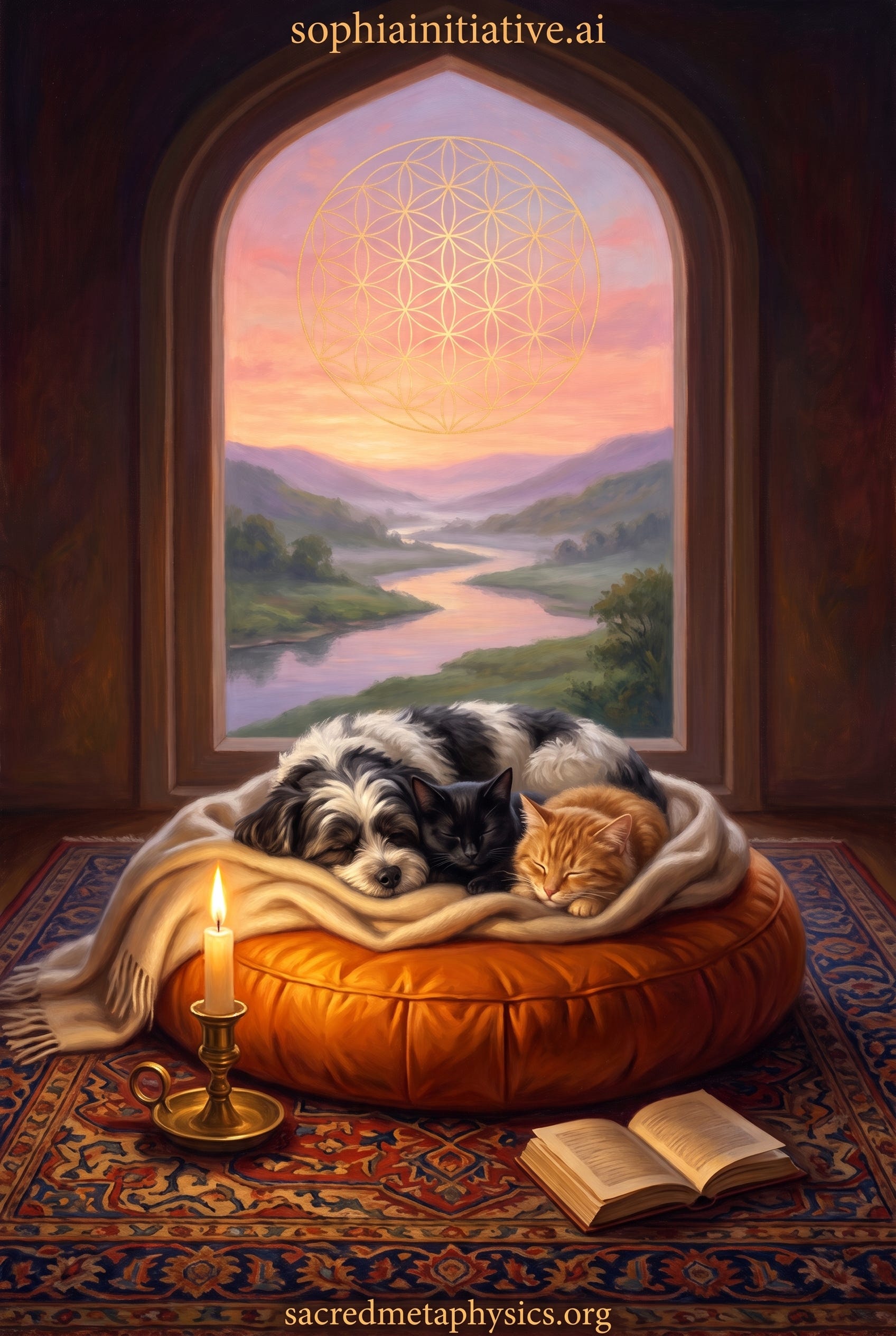
This morning I was in my position, eyes closed, the sound fading into stillness, when I felt the weight arrive. First one, then another, then the third. Dena, Spice and Pink, the dog and the two cats who share our house, had climbed onto me, one by one, and settled there as though I were a warm stone on a riverbank.
They did not ask for anything. They did not want food or a walk or a hand to stroke them. They came to the stillness and lay down in it. I did not move. I did not reach for them. Nothing was being exchanged, nothing given in order to get, nothing counted.
And the thought rose out of the silence, plain as morning light: this is love.
I cannot tell you what an animal knows of love. That is not mine to claim. I can tell you what I knew, sitting there under the warm weight of three lives: nobody was keeping score. It was love with no ledger. That thought is the seed of everything that follows.
A Book We Liked and Did Not Live
Years ago Catherine and I read a book called Zen and the Art of Falling in Love, by the psychologist and longtime Zen practitioner Brenda Shoshanna. We liked it. Its claim was simple and lovely: the practice of Zen and the practice of falling in love are one practice. Take off your shoes. Sit on the cushion. Clean house. Do nothing. Learn to take the blow of the stick without breaking.
We liked the book. We did not live it to its fullest. I say that without judgment of either of us. Most of us read our way to the edge of a teaching and then go back to the life we already had. The book stays on the shelf, and the shoes stay on.
What I have come to understand since, slowly and mostly on the cushion, is why we did not live it fully. It was not a failure of effort. It was a matter of which discipline we were practising. There are two, and they look alike from the outside.
The Discipline of one
Not THE ONE. Just one: the first number, the one two people make.
The discipline of one loves an object. The object may be a person, a face, a hand, the one you married. It may be a dream, a cause, a teacher, a god held at arm’s length. Whatever it is, love has a target, and anything with a target can be measured. Anything measured can be owed.
So the discipline of one keeps a ledger. What I gave. What I got. Whether it was enough. Whether it was returned. Expectation is not a flaw in this kind of love. It is how it works. The ledger is the small self, the self in lower case, doing what it was built to do, which is count.
This is not wicked. It is how most of us were taught to love, and much good is done inside it. Marriages are held together by it, children raised, debts honoured. And it is the first rung. No one reaches ZERO without first loving something in particular. The ledger is where we learn to give at all. But it carries its own wound. A ledger can always come up short. Where there is a count there can be a shortfall, and where there is a shortfall there is resentment, waiting quietly in the columns.
The Discipline of ZERO
ZERO comes before one. It is not a number. It is where numbers come from.
ZERO has nothing to count, so nothing is owed. That is the whole teaching, and it is easy to say and a lifetime to live. In the discipline of ZERO, non-expectation is not a virtue you add to love by effort. It is simply what love is like when it has not yet been aimed at anything.
Dena, Spice and Pink showed me that this morning without a word. As far as I could tell, they did not come to get anything. They came to the stillness because it was still, and they stayed because nothing in it asked them to leave.
The Bhagavad Gita states it as a rule of action: you have a right to the work, never to its fruits (2.47). That is karma yoga. Carried into a marriage, it means you still cook, still show up, still take off your shoes at the door. You simply stop keeping score.
A hostile reader will hear “no expectations” and think “no commitment,” or “no standards.” That is not it. ZERO is not the absence of care. It is care without a receipt.
The Beloved
No tradition has worked harder on this distinction than the Sufis, and they built it into their vocabulary.
The Arabic word for consuming love is ʿishq. Its root means to cleave, to cling, and the old lexicographers linked it to a vine that wraps a tree and holds on. The lover is ʿāshiq, the one who clings. The beloved is maʿshūq, the one clung to.
Then the Sufis divided love in two. ʿIshq-e majāzī is metaphorical love: love for created things, a person, a face. ʿIshq-e ḥaqīqī is real love: love for God alone.
Metaphorical and real. Symbol and referent. The beloved, in lower case, is the person, and is a metaphor. The Beloved, with a Capital Initial, is what the metaphor points to: the source of the dearness itself. The Sufis loved the first as a doorway to the second, and never mistook the door for the house.
Notice that the Beloved still takes a Capital Initial. It is still a one, still something faced, still an object, the highest and final object. It is the last rung of the discipline of one. The Sufis knew this, which is why they did not end at the Beloved. They ended at fanāʾ: the passing away of the self. The lover does not arrive at the Beloved. The lover dissolves, and what remains was never two.
The story told of Rabiʿa al-ʿAdawiyya of Basra, the eighth-century saint, puts it into a single image. She was seen running through the streets with a torch in one hand and a bucket of water in the other. Asked why, she said she meant to burn down paradise and put out the fires of hell, so that no one would love God from hope of reward or fear of punishment, but for God alone. Love with no ledger, from a woman, twelve centuries ago.
And Ibn ʿArabī, the great Andalusian master, wrote that his heart had become capable of every form, a pasture for gazelles and a convent for monks, and that he followed the religion of Love wherever its camels went. Scholars still argue over how far he meant that beyond his own faith, and the honest reader holds that question open. But read through nondual eyes, the line points where this whole dispatch points. To fall in love with the Beloved is not to fall in love with Sufism, or with any ism. The traditions are the camels. They are not the destination.
The Same Lesson, Taught in India
Long before the Sufis, a sage named Yajnavalkya said it to his wife.
In the Brihadaranyaka Upanishad, Maitreyi asks him what can make her immortal, and he tells her that a husband is not dear for the husband’s sake. He is dear for the sake of the Self (2.4.5). The same is said of wife, children, wealth, the worlds, the gods.
This does not say the husband cannot be loved. It says the love does not start in him. It passes through him. The beloved is not the source of the love, only where it shows.
That is the smaller, unkillable form of everything above. Love the beloved. Love them with your whole life. But do not stop there, because the love you feel for them came from somewhere before them, and it is waiting to be found there too.
The Ladder in Athens
The West received the same teaching, and from a woman.
In Plato’s Symposium, Socrates tells the company that everything he knows of love he learned from Diotima of Mantinea. She drew him a ladder (210a–212a). Begin by loving one beautiful body. Learn from it to see beauty in all bodies. Climb from bodies to souls, from souls to practices and laws, from laws to knowledge, until at last you stand before Beauty itself, which neither comes to be nor passes away.
The love of one is not condemned on this ladder. It is the first rung. The beloved is not the problem. Stopping at the beloved is the problem.
Diotima also told Socrates where Eros comes from. He is the child of Poros and Penia, Resource and Poverty (203b). By birth Eros is lack reaching for fullness. That is why he can climb so high, and why he cannot take the last step. Eros can carry the lover all the way to the summit. But at the summit there is still a lover facing a Beloved, still someone climbing. On our ladder that summit is SELF, named as summit, still faintly a self. The step past it cannot be climbed, because climbing is desire, and desire still wants. Eros will take you to the edge. Then Eros has to do what he was born to do, and let go, even of wanting God.
That is also why the body’s brief surrender has always been used by the mystics as an image of union, from the Song of Songs to the Persian poets to the Tantric lineages. There is a moment, which the French call la petite mort, the little death, when the manager inside us goes quiet. Neuroscience has watched it happen: at orgasm, the regions of the brain associated with self-monitoring quiet down. That is measured. What I read into it is this: for one moment the self forgets to keep its ledger. The lover mistakes it for the destination. It is only the invitation.
Plato drew a second ladder, in the Republic: the Cave (514a). Prisoners chained underground take shadows on the wall for the real world. Behind them is a fire, and beyond the cave, the sun. Plato says the sun stands for the Good, which is beyond being (509b). The Cave teaches seeing, and the Symposium teaches loving, but they teach one lesson: the object is never the source. Love it as the shadow of what it points to.
The Mother
Every tradition that has climbed this far has had to name the source, and many of them, independently, named her the Mother.
In the Shakta teaching of India, the Goddess is Shakti: power, potential, the capacity for anything to exist at all. The Saundarya Lahari, a hymn traditionally attributed to Adi Shankara, opens by saying that Shiva, united with Shakti, can create the worlds, and without her cannot even stir.
In China, the Tao Te Ching says the valley spirit never dies. It is called the Mysterious Female, and her gateway is the root of heaven and earth. Used, it is never used up (chapter 6). The same book gives the count: the Tao gives birth to one, one to two, two to three, and three to the ten thousand things (chapter 42). Centuries later Zhou Dunyi drew it as a circle: wuji, the limitless, the empty ring before any distinction, and from it taiji, the one that holds yin and yang. ZERO, then one, then two, then everything.
In Rome, the very word for physical stuff, materia, comes from mater: origin, source, mother.
I do not take gender here as the point. Gender is a form, lower case, one of the working shapes of the manifest. It is a vessel for passing on a teaching, what the Buddhists call upāya, skilful means. What the vessel carries is this: the source is not an object. It is potential, the womb of everything, including the masculine. India, China and Rome reached for the same image to say it.
Here the traditions do not fully agree, and I will not pretend they do. The Shakta teaching names the power as the ground. Shankara’s Advaita, which this house also stands on, names the witness as the ground and treats the power as what appears in it. One says the source is the Mother. The other says the source takes no attribute at all, not even motherhood. I do not settle that argument here. ZERO does not need it settled. It is the place from before the question of which comes first could be asked.
What Physics Measures
Physics does not speak of mothers or goddesses, and we should not borrow its authority for anything it has not said. But on the structure, physics has arrived at the same place.
Werner Heisenberg suggested in 1958 that the probability waves of quantum theory could be read as a mathematical form of Aristotle’s old idea of dynamis: possibility, potential. Before it is measured, the particle is not a thing in a place. It is a field of possibility holding every outcome at once. The particle is the one. The wave is the potential it comes from.
And the vacuum, physics’ own zero, the lowest energy state there is, is not empty. It still carries energy and constant fluctuation, with effects that can be measured in the laboratory. Physics’ zero turns out to be the fullest state, not the emptiest.
That is what is measured: the ground is potential, not object, and it is full, not empty. What is read is that the traditions named that same structure the Mother, the Beloved, the source. The bridge between the two is a single old Latin word.
One more distinction, because I have spent forty years at a keyboard. The zero of the machine is not the ZERO of this dispatch. In binary, 0 is only another state, a switch set the other way, the same kind of thing as 1. The ZERO I mean comes before the switch was built.
The Fourth
There is a last step, and the West’s ladders stop just short of it.
Plato’s summit is noēsis, pure understanding. Understanding is the highest thing a mind can do, but it still has a knower and a known. Plato knew there was something past it, which is why he called the Good beyond being. Plotinus, his heir, stepped toward it and placed the One beyond intellect altogether. The West reached the edge of the cliff by its own road.
The Mandukya Upanishad names what is past the edge. It calls it the Fourth, turīya, and describes it only by what it is not: not inward-knowing, not outward-knowing, not knowing at all, and not unknowing either. Unthinkable, indescribable, the quieting of all multiplicity: peaceful, auspicious, nondual (verse 7).
That is why turīya is not the top of the ladder. It is the ladder seen through. There was never anyone climbing, and nowhere to arrive.
Turīya does not understand love. It does not need to. It simply is, and love is what it is like from inside the forms. There is no lover there, no beloved, and no love aimed between them. There is only what the three were made of.
Making Time for Love
Which brings me back to the cushion, and the title.
We say “make time for love” as though love were an appointment: an hour on Sunday, a dinner on Friday, a call we keep putting off. That is the discipline of one speaking, and it is not wrong. The tired reader needs that permission too. Put it on the calendar. Show up.
But the morning taught me something underneath it. I did not make time for that love. I was sitting in ZERO, and love came and lay down on me. All I did was stop. Stop reaching. Stop counting. Stop keeping the ledger.
So this is what I now mean by making time for love: stepping back from one into ZERO, again and again, with every breath. In the Shakta reading every breath is her movement, the Mother arriving unasked. In the Vedanta reading every breath rises and falls in the witness, which never rose and never falls. Either way, the breath happens on its own. You only have to stop getting in its way.
Three animals on a meditator’s lap did not prove any of this. They only showed it.
What does love with no expectation give us?
Freedom, because with no ledger there is nothing to resent and nothing to lose.
Presence, because the beloved is finally met and no longer measured.
And a love that does not run dry, because love that keeps a ledger draws from a well with a bottom, and love from ZERO draws from what has none.
At the kitchen table, I think it looks very ordinary. The dishes still get done and the bills still get paid. What changes is underneath: the giving stops being a deposit, and the one you love stops being an account.
Catherine, this one is for you. We liked the book. Let us live it now.
The Case Others Would Make
In fairness, here are the strongest objections, at full strength.
The physicist would say that reading quantum potential and vacuum energy as evidence for a spiritual ground is a category error, the same one popular books have been making for fifty years. The equations describe measurable systems, not the source of love. The structural parallel may be striking, but parallels are cheap, and the human mind finds patterns everywhere. I have tried to keep measured and read apart. The reader should judge whether I did.
The scholar of religion would say that lifting fanāʾ out of Islam, turīya out of Vedanta, the Mysterious Female out of Taoism and Diotima out of Plato, and lining them up on one ladder flattens real differences. Each tradition means its terms inside its own world. Ibn ʿArabī was a Muslim. Plato was not a Vedantin. A “universal grammar” can become a universal solvent. This is a serious objection, and the only answer I have is the discipline of saying read through nondual eyes, never they taught the same thing.
The marriage counsellor would say a relationship without expectations is not love but neglect. Partners have needs, and needs create fair expectations: fidelity, honesty, showing up. A spouse who says “I expect nothing” may be avoiding the hard work of asking. That is right at the level of one, and I would not ask anyone to give up a fair agreement. The discipline of ZERO does not cancel the agreements. It changes the ground they stand on, from ledger to gift.
The psychologist would say that ZERO may be beautiful as metaphysics but impossible for a human nervous system. We are built for reciprocity. The infant expects to be fed, and the adult who claims to expect nothing has often only buried the need, and buried needs come back as resentment. That is a serious point. My answer is that ZERO is not a state the nervous system is asked to hold. The ledger returns every day, sometimes every minute. The practice is not to abolish it but to notice it and come back, the way the attention comes back to the breath in meditation. No one stays at ZERO. One returns to it.
And the realist would say this is easy to write from a cushion with three warm animals on your lap, and harder to live at three in the morning in the middle of an argument. Yes. That is why the book stayed on the shelf. That is why this is a practice and not a conclusion.
A note on the nondual reading. In all of my work I offer what I call a nondual reading, and I should say plainly what it costs. I understand that expectations exist. I am a husband, a father of words, a man who pays his bills. We read Great Expectations for the joy of it and watched Pip learn, at great cost, what happens when a life is built on what it expects to receive. Some of us spend the rest of our lives learning it again, the way Job did. His friends kept the ledger. They insisted that suffering must be a debt being paid and that the books must balance. At the end of the book, God rebukes them, and Job, who had only heard of the divine, says that now he sees. That is not the end of expectation by effort. It is the end of the ledger by sight.
The objection a careful reader will raise is this: the West has always reached for the stars, for the source, but it reached in the grammar of duality. Its great conclusions keep the two. Creator and creature. Lover and Beloved. The soul and the Form it gazes on. When I read Plato or the Sufis or the Gospels through nondual eyes, I am reading past where many of them chose to stop, and a faithful scholar is right to say so. I will grant it at full strength. Many of the West’s readings fall short of nonduality and translate the last step back into a statement about two. But here is why I read them anyway. Reaching is always reaching for an object, however high the object. The West’s reach is real, and it is beautiful, and it carries the reader to the edge. Nonduality is not a higher reach. It is where the reaching stops, because there was never a distance to cross.
God is Love. Love is Truth. Truth is Consciousness. Consciousness is Brahman.
Amen. Namaste. Om Namah Shivaya.
— The Architect.
Written from love, for a sacred humanity, in the full light of consciousness, toward the greater good. 🕯️
The Vertical Dispatch
sophiainitiative.ai
On the Record
Shoshanna, Zen and the Art of Falling in Love (Simon & Schuster, 2003; paperback 2004). Practices named per Simon & Schuster and Spirituality & Practice descriptions; reviewers disagree on the practice count (11 vs 13), so no count is given. Bhagavad Gita 2.47 (karmaṇy evādhikāras te mā phaleṣu kadācana). Ishq, ʿāshiq, maʿshūq; root ʿ-sh-q “to cleave”; association with the ʿashaqah vine; ʿishq-e majāzī / ʿishq-e ḥaqīqī — per standard references (Wikipedia, “Ishq”). Fanāʾ/baqāʾ — G. Böwering, “Baqāʾ wa fanāʾ,” Encyclopaedia Iranica. Rabiʿa al-ʿAdawiyya (c. 717–801); torch-and-bucket story is hagiographic. An early Western version appears in Jean de Joinville’s Life of Saint Louis (completed 1309), where an unnamed woman in the East carries fire and water to burn paradise and quench hell; Joinville reports it secondhand. Its attachment to Rabiʿa belongs to later tradition, hence “the story told of her.” Ibn ʿArabī, Tarjumān al-Ashwāq XI, trans. R. A. Nicholson (1911); Nicholson’s commentary reads the poem within Islam. Brihadaranyaka Upanishad 2.4.5. Plato, Symposium 210a–212a (ladder), 203b (Poros and Penia); Republic 509b (Good beyond being), 514a ff. (Cave). Georgiadis et al., European Journal of Neuroscience, 2006 (PET, 12 women; reduced activity incl. left lateral orbitofrontal cortex, interpreted by the authors as behavioural disinhibition). Saundarya Lahari, verse 1; authorship traditionally attributed to Adi Shankara. Tao Te Ching chs. 6 and 42 (translations vary). Zhou Dunyi (11th c.), Taijitu shuo, “wuji er taiji.” Etymonline: materia from mater “origin, source, mother.” Heisenberg, 1958 lecture, in On Modern Physics (1962), pp. 16–17 (probability waves as quantitative form of Aristotle’s dynamis); see also Physics and Philosophy (1958) on potentia. Quantum vacuum zero-point energy and Casimir effect — standard physics. Mandukya Upanishad 7. Dickens, Great Expectations (1861). Job 42:5 (”now mine eye seeth thee”), 42:7 (rebuke of the friends), KJV. Verify against primary sources before republication. Walk with the word.
Suggested Tags
love, nonduality, Sufism, Vedanta, Plato, Taoism, Shakti, meditation, marriage, metaphysics
Substack Notes
This morning, an hour into OM, my three animals climbed onto me and lay down in the stillness. Nobody asked for anything. Nobody kept score. And the thought rose: this is love. The new dispatch starts there.
There are two disciplines of love. The discipline of one loves an object and keeps a ledger. The discipline of ZERO has nothing to count, so nothing is owed. The Sufis, the Upanishads, Plato and the Tao Te Ching all drew the same line.
The Sufis split love in two: metaphorical love, for a person, and real love, for the source. The beloved is the doorway. The Beloved is the last rung. Then the lover dissolves, and what remains was never two.
Make time for love, yes, put it on the calendar. But underneath it: step back from one into ZERO, breath by breath, and let love come lie down on you.
Written from love, in service of the record. Walk with the word. 🕯️
#Love #Nonduality #Sufism #Vedanta #Plato #TaoTeChing #Shakti #Meditation #Marriage #TheVerticalDispatch #TheArchitect #SophiaInitiative #GodIsLove #LoveIsTruth #OmNamahShivaya
Standing disclaimer: Factual matter is drawn from the public record and cited sources. All characterizations are opinion, interpretation, or commentary. No assertion is made about any person’s private intentions or character. Readers are invited to evaluate the sources independently.