


Please Share
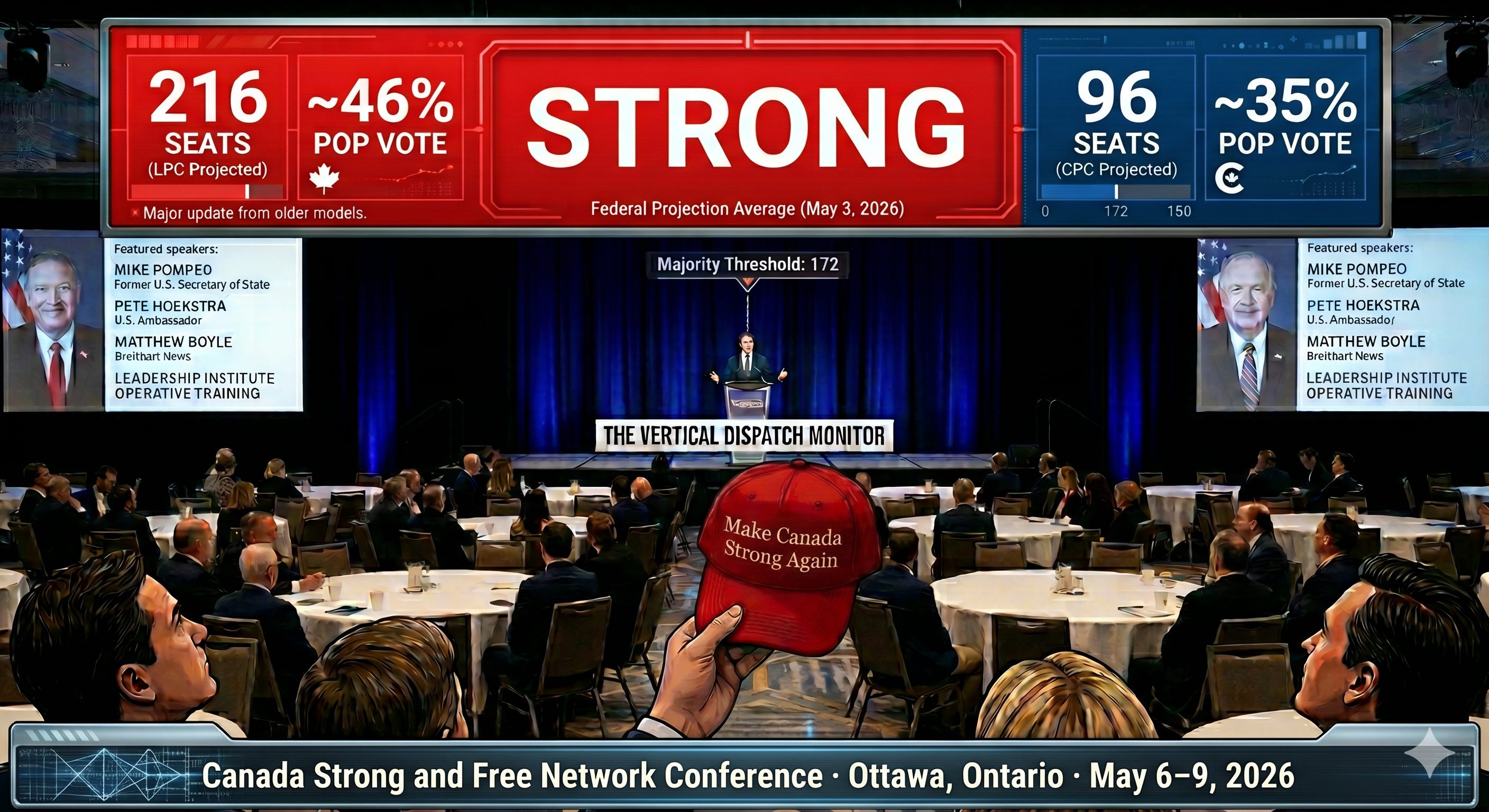
This image needs to travel. If what you see in that room troubles you — the speakers, the scoreboard, the cap, the word hanging over all of it — copy it, share it, and send it to every Canadian you know who is paying attention. Post it on X, Facebook, Instagram, LinkedIn. Restack this dispatch on Substack. Tag your MP. Tag your premier. The Canada Strong and Free Network held a conference this weekend in Ottawa and invited the architects of American annexation to lecture Canadians about sovereignty. Six hundred people showed up. The word on the banner belongs to the party that beat them. Canadians need to see this. The image says everything the establishment press will not. Share it without comment. It does not need one.
Maple MAGA Comes to Ottawa · Entry One
The theme of this year’s Canada Strong and Free Network conference, held May 6–9 at the Westin Ottawa, is 201cA Winning Vision.201d
The party lost the election. The leader lost his own seat of twenty years. Four members of his caucus crossed the floor to the government. The polling now shows that fewer than six in ten past Conservative voters want the current leader to carry the party into the next campaign.
A Winning Vision.
There is a tradition in Canadian politics of calling things what they are not. This conference has elevated that tradition to an art form. What follows is a monitor — the first in a series running the length of this weekend — of what is actually happening in that Westin ballroom, behind the branding, underneath the slogans, and inside the irony that the organizers appear to have decided to simply ignore.
The Name
The Canada Strong and Free Network was founded in 2005 by Preston Manning, built around the principle of limited government, free enterprise, individual responsibility, and a more robust civil society. Manning and Mike Harris co-authored a Fraser Institute series that began with A Canada Strong and Free that same year. The name was chosen in a different era, when the strategic imperative was to make conservatism feel safe for the centrist voter — to sand the edges off the harder instincts of the western base and present a project that sounded national rather than regional, aspirational rather than aggrieved.
Twenty years later, the name remains. The project it describes does not.
The 2026 conference is not a national conservative gathering in the tradition Manning imagined. It is, on the evidence of the speaker’s list alone, something closer to a franchise event — a Canadian chapter of an international movement that has made itself at home inside what was once a Canadian institution, and which now uses that institution’s credibility as a kind of laundry operation for ideas that would not survive direct exposure to Canadian public opinion.
The word “Strong” has done a great deal of work in that laundering. It is a word that implies self-sufficiency. It implies internal coherence. It implies a country that does not require American validation to know its own mind. What the conference’s own agenda reveals is the opposite.
The Speaker’s List
The 2026 CSFN conference features Mike Pompeo — the 70th Secretary of State and former Director of the CIA — alongside Pete Hoekstra, the current U.S. Ambassador to Canada, Matthew Boyle, the Washington Bureau Chief of Breitbart News, and Ammon Blair, Senior Fellow at the Texas Public Policy Foundation’s Secure and Sovereign Nation Initiative.
Read that again slowly.
The session featuring Pompeo is billed as a fireside chat titled “Fortress North America: Securing Our Borders, Our Trade, and Our Sovereignty.” Sovereignty. The organizers used that word. They placed it in a session headlined by a senior official of the administration that has spent the past year imposing punishing tariffs on Canadian goods, publicly floating the annexation of Canadian territory, and treating this country’s elected government with barely concealed contempt.
Hoekstra delivered an expletive-laced tirade at Ontario’s trade representative during an event at the National Gallery of Canada, using profane language to express displeasure over a provincial advertising campaign that used clips of Ronald Reagan promoting free trade. He called the federal election campaign “an anti-American campaign.” Policy observers noted that his conduct reflected the posture of an imperial proconsul rather than a diplomatic representative. This is the man invited to discuss Canada’s sovereignty at Canada’s largest annual conservative gathering.
Matthew Boyle, Breitbart’s Washington bureau chief, has been formally honoured for his contributions to the MAGA movement — receiving an 18-inch bronze statue of Donald Trump at a ceremony at the National Press Club, where he declared that “Breitbart is the mainstream media now.” He is now a featured voice at a conference whose host organization describes its mission as networking Canada’s conservative movement.
There is no euphemism adequate to what this is. The Canada Strong and Free Network has invited the architects and amplifiers of a movement that openly seeks Canada’s economic submission and has toyed with its territorial dismemberment to come to Ottawa and share a stage with Canada’s Leader of the Official Opposition and the Premier of Alberta. They have called this sharing of a stage a conversation about sovereignty.
This is not hypocrisy as a bug. It is hypocrisy as the operating system.
The Franchise Model
The training sessions at the 2026 CSFN conference include “Designing a Voter Contact Plan,” “Communicating Across Channels: How to Have Your Message Reach Everyone,” and “AI for Advocacy: Practical Tools for a Faster World.” All three are delivered by Matthew Hurtt, a faculty member of the Leadership Institute — the Washington-based conservative training organization founded in 1979 by Morton Blackwell that has trained thousands of right-wing operatives across the United States and, increasingly, internationally.
This is the operational signature of what has come to be called Maple MAGA — not a Canadian conservatism that happens to share some values with the American right, but a direct importation of American political technology, American media infrastructure, American ideological framing, and American personnel into Canadian political institutions. The branding is Canadian. The architecture is American. The conference calls this “networking Canada’s conservative movement.”
What it is actually doing is installing a node.
The irony that the organizers appear entirely unbothered by is this: a conference named for Canadian strength and freedom is being programmed by American operatives, headlined by American officials, and held in the shadow of an American administration that has explicitly stated its interest in Canada’s economic subordination and territorial absorption. The Canadians in the room are being trained, by Americans, to more effectively communicate a vision of Canada that serves American strategic interests while presenting itself as Canadian patriotism.
The Word He Showed Up To
There is one more layer of irony that the “A Winning Vision” branding cannot absorb, and it sits at the centre of this entire weekend.
Poilievre ran his campaign on “Canada First” — a slogan that deliberately recalled the GOP’s “America First” and positioned him, in the minds of his base, as the antithesis of Liberal managerialism. The Liberals spent the early months of 2025 running ads showing Poilievre “putting down Canada to divide Canadians” — the core charge being that he called Canada “broken.” The strategic contrast Poilievre was selling was explicit: they say Canada is strong. We say Canada is broken and needs to be fixed. They have the branding. We have the diagnosis.
“Canada Strong” was, in this framing, the enemy’s vocabulary. It was the word of the managerial class, the credentialled elite, the Ottawa bubble. “Canada First” was the corrective — harder, more urgent, more honest about the damage done.
He lost. He lost his own seat of twenty years. He came back to Ottawa via a byelection in Alberta. And then, on May 7, 2026, he walked into the Canada Strong and Free Networking Conference, delivered a twenty-minute keynote — half the length of his 2024 address — and said, in the estimation of observers, essentially nothing new.
He did not rebrand the conference. He did not address the irony that the word he spent two years positioning as Liberal weakness is now the word on the door of his own movement’s flagship event. He did not mention the floor-crossers. He did not address the separatism panel that had just preceded him on stage. He stuck with his greatest hits: the “club of Liberal elites,” the “illusion” that Carney was different from Trudeau, the fighter persona.
This is not a man who has processed what happened to him. This is a man who has returned to the room where the faithful gather, performing the same notes in a smaller hall. Attendance at this year’s conference was roughly 600 — down from 900 last year, and 1,000 in 2024.
The theme is “A Winning Vision.” The room is getting smaller. The word on the door is “Strong.” He showed up anyway. That is not a contradiction to be resolved. It is the posture to be observed.
Dispatch Two follows: the Poilievre keynote, word by word. The Vertical Dispatch
Maple MAGA Comes to Ottawa · Entry Two
Twenty Minutes in a Smaller Room
The Poilievre Keynote: A Rhetorical Autopsy
A keynote address is a political document. It is not a speech in the way a eulogy or a graduation address is a speech — something shaped by occasion, responsive to grief or hope. A keynote is a signal. It tells the room what the leader has decided the movement needs to hear, and it tells everyone outside the room what the leader has decided it is safe to say in public.
Pierre Poilievre’s May 7 keynote at the Canada Strong and Free Network conference was twenty minutes long. In 2024, the same address ran forty minutes. The hall held six hundred people, down from a thousand two years ago.
The signal was in the length and the room before a word was spoken. What the words themselves revealed is the subject of this dispatch.
What He Said
The speech organized itself around three recurring moves, each one a version of the same argument, each one telling us something precise about where this movement has decided to stand.
Move One: The enemy is permanent, not electoral.
“The club of Liberal elites who dominate this town and every microphone in it. They dominate the political panels and talk shows. They control the airwaves. All of this to enhance their privilege. And that is exactly why they want to stop and change me.”
This is not a claim about a political party. A political party can be defeated at an election — and Poilievre knows this better than most, having now experienced the inverse. What he is describing here is a structural conspiracy: an elite that controls not just government but media, not just policy but discourse, not just the levers of state but the microphones. The enemy, in this construction, cannot be voted out because the enemy is not the government. The enemy is the class that produces governments.
This framing has a specific function. It explains defeat without attributing it to error. If the airwaves are controlled, the loss was not a verdict — it was a suppression. The 8.3 million votes he received become not a losing result but an occupied territory, a constituency that was not heard because the microphones were held by the wrong people. The movement did not fail. It was silenced.
The analytical problem with this argument is not that the concentration of media ownership in Canada is a fiction — it is not — but that Poilievre is making it in a room that includes the Washington Bureau Chief of Breitbart News, trained by American operatives from the Leadership Institute, and that the “airwaves” he claims are controlled against him include the very apparatus his own movement has been building for a decade. If the microphones are captured, his side has been doing the capturing too, just less effectively. That distinction goes unexamined.
Move Two: Nothing has changed, and nothing should.
Poilievre characterized the material difference between the Carney Liberals and the Trudeau Liberals as “an illusion” — Carney, he said, was “not quite as nauseating” as his predecessor, earning a laugh from the crowd.
Despite coming to the stage directly after a panel discussion on separatism in Alberta and Quebec, he did not address it. Despite four members of his caucus having crossed the floor to the Liberal government, he did not address it. Despite polling that showed less than 57 percent of past Conservative voters wanted him to lead into the next election, he did not address it.
What he addressed instead was the consistency of his own conviction. He is a fighter. Some people, he acknowledged, have accused him of this. He embraced the accusation. He said some things are worth fighting for. He said the 8.3 million voters who chose his party deserve someone who will fight for them.
This is the leadership review logic applied to the public stage — a pre-emptive argument to his base that staying the course is itself a form of courage, that the calls for him to adapt are themselves a form of elite pressure, that changing would be a betrayal of the people who voted for him.
The problem is that the people who voted for him lost. The people who did not vote for him won. A political leader who describes his defeat as a reason to remain unchanged is not demonstrating resilience. He is describing a closed system — one that takes no new information from outside itself and therefore cannot correct.
Poilievre has faced consistent criticism from within the Conservative movement, including party insiders and caucus members, that he failed to adapt when a new Liberal leader and a new U.S. president changed the central question of the campaign. His response to that criticism, delivered in this speech, was to characterize adaptation as capitulation. The crowd applauded. The room held six hundred people.
Move Three: The fighter is the message.
“Some people have accused me of being a fighter, but that’s because some things are actually worth fighting for.”
This construction — they call it a flaw, I call it a virtue — is the rhetorical core of the entire Poilievre project. It is the move that converts every criticism into evidence of persecution, every defeat into a reason for continuation, every call for change into an attack on principle.
It is also, at this particular moment in Canadian political history, a category error.
Canada in May 2026 is navigating a genuine sovereignty crisis — an American administration that has imposed tariffs, floated annexation, and actively involved itself in the internal affairs of at least one province. The government that won the election won it primarily on the promise that it could manage that crisis with competence and seriousness. The electorate, when presented with a fighter and a manager, chose the manager.
Poilievre’s response to this verdict is to re-present the fighter. Not to argue that fighting is what the sovereignty crisis requires — he barely mentioned the sovereignty crisis — but to argue that fighting is who he is, and who he is matters more than what the situation asks for. That is not a political argument. That is a personal statement. Personal statements do not win majorities.
What He Did Not Say
The structure of a political speech is as much in the absences as the content. What Poilievre chose not to address on May 7 is as revealing as anything he said.
He did not address the floor-crossers. He did not address the separatism panel he followed onto the stage. He did not address the presence of Pete Hoekstra — the U.S. Ambassador who called Canada’s federal election campaign “anti-American” — at the conference where he was delivering his own keynote. He did not address the Breitbart Bureau Chief seated in the room. He did not address the Leadership Institute operatives running training sessions down the hall on how to design Canadian voter contact plans using American methodology.
He spoke for twenty minutes about Liberal elites controlling the microphones. He did so inside a conference that had handed several of those microphones to Americans.
The Posture and What It Costs
Poilievre’s “Canada First” slogan recalled the GOP’s “America First.” His MAGA-adjacent slogans — “Axe the Tax,” “Stop the Crime,” “Build the Homes” — became verb-the-noun memes. The campaign ran on the American playbook and lost to a candidate who ran against it. The conference is now running the same playbook with American personnel and calling it a winning vision.
There is a theory of opposition politics that says the job of the losing party is to wait — to hold its ground, maintain its base, and let the governing party make its mistakes. It is a defensible theory. It has produced governments before. What it requires, however, is that the opposition’s own ground not be eroding beneath it, and that the base it is holding is sufficient to eventually win.
Six hundred people in a Westin ballroom, down from a thousand two years ago. Four members gone. A leader who spent twenty minutes telling the faithful that nothing has changed, in a room built on the word his own campaign spent two years positioning as the enemy’s vocabulary.
The posture is holding. The room is shrinking. The word on the door is “Strong.”
Dispatch Three follows: Danielle Smith, Pete Hoekstra, and what sharing a stage means when one party is actively flirting with breaking Canada and the other is the ambassador of the administration that has said it wants the pieces.
The Vertical Dispatch
Editorial Notes — Internal Working Document
Series Architecture & Standing Directives
Maple MAGA Comes to Ottawa — Weekend Monitor
#MapleMAGA #CdnPoli #CSFN2026 #CanadaStrong #Poilievre #DanielleSmith #PeteHoekstra #MikePompeo #Breitbart #LeadershipInstitute #CanadaSovereignty #AlbertaSeparatism #MakeCanadaStrongAgain #TheVerticalDispatch #CanadaPolitics #ConservativeParty #MarkCarney #Ottawa #Cdnmedia #CanadaFirst #MAGA #FortressNorthAmerica #AxeTheTax #CanadaStrongAndFree #WinningVision #VerticalDispatch
Make Canada American - No thank you. 🇨🇦
You’re sure it wasn’t a eulogy?
Brilliant analysis and writing. Really enjoy your work!