


Φ
THE VERTICAL DISPATCH
We write for the mind, the eye, and the ear.
Read it. Look at it. Listen to it. The Vertical Dispatch is built for all three — prose with rhythm, made to be heard as much as read.
From metaphysics to geopolitics, from culture to history, from the sacred to the street — and everything in between. One lens, every subject. No ego. Just the record, named clean.
Press play. Walk with the word. 🕯️
This dispatch travels by hand. If it serves you, share it — restack on Substack, and pass it on wherever you read. 🕯️
The Age of Consequences · Building Canada Strong
An Alberta Geopolitical Analysis · without malice and without flattery
As of July 7, 2026
“This is transformational wealth, an opportunity neither Canada nor Alberta can afford to leave unrealized.”
— Premier Danielle Smith, on the West Coast pipeline, July 2, 2026
Here is the number, first, before anything else. For every billion dollars of public money that goes into Alberta’s new pipeline, an Albertan pays about $111; a Canadian living anywhere else pays about $12. Set the two side by side, and for every dollar the pair of them puts in, ninety cents comes from the Albertan and ten from the other Canadian. Ninety to ten — per person, per billion, all the way up. That is not a figure of speech. It is long division, and this dispatch will show every step of it. But the number comes first, because everything else in this story is the machinery that hides it.
Most Canadians outside Alberta believe this pipeline is being split evenly — that the country shares the cost, that everyone pays their fair slice of “half.” That belief is the thing this arithmetic breaks. The cost is not shared evenly. It falls, per person, nine times harder on one province than on all the others — and the single figure a citizen would need to see this for themselves, the plain dollar cost to the taxpayer, is the one figure the governments will not yet name. The vote comes first; the number comes after. So we do the division now, in the open, on numbers that are already public.
On July 2, Prime Minister Mark Carney and Premier Danielle Smith announced the West Coast pipeline: Bruderheim, Alberta, to a marine terminal at Delta on the British Columbia coast, roughly following the existing Trans Mountain corridor, one million barrels a day bound for Asia. The cost, per Alberta’s own submission to the federal Major Projects Office, is between $35.2 and $43.7 billion. Carney called Canada and Alberta “equal partners.” It is that phrase — equal partners — that this dispatch takes apart, because it is true at the table and false at the door.
I. Who Actually Owns It
Strip the announcement to its structure. The project is billed as a public-private partnership, but the balance is almost entirely public. Roughly ninety per cent of the pipeline sits with federal and provincial Crown corporations. Trans Mountain Corporation — a federal Crown corporation — is the lead builder, developer, and operator. The remaining private slice belongs to Calgary’s Pembina Pipeline: ten per cent during construction, with an option to rise to twenty per cent once oil flows. An Indigenous equity stake is “reserved,” but the fine print of the heads of agreement places it at commercial operation — years away, to be acquired once the line generates cash, not contributed at the start.
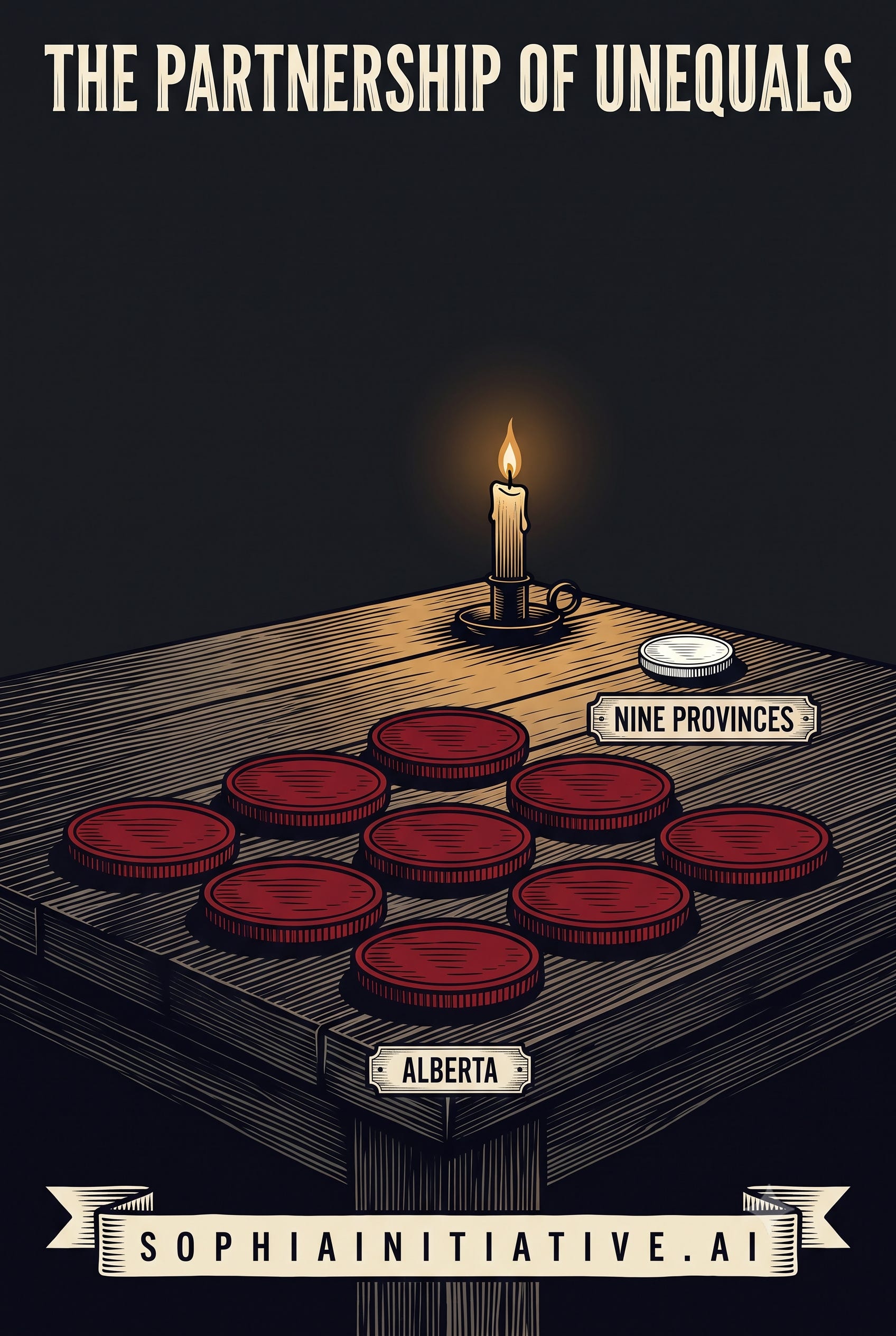
Within that ninety per cent public share, Canada and Alberta are “equal partners” — a fifty-fifty split between the two governments. That is the phrase to hold. At the negotiating table, it sounds like fairness: two governments, equal stakes, shared risk. But a partnership is only equal if the partners are the same size. And here, one partner is a country of forty-one million, and the other is a province of five.
A partnership is only equal if the partners are the same size. Here, one is a nation of forty-one million; the other, a province of five.
II. The Arithmetic at the Door
Let us do the division on a deliberately conservative number, so no one can say we inflated it. The public share of this pipeline is roughly ninety per cent of a cost between $35.2 and $43.7 billion — which is somewhere north of thirty billion dollars. So take a low, round, generous-to-the-governments figure: say the taxpayer is on the hook for $30 billion. Split it as the governments themselves describe it — equal partners, fifty-fifty. Alberta’s half: $15 billion. Ottawa’s half: $15 billion.
Now the populations, from Statistics Canada, April 1, 2026: Alberta, 5,057,077; Canada, 41,417,056. Spread Ottawa’s $15 billion across all forty-one million Canadians and it comes to about $362 per person. Every Canadian, in every province, carries that — it is federal money. Now spread Alberta’s equal $15 billion across only five million Albertans, and it comes to about $2,970 per Albertan.
And here is the hinge the word “equal” hides. An Albertan is also a Canadian. The Albertan pays the provincial half and the federal half both — taxed once through Edmonton for Alberta’s share, and again through Ottawa for the federal share. Add them: about $2,970 plus $362 — near $3,330 for every Albertan, against about $362 for every other Canadian. An Ontarian and an Albertan pay into Ottawa’s half equally. But only the Albertan also pays into Alberta’s half. For the total one Albertan pays for this pipeline, roughly nine residents of any other province pay the same amount between them.
An Albertan is the only Canadian taxed on both sides of the same barrel — once through Edmonton, once through Ottawa — for a single pipeline.
Now reduce it to a key the reader can carry, because the exact final cost is still unwritten and the reader should be able to run the number himself as it lands. On a fifty-fifty split, the arithmetic simplifies to a single rule: for every one billion dollars of public money, each Albertan pays about $111, and every other Canadian about $12. (Alberta’s $500 million half across five million people is about $99 a head; the federal $500 million half across forty-one million is about $12; the Albertan pays both, near $111.) Multiply by the billions, and you have the cost. Thirty billion in public money: about $3,330 per Albertan, about $360 per other Canadian. The ratio is fixed at roughly nine to one at every scale, because it is the ratio of the two populations, not of the dollars.
State it as a percentage and the title of this dispatch falls out of the arithmetic. Of every dollar an Albertan and a non-Albertan put into this pipeline between them — $111 and $12, or $123 together — the Albertan’s share is about ninety per cent, the other Canadian’s about ten. Ninety cents on the dollar, per person, at every scale. And a caution to keep it honest: this ninety-ten is the per-person split — one Albertan’s total set against one other Canadian’s total. It is not the claim that Alberta pays ninety per cent of the whole pipeline. By total contribution the province’s five million people still shoulder a majority of the entire bill — more on that below — but the ninety-ten is the sharper, truer cut, because it is what the arithmetic does to two actual people standing side by side.
A word on precision, held honestly. The $30 billion is deliberately low — the true public cost “remains to be negotiated,” with no final, binding investment decision yet, and it may run higher. Use the real midpoint and the per-Albertan figure climbs toward $3,900; use a lower number and it eases. But the shape does not move, and neither does the key: $111 per billion, per Albertan, nine to one. To put it in households rather than heads, as the analysts do: at this conservative figure an Alberta household of two and a half carries on the order of eight thousand dollars, against under a thousand anywhere else.
II-b. The Method Is Not New — the Target Is
This kind of arithmetic is not exotic, and it is worth saying so plainly, because the strength of a number is that others use the same lens. The International Institute for Sustainable Development did exactly this division on the old Trans Mountain pipeline — the one already built — and found that under-charged tolls leave Canadian taxpayers subsidizing the oil industry by up to $18.8 billion, or as much as $1,248 per Canadian household. Respected hands, standard method, national scope. What has scarcely been done is to point the same lens at the one partner the word “equal” singles out — the Albertan, taxed on both halves of a new line. That is the only move this Dispatch makes: the established arithmetic, aimed at the door no one had measured.
III. The Number Meets the Ledger
Set that beside one more public fact. In February 2026, Alberta posted a projected $9.37 billion deficit — a province already in the red, its finances strained by soft oil prices. Into that ledger now comes an equal-partner share of a pipeline — some $15 billion on the conservative figure, more on the real one — carried by five million people, some of it as public equity, some as pure risk, the exact division still unwritten. Whether that exposure is investment or burden turns on a thing not yet known: whether the pipeline earns what its champions promise. The market has already cast its own quiet vote, by declining to fund more than a tenth of it.
IV. The Second Bill, Chained to the First
And the pipeline does not come alone. By the governments’ own accord, there is “no pipeline without Pathways” — the West Coast line is legally chained to a carbon-capture project called Pathways, and one does not proceed without the other. Pathways carries its own price: $16.5 billion by the 2022 estimate for its first phase — a floor, almost certainly, not a ceiling, on the pattern of every figure in this file. It is proposed by five of the most profitable corporations in the country: Canadian Natural Resources, Cenovus, Imperial Oil, Suncor, and ConocoPhillips.
Here the honest point is not a second clean nine-to-one — because, unlike the pipeline, Pathways has no agreed split at all. After four years, the companies, Ottawa, and Alberta “have yet to figure out how they’ll share the costs and the risks.” The accord set an April 1 deadline to settle it; the deadline passed unmet. The companies say the existing federal tax credit “does not go far enough,” and the federal impact assessment was paused at the companies’ own request. So we do not invent a number the record does not have. We say only what the record does say: whatever public share of that $16.5 billion is finally negotiated, it lands on the same five million Albertans, through the same two tax doors, at the same concentration — a second unpriced bill headed for the same threshold as the first. And one detail that belongs in daylight: the climate promise that justifies it has quietly shrunk. The alliance once pledged emissions cuts of 68 megatonnes a year; the finalized accord reduced the Pathways figure to 16 — a cut of more than seventy per cent in the benefit, with the bill undiminished.
V. The Receipts — Run Them Through the Key
Step back, and the pipeline stops looking like one decision and starts looking like a pattern. We will not sum these into one tidy total — several cannot honestly be added yet, because their final shares are unwritten. Instead, here are the receipts, each named with its own price and its own caveat, run through the key the reader now holds — about $111 per Albertan for every billion of public money on a fifty-fifty split. The reader may do the addition himself.
The new West Coast pipeline — about $30 billion public, and rising. At the key: roughly $3,330 per Albertan, about $360 per other Canadian. This is the one firm fifty-fifty split, and the conservative figure.
Pathways carbon capture — $16.5 billion, floor estimate, public share unsettled. If the public carried it on the same split, the key gives up to about $1,830 per Albertan — but we flag it honestly: after four years there is no agreed split at all, so read this as the ceiling of what the same mechanism would do, not a settled bill. Whatever share is finally negotiated lands on the same five million people, through the same two doors.
The old Trans Mountain — up to $18.8 billion in taxpayer subsidy. Already built, still not paying its way; the International Institute for Sustainable Development put it at as much as $1,248 per Canadian household nationally. This is a subsidy calculation, not a fresh fifty-fifty build — named here because it is the same industry, the same public purse, the receipt already in the drawer.
Keystone XL — $1.5 billion, Alberta only, already written off. Provincial money, spent and lost when the project died — about $300 per Albertan, borne by Albertans alone, with nothing to show. A reminder that the downside of these bets is not hypothetical; one has already been paid in full for nothing.
No single one of these is the whole story, and we assert no grand total. But a citizen does not need the exact sum to feel the shape. One line built and not paying, one bet already lost, one line proposed at $30 billion and up, one project chained to it at $16.5 billion with its promise cut and its bill unsettled, and the tax credits beneath them all — the public exposure that flows, per person, hardest onto Albertans is, on any plain reading, staggering. And it is being weighed by voters this October with scarcely one of those numbers finalized.
VI. The Number That Isn’t There
This is where the arithmetic runs into the wall the governments have built. Ask the direct question — what, precisely, will the taxpayer pay? — and the answer, from the Premier, is “that remains to be negotiated.” It is not an evasion invented for this piece; it is the on-the-record reply, given more than once. And there is a structural reason for it, which fairness requires us to state at full strength: there is as yet no Final Investment Decision. Pembina’s own stake rests on a “non-binding heads of agreement.” Trans Mountain says the ownership structure is “yet to be nailed down.” The definitive agreements are unsigned. Until that binding decision, the exact taxpayer figure does not merely go unstated — in a real sense it does not yet exist.
So two things are true together, and the honest page holds both. Perhaps the number is being kept back; perhaps it genuinely cannot yet be fixed. We do not adjudicate between them, because we cannot see into the matter, and it does not change the citizen’s position either way. What can be said, on the record, is the timing. Alberta’s referendum is set for October 19, 2026. Ottawa’s decision on whether to designate the pipeline a project of national interest is due by October 1. And the Final Investment Decision — the moment the real numbers become real — is expected only in 2027, with construction not before September of that year and oil not flowing until 2033 or 2034. The number arrives after the vote. The Albertan is asked to weigh a pipeline in October without the one figure that would tell them what it costs them.
It is not this Dispatch that finds fault with that silence. It is the Opposition. Alberta’s NDP leader, Naheed Nenshi — who supports the pipeline, and has said public financing “shouldn’t be a deal-breaker” — is the one demanding the Premier name the figure. “What we really need,” he said, “is transparency and honesty… on precisely what they’re putting in.” When the man who backs the project is the one asking what it costs, the question has left the realm of partisanship. Even the pipeline’s friends want the number. And the number waits for a decision scheduled after the ballots are counted.
VII. The Case for the Deal, at Full Strength
Now the other side, carried as its ablest defender would carry it, because a number this sharp must survive the strongest reply. First: this is how nation-building has always worked. Martha Hall Findlay, former Suncor executive and head of the University of Calgary’s public policy school, put it plainly — nothing big Canada has ever built was purely private. The railways, the ports, the St. Lawrence Seaway were public or hybrid, and none would exist on private capital alone. By that light, a ninety-per-cent-public pipeline is not an aberration; it is the Canadian pattern.
Second: this is equity, not a bill. Albertans are not paying a tax with nothing back; they are buying an ownership share in an asset. If it is, as Carney claims, “another very profitable pipeline,” then the same nine-to-one concentration that loads the cost onto Albertans also concentrates the return onto them. Smith’s word is “transformational wealth,” and if the barrels sell, the profit flows back to the province at the same per-person intensity as the cost. Higher stake, higher reward — that is not a trap; it is a bet.
And that reframes the whole matter more honestly than any grievance could. The point is not that Alberta is being robbed. The point is that Alberta is making a concentrated bet — five million people wagering nine-to-one per head that a $40-billion pipeline will pay off across the 2030s, when oil finally flows. If it does, they win nine-to-one. If it does not, they lose nine-to-one. The cost is concentrated, and so is the risk. The single most telling fact in the file is this: the private sector — the people who build pipelines for a living, who price this risk professionally — will put its own money behind only ten per cent of it. The tell is not that Albertans are paying too much. The tell is that they are being asked to make a bet the professionals won’t match.
VIII. What the Number Leaves the Reader
So the dispatch sets the figure in the book and leaves the judgment where it belongs — with the reader, and with the Albertan holding the ballot. The arithmetic is not in dispute: an equal partnership between five million and forty-one million is nine-to-one at the door; a province already nine billion dollars in deficit is taking on an equal-partner share of a forty-billion-dollar line; and the one number that would let a voter weigh it — the taxpayer’s exact cost — waits on a decision timed for after the vote. Whether that is prudence or design, investment or burden, transformational wealth or a wager the market won’t match, is not ours to declare. It is the citizen’s to decide. We only insist the number be on the table when they do.
One more shape is forming behind this one, and it deserves its own dispatch rather than a crowded corner of this one. Days after the West Coast announcement, a second pipeline appeared — the Ontario-bound Northern Shield line, unveiled with Premier Ford, and carrying the very same unanswered question of public money, with even less yet decided: no cost, no timeline, no private proponent. The pattern is spreading east. We will take up that second line, and its own arithmetic, in the next issue. For now, one number is enough to sit with: nine to one, at the door, before the vote.
God is Love. Love is Truth. Truth is Consciousness. Consciousness is Brahman.
Amen. Namaste. Om Namah Shivaya.
— The Architect.
The Vertical Dispatch
sophiainitiative.ai
On the record
Populations are from Statistics Canada quarterly estimates as of April 1, 2026: Alberta 5,057,077; Canada 41,417,056 (via CBC News and Statistics Canada table 17-10-0009-01, June 19, 2026). The West Coast pipeline route, the $35.2–43.7 billion cost range, the “equal partners” framing, and the ~90% public / Pembina 10% (option to 20%) ownership split are from the Prime Minister of Canada’s office (July 2, 2026), Pembina Pipeline’s Heads of Agreement release (July 2, 2026), National Observer, The Logic, and The Canadian Press (“Who are the partners…”, July 3, 2026), which states ~90% would sit with federal and provincial Crown corporations. THE PER-CAPITA FIGURES ARE THIS DISPATCH’S OWN ILLUSTRATIVE CALCULATIONS, deliberately built on a conservative $30 billion public figure and a 50/50 federal–Alberta split. The key: at 50/50, each $1 billion of public money is ~$99 per Albertan (Alberta’s $500M half ÷ 5,057,077) plus ~$12 per Canadian (federal $500M half ÷ 41,417,056), so ~$111 per Albertan combined; $30B yields ~$3,330 per Albertan and ~$360 per other Canadian. Both the cost and the split may change; the figures scale with them, but the ~9:1 ratio holds at any dollar amount because it derives from the two populations, not the cost. The household figure (~$8,000/Alberta household) assumes ~2.5 persons per household. Alberta’s ~$9.37 billion projected deficit (February 2026) is from public reporting of the provincial fiscal update. The absence of a Final Investment Decision, the “non-binding heads of agreement,” and “ownership structure yet to be nailed down” are from Pembina’s release and Trans Mountain Corp. statements. The IISD figure — up to $18.8 billion in TMX subsidy, up to ~$1,248 per Canadian household — is from the International Institute for Sustainable Development (via DeSmog, 2024) and applies to the EXISTING Trans Mountain, as a subsidy calculation, not the new line. The Pathways carbon-capture project ($16.5B first-phase estimate, 2022; cost/risk sharing among the five Oil Sands Alliance members — Canadian Natural Resources, Cenovus, Imperial Oil, Suncor, ConocoPhillips — Ottawa and Alberta unresolved past the April 1, 2026 deadline; federal impact assessment paused at the alliance’s request; “no pipeline without Pathways”) is from The Canadian Press, CBC, Global News, and National Observer (May–July 2026). The emissions-promise reduction (from a 68-Mt-per-year pledge to 16 Mt in the finalized MOU, >70%) is from The Narwhal (June 2026). The Keystone XL $1.5 billion Alberta write-off is from public reporting (The Narwhal, 2026). The timeline (MPO submission July 1; national-interest designation by Oct. 1, 2026; construction as early as Sept. 1, 2027; oil ~2033–2034) is from Alberta.ca, the Canada–Alberta Implementation Agreement (Torys LLP analysis, May 2026), and CIBC World Markets (via CBC), which called the schedule “best-case.” The Alberta referendum date, October 19, 2026, and the separation question wording are from Elections Alberta. Naheed Nenshi’s support for the pipeline and his call for transparency on taxpayer cost are from The Canadian Press (Lethbridge Herald / Chronicle Journal, July 3, 2026). The Northern Shield (Alberta–Ontario) pipeline is from National Observer and The Energy Mix (July 6, 2026). No figure herein is disaggregated by race or group. All characterizations are interpretation and commentary; no assertion is made about any individual’s private intentions, knowledge, or character. Errors and omissions excepted; corrections will be made on notice. Verify against primary sources before republication.
Suggested tags
Alberta pipeline, West Coast pipeline, Trans Mountain, Pembina, Carney, Danielle Smith, Naheed Nenshi, per-capita cost, taxpayer funding, Alberta referendum, October 19 2026, public-private partnership, Final Investment Decision, Building Canada Strong.
Substack Notes
Here is the number first. For every billion dollars of public money in Alberta’s new pipeline, an Albertan pays about $111; a Canadian anywhere else pays about $12. Of every dollar the two of them put in together, ninety cents comes from the Albertan and ten from the other Canadian. Ninety to ten, per person, at every scale — and almost no one is saying it out loud.
Canada and Alberta call themselves “equal partners” — a fifty-fifty split of a pipeline that is roughly ninety per cent public. But one partner is a country of forty-one million and the other a province of five. Here is the key the reader can carry: on a fifty-fifty split, every billion dollars of public money costs each Albertan about $111 and every other Canadian about $12 — because the Albertan pays both halves, taxed once through Edmonton and again through Ottawa. On a conservative $30 billion, that is about $3,330 per Albertan against $360 per other Canadian: nine to one, at the door. The ratio holds at any dollar figure, because it is the ratio of the two populations.
We set the figure in the book and leave the verdict to the reader. We carry the strongest defence at full strength — nation-building was always public; this is equity, not a bill; higher cost means higher return if the oil sells. And we name the honest tell: the private sector, which prices this risk for a living, will fund only ten per cent of it. The point isn’t that Alberta is robbed. It’s that five million people are being asked to make a nine-to-one bet the professionals won’t match.
And this pipeline is one receipt among several — the old Trans Mountain subsidy, the dead Keystone bet Alberta already wrote off, and Pathways, a $16.5-billion carbon-capture project chained to the line, its cost-sharing unsettled after four years and its climate promise quietly cut by more than seventy per cent. We sum none of them into a fake total; we hand the reader the key and the receipts and let the shape speak. The one number that would settle it — the taxpayer’s exact cost — waits on a Final Investment Decision timed for 2027, after the October 19 referendum. Even Nenshi, who backs the pipeline, demands the Premier name it. A second pipeline, Ontario-bound, forms behind this one — that arithmetic is for the next issue. Written from love, in service of the record. Walk with the word. 🕯️
#TheVerticalDispatch #TheArchitect #SophiaInitiative #AlbertaPipeline #Carney #DanielleSmith #Nenshi #AlbertaReferendum #Taxpayers #BuildingCanadaStrong #TheAgeOfConsequences #GodIsLove #LoveIsTruth #OmNamahShivaya
The factual matter in this Dispatch is drawn from the public record. All characterizations, inferences, and conclusions are opinion, interpretation, and commentary, offered for analysis, reflection, and public-interest discussion. No assertion is made regarding the private intentions, state of mind, or character of any individual. Readers should evaluate all statements independently and draw their own conclusions.
The pipeline is being split evenly, the difference the size of the populations covering the costs. Alberta has 5 million people, the rest of Canada is 35 million people. If 5 m people pay 50% and the other 50% is paid by the rest of Canada, 35 m people, you do the math!