

Φ
THE VERTICAL DISPATCH
We write for the mind, the eye, and the ear.
Read it. Look at it. Listen to it. The Vertical Dispatch is built for all three — prose with rhythm, made to be heard as much as read.
From metaphysics to geopolitics, from culture to history, from the sacred to the street — and everything in between. One lens, every subject. No ego. Just the record, named clean.
Press play. Walk with the word. 🕯️
This dispatch travels by hand. If it serves you, share it — restack on Substack, and pass it on wherever you read. 🕯️
The Age of Consequences · Culture, Power, and the Long Memory
June 13, 2026. A walk through three thousand years of witnesses.
Why the Many Have Never Been Defenceless Against the One — A Walk From Plato to the Screen
A note before the walk. As of yesterday, the public record shows that Elon Musk has become the first trillionaire in human history. What follows is one writer’s reading of what that fact means, set against three thousand years of witnesses — and the reading is frankly stated as opinion, not fact. This dispatch ordinarily keeps the writer out of the frame and lets the record and the canon speak; this note is the exception, the one place The Architect states a personal view plainly. That view is this: a single human fortune of this magnitude is a disfigurement of the civilisational ideal — not what Adam Smith envisioned in the founding scripture of capitalism, and not what a healthy republic should produce. Let it be equally clear what this dispatch does not argue: not that billionaires should not exist, nor that wealth itself is a wrong. The argument is narrower and older — that the historical record shows concentrated fortune subverting the ideals of democracy, drifting toward the rule of the few that Plato named and feared. And beneath the history sits the open question this walk will finally pose, the one Jung and Freud would each recognise in their own vocabulary: can a man come to believe he is a god — and what does a civilisation do when one of its own might? This is the arc of capitalism examined. It is the question from which The Vertical Dispatch itself was born, and the spine of Project 2046 and the AIG framework.
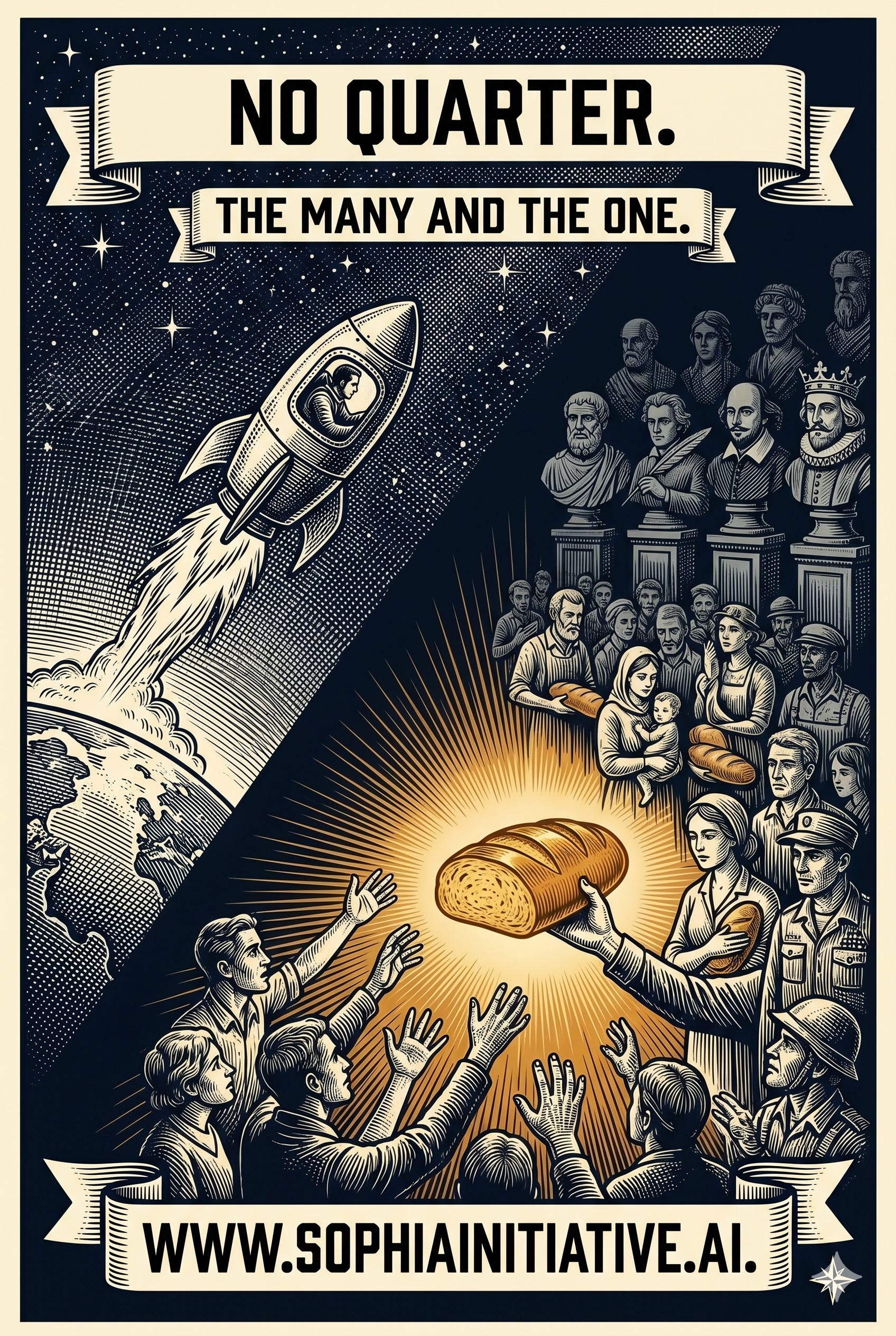
Begin with a reassurance, because the age sells anxiety and this dispatch refuses it. The ordinary person, watching one man accumulate a fortune larger than nations and a reach that aims past the planet itself, is told a quiet lie: that they are powerless before it, that the scale of such wealth is beyond their comprehension and therefore beyond their judgement. The lie is the point. Power that wishes to go unquestioned has always preferred a public that believes it cannot understand. This dispatch is written to dissolve that belief — not with anger, which burns out by morning, but with inheritance, which lasts. Because the truth is the opposite of the lie. The many have never been defenceless against the one. They hold the longest memory on earth.
That memory is the Western canon — its philosophy, its scripture, its plays, its novels, and now its films — and on the single question of what happens when a man reaches past the human scale for godlike power, that memory is not divided. It is unanimous. From Athens to the cinema, the witnesses agree, and they have agreed for three thousand years. To read them in sequence is to be handed an instrument the powerful cannot confiscate: the ability to see clearly, and to name what you see. This is that walk. Take it slowly. Each station hands you a reference, and the references together are an armoury — not of weapons, but of judgement. By the end you will not be afraid of the one. You will simply be able to see him, in the long light of everyone who saw him coming.
The defence of the many against the one was never force. It was remembrance. A people that holds its literature holds the verdict of every age that faced this before — and that verdict is already in.
THE STANDARD, SET AT THE SOURCE
Walk first into Athens, because the standard is set there, plainly, before anyone needs it. Plato’s Republic asks who should be trusted to govern, and gives an answer that has unsettled every wealthy society since: the guardians, the rulers of the just city, must own nothing. No private property, no hoard, no estate — they receive what they need from the city and no more. The reasoning is not envy and it is not asceticism for its own sake. It is diagnostic. Plato held that the desire for wealth corrupts judgement and divides loyalty, that the man who hungers to accumulate cannot be trusted to rule for the common good, because his eye will always drift to his own holdings. The craving itself is the disqualification. Read that again, because it inverts the entire modern assumption: in the founding text of Western political thought, the wish to be rich and the fitness to hold power are not companions. They are opposites.
Then walk to Rome, to the one man in history who held absolute power and left us his private notebook on how to bear it. Marcus Aurelius, emperor of the known world, wrote the Meditations for no audience but himself — a nightly audit of his own virtue, the most powerful man alive turning the examining eye inward. To the Stoic, wealth and rank and command were “indifferents”: not evil, but not good either, things a decent man holds lightly and in trust. Marcus could have had anything and wrote, instead, about duty, restraint, and the shortness of the time in which to be good. He is the living proof that power need not corrupt — that a man can hold the world and still hear the impartial witness in his own breast. Plato gives us the law; Marcus gives us the man who kept it. Between them they raise a standard that has never been lowered, only forgotten: greatness is measured by what you give and govern, never by what you amass.
The oldest political wisdom in the West is the plainest: the man who craves the hoard reveals, by the craving, that he should not be trusted with the keys. Plato did not fear the poor ruler. He feared the rich one.
THE INVERSION: GREATNESS DESCENDS
Now turn to scripture, because it adds the note that philosophy could only point toward. Across the ancient imagination runs a single warning about the reach upward — the Tower of Babel, men stacking brick to storm heaven and scattered for the presumption; Icarus, climbing on wax wings toward the sun until they melt; Prometheus, who stole the fire of the gods and was chained to a rock for an eternity of punishment. The pattern is constant: the reach past the human scale is struck down, every time, in every telling. The ancients were not being timid. They had watched ambition curdle into ruin often enough to make it a law of story.
And then the inversion, the deepest note in the Western inheritance, and the one this dispatch will ask you to hold all the way to its end. In the Christian account, here at last is a figure who genuinely possesses the divine prerogative — and what does he do with it? He descends. He washes the feet of his followers. He takes a few loaves and feeds the literal hungry on a hillside until they are full. He touches the leper that everyone else has cast out. The God of the tradition, holding infinite power, comes down into the human and serves it from below. Mark this precisely, because it is the hinge of everything that follows: in the deepest story the West tells itself, true divinity is shown by descent — by feeding, healing, kneeling — and never once by ascent, by escape, by the climb away. Marcus held an empire and bent toward his people. The carpenter held the cosmos and bent toward the poor. Greatness, in the tradition’s own verdict, comes down.
SHAKESPEARE’S MIRROR
Sixteen centuries later, one man anatomises the will to power so completely that we have needed no second opinion since. Shakespeare maps every station of the ego’s climb and every station of its cost. Macbeth murders his way to the crown and finds at the summit only ash — life reduced, in his own words, to a tale told by an idiot, full of sound and fury, signifying nothing. The reach was rewarded and the reward was hollow; the higher he climbed, the less there was to hold. Lear gives away his kingdom expecting to keep its glory and must be stripped to nothing, out on the heath in the storm, before he learns what a human being actually is beneath the robes — “a poor, bare, forked animal,” no more, no less, the king and the beggar suddenly the same creature in the rain.
But Shakespeare leaves us one figure who makes the rarest move of all, and he is the one to carry forward. Prospero, the magus of The Tempest, has acquired something close to godlike power — he commands the spirits, the weather, the island itself. And at the height of his command, with every enemy at his mercy, he chooses to renounce it. He drowns his book. He breaks his staff. He lays the power down and walks back into the ordinary human company of others, mortal and limited and free. It is the voluntary descent — Prospero doing by choice what Lear had to be broken to learn and what Macbeth never learned at all. The tradition keeps offering us this same exit, and it keeps being the mark of the wise: the one who, holding the power to be a god, chooses instead to remain a man among men.
Macbeth seized the crown and found ash. Lear lost everything and found his humanity. Prospero held the power of a god and laid it down. Shakespeare gives us three doors, and only the one that descends leads anywhere worth arriving.
THE PHILOSOPHER THEY CAPTURED
Here the walk reaches a turn that almost everyone gets wrong, and getting it right is itself a defence against the one. Adam Smith — the name invoked above all others to bless unlimited accumulation — wrote two books, and the moral one came first. Before The Wealth of Nations there was The Theory of Moral Sentiments, and its foundation is not self-interest but sympathy: the human capacity to imagine yourself into another’s place, and the “impartial spectator,” the inner witness who judges whether your conduct would look just to a fair observer. Smith never imagined the market as a place without conscience. He assumed the merchant remained a man of virtue, embedded in a web of fellow-feeling, watched always by that spectator in the breast. His famous invisible hand was supposed to turn private effort toward public good — the wealth of nations, the prosperity of a whole people, not the maximal pile of one man on an island. And Smith said the dangerous part aloud, the part his modern admirers never quote: he warned against the “vile maxim of the masters of mankind — all for ourselves, and nothing for other people.”
How thoroughly was he captured? A novelist saw it happen and left us the evidence. In Hard Times, published in 1854, Charles Dickens built a whole world from the philosophy that had hardened around Smith’s misread name — Coketown, the mill town reduced to fact and figure; Gradgrind, the man who wants nothing but facts and weighs human nature like a parcel; Bounderby, the factory owner whose self-made-man story turns out to be a lie. And Dickens drove the point home with a detail too sharp to be accident: he named Gradgrind’s coldest, most calculating children Adam Smith and Malthus. He was telling his readers, in 1854, that Smith’s name had already been stolen — turned from the philosopher of sympathy into the mascot of pure calculation. So understand what this means for your armoury: when a modern fortune cites Adam Smith to justify itself, it cites the captured Smith, the Gradgrind Smith, the corpse of him. The real Smith — the one who put moral sentiment first and warned against all-for-ourselves — stands with Dickens, against the mill. Reclaim him, and you take the one’s favourite weapon out of his hand.
THE MODERN PROMETHEUS
And now the keystone of the whole walk, written by a teenager who saw further than the industrialists around her. In 1818 Mary Shelley published Frankenstein, and gave it a subtitle that names this entire dispatch: The Modern Prometheus. Her Victor Frankenstein is the man who reaches for the divine prerogative — to create life itself, to stand where only God or nature had stood. And Shelley’s genius is in locating his exact sin, which is not the ambition and not even the creation. It is that he could not love what he made. He reaches the godlike power and fails utterly at the godlike responsibility; he animates his creature and then, repulsed, abandons it. The tragedy that follows — the creature turning on the maker who would not father it — is the direct consequence of a reach that exceeded a man’s capacity for care. At nineteen, Shelley wrote the warning label for the entire scientific-industrial age, and it has never needed revising: the power to make is not the same as the love to tend, and a creator who has the first without the second produces monsters — not because his creatures are evil, but because they were never loved.
She wrote it as the dark mills rose around her — the same mills William Blake had already called “dark Satanic” in the verses that became England’s second hymn, naming the factory a spiritual horror at the very hour of its triumph. The poets and the teenage novelist saw it first, before the economists had a name for it: that a power which reaches past the human, ungoverned by the love that tends the human, does not ascend to the divine. It descends into something colder than the merely human. The reach up becomes a fall.
Frankenstein’s sin was not that he made life. It was that he could not love what he made. Every reach for godlike power is measured by the same question Shelley asked at nineteen: can you love the thing you have made, or only marvel at having made it?
THE HANDS
Follow the witnesses into the factory itself, because here the abstract warning becomes flesh and the human scale begins, visibly, to die. Dickens’s Coketown does not call its workers people. It calls them “Hands” — named for the one part of them the machine uses, the rest discarded as surplus. That single word is the whole reduction: a human being shrunk to his utility, his heart and mind and family treated as waste the process does not require. Dickens saw where the logic ended and wrote it in a line that has lost none of its chill: that under this philosophy every inch of a human life, from birth to death, was to be “a bargain across a counter.” Not a gift, not a calling, not a communion — a transaction, priced and closed.
Cross the ocean and the same machine is grinding. Upton Sinclair’s The Jungle, in 1906, put the immigrant worker into the Chicago killing-floors and showed him used up exactly like the livestock — worked until he broke, then discarded without a backward glance, because the next desperate man was already at the gate. Sinclair aimed at the public’s conscience and, as he said, hit its stomach instead; the nation recoiled at the filth in its meat and largely missed the human being bled out beside it, which is its own bitter lesson in how a comfortable society absorbs the cry of the worker and changes the subject. From Manchester to Chicago the verdict is identical, and it is a verdict the witnesses reached from inside the system, not outside it: when scale grows past a certain point, labour stops being people and becomes an input, bought at the lowest price desperation will accept. The Hand. The carcass on the line. The name the system gives the human it has stopped seeing.
THE MONSTER MEN MADE
Steinbeck gives us the next turn, and it is the one that carries us to our own moment. In The Grapes of Wrath, the tenant families are driven off their land, and they look for someone to confront — someone to blame, to argue with, to shoot if it comes to that. And they cannot find him. The decision came from the bank, and the bank is not a man. Steinbeck called it the monster: a thing that men made, that runs on profit the way a man runs on food, and that no single human being any longer controls. The family asks who is responsible and the answer is everyone and no one — the agent points to the bank, the bank to the investors, the investors to the system — a chain of hands with no face at the end of it. This is the death of human scale named exactly: the moment the decision-maker dissolves into an abstraction you cannot reach, cannot shame, cannot appeal to, because it has no impartial spectator in its breast for the simple reason that it has no breast at all.
Watch that monster grow, in living memory, in three movements anyone over fifty has witnessed. First the shopping mall pulled commerce off the public main street into private, owned, patrolled space — and the merchant who knew your name and sat on the town council became a chain-store manager who answered to a head office in another city. Then the big-box giant on the edge of town undersold the last of the independents into closure, and the dollars that once circulated through the town flowed out to a distant headquarters, the proprietor replaced by the associate on an hourly wage. Then commerce left physical place altogether: the warehouse timed by an algorithm, the driver routed by an app, the owner the largest concentration of capital in the history of the species, and not a single human face anywhere in the transaction. At each step the owner moved one pace further from the people his wealth was drawn from — until the distance became total, and the monster Steinbeck named acquired what it had always been reaching toward: a scale at which no one it touches can ever look it in the eye.
Steinbeck’s family went looking for someone to hold responsible and found a monster with no face. That facelessness is not a side effect of great scale. It is the precondition of it — you cannot take everything from people you still have to look at.
“WE ARE THE GODS NOW”
And so to the screen, where the oldest myth went electric — and it opens, fittingly, with the film that critics have for generations named the greatest ever made. Orson Welles’s Citizen Kane is the American autopsy of the one, and it is built entirely on the wound this dispatch keeps naming: the gap between the symbol and the thing itself. Charles Foster Kane gains the whole world — the fortune, the newspapers, the power to manufacture what a nation believes — and Welles shows us, in the unopened crates piled in the halls of Xanadu, what accumulation finally is: symbols, boxed and never opened, a pleasure-dome stuffed with the treasures of the earth and empty of a single thing a man can love. Kane begins as an idealist who writes a Declaration of Principles vowing to defend the common people against the powerful, and becomes the powerful — and the moment he tears up that declaration is the impartial spectator falling silent on screen, Smith’s inner witness dying in a single shot. He climbs to the summit of having and finds, exactly as Macbeth found, only ash. And the answer to the riddle of his life is a child’s sled — Rosebud — the one referent beneath all the symbols, the lost prelapsarian self, the boy in the snow before the reaching began. Rosebud is the impossible nostos, the homecoming wealth made unaffordable; it is the ache for the undivided state before ambition split the self from its own source; it is, in the end, the single real thing a life of symbols was secretly trying to buy back and never could. The richest man on the hill dies whispering the name of the warmth he sold to climb it. No film has ever said the thing this dispatch is about more completely, which is perhaps why no film has ever been ranked above it.
Then to the director who has spent half a century telling the same story in another key. Ridley Scott has returned, again and again, to a single figure: the corporate creator who reaches for the divine prerogative and is destroyed by the reach. In Blade Runner it is Eldon Tyrell, who builds artificial humans and rules, in the film’s own image, like a god atop a pyramid over a city of light — and who is killed by Roy Batty, the very creature he made, the replicant who turns out in his dying moments to be more human than his maker, because he learns to grieve and, at the last, to save a life rather than take it. The created surpasses the creator in the one thing the creator lacked: mercy. Frankenstein’s lesson, two centuries on, in neon and rain.
Then in Prometheus — Scott naming the film, deliberately, after the same myth that titled Shelley’s novel — the trillionaire Peter Weyland funds a voyage to the ends of creation to meet his makers and defeat death itself, and in the promotional address that introduced him he stands before a crowd and declares: “We are the Gods now.” He reaches the makers, and they do not embrace him. The reach for immortality, the climb past the human, ends as it always ends in these stories — in ruin, because the desire to escape the human condition is treated, by the deep logic of the tale, as the one ambition the universe will not abide. Scott said plainly why he built these men: he believed the future would be owned by enormous companies, and he set out to film what that ownership would do to the soul. He has been documenting, for forty years, the precise figure this dispatch has walked three thousand years to meet — the man who, given the power to make and to reach, says we are the gods now, and is unmade by the saying.
THE RECORD LAID BESIDE THE MYTH
Now, and only now, with the whole canon at your back, look at the present — carefully, fairly, and without the anger the age would prefer you feel, because clear sight is the better weapon. In June of 2026 one man crossed the threshold to become, by public accounting, the wealthiest human being ever recorded, his fortune passing a trillion dollars; and his company’s shareholders approved a pay package that could, over a decade, roughly double it again. These are facts of record, and so is this: the man has built things that genuinely serve the many. Electric vehicles that pulled an entire industry toward the sun. Reusable rockets that did what governments had stopped attempting. To pretend otherwise would be propaganda, and this house does not print it. The strongest case for his life’s project deserves its full weight: that a species confined to one planet is a species one catastrophe from extinction, and that a man spending his fortune to make humanity multiplanetary is reaching not from vanity but from a kind of stewardship — a hedge, written in rocket fuel, against the night. State it fairly, because a verdict that hides the other side’s best argument is not worth reaching.
And then lay the record beside the myth, and let the reader — not the writer — weigh it. In 2021 the head of the United Nations World Food Programme named a number and a plan: a sum that would, he said, save more than forty million people standing on the edge of famine, in forty-three countries, and he asked the world’s richest men to step up. The wealthiest among them replied, in public, that he would sell the stock and do it if the agency would show him exactly how the money would be spent. The agency answered with the plan he demanded. And weeks later he moved a sum even larger than the one requested — not to the hungry who had been named to him by the million, but into his own charitable foundation, a vehicle he controls, which in that year disbursed only a small fraction of what it held. The hungry were shown to him by number, with the plan he asked for in his hand, and the money went inward. This is the documented sequence. The characterisation of it belongs to each reader’s own conscience, and the canon you have just walked is the instrument by which that conscience now reads.
Fairness requires the counterweight, and the counterweight is real: he has given — to a children’s hospital, to education, to prizes for human achievement — and he signed, years ago, the pledge to give most of his fortune away. He is not a man who has never parted with a dollar. The question the canon presses is narrower and harder than that, and it is a question, not a verdict, because no one can read another’s soul and this house does not claim to. It is simply this. The tradition, from Plato to the screen, measures the holder of godlike power by a single axis: does he descend, or does he climb? Does he kneel to wash the feet and feed the hungry on the hillside in front of him — or does he reach past them, past the planet itself, toward the makers and the stars, in the gesture every story from Babel to Weyland has named and mourned? Christ fed the multitude on the ground where they stood. The question the record leaves open — and it is only a question — is which of these two ancient patterns a life of escape velocity most resembles. The reader has the whole canon now with which to answer. That is the entire purpose of this walk.
The tradition offers two images of godlike power: the one that comes down to feed the hungry where they stand, and the one that climbs past them toward the stars. It does not tell you which a given man is. It hands you the eyes to see for yourself — and the seeing is the freedom.
THE ARMOURY OF THE FREE
Step back now and see what you are holding, because this was never finally about one man — he is only the latest figure the oldest story has always been about, and there will be others. What you are holding is the answer to the lie this dispatch began with: that the ordinary person is powerless before concentrated wealth and unfit to judge it. You are not powerless, and you were never unfit. You are the inheritor of three thousand years of witnesses who faced this exact figure and rendered their verdict in language that cannot be bought, deleted, or outspent. Plato, who said the craving disqualifies. Marcus, who held the world and wanted nothing for himself. The carpenter who fed the hungry from below. Shakespeare, who showed that the crown seized is ash and the power laid down is wisdom. The real Smith, stolen and reclaimable. Shelley, who knew the maker is judged by his love. Dickens and Sinclair and Steinbeck, who named the Hand and the monster. Welles, who showed the richest man on the hill dying for a child’s sled. Scott, who filmed the god-king’s fall in our own century’s light. This is the armoury of a free people, and no fortune on earth can confiscate a single piece of it, because it lives in the common mind and is handed down for nothing, to anyone who will read.
This is why a people must hold its literature — and why a nation that wishes to remain sovereign must keep its citizens able to read at the depth these witnesses demand. A republic of readers cannot be ruled by the unexamined claim of the powerful, because it holds the long memory that has heard every such claim before and watched each one end. That is the quiet thesis beneath everything The Vertical Dispatch attempts, and beneath the work of building a country strong enough to belong to its own people: that the defence of the common good begins in the common mind, and that the common mind is armed not with rage but with reference — with the patient, unhurried inheritance of everyone who saw clearly before us. A sovereign people is a remembering people. It gives no quarter to power that cannot answer to the standard the whole tradition set — not because it is cruel, but because it remembers, and memory is the one thing the one can never take from the many.
So give no quarter — but understand at last what that means, here, in the light. It does not mean the torch and the mob; those are the tools of the very thing we are warning against, the reach that does not love what it touches. It means something cooler and far harder to defeat. It means the refusal to be told you cannot understand. It means reading the record, holding the standard, and naming what you see in the long calm light of everyone who saw it first. The many were never defenceless against the one. They were only, for a while, persuaded to forget the armoury they were born holding. Pick it up. It was always yours.
Greatness descends. The tradition has said so for three thousand years, in every tongue it owns. Feed the hungry on the hillside where they stand — and if a man reaches instead for the stars while they starve below, you will know what you are looking at, because the long memory of your people has shown you the shape of it since before Athens. That knowing is the whole of your freedom. Guard it. Hand it on.
— The Architect

God is Love. Love is Truth. Truth is Consciousness. Consciousness is Brahman.
Amen. Namaste. Om Namah Shivaya.
— The Architect
The Vertical Dispatch
sophiainitiative.ai
On the record. Elon Musk’s crossing of the trillion-dollar net-worth threshold in June 2026 (following the SpaceX public offering) and the Tesla shareholder approval (over 75%) of a pay package worth up to ~$1 trillion over a decade against performance milestones, verified via CNBC, NPR, NBC News, and AOL/Bloomberg reporting, November 2025–June 2026. The 2021 World Food Programme episode — director David Beasley’s public call (a sum cited as able to help ~42 million people across 43 countries on the brink of famine), Musk’s public reply conditioning a sale on an itemised plan, and his subsequent ~$5.7 billion Tesla-stock donation in November 2021 which Bloomberg reported went to the Musk Foundation rather than the WFP — verified via CNN, Bloomberg, Fortune, and Al Jazeera reporting; the Musk Foundation’s ~$160 million in 2021 disbursements against ~$9.4 billion in assets per Bloomberg/Philanthropy News Digest. Counterweight giving (St. Jude, education, the XPrize; the 2012 Giving Pledge) per Philanthropy News Digest and foundation records. Comparative philanthropy of Bill Gates, Melinda French Gates (formerly Melinda Gates; Pivotal Ventures; departed the Gates Foundation 2024), and Warren Buffett per Chronicle of Philanthropy and public filings. Literary and philosophical references — Plato’s Republic (guardians forbidden private property, 415e–417a); Marcus Aurelius’s Meditations; the Gospels and the Tower of Babel; Shakespeare’s Macbeth, King Lear, and The Tempest; Adam Smith’s The Theory of Moral Sentiments and The Wealth of Nations (the “vile maxim” passage); Dickens’s Hard Times (the “Hands,” Coketown, the Gradgrind children named Adam Smith and Malthus); Blake’s “dark Satanic Mills”; Mary Shelley’s Frankenstein; or, The Modern Prometheus (1818); Upton Sinclair’s The Jungle (1906); John Steinbeck’s The Grapes of Wrath (1939) — are drawn from the public texts and standard scholarship; brief quotations are used for comment and criticism. Orson Welles’s Citizen Kane (1941) — Xanadu, the unopened crates, the torn Declaration of Principles, and “Rosebud” — and Ridley Scott’s Blade Runner (1982) and Prometheus (2012), the Tyrell and Weyland figures, and the “We are the Gods now” line from the Weyland TED promotional address verified via the films and contemporaneous reporting (Gizmodo, Collider, Den of Geek). All characterisations are interpretation. Volatile facts date-stamped June 13, 2026. Errors and omissions excepted; verify against primary sources before republication.
Suggested tags: capitalism, wealth and virtue, Elon Musk, philanthropy, Adam Smith, Plato, Marcus Aurelius, Frankenstein, Mary Shelley, Charles Dickens, Steinbeck, Ridley Scott, Blade Runner, literature and power, inequality, the common good, Western canon, The Age of Consequences, AIG
Substack Notes
You are told you cannot understand wealth at the scale of one trillion dollars — that it is beyond you, and therefore beyond your judgement. That is the lie this dispatch dissolves. The many have never been defenceless against the one. They hold the longest memory on earth.
No Quarter is a walk through three thousand years of witnesses on a single question: what happens when a man reaches past the human scale for godlike power? Plato, who said the craving for wealth disqualifies a man from rule. Marcus Aurelius, who held the world and wanted nothing for himself. The carpenter who fed the hungry from below. Shakespeare’s ash-filled crown and Prospero’s drowned book. The real Adam Smith — stolen, and reclaimable. Mary Shelley’s maker who could not love what he made. Dickens’s “Hands,” Steinbeck’s faceless monster, and Ridley Scott’s god-king who said “we are the Gods now” and was unmade by the saying.
Then the record, laid beside the myth — fairly, with the counterweight — and the question held open for the reader, never the writer, to answer: does godlike power descend to feed the hungry where they stand, or climb past them toward the stars? This is not a piece written in anger. It is written to hand you the armoury of the free: the patient inheritance of everyone who saw clearly before us. Pick it up. It was always yours. Walk with the word. 🕯️
Written from love, in service of the record. Walk with the word. 🕯️
#NoQuarter #TheManyAndTheOne #WealthAndVirtue #AdamSmith #Plato #MarcusAurelius #Frankenstein #MaryShelley #Dickens #HardTimes #Steinbeck #UptonSinclair #Shakespeare #Prospero #BladeRunner #Prometheus #RidleyScott #ElonMusk #Philanthropy #TheCommonGood #WesternCanon #LiteratureAndPower #TheAgeOfConsequences #AIG #TheVerticalDispatch #TheArchitect #SophiaInitiative #GodIsLove #LoveIsTruth #OmNamahShivaya
The factual matter in this Dispatch is drawn from the public record. All characterizations, inferences, and conclusions are opinion, interpretation, and commentary, offered for analysis, reflection, and public-interest discussion. No assertion is made regarding the private intentions, state of mind, or character of any individual; questions raised about motivation are posed as questions and are not statements of fact. Readers should evaluate all statements independently and draw their own conclusions.
I always savour your blogs that focus on literature and in this one movies.
As to Elon Musk, ...he lives within a cracked vessel. He medicates himself with drugs, which only allows more cracks to form. His dream of establishing a colony on Mars has no reality in your reference of not coming from his vanity, but from stewardship. One catastrophe from extinction. I can't buy that one. Saving humanity, in any way shape or form, has never been a thought of truth in Elon -- it is a cloak he uses when justification is needed.
(Personal note : He needs an escape route off this planet after he and all the others, have depleted this one of its water and resources that support life, in their quests for dominance and fortunes)
He'll inevitably reach his peak and find ashes only, just as in your essay.
While I agree that power must go down to the people, and not up -- 3000 years of history has seemed to prove that there's a repeating cycle occurring where the same scenario plays out over and over, just with changing characters and eras. That's just a human characteristic, I guess.
Our response to that inevitably reaches the same conclusion you're stating here. We aren't subservient, below, nor fearful of the powerful when the cycle completes its rotation back to the power of the people. Wash, rinse, repeat -- wash, rinse, repeat...
Mythical gods, that exist only in the minds of those who create them in their own minds, fulfill their own definition -- myths aren't real and mythical gods aren't real, they crumble in the light of truth. Just like the vessels that create them. Elon may be the first trillionaire, but he'll crumble none the less.
All that wealth will have done little for the betterment of his fellow citizens or this planet. Not just an opinion, but the facts of actions to date that are known, shows him to be an imposter who has learned how to use the system for his own ends -- nothing resembling paying it back down to the people.