


THE VERTICAL DISPATCH
We write for the mind, the eye, and the ear.
Read it. Look at it. Listen to it. The Vertical Dispatch is built for all three — prose with rhythm, made to be heard as much as read.
From metaphysics to geopolitics, from culture to history, from the sacred to the street — and everything in between. One lens, every subject. No ego. Just the record, named clean.
Press play. Walk with the words. 🕯️
Building Canada Strong · The Age of Consequences
May 2026
“Trade between Commonwealth countries is around twenty percent cheaper — through shared language, legal traditions, and long-standing commercial relationships.”
— Commonwealth Enterprise and Investment Council, Commonwealth Day, Accra, March 2026
There is an economic bloc on this earth that contains a third of humanity, generates an output approaching sixteen trillion dollars a year, spans every inhabited continent, and trades inside its own membership at a measurable discount the rest of the world does not enjoy. It is not the European Union. It is not the trading system organized around the United States. It is older than both as an association, larger than both in population, and almost entirely overlooked as an economic actor — because it has never once decided to behave as one.
It is the Commonwealth of Nations: fifty-six member states bound not by a shared border or a single currency, but by something subtler and, in the long run, more durable — a shared language, a common legal inheritance, compatible institutions, and a century of commercial familiarity. This dispatch makes a single argument: that the raw material for one of the most powerful economic networks on earth already exists, already functions, and already trades; that the moment in world affairs has finally arrived in which it makes sense to organize it; and that Canada, of all the members, is the one now reaching to do exactly that. The bloc is real. What has been missing is the decision.
I. The Scale Already on the Table
Begin with the arithmetic, because the arithmetic is the argument. The Commonwealth’s combined gross domestic product reached fourteen trillion dollars for the first time in 2022 and stands, by 2025 estimates, near sixteen trillion — roughly thirteen to fourteen percent of the entire world economy — with credible projections placing it near twenty trillion by the end of the decade. Its member states are home to some two and a half billion people. And the trade among those members, which reached a record eight hundred and fifty billion dollars in 2022, is expected to cross one trillion dollars in 2026 — this year.
These are not the numbers of a ceremonial club. They are the numbers of a latent economic superpower. The bloc already accounts for a share of global output comparable to that of the major organized blocs, and it does so without a common market, without a customs union, without a single coordinating economic institution. The figure that ought to stop a reader is this: the Commonwealth produces this output, and conducts this trade, with none of the integrating machinery that the European Union spent seventy years building. It performs at the scale of a bloc while remaining, formally, no bloc at all. That gap — between what it already is and what it has never organized itself to be — is the whole opportunity.
II. The Commonwealth Advantage
Here is the mechanism, and it is the part most observers miss because it does not announce itself. Economists who study the bloc have identified, and repeatedly measured, what they call the “Commonwealth Advantage”: the cost of trade between two Commonwealth members is, on average, around twenty percent lower than the cost of equivalent trade between a Commonwealth member and an outside country. Bilateral trade costs run roughly a fifth cheaper, simply by virtue of membership.
The advantage is not magic and it is not sentiment. It is the quiet compounding of shared infrastructure that took a century to lay down. A common working language removes the friction of translation and the cost of misunderstanding. A shared common-law tradition means that contracts, arbitration, and dispute resolution run on familiar rails — a business in Toronto and a business in Nairobi or Mumbai are reading the same kind of legal document, enforcing it through the same kind of court. Compatible regulatory and administrative systems, decades of commercial relationship, and large diasporas linking the member economies all lower the cost of doing business in ways no trade treaty can manufacture overnight. This is the rarest kind of economic asset: trust, already built, already paid for, simply waiting to be used.
The effect is strongest precisely where it matters most for development. The trade-enhancing effect of membership runs higher still for food trade between members, and — the figure that should reframe the entire conversation — the least-developed economies of the Commonwealth grew their exports by roughly forty percent over a recent pre-pandemic decade, against twelve percent for the world’s least-developed countries as a group. The advantage does not merely enrich the rich members. It lifts the poorest fastest. That is not the signature of an extractive arrangement. It is the signature of a network that works for the small as well as the large — which is the moral and the practical case for organizing it, in a single fact.
III. The Anchors, and the One That Will Not Be Led
A network this large is not uniform, and honesty requires naming its shape. The Commonwealth’s economic weight is carried, in the main, by four anchor economies: India, the United Kingdom, Canada, and Australia, which together account for well over seventy percent of the bloc’s total output. These four are the load-bearing members — the ones with the scale, the capital markets, and the institutional reach to give any organized effort its spine. Around them turn the dozens of mid-sized and developing economies, from Nigeria and South Africa to Bangladesh and Malaysia to the small island states of the Caribbean and the Pacific, each of which gains from the network and contributes to it.
And here the one essential caution must be stated plainly, because it is the hinge on which every realistic plan turns. India is the largest member by far — by some measures the largest economy in the entire bloc — and India will not be led. It guards its strategic autonomy as a first principle; it joins no bloc as a junior partner and subordinates itself to no other member’s agenda. Any honest account of an organized Commonwealth must therefore hold two truths at once: that India’s scale makes it the single most valuable potential participant, and that India’s independence makes it the least likely to be folded into anything resembling a directed structure. The realistic design is not a bloc that contains India. It is a network in which India participates on its own terms, where and when its interest aligns — and where the other members build the architecture robust enough to function with India as a partner rather than dependent on India as a follower.
IV. A Hedge, Not a Replacement
It is necessary to say clearly what this argument is not, because the careless version of it invites a fair objection. The case for organizing the Commonwealth is not a case for nostalgia, nor for the reconstruction of any imperial past, nor for any member to turn its back on its existing trading relationships. Canada will not stop trading with the United States; Britain will not unwind its ties to Europe; no member is being asked to choose the Commonwealth instead of its neighbours. The argument is narrower and more durable than that: in a world where the old single-anchor trading order has shown that it cannot be relied upon — where tariffs arrive without warning between supposed allies, and where the largest economy has demonstrated that proximity is no protection — every serious nation needs a hedge. A second network. A diversified set of relationships that cannot all be disrupted by a single decision in a single capital.
That is what the Commonwealth offers, and offers uniquely: not a replacement for any member’s primary relationships, but a ready-made, high-trust, low-friction second network that already spans the globe and already works. The genius of the proposition is that almost nothing needs to be built from nothing. The language is shared. The legal systems are compatible. The relationships exist. The trade is already flowing and already crossing a trillion dollars. What is required is not construction but — organization. A decision to treat the network as the strategic asset it already is. The hedge is sitting in plain sight, and the cost of activating it is a fraction of the cost of the vulnerability it would cure.
V. Why the Decision Falls to Canada
Of the four anchor economies, each is positioned differently toward this opportunity, and the differences explain why the initiative has fallen where it has. India will participate but will not lead a structure it did not design. The United Kingdom, the historic center of the association, carries the complicated inheritance of having once been its imperial metropole — which makes British leadership of an organized Commonwealth perpetually vulnerable to the charge of restoration, however unfair. Australia is engaged but regionally focused, its strategic attention fixed on the Indo-Pacific and its own security arrangements.
Canada is the anchor without the disqualifying complication. It carries no imperial history within the association to live down. It sits inside the Commonwealth by birth and inside the G7 by weight. It holds one of the richest natural-resource inheritances on earth and the clean energy to process it. And it has, at this moment, a government whose head has spent his working life in exactly the institutions — the central banks, the finance ministries, the global capital markets — where a network like this is either organized or left fallow. When the Canadian prime minister describes his country as positioning itself to be a bridge between the European Union and the nations of the Pacific Rim, he is describing, in the vocabulary of the moment, precisely the convening role that an organized Commonwealth would require. The decision to treat the network as an asset is a decision someone has to make. Canada is the member for whom making it carries the fewest contradictions and the clearest advantage.
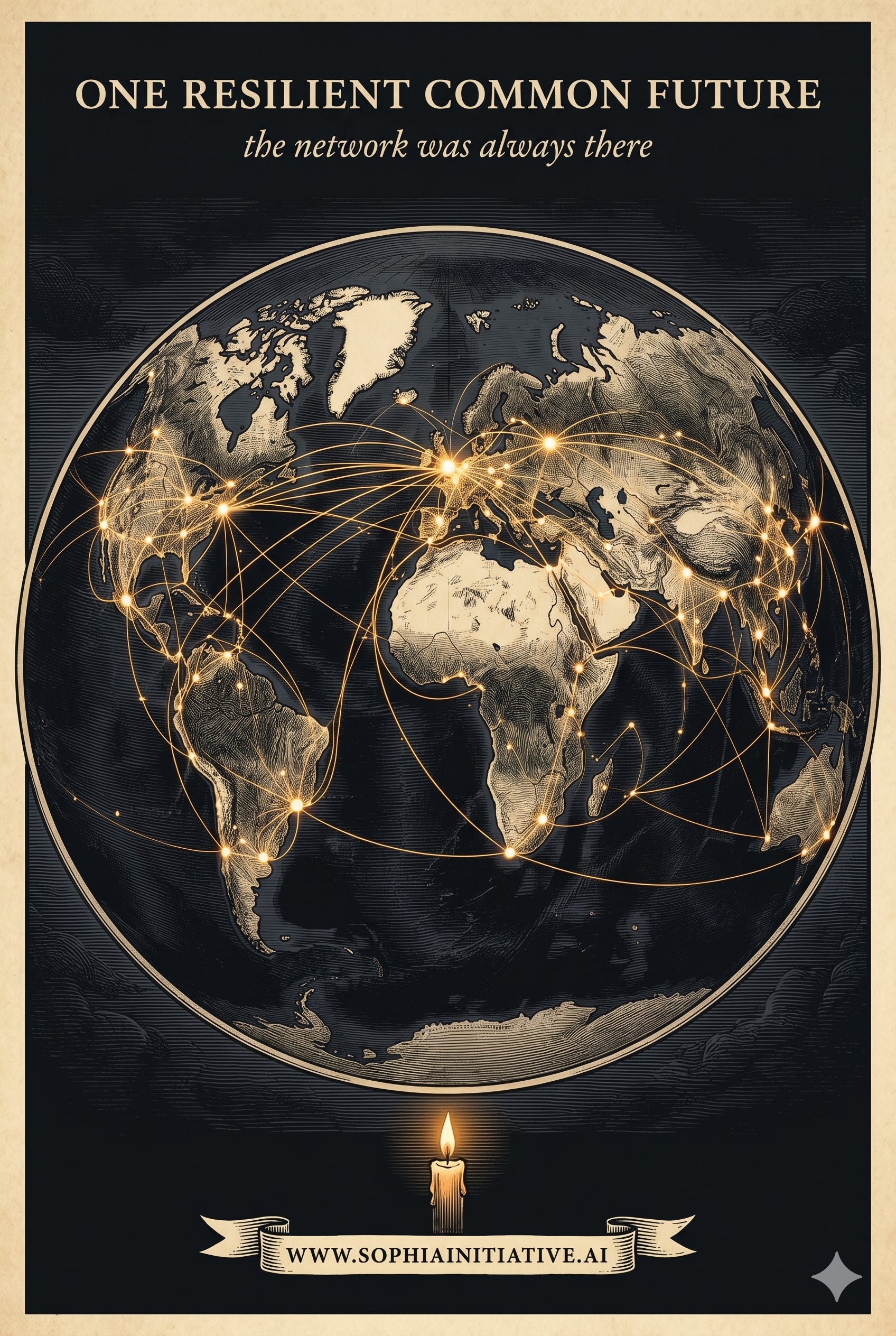
The Network Was Always There
The deepest point in this whole argument is also the simplest. Nothing in it requires an invention. The Commonwealth is not a proposal; it is a fact. Its scale is a fact, near sixteen trillion dollars and a third of humanity. Its trade is a fact, crossing a trillion dollars this year. Its advantage is a fact, measured at a fifth lower cost between members. Its developmental effect is a fact, lifting the poorest members fastest. Every element of the case already exists in the world, already functioning, already generating value — and has done so quietly for decades while the strategic conversation looked elsewhere.
What has never existed is the decision to see it whole. The Commonwealth has behaved, for its entire modern life, as an association of sentiment — a meeting, a games, a shared crown — while being, all along, one of the largest functioning economic networks on the planet. The argument of this dispatch is only that the moment has arrived to stop overlooking what is already there. The old order is loosening. Every serious nation is reaching for a hedge. And the largest, most durable, most overlooked hedge in the world is a network these nations already belong to. The Commonwealth is already a superpower. It has simply never decided to act like one. The question of the coming decade is whether — and through whom — it finally will.
The network was always there. What was missing was the decision to see it whole.
· · ·
God is Love. Love is Truth. Truth is Consciousness. Consciousness is Brahman.
Amen. Namaste. Om Namah Shivaya.
— The Architect
The Vertical Dispatch
sophiainitiative.ai
On the record: Commonwealth figures are drawn from the Commonwealth Secretariat and the 2024 Commonwealth Trade Review. Combined GDP reached ~US$14 trillion in 2022 and ~US$15.7 trillion by 2025 estimates (~13–14% of global GDP), projected toward ~US$20 trillion by 2029. Intra-Commonwealth trade reached a record ~US$854 billion in 2022 and is expected to surpass US$1 trillion in 2026. The “Commonwealth Advantage” — bilateral trade costs roughly 19–21% lower between member pairs — reflects repeated Commonwealth Secretariat and OECD-cited analysis. Commonwealth membership is 56 states with a combined population commonly cited at ~2.5 billion, more than 60% under age 30. The four anchor economies (India, UK, Canada, Australia) account for over 70% of total output; India is the largest member. The least-developed Commonwealth economies grew exports ~41% over 2011–2019 against ~12% for all LDCs. The Carney “bridge between the EU and the Pacific Rim” framing reflects reporting from early 2026. Figures should be verified against primary sources before republication.
#BuildingCanadaStrong #Commonwealth #OneResilientCommonFuture #CommonwealthAdvantage #TradeDiversification #CANZUK #India #Canada #Carney #TheNewOrder #MiddlePowers #GlobalTrade #Geopolitics #TheVerticalDispatch #TheArchitect #SophiaInitiative #AgeOfConsequences #GodIsLove #LoveIsTruth #OmNamahShivaya
Substack Notes
There is an economic bloc containing a third of humanity, generating output approaching sixteen trillion dollars, spanning every inhabited continent, and trading inside its own membership at a measurable discount the rest of the world doesn’t get. It is not the EU. It is not the American system. It is the Commonwealth — and it has never once decided to behave as the superpower it already is.
Fifty-six nations. Trade crossing a trillion dollars this year. A measured “Commonwealth Advantage” that makes commerce between members about a fifth cheaper — through shared language, shared law, a century of trust already built. And the effect lifts the poorest members fastest: Commonwealth least-developed economies grew exports ~41% in a decade, against ~12% for the world’s poorest as a group. The hedge is sitting in plain sight.
In a world where tariffs now arrive without warning between allies, every serious nation needs a second network. The Commonwealth is the largest, most durable, most overlooked one on earth — and almost nothing needs building. The language is shared. The law is compatible. The trade is already flowing. What’s missing is the decision to organize it. And of the anchor economies, Canada is the one reaching to make it.
The network was always there. What was missing was the decision to see it whole. 🕯️
The factual matter in this Dispatch is drawn from the public record. All characterizations, inferences, and conclusions are opinion, interpretation, and commentary, offered for analysis, reflection, and public-interest discussion. No assertion is made regarding the private intentions, state of mind, or character of any individual. Readers should evaluate all statements independently and draw their own conclusions.
The commonwealth, activated at the present moment, also presents an opportunity to reconcile with the global legacy of colonialism on the land and the people. Common wealth, not oligarchy.