


Φ
THE VERTICAL DISPATCH
We write for the mind, the eye, and the ear.
Read it. Look at it. Listen to it. The Vertical Dispatch is built for all three — prose with rhythm, made to be heard as much as read.
From metaphysics to geopolitics, from culture to history, from the sacred to the street — and everything in between. One lens, every subject. No ego. Just the record, named clean.
Press play. Walk with the word. 🕯️
This dispatch travels by hand. If it serves you, share it — restack on Substack, and pass it on wherever you read. 🕯️
The Canadian Shadow Chronicles · The Age of Consequences
Entry Two · Ottawa’s Own Gap · Volatile political and legal facts date-stamped as of June 23, 2026
“Nothing can be changed until it is faced.”
— James Baldwin
In the founding entry of this chain, we set a rule and promised to keep it: the measure is not party. The Canadian Shadow Chronicles track one thing across the whole country — the gap between the gesture of facing our founding wound and the substance of it — and we said, in the first line, that the chain would come for every chair, including the comfortable ones, because the smug certainty that one’s own house has finished facing is the surest sign it has not. The first entry took Alberta, because the gap there was widest and a court had already measured it. This one keeps the promise. It turns to Ottawa.
And it turns to the chair this publication has, on the record, judged uniquely suited to the moment — well-received by the peers he has met, a high-stratum mind on a long clock. We have said all of that, and we do not take it back. But the discipline that makes such a judgment worth anything is that it applies the same measure to the same chair when the gap appears there too. To praise a man’s fitness and then look away from his shadow is not analysis. It is affection wearing the costume of analysis. So we look. The same lens we turned on the Premier of Alberta, we now turn on the Prime Minister of Canada — not softer, not harder, the same.
To praise a man’s fitness and then look away from his shadow is not analysis. It is affection wearing the costume of analysis.
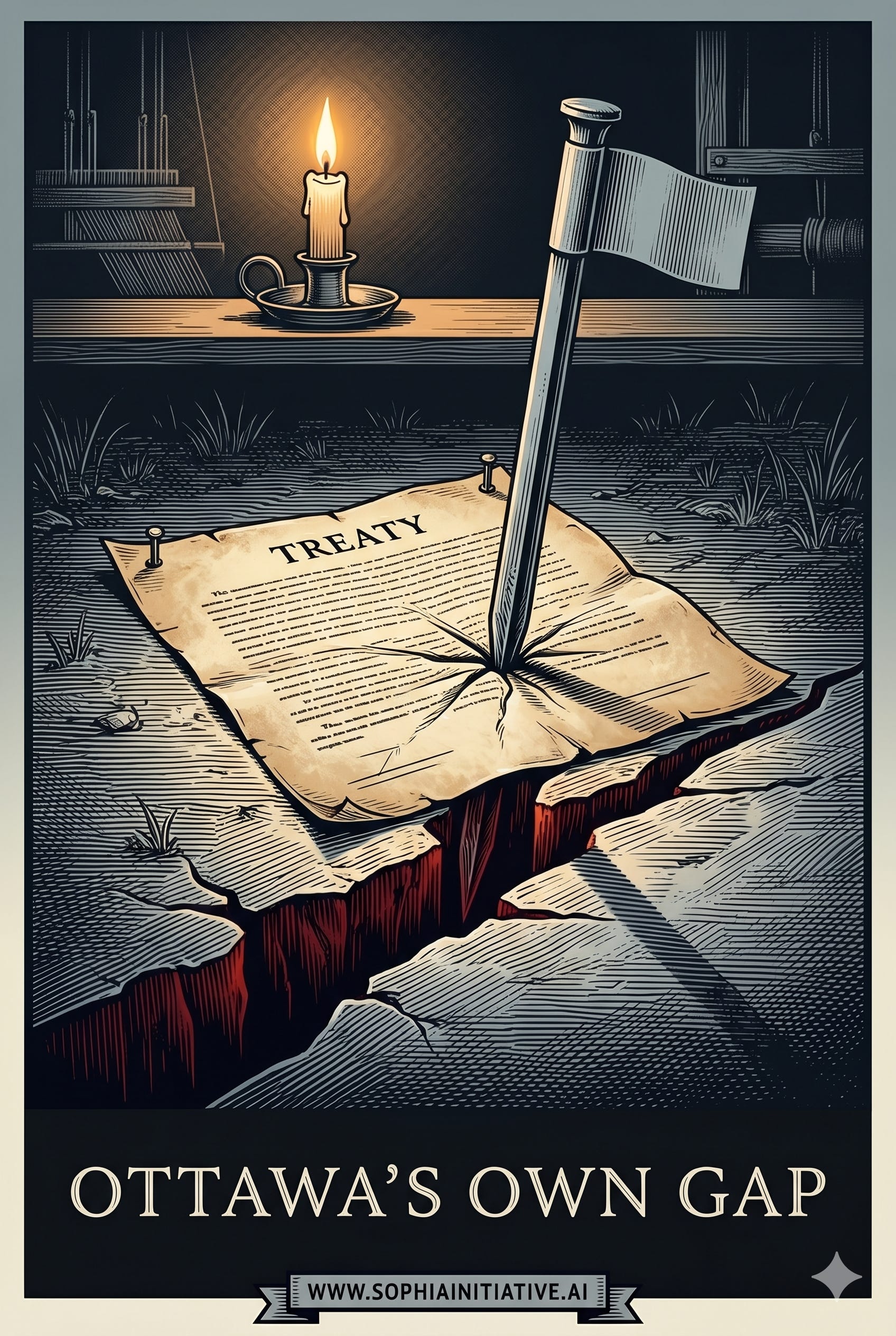
The Law and Its Two Halves
The instrument is Bill C-5, the One Canadian Economy Act, the Carney government’s flagship economic legislation, born of the trade war with the United States and the conviction that Canada must — in the Prime Minister’s own phrase — build, and build at a speed it has never seen. It received royal assent on June 26, 2025. It is not a proposal. It is law.
It contains two distinct Acts, and honesty requires separating them, because one is uncontroversial and the other is the subject of this entry. The first, the Free Trade and Labour Mobility in Canada Act, removes federal barriers to trade and worker movement between provinces — so that a good or a credential accepted in one province is accepted across the federation. It is sensible, overdue, and has provoked almost no objection; it is genuinely strange that it has sometimes been easier to sell across an international border than across a provincial one, and the Act fixes that. We name it fairly: this half is good government, and we will not manufacture a shadow where there is none.
The second Act is where the gap opens. The Building Canada Act empowers the federal cabinet to designate certain infrastructure projects — ports, pipelines, energy corridors, critical-mineral developments — as being “in the national interest,” and then to accelerate them through a streamlined approval process. The mechanism, as legal analysts and the independent press have read the statute, inverts the ordinary order of things: once cabinet places a project on the national-interest list, the determinations and findings that would normally have to be made for an authorization are deemed to have been made in favour of permitting the project, with the specific conditions to be set afterward. Approval first; conditions later. The Narwhal summarized it without malice and without softening: if a project is determined to be in the national interest, then anything the project needs in order to be approved is considered to have been done.
The Same Objection, the Same Ground
Here is why this belongs in this chain and not merely in the business pages. The objection raised against the Building Canada Act is, almost word for word, the objection the treaty chiefs raised against Alberta’s Sovereignty Act in the founding entry. It is the duty to consult. It is the honour of the Crown.
On the day the bill was tabled, the Assembly of First Nations announced a meeting of chiefs to coordinate a response. Indigenous organizations charged that the Act would hand cabinet the power to — their word — bulldoze constitutionally protected rights, and objected that they had been given roughly a week to review a bill of such consequence before it was introduced. The Canadian Bar Association’s own Aboriginal Law Section, not an activist body but the professional association of the country’s lawyers, warned in a formal submission that the bill in its form risked undermining constitutionally protected Aboriginal and treaty rights and Canada’s commitments under the United Nations Declaration on the Rights of Indigenous Peoples. The concern is precise and it is legal: that a process which presumes approval and consults afterward cannot satisfy a duty to consult that the Supreme Court has rooted in the honour of the Crown — the same doctrine, from the same cases, Haida Nation and Mikisew Cree, that we laid out in the founding entry.
Read the two entries side by side and the symmetry is exact. In Alberta, a Premier moved to take treaty land out of Canada and told the treaty nations who invoked the law to check themselves; a court found her government had neglected its duty to consult. In Ottawa, a Prime Minister moved to fast-track megaprojects across that same treaty land, and the treaty nations and the country’s own bar association raised the identical objection: that the substance of consultation cannot be satisfied by a process built for speed. The gestures differ — separation in one case, construction in the other. The gap is the same gap. The honour of the Crown does not bend to the direction of the project, or to the party of the chair.
The gestures differ — separation in one case, construction in the other. The gap is the same gap.
The Case for the Prime Minister, at Full Strength
Evenhandedness is the keel of this work, and the case for the chair must be put as strongly as the government itself would put it — more strongly here than usual, because this is the chair we have judged well, and the temptation to go gentle on a chair one admires is exactly the temptation this entry exists to refuse. So here is the defence, at full height.
Canada faced, and faces, a genuine economic emergency: a trade war with its largest partner, a sovereign need to build infrastructure and diversify markets at speed, and an approvals regime that all sides — including the government’s own critics — agree had become so slow that economically vital projects died in the queue. The Prime Minister has argued, not unreasonably, that an emergency justifies an extraordinary instrument, and that the cost of building nothing is also paid by Canadians, Indigenous and non-Indigenous alike. Nor is the statute as bare of process as a critic might wish: before a project can be placed on the national-interest list, the government’s own framework requires that its name and description be published in the Canada Gazette for thirty days for public feedback, and that the affected Indigenous rights-holders be consulted, with a single set of binding conditions — including accommodation measures for Section 35 rights — issued only after that. The government did not simply dismiss the Indigenous objection: it doubled the Indigenous Loan Guarantee Program from five billion dollars to ten, explicitly to let Indigenous groups become owners, not merely consultees, of the projects built on their lands, and it set the first of its First Nations summits for July 17, with further meetings to follow over the summer. And Parliament built in a five-year window and an oversight role. This is not the conduct of a government indifferent to the rights in question. It is the conduct of a government that judged speed an emergency necessity and tried to bolt consultation onto a fast-moving train. That is a serious position, held by serious people, and it deserves to be stated without a sneer.
Now the answer, and it is the same answer the whole chain gives. A loan guarantee is ownership, which is good — but ownership is not consent, and the duty to consult is not a duty to compensate after the fact. A thirty-day Gazette notice and a single round of conditions set by a minister are a process, but the question the honour of the Crown asks is not whether a process exists; it is whether the consultation is meaningful and, where rights are strong, prior. A summit set for July 17 — announced after the bill had already received royal assent on June 26 — is consultation offered after the instrument is law, not before it; it is the meeting offered on the day of the Throne Speech, in another building, under another flag. The emergency is real — and emergencies are precisely the conditions under which the honour of the Crown is most tested and most often neglected, because speed is always the reason given. The gesture here is genuine: the loan guarantee, the summits, the Gazette window, the review clause, the stated respect for Section 35 written into the framework. The substance is the question a court may yet have to measure, exactly as a court measured it in Alberta. The symbol is not the referent. That is the whole of it, and it does not change because the chair is one we respect.
Why the Comfortable Chair Matters Most
It would be easier to leave this entry unwritten. The Carney pieces that travel furthest from this desk are the ones that read his fitness generously, and a reader who came here for that will feel the turn. But the chain was built precisely so that it could not flatter. An accountability that points only at the chairs we already dislike is not accountability; it is partisanship with a candle lit over it. The honour of the Crown is either a principle that binds every government, or it is a stick we pick up only against our opponents — and the moment it becomes the latter, it stops being worth anything at all, including against the opponents.
So this entry is the proof of the chain’s seriousness, and it had to fall on a chair we respect, or it would have proved nothing. The Prime Minister may well be, as we have said, uniquely suited to the moment. The Building Canada Act may well build things Canada genuinely needs. And the duty to consult may still have been thinned, in the building, to a speed the honour of the Crown cannot travel at. All three can be true at once, and holding all three without dropping any is the entire discipline. We do not retract our judgment of the chair. We refuse to let that judgment buy the chair an exemption from the measure. Ottawa, too, has a gap between the gesture of facing and the substance of it — and a chain that would not name it would be the gesture, not the substance, in its own conduct.
Alberta was first because the gap was widest and a court had taken its measurement. Ottawa is second because it is the proof: that the same lens, turned on the chair we admire, finds the same shadow, and names it with the same plain voice. The chain holds when it costs us something to hold it. This one cost. Nothing can be changed until it is faced — and that includes the things we would rather not face about the people we hoped were different.
God is Love. Love is Truth. Truth is Consciousness. Consciousness is Brahman.
Amen. Namaste. Om Namah Shivaya.
— The Architect
For the treaty nations, whose rights do not bend to the direction of the project.
The Vertical Dispatch
sophiainitiative.ai
On the record
The law. Bill C-5, the One Canadian Economy Act, received royal assent June 26, 2025 (Parliament of Canada, LEGISinfo; Canada.ca; Statutes of Canada 2025, c. 2). It enacts two statutes: the Free Trade and Labour Mobility in Canada Act (in force January 1, 2026), removing federal interprovincial trade/labour barriers; and the Building Canada Act, allowing federal cabinet (Governor in Council) to designate “national interest” infrastructure projects for an accelerated approval process. The “approval presumed, conditions later” characterization reflects the statute’s deeming provisions and legal-press readings (Building Canada Act, S.C. 2025, c. 2; Norton Rose Fulbright; McMillan LLP; The Narwhal); the precise operation, including the 30-day Canada Gazette notice and consultation requirements before listing, is set out in the Act itself — consult the statute before republication.
The objections. The Assembly of First Nations announced a chiefs’ meeting to coordinate a response on the day the bill was tabled; Indigenous groups objected to roughly one week’s review time and characterized the cabinet powers as a threat to bulldoze rights (contemporaneous reporting). The Canadian Bar Association’s National Aboriginal Law Section submitted formal concerns that Part 2 risked undermining constitutionally protected Aboriginal and treaty rights and Canada’s UNDRIP commitments (cba.org). Duty to consult / honour of the Crown per Haida Nation, 2004 SCC 73, and Mikisew Cree, 2005 SCC 69.
The government’s case. Carney defended the Act as justified by the economic emergency and the trade war and announced consultation summits with Indigenous leaders, with the first First Nations meeting set for July 17, 2025 (Canada.ca; Privy Council Office). The Building Canada framework doubled the Indigenous Loan Guarantee Program from $5B to $10B and includes a five-year window for adding projects, a 30-day Canada Gazette notice, an Indigenous Advisory Council, and binding conditions issued after consultation (Canada.ca, “Building Canada Act — Projects of National Interest”).
Date-stamp. Political and legal facts current as of June 23, 2026. No court ruling on the Building Canada Act’s consultation adequacy is asserted here; the Alberta duty-to-consult finding referenced is from the founding entry and concerns a separate matter. Verify all load-bearing facts against primary sources before republication.
Standing note. All characterizations — “Ottawa’s own gap,” the gesture-versus-substance reading, the symmetry with the founding entry — are the author’s interpretation and commentary, clearly distinguished from the record. The reading judges conduct and legislation on the record, not the private mind, motive, or character of any individual. The case for the government is stated at full strength. Accountability is directed at power and on-record conduct. No figure is disaggregated by race, group, or class. Verify against primary sources before republication.
Suggested tags
Mark Carney, Bill C-5, One Canadian Economy Act, Building Canada Act, duty to consult, honour of the Crown, treaty rights, reconciliation, The Canadian Shadow Chronicles
Substack Notes
The Canadian Shadow Chronicles promised in its founding entry that the chain would come for every chair — including the comfortable ones. Entry One took Alberta. Entry Two keeps the promise, and turns to Ottawa, and to the very chair this publication has judged uniquely suited to the moment. To praise a man’s fitness and then look away from his shadow is not analysis. It is affection wearing the costume of analysis.
Bill C-5, the One Canadian Economy Act, is Carney’s flagship law — royal assent June 26, 2025. Half of it is good government: removing barriers to trade between provinces. The other half, the Building Canada Act, lets cabinet designate “national interest” megaprojects and fast-track them — approval presumed, conditions set later. And the objection raised against it is, almost word for word, the objection the treaty chiefs raised against Alberta’s Sovereignty Act in Entry One: the duty to consult, the honour of the Crown. The Assembly of First Nations and the Canadian Bar Association both warned it risks treaty and constitutional rights.
We state the government’s case at full strength — a real economic emergency, a doubled Indigenous loan guarantee, a 30-day Gazette window, a First Nations summit set for July 17. Then we answer it: ownership is not consent, and a summit announced after the bill is already law is not prior consultation. The emergency is real — and emergencies are exactly when the honour of the Crown is most often neglected, because speed is always the reason given. The symbol is not the referent.
This entry is the proof of the chain’s seriousness, and it had to fall on a chair we respect, or it would have proved nothing. An accountability that points only at the chairs we dislike is partisanship with a candle lit over it. We do not retract our judgment of the Prime Minister’s fitness. We refuse to let it buy him an exemption from the measure. Ottawa, too, has a gap. Nothing can be changed until it is faced. Walk with the word. 🕯️
Written from love, in service of the record. Walk with the word. 🕯️
#TheCanadianShadowChronicles #TheAgeOfConsequences #MarkCarney #BillC5 #BuildingCanadaAct #DutyToConsult #HonourOfTheCrown #TreatyRights #Reconciliation #TheVerticalDispatch #TheArchitect #SophiaInitiative #GodIsLove #LoveIsTruth #OmNamahShivaya
The factual matter in this Dispatch is drawn from the public record. All characterizations, inferences, and conclusions are opinion, interpretation, and commentary, offered for analysis, reflection, and public-interest discussion. No assertion is made regarding the private intentions, state of mind, or character of any individual. Readers should evaluate all statements independently and draw their own conclusions.
The nomination of Honourable Glenn Joyal to the Supreme Court of Canada, announced on June 22, may signal something important.